Motorcycle Safety Gear Market Size, Share & Demand Report By Product Type (Helmets, Jackets, Gloves, Boots, Body Armor, Smart Helmets), By Distribution Channel (Offline Retail, Online Retail), By End User (Commuter Riders, Sports Riders, Adventure & Touring Riders, Professional Racers), By Region & Segment Forecasts, 2026–2034
USD 3950
Market Overview
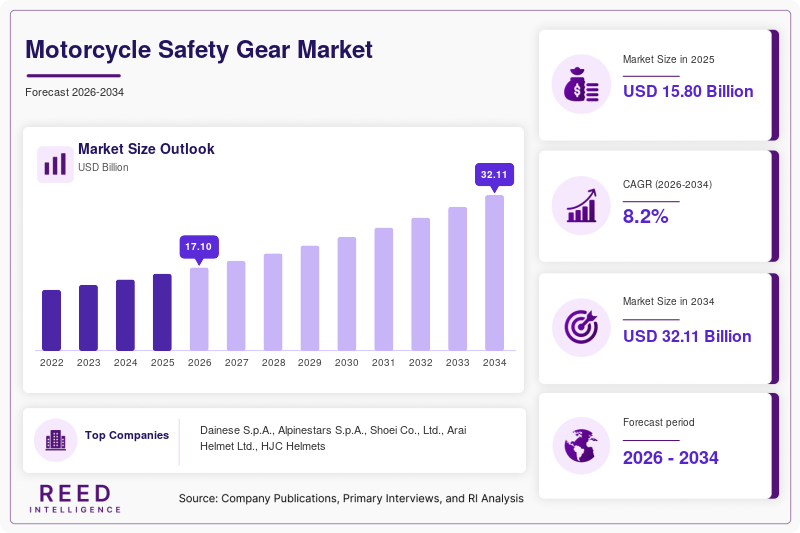
The global Motorcycle Safety Gear Market size was valued at USD 15.8 billion in 2026 and is projected to reach USD 29.6 billion by 2034, expanding at a CAGR of 8.2% during the forecast period from 2026 to 2034. The market continues to experience steady growth due to rising motorcycle ownership, increasing road safety awareness, and evolving regulations related to rider protection across developed and emerging economies. Governments, safety organizations, and insurance providers are increasingly promoting the use of certified protective equipment, creating favorable conditions for long-term market expansion.
The growing popularity of motorcycles as an economical transportation option has significantly contributed to the demand for helmets, jackets, gloves, boots, and body armor. Urban congestion, rising fuel costs, and increasing adoption of two-wheelers for daily commuting have encouraged consumers to invest in advanced safety products that provide protection and comfort. Manufacturers are responding by introducing lightweight materials, impact-resistant technologies, ventilation systems, and smart connectivity features that improve rider safety while enhancing the overall riding experience.
Key Highlights
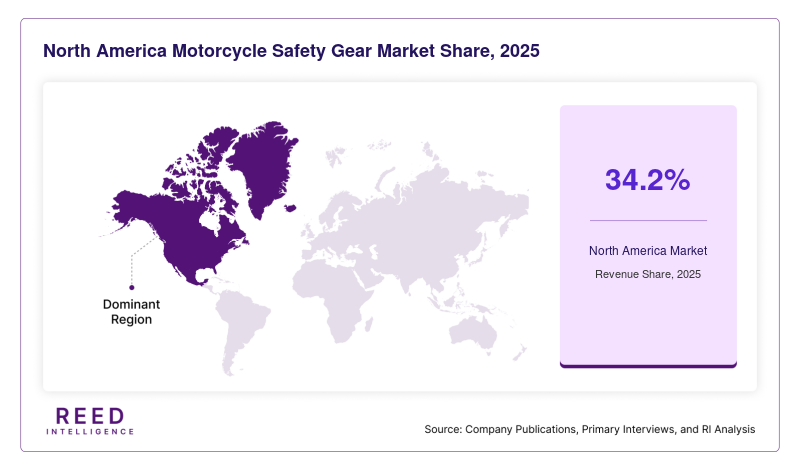
- North America dominated the market with a 34.2% share in 2025, while Asia Pacific is expected to grow at the fastest CAGR of 10.8% during 2026–2034.
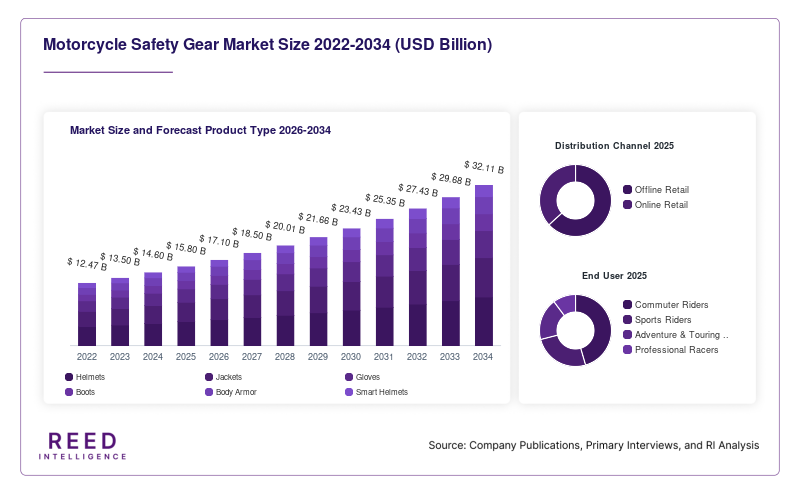
- By product type, helmets accounted for the largest share of 42.6%, while smart helmets are projected to grow at a CAGR of 12.9%.
- By distribution channel, offline retail led with a 63.4% share, whereas online retail is expected to expand at a CAGR of 11.7%.
- By end user, commuter riders held a 58.3% share, while adventure and touring riders are anticipated to grow at a CAGR of 10.5%.
- The United States remained the dominant country, with market values of USD 2.82 billion in 2024 and USD 3.05 billion in 2025.
Market Trends
Integration of Smart and Connected Safety Equipment
One of the most significant trends shaping the Motorcycle Safety Gear Market is the increasing adoption of smart and connected protective equipment. Manufacturers are introducing helmets equipped with Bluetooth communication systems, navigation displays, collision alerts, voice controls, and integrated cameras. These technologies improve rider awareness and convenience while supporting safer riding practices. Consumers are showing strong interest in gear that combines protection with digital functionality. The trend is particularly evident among touring riders and technology-focused consumers who seek enhanced riding experiences. Continuous innovation in sensors, connectivity modules, and battery technologies is expected to encourage wider adoption of smart motorcycle safety products throughout the forecast period.
Growing Demand for Lightweight and High-Performance Materials
The use of advanced materials in motorcycle safety gear is becoming increasingly common as riders seek improved comfort and protection. Manufacturers are replacing traditional materials with carbon fiber composites, aramid fibers, reinforced polymers, and advanced impact-absorbing foams. These materials reduce weight while maintaining high safety standards. Lightweight products help reduce rider fatigue during long-distance travel and daily commuting. The trend is especially strong in premium helmets, jackets, and body armor segments. As material science advances and production costs gradually decline, high-performance protective equipment is expected to become more accessible across a broader range of consumer groups.
Market Drivers
Rising Awareness of Road Safety and Protective Equipment Usage
Increasing awareness regarding road safety is a major factor driving the Motorcycle Safety Gear Market. Governments, transportation agencies, and safety organizations continue to conduct campaigns highlighting the importance of protective equipment in reducing injury severity during accidents. Consumers are becoming more informed about the benefits of certified helmets, jackets, gloves, and riding boots. Rising accident statistics in several regions have encouraged riders to prioritize personal safety. Insurance companies are also supporting protective gear adoption through educational initiatives and incentive programs. This growing emphasis on rider protection is encouraging both first-time and experienced motorcyclists to invest in high-quality safety products.
Expanding Motorcycle Ownership Across Emerging Economies
The rapid growth of motorcycle ownership in emerging economies is another important driver supporting market expansion. Motorcycles remain an affordable transportation solution for millions of consumers, particularly in densely populated urban areas. Rising disposable incomes, infrastructure development, and increasing employment opportunities have contributed to higher two-wheeler sales. As motorcycle ownership increases, demand for helmets and other safety accessories grows simultaneously. Manufacturers are expanding distribution networks and introducing region-specific products to capture emerging opportunities. The combination of rising vehicle ownership and increasing safety awareness is creating a strong foundation for sustained market growth across developing countries.
Market Restraint
High Cost of Premium Protective Equipment
The relatively high cost of premium motorcycle safety gear remains a significant challenge for market growth. Advanced products incorporating smart technologies, high-performance materials, and enhanced impact protection often carry premium price tags that may discourage budget-conscious consumers. In many developing regions, riders continue to prioritize affordability over advanced safety features, resulting in lower adoption rates for premium products. The availability of low-cost, uncertified alternatives further intensifies pricing pressure on established manufacturers. This situation can affect overall market penetration and slow the transition toward higher-quality protective equipment. Although regulatory enforcement and consumer education efforts are helping address this issue, price sensitivity continues to influence purchasing decisions across several important markets.
Market Opportunities
Expansion of E-Commerce and Direct-to-Consumer Sales Channels
The rapid growth of digital commerce presents a substantial opportunity for the Motorcycle Safety Gear Market. Online platforms allow manufacturers to reach customers across wider geographic regions while reducing dependence on traditional retail channels. Consumers benefit from extensive product comparisons, detailed specifications, customer reviews, and competitive pricing. Direct-to-consumer sales models enable brands to strengthen customer relationships and gather valuable purchasing insights. Improved logistics infrastructure and digital payment systems are supporting online market expansion globally. As internet penetration continues to increase, online sales channels are expected to become a major contributor to future revenue growth.
Increasing Popularity of Adventure Touring and Recreational Riding
The growing popularity of adventure motorcycling and recreational riding activities is creating favorable opportunities for market participants. Riders engaged in long-distance touring typically invest in premium helmets, jackets, protective armor, gloves, and specialized footwear. Adventure riders often require gear capable of providing protection under diverse weather and terrain conditions. Motorcycle tourism is expanding in several countries, encouraging consumers to purchase durable and feature-rich safety equipment. Manufacturers are responding with dedicated product lines tailored to touring and off-road applications. This shift toward experience-oriented motorcycling is expected to support demand for high-value safety gear products throughout the forecast period.
Segmental Analysis
By Product Type
Helmets represented the dominant subsegment within the Motorcycle Safety Gear Market, accounting for approximately 42.6% of total revenue in 2024. Helmets remain the most widely adopted form of protective equipment due to regulatory requirements and their proven ability to reduce head injuries. Demand is supported by mandatory helmet laws in numerous countries and increasing awareness regarding rider safety. Manufacturers continue to enhance helmet performance through improved ventilation systems, aerodynamic designs, impact-absorbing liners, and lightweight materials. Premium full-face helmets are gaining popularity among consumers seeking superior protection and comfort. The segment also benefits from frequent replacement cycles driven by wear, safety standards updates, and evolving consumer preferences.
Smart helmets are projected to be the fastest-growing product subsegment, registering a CAGR of 12.9% during the forecast period. These products incorporate communication systems, navigation functions, cameras, and emergency response capabilities that enhance rider awareness and convenience. Growing interest in connected mobility solutions is driving adoption among technology-oriented consumers. Manufacturers are investing heavily in research and development to improve battery performance, connectivity reliability, and user interfaces. The increasing integration of artificial intelligence and sensor technologies is expected to further strengthen demand. As production costs decline and product availability expands, smart helmets are likely to become a key growth category within the broader market.
By Distribution Channel
Offline retail accounted for the largest share of the Motorcycle Safety Gear Market in 2024, representing approximately 63.4% of total revenue. Physical stores remain important because consumers often prefer to evaluate fit, comfort, and product quality before purchasing protective equipment. Specialized motorcycle dealerships and safety gear retailers provide expert guidance, helping customers select products that meet specific riding requirements. The offline channel also benefits from established brand visibility and after-sales support services. Product demonstrations and in-store fitting experiences contribute to customer confidence, particularly for premium helmets and protective apparel. These advantages continue to support strong sales performance across traditional retail channels.
Online retail is expected to register the fastest CAGR of 11.7% through 2034. The expansion of e-commerce platforms has transformed purchasing behavior by providing consumers with greater convenience and product variety. Online channels enable customers to compare specifications, read reviews, and access competitive pricing. Manufacturers increasingly use direct-to-consumer strategies to strengthen brand engagement and improve profit margins. Enhanced logistics capabilities and secure payment systems have further accelerated digital adoption. The growing influence of social media marketing and digital advertising is also encouraging consumers to purchase motorcycle safety gear through online platforms, supporting rapid channel growth.
By End User
Commuter riders held the largest market share in 2024, accounting for approximately 58.3% of total revenue. Daily commuting remains one of the primary uses of motorcycles worldwide, particularly in urban environments where traffic congestion and fuel efficiency concerns encourage two-wheeler adoption. Commuters typically invest in essential safety products such as helmets, gloves, and protective jackets to reduce accident-related risks. Rising awareness regarding personal safety and increasing enforcement of protective equipment regulations continue to support segment growth. Manufacturers are introducing affordable and lightweight products specifically designed for everyday riders, further strengthening demand among commuter populations.
Adventure and touring riders are expected to record the fastest CAGR of 10.5% during the forecast period. This segment is benefiting from growing interest in long-distance travel, motorcycle tourism, and outdoor recreational activities. Adventure riders generally require premium safety equipment capable of performing in varying weather and terrain conditions. Demand is particularly strong for advanced helmets, armored jackets, reinforced boots, and multifunctional protective gear. Manufacturers are expanding product portfolios to address the unique requirements of touring enthusiasts. Rising participation in organized riding events and cross-country travel experiences is expected to generate significant opportunities within this high-value segment.
Regional Analysis
North America
North America accounted for approximately 34.2% of the global Motorcycle Safety Gear Market in 2025 and maintained its position as the leading regional market. The region benefits from strong consumer awareness regarding protective equipment and a well-established premium motorcycle culture. Demand for certified helmets, protective apparel, and smart safety products remains robust. The regional market is projected to grow at a CAGR of 7.4% through 2034, supported by technological innovation and consistent spending on rider safety products.
The United States remains the dominant country within North America. A major growth factor is the strong presence of recreational motorcycling communities and touring enthusiasts who regularly invest in advanced protective equipment. Consumers increasingly prefer premium products featuring communication systems, impact sensors, and lightweight materials. High product replacement rates and widespread availability through specialized retail networks further support market growth across the country.
Europe
Europe represented approximately 27.5% of global revenue in 2025 and continues to be a significant market for motorcycle safety gear. Strict safety regulations, widespread adoption of certified equipment, and strong consumer awareness contribute to market stability. The region is expected to register a CAGR of 7.8% during the forecast period. Demand is particularly strong for premium helmets and protective apparel designed to meet evolving safety standards established by regulatory authorities.
Germany remains the dominant market within Europe due to its large motorcycle population and strong manufacturing ecosystem. One unique growth factor is the increasing preference for sustainable and environmentally responsible riding gear. Manufacturers are introducing products made from recycled materials and eco-friendly textiles. This trend is attracting environmentally conscious consumers while supporting long-term market development across the region.
Asia Pacific
Asia Pacific accounted for approximately 24.8% of the global Motorcycle Safety Gear Market in 2025 and is expected to record the fastest CAGR of 10.8% through 2034. Rapid urbanization, growing motorcycle ownership, and increasing road safety awareness are driving regional demand. Rising disposable incomes are encouraging consumers to upgrade from basic protective products to higher-quality certified equipment. The region also benefits from extensive manufacturing capabilities and expanding retail infrastructure.
China remains the dominant country within Asia Pacific. A key growth factor is the rising adoption of premium motorcycles and recreational riding activities among younger consumers. As disposable incomes increase, riders are demonstrating greater willingness to invest in advanced protective equipment. Government initiatives promoting road safety and improved product availability through digital platforms are further contributing to market expansion.
Middle East & Africa
The Middle East & Africa region captured approximately 7.1% of global market revenue in 2025. Although the market remains relatively smaller than other regions, increasing urban mobility and infrastructure development are creating new growth opportunities. The market is projected to expand at a CAGR of 8.1% through 2034. Growing awareness of road safety and rising adoption of motorcycles for commercial transportation are supporting demand for protective gear.
Saudi Arabia represents the leading country within the region. A unique growth factor is the increasing popularity of leisure motorcycling and organized riding events. Investments in tourism and outdoor recreation are encouraging more consumers to participate in motorcycle-related activities. This trend is generating demand for premium helmets, jackets, and protective accessories designed for long-distance riding conditions.
Latin America
Latin America accounted for approximately 6.4% of the global Motorcycle Safety Gear Market in 2025 and is expected to grow at a CAGR of 8.5% through 2034. Motorcycles serve as a vital transportation solution across many countries due to affordability and mobility advantages. Rising awareness of rider protection and gradual improvements in safety regulations are supporting market development. Expanding retail networks and greater product accessibility are also contributing to increasing adoption rates.
Brazil remains the dominant country in Latin America. One important growth factor is the growing use of motorcycles for delivery and logistics services. The expansion of e-commerce and on-demand delivery platforms has increased the number of professional riders. Employers and fleet operators are increasingly encouraging the use of certified safety equipment, creating sustained demand for helmets, gloves, and protective apparel.
Competitive Landscape
The Motorcycle Safety Gear Market is characterized by intense competition among global and regional manufacturers focused on innovation, product quality, and brand positioning. Companies are investing in advanced materials, smart technologies, and safety certifications to strengthen their competitive presence. Product differentiation remains a critical strategy as consumers increasingly seek equipment that combines protection, comfort, and connectivity features.
Dainese continues to hold a leading position due to its strong brand reputation, extensive product portfolio, and emphasis on technological innovation. The company recently expanded its premium riding gear lineup with enhanced impact-protection systems and lightweight construction materials. Other major participants are focusing on strategic partnerships, digital sales channels, and regional expansion initiatives to increase market penetration.
Key Players
- Dainese S.p.A.
- Alpinestars S.p.A.
- Shoei Co., Ltd.
- Arai Helmet Ltd.
- HJC Helmets
- Bell Helmets
- Schuberth GmbH
- Fox Racing Inc.
- Klim Technical Riding Gear
- REV'IT! Sport International
- LS2 Helmets
- AGV Helmets
- Icon Motorsports
- Scorpion Sports Inc.
- Leatt Corporation
Recent Developments
- In 2025, a leading motorcycle safety equipment manufacturer launched a next-generation smart helmet featuring integrated navigation, communication, and emergency alert capabilities.
- In 2025, a major protective apparel company introduced a new range of lightweight riding jackets utilizing advanced abrasion-resistant composite fabrics.
- In 2024, several global brands expanded direct-to-consumer e-commerce platforms to strengthen digital sales and improve customer engagement.
- In 2024, a prominent helmet producer invested in automated manufacturing technologies to increase production efficiency and support growing demand for premium safety products.
- In 2025, multiple industry participants introduced sustainability initiatives focused on recycled materials and environmentally responsible production processes.
Motorcycle Safety Gear Market Segments
Product Type
- Helmets
- Jackets
- Gloves
- Boots
- Body Armor
- Smart Helmets
Distribution Channel
- Offline Retail
- Online Retail
End User
- Commuter Riders
- Sports Riders
- Adventure & Touring Riders
- Professional Racers
By Region
- North America
- Europe
- APAC
- Middle East and Africa
- LATAM