Motorized Decoiler Machine Market Size, Share Demand Report By Type (Single-Head Decoiler, Double-Head Decoiler), By Application (Automotive Manufacturing, Electronics Manufacturing, Construction, Others), By End-Use Industry (Manufacturing, Construction, Metal Processing, Others), By Region & Segment Forecasts, 2026–2034
USD 3950
Market Overview
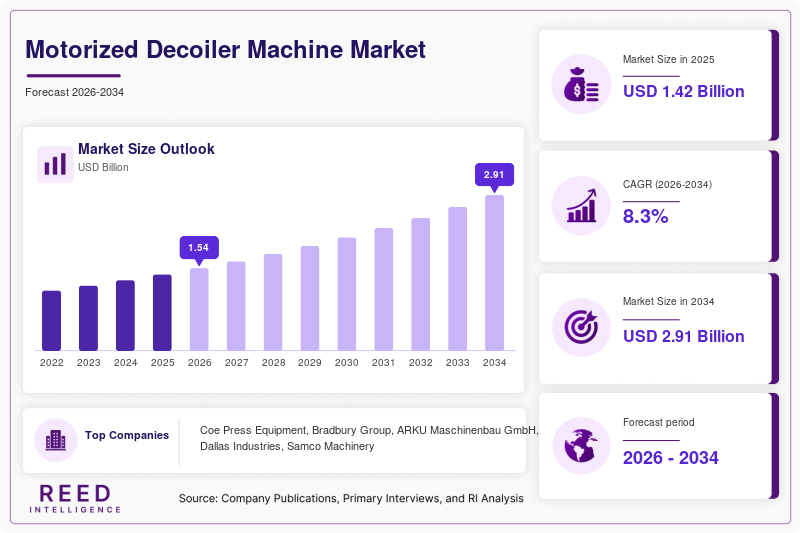
The Motorized Decoiler Machine Market was valued at approximately USD 1.42 billion in 2026 and is projected to reach USD 2.68 billion by 2034, expanding at a compound annual growth rate (CAGR) of 8.3% during the forecast period (2026–2034). The market growth is supported by increasing automation across metal processing industries, where motorized decoilers play a crucial role in improving operational efficiency and reducing manual handling of coil materials. Rising investments in industrial infrastructure and smart manufacturing facilities are further driving demand for advanced decoiling solutions globally.
A significant global factor contributing to the market expansion is the rapid adoption of Industry 4.0 technologies. Manufacturers are increasingly integrating motorized decoiler machines with automated production lines, robotics, and IoT-enabled monitoring systems. This integration allows real-time control, precision feeding, and improved safety, which enhances productivity and reduces downtime. Additionally, the growing demand for high-quality metal sheets and coils in automotive, construction, and electronics industries is further accelerating the adoption of motorized decoilers.
Key Highlights
- North America dominated the market with a 33.8% share in 2025.
- Asia Pacific is expected to grow at the fastest CAGR of 9.6% during 2026–2034.
- By equipment type, single-head decoilers accounted for the largest share of 39.2%.
- while double-head decoilers are projected to grow at a CAGR of 9.1%.
- By application, automotive manufacturing led with a 42.5% share, whereas electronics manufacturing is expected to expand at a CAGR of 9.8%.
- The United States remained the dominant country, with market values of USD 480 million in 2024 and USD 520 million in 2025.
Market Trends
Integration of Smart Automation and IoT in Decoiling Systems
The integration of smart automation and IoT-enabled technologies is becoming a defining trend in the Motorized Decoiler Machine Market. Manufacturers are increasingly adopting connected machines that provide real-time monitoring of coil tension, feed rate, and operational efficiency. These smart systems allow predictive maintenance, reducing unexpected downtime and maintenance costs. Additionally, IoT integration supports remote diagnostics and centralized control, which is particularly valuable for large-scale manufacturing facilities. As companies strive to enhance productivity and reduce labor dependency, the demand for intelligent decoiling solutions continues to rise. This trend is further reinforced by the growing adoption of digital manufacturing ecosystems, where decoilers are integrated into fully automated production lines.
Growing Demand for Compact and Energy-Efficient Machines
Another key trend shaping the market is the increasing demand for compact and energy-efficient motorized decoiler machines. Manufacturers are focusing on designing equipment that occupies less floor space while delivering high performance. This is particularly important for small and medium enterprises that operate in limited industrial spaces. Additionally, energy efficiency has become a critical consideration due to rising energy costs and sustainability regulations. Modern decoilers are equipped with variable frequency drives and energy-saving motors, which help reduce power consumption. This shift toward eco-friendly machinery aligns with global sustainability goals and enhances the overall cost-effectiveness of production processes.
Market Drivers
Rising Automation in Metal Processing Industries
The increasing automation in metal processing industries is a major driver for the Motorized Decoiler Machine Market. Industries such as automotive, construction, and heavy machinery require high-speed and precise material handling systems to meet production demands. Motorized decoilers enable continuous and efficient feeding of metal coils into processing lines, reducing manual intervention and improving accuracy. As companies aim to enhance operational efficiency and minimize human errors, the adoption of automated decoiling systems is accelerating. Furthermore, the integration of these machines with advanced control systems allows seamless coordination with other equipment, boosting overall productivity and throughput.
Expansion of Automotive and Construction Sectors
The rapid expansion of automotive and construction sectors globally is significantly driving the demand for motorized decoiler machines. These industries rely heavily on metal sheets and coils for manufacturing components and structural elements. As vehicle production increases and infrastructure projects expand, the need for efficient coil handling equipment grows. Motorized decoilers provide consistent material feeding, ensuring high-quality output and reduced material wastage. Additionally, the shift toward electric vehicles and modern construction techniques is creating new opportunities for advanced decoiling systems, further supporting market growth.
Market Restraint
High Initial Investment and Maintenance Costs
One of the primary restraints affecting the Motorized Decoiler Machine Market is the high initial investment required for advanced systems. Motorized decoilers equipped with automation features, IoT capabilities, and precision control mechanisms often involve significant capital expenditure. This can be a barrier for small and medium enterprises, especially in developing regions where budget constraints are more prominent. Additionally, the cost of installation, training, and integration with existing production lines adds to the overall financial burden.
Maintenance costs also pose a challenge, as these machines require regular servicing to ensure optimal performance. Components such as motors, control systems, and sensors may need periodic replacement or calibration, increasing operational expenses. In cases where specialized technicians are required for maintenance, the costs can escalate further. These financial constraints may limit the adoption of motorized decoilers, particularly among smaller manufacturers, thereby restraining market growth to some extent.
Market Opportunities
Growth in Emerging Economies
Emerging economies present significant growth opportunities for the Motorized Decoiler Machine Market. Countries in Asia, Latin America, and Africa are experiencing rapid industrialization and infrastructure development. Governments in these regions are investing heavily in manufacturing and construction sectors, creating a strong demand for efficient material handling equipment. As local industries expand, the need for automated solutions such as motorized decoilers increases. Additionally, favorable government policies and incentives for industrial growth are encouraging manufacturers to adopt advanced machinery, further boosting market potential.
Adoption of Customized and Modular Solutions
The growing demand for customized and modular decoiler solutions is another promising opportunity for market players. Different industries have unique requirements in terms of coil size, material type, and production speed. Manufacturers are increasingly offering tailored solutions that cater to specific operational needs. Modular designs allow easy upgrades and scalability, enabling businesses to adapt to changing production demands. This flexibility enhances the appeal of motorized decoilers, particularly for industries with diverse manufacturing processes. As customization becomes a key differentiator, companies that focus on innovative and adaptable solutions are likely to gain a competitive edge.
Segmental Analysis
By Type
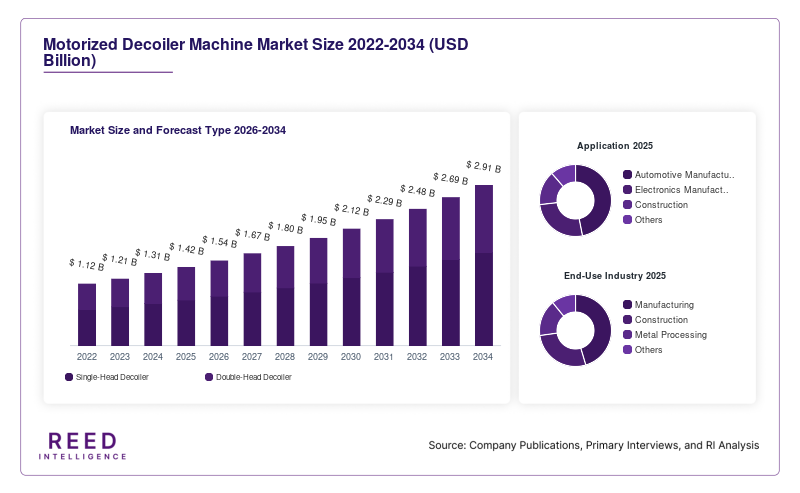
Single-head motorized decoilers dominated the market in 2024, accounting for approximately 39.2% of the total share. These machines are widely used due to their simplicity, cost-effectiveness, and suitability for standard applications. Industries prefer single-head decoilers for operations that do not require frequent coil changes, as they offer reliable performance and easy maintenance. Their compact design makes them ideal for small and medium manufacturing units. Additionally, advancements in control systems have enhanced the efficiency of single-head decoilers, making them a preferred choice across various industries.
Double-head motorized decoilers are expected to be the fastest-growing subsegment, with a CAGR of 9.1% during the forecast period. These machines allow continuous operation by enabling quick coil changes, reducing downtime and improving productivity. The growing demand for high-speed manufacturing processes is driving the adoption of double-head decoilers. Industries such as automotive and electronics are increasingly using these machines to maintain uninterrupted production. The ability to handle multiple coils efficiently makes double-head decoilers a valuable asset in modern manufacturing setups.
By Application
Automotive manufacturing emerged as the dominant application segment in 2024, accounting for 42.5% of the market share. The automotive industry relies heavily on metal sheets and coils for producing vehicle components. Motorized decoilers play a crucial role in ensuring consistent material feeding, which is essential for maintaining product quality. The increasing production of vehicles, including electric vehicles, is further driving the demand for decoiling equipment in this segment.
Electronics manufacturing is projected to be the fastest-growing application segment, with a CAGR of 9.8%. The demand for precision and high-quality materials in electronics production is driving the adoption of advanced decoiling systems. Motorized decoilers enable accurate handling of thin metal sheets used in electronic components. The rapid growth of the electronics industry, particularly in Asia Pacific, is creating significant opportunities for this segment.
By End-Use Industry
The manufacturing sector dominated the end-use industry segment in 2024, accounting for a significant share of the market. This sector includes a wide range of industries such as automotive, construction, and heavy machinery. Motorized decoilers are essential for efficient material handling and production processes in these industries. The increasing focus on automation and productivity is driving the adoption of advanced decoiling systems in the manufacturing sector.
The construction industry is expected to be the fastest-growing end-use segment, with a CAGR of 8.9%. The growing demand for infrastructure development and urbanization is driving the need for metal sheets and coils. Motorized decoilers are used to process these materials efficiently, supporting construction activities. The adoption of modern construction techniques and equipment is further boosting the demand for decoiling machines in this segment.
Regional Analysis
North America
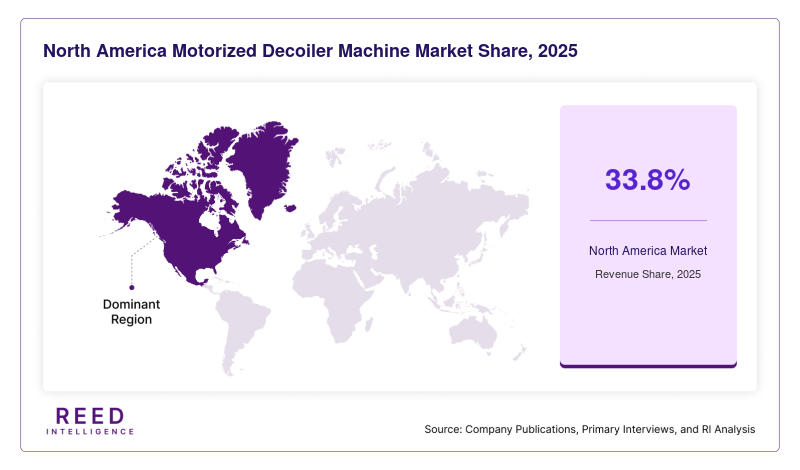
North America accounted for approximately 33.8% of the Motorized Decoiler Machine Market share in 2025 and is expected to grow at a CAGR of 7.8% during the forecast period. The region’s dominance is attributed to its advanced manufacturing infrastructure and high adoption of automation technologies. Industries in the United States and Canada are increasingly investing in smart manufacturing solutions, which include motorized decoilers integrated with automated production lines.
The United States remains the dominant country in this region, driven by strong demand from the automotive and aerospace sectors. A key growth factor is the increasing focus on reshoring manufacturing activities, which is boosting domestic production. This trend is encouraging companies to invest in efficient and automated machinery, thereby driving the demand for motorized decoilers.
Europe
Europe held a market share of around 27.4% in 2025 and is projected to grow at a CAGR of 7.5% during the forecast period. The region’s growth is supported by its well-established industrial base and emphasis on technological innovation. Countries such as Germany, Italy, and France are leading adopters of advanced manufacturing equipment, including motorized decoilers.
Germany stands out as the dominant country in Europe, owing to its strong automotive and engineering industries. A unique growth factor is the region’s strict environmental regulations, which are driving the adoption of energy-efficient machinery. Manufacturers are increasingly investing in eco-friendly decoiling solutions to comply with sustainability standards.
Asia Pacific
Asia Pacific is expected to witness the fastest growth, with a CAGR of 9.6% during 2026–2034, and held a market share of 24.6% in 2025. The region’s rapid industrialization and expanding manufacturing sector are key factors driving market growth. Countries such as China, India, and Japan are major contributors to the demand for motorized decoilers.
China dominates the Asia Pacific market due to its large-scale manufacturing capabilities. A significant growth factor is the government’s focus on industrial automation and smart factories. This initiative is encouraging manufacturers to adopt advanced machinery, including motorized decoilers, to enhance productivity and efficiency.
Middle East & Africa
The Middle East & Africa region accounted for 7.2% of the market share in 2025 and is projected to grow at a CAGR of 6.9%. The market growth in this region is driven by increasing investments in infrastructure and industrial development. Countries in the Gulf Cooperation Council (GCC) are focusing on diversifying their economies, which is boosting the manufacturing sector.
Saudi Arabia is the dominant country in this region, supported by large-scale construction projects and industrial initiatives. A unique growth factor is the government’s vision programs aimed at reducing dependence on oil revenues. These initiatives are promoting the adoption of advanced machinery, including motorized decoilers.
Latin America
Latin America held a market share of 7.0% in 2025 and is expected to grow at a CAGR of 7.1% during the forecast period. The region’s growth is driven by the expansion of manufacturing and construction industries. Countries such as Brazil and Mexico are key contributors to the market.
Brazil leads the Latin American market due to its strong industrial base. A key growth factor is the increasing foreign investment in manufacturing sectors. This investment is driving the adoption of modern equipment, including motorized decoilers, to improve production efficiency and competitiveness.
Competitive Landscape
The Motorized Decoiler Machine Market is moderately fragmented, with several global and regional players competing based on product innovation, quality, and pricing. Leading companies are focusing on developing advanced machines with automation and energy-efficient features to gain a competitive advantage. Strategic partnerships, mergers, and acquisitions are common strategies adopted by market players to expand their presence.
A leading player in the market is Coe Press Equipment, known for its advanced coil handling solutions. The company has recently introduced a new range of IoT-enabled motorized decoilers, enhancing operational efficiency and predictive maintenance capabilities. Other key players are also investing in research and development to introduce innovative products that cater to evolving industry requirements. The competitive landscape is expected to remain dynamic, with companies focusing on technological advancements and global expansion.
Key Players List
- Coe Press Equipment
- Bradbury Group
- ARKU Maschinenbau GmbH
- Dallas Industries
- Samco Machinery
- Acier Equipment
- Loopco Industries
- Kent Corporation
- Heinrich Georg GmbH
- Fagor Arrasate
- ANDRITZ Group
- Sotech Coil Handling
- AIDA Engineering Ltd.
- Dimeco Group
- Shung Dar Industrial Co., Ltd.
Recent Developments
- In 2025, Coe Press Equipment launched a new series of smart motorized decoilers with integrated IoT monitoring systems.
- In 2024, ARKU Maschinenbau GmbH expanded its production facility to increase output capacity for coil handling equipment.
- In 2025, ANDRITZ Group introduced an energy-efficient decoiler model designed for high-speed industrial applications.
Motorized Decoiler Machine Market Segments
Type
- Single-Head Decoiler
- Double-Head Decoiler
Application
- Automotive Manufacturing
- Electronics Manufacturing
- Construction
- Others
End-Use Industry
- Manufacturing
- Construction
- Metal Processing
- Others
By Region
- North America
- Europe
- APAC
- Middle East and Africa
- LATAM