MPO Fiber Optic Connector Market Size, Share & Trends Analysis Report By Connector Type (MPO-12, MPO-16, MPO-24, Others), By Fiber Type (Single-mode Fiber, Multimode Fiber), By Application (Data Centers, Telecommunications, Enterprise Networks, Others) and By Region (North America, Europe, APAC, Middle East and Africa, LATAM) Forecasts, 2026–2034
USD 3950
MPO Fiber Optic Connector Market Size
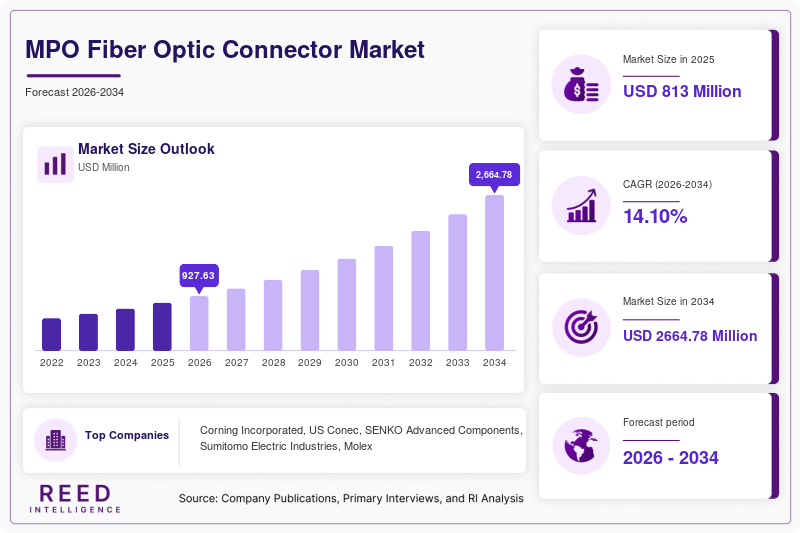
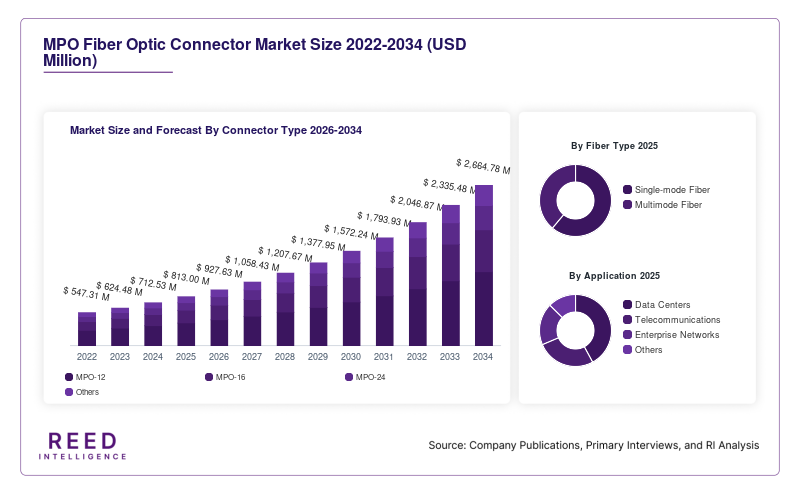
The global MPO Fiber Optic Connector Market is valued at USD 813 Million in 2025 and USD 927.63 Million in 2026. The market is projected to reach USD 2664.78 Million by 2034, registering the stated 14.10% CAGR during the forecast period.
The MPO fiber optic connector market is closely linked to the increasing fiber density requirements of hyperscale data centers, cloud infrastructure, telecom networks, and artificial-intelligence computing environments. MPO connectors terminate multiple fibers in one connector footprint, enabling high-density trunking and faster deployment than individually terminated duplex fiber architectures. Corning identifies MPO/MTP as a core data-center connectivity technology and notes that modern 400G and 800G environments are expanding the range of multi-fiber configurations used across the network.
The transition toward AI infrastructure is increasing the amount of fiber used within data centers. Corning states that AI data centers can require more than ten times the fiber of traditional data-center architectures, increasing demand for high-density cabling, interconnects, and structured optical systems.
Market Drivers
AI data centers are increasing fiber density per rack and network fabric
AI and high-performance computing clusters require dense optical interconnections between GPUs, switches, servers, storage, and network fabrics. Corning's AI cabling guidance notes that AI data centers can require more than ten times the fiber of traditional data centers, which increases the number of optical connectors, trunks, adapters, and breakout assemblies required per deployment.
MPO technology benefits directly because multiple fibers can be terminated in a single interface. This reduces connector count, supports pre-terminated trunking, and simplifies the deployment of high-fiber-count structured cabling. Corning's 800G guidance identifies MPO/MTP, MPO-16, 24-fiber architectures, and emerging VSFF interfaces as part of the connectivity landscape for higher-speed networks.
The demand mechanism is particularly strong in greenfield AI facilities, where cabling architecture can be designed around high-density optical connectivity from the outset. Vendors are also adapting connector housings and pull mechanisms for tight transceiver spacing and dense patching environments.
400G and 800G optical migration is creating demand for higher-fiber-count interfaces
The move to 400G and 800G networking is changing connector requirements across the data center. Corning's current cabling documentation includes MPO-16 interfaces in 800G configurations, while TE Connectivity lists active 800G optical transceivers using MPO-16 interfaces for SR8 architectures.
US Conec's MTP-16 portfolio supports 16-fiber connectors and assemblies for parallel-optics applications, including aggregation, breakout and high-density trunking. The company also supports 24- and 32-fiber configurations within its broader MTP platform.
As network speeds rise, the importance of insertion loss, alignment precision, end-face quality and polarity control increases. This favors suppliers with low-loss ferrule technology and connector systems engineered for demanding optical budgets. SENKO, for example, positions its MPO-PLUS family around precision ferrules and low insertion loss for next-generation data rates.
Pre-terminated and modular cabling is reducing installation time
Large data centers increasingly use factory-terminated trunk cables, breakout assemblies, cassettes, and modular fiber systems to reduce field labor and improve deployment consistency. US Conec's Fast-Track MTP system is designed for pre-terminated, high-fiber-count cabling and emphasizes rapid deployment without field processing.
MPO connectors support this model because multiple fiber channels can be terminated simultaneously and deployed as a single assembly. This makes them particularly useful in large-scale projects where installation speed, polarity consistency, and repeatability are important.
Legrand's recent data-center deployment case study also highlights high-density MPO and MDC connectors, modular trunks, and customized patching systems used to accelerate large-scale data-center expansion.
Market Restraints
MPO systems require careful polarity, inspection, and contamination management
Multi-fiber connectors simplify dense cabling but introduce additional installation and maintenance requirements. Polarity must be correctly configured across trunks, cassettes, adapters, and transceivers, while contamination of connector end faces can affect optical performance.
Corning identifies polarity and migration considerations as important elements of MPO deployment, particularly when moving between Base-8 and Base-16 architectures. The company also notes that higher-fiber-count systems can increase testing, cleaning, inventory, and deployment complexity.
This increases the value of factory-terminated assemblies and connector designs that simplify polarity changes, cleaning and field servicing.
Alternative high-density connector architectures are increasing competition
MPO connectors face competition from smaller connector formats including SN, SN-MT, MDC and other very-small-form-factor solutions. Corning identifies these architectures as options for high-speed applications, while SENKO positions SN-MT as a smaller footprint multi-fiber interface for high-density AI environments.
Expanded-beam connectivity also creates an alternative for selected applications where contamination resistance and serviceability are priorities. Molex's VersaBeam EBO portfolio and the joint SENKO-3M-Molex MPO EBO EZ-Way solution illustrate how suppliers are combining multi-fiber density with non-contact optical technologies.
Market Opportunities
AI networking and 800G/1.6T infrastructure
The expansion of AI clusters creates a long-term opportunity for higher-density, lower-loss, serviceable optical connectors. SENKO's current MPO portfolio includes solutions designed for dual 800G and 1.6T transceiver configurations, while the company is also developing connectivity closer to photonic integrated circuits and co-packaged optics.
The opportunity extends beyond standard MPO connectors into breakout assemblies, adapters, cassettes, harnesses, optical engines, and chip-to-fiber connectivity.
Connector designs optimized for difficult operating environments
There is increasing demand for optical connectors that can tolerate contamination, vibration, environmental exposure and repeated servicing. SENKO's IP-9 MPO platform supports up to 24 fibers in an IP68-rated housing for FTTx and outside-plant applications. The company's MPO EBO EZ-Way design also combines an MPO architecture with a non-contact expanded-beam interface.
These applications expand the addressable market beyond conventional controlled-environment data centers into telecom infrastructure, wireless networks and outdoor optical systems.
Connector Type Segment Analysis
MPO-12 remains the largest connector category
The MPO-12 segment accounts for 43% of the 2025 market, equivalent to USD 349.59 Million, and is projected to reach a 36% market share by 2034, equivalent to USD 646.20 Million. The segment is expected to register a 7.06% CAGR during 2026–2034.
MPO-12 remains the largest segment because of its established deployment base across structured cabling, data centers, telecom environments, and parallel-optics systems. Corning describes 12-fiber MPO/MTP interfaces as established solutions for 10G, 40G and 100G environments, while Sumitomo Electric continues to include MPO connectivity in its current fiber-optic product portfolio for data-center applications.
MPO-16 is the fastest-growing major connector type
The MPO-16 segment accounts for 28% of the 2025 market, representing USD 227.64 Million, and reaches a 36% share by 2034, representing USD 646.20 Million. The segment is projected to expand at a 12.29% CAGR.
MPO-16 is gaining importance because of its application in high-speed parallel-optics configurations. Corning's current 10G-to-800G cabling guidance includes MPO-16 APC interfaces, while TE Connectivity offers 800G SR8 optical transceivers using MPO-16 interfaces.
Application Analysis
Data centers dominate the application landscape
The Data Centers segment accounts for 58% of the 2025 market, representing USD 471.54 Million, and increases to 63% in 2034, representing USD 1.131 Billion. The segment is projected to grow at a 10.21% CAGR.
Data centers represent the largest application because MPO connectivity is closely tied to rack-scale structured cabling, high-density trunking, parallel optics, pre-terminated assemblies, and increasingly demanding AI infrastructure.
Corning's AI cabling guidance states that AI data centers can require more than ten times the fiber of conventional facilities, while its 800G documentation identifies MPO-16, 24-fiber MPO and other high-density interfaces as important options for high-speed data-center networks.
Telecommunications remains a substantial application
The Telecommunications segment represents 22% of the 2025 market, equivalent to USD 178.86 Million, and reaches 18% by 2034, equivalent to USD 323.10 Million. The segment is projected to grow at a 6.79% CAGR.
Telecom networks continue to use multi-fiber connectivity for high-capacity transport, aggregation, access and network distribution. Sumitomo Electric's current optical-connectivity portfolio includes MPO applications across data-center and telecom environments, while SENKO's MPO portfolio includes telecom and FTTx applications.
MPO Fiber Optic Connector Market Regional Analysis
North America MPO Fiber Optic Connector Market
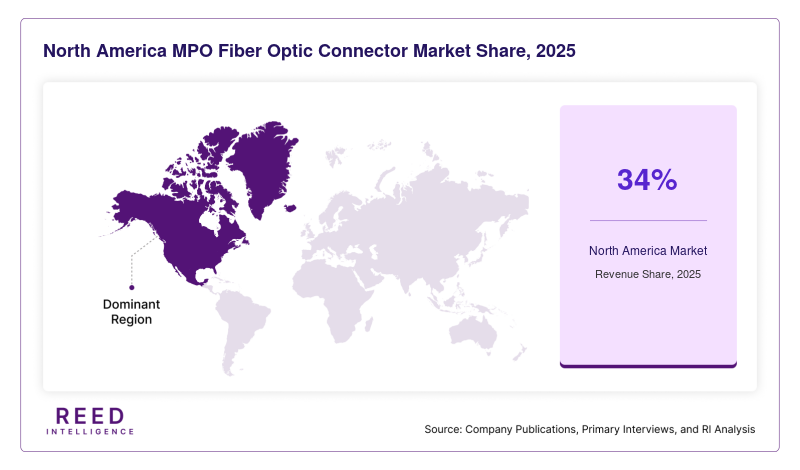
The North America market represents 34% of the 2025 global market, equivalent to USD 276.42 Million, and reaches 32% by 2034, equivalent to USD 574.40 Million. The region is projected to grow at an 8.47% CAGR.
North America represents the largest regional market because of its concentration of hyperscale operators, cloud platforms, colocation facilities, enterprise data centers and optical-connectivity suppliers. The region is also an important center for AI infrastructure expansion, increasing demand for dense optical networks.
Europe MPO Fiber Optic Connector Market
The Europe market represents 27% of the 2025 market, or USD 219.51 Million, and reaches 24% by 2034, or USD 430.80 Million. The market is projected to grow at a 7.78% CAGR.
Europe has a mature installed base of fiber infrastructure supported by telecom networks, enterprise data centers, industrial applications and structured cabling systems. The region is also adopting higher-density optical technologies as data-center operators modernize infrastructure.
APAC MPO Fiber Optic Connector Market
The APAC market accounts for 25% of the 2025 market, equivalent to USD 203.25 Million, and increases to 29% in 2034, equivalent to USD 520.55 Million. The region is projected to grow at an 11.01% CAGR.
APAC is expected to record the strongest regional expansion due to data-center construction, cloud adoption, telecom development, electronics manufacturing and the growing deployment of AI infrastructure. Japan, China, South Korea, Singapore and India remain important markets for optical connectivity and high-density networking.
Middle East and Africa MPO Fiber Optic Connector Market
The Middle East and Africa market represents 8% of the 2025 market, or USD 65.04 Million, and reaches 8% in 2034, or USD 143.60 Million. The regional market is projected to grow at a 9.20% CAGR.
The Middle East and Africa market is being supported by data-center investment, cloud infrastructure, telecom modernization and large-scale digital infrastructure projects. Increasing requirements for high-capacity optical connectivity are creating opportunities for both conventional MPO and next-generation compact fiber interfaces.
LATAM MPO Fiber Optic Connector Market
The LATAM market represents 6% of the 2025 market, equivalent to USD 48.78 Million, and increases to 7% by 2034, equivalent to USD 125.65 Million. The region is projected to grow at an 11.09% CAGR
LATAM continues to expand fiber infrastructure through telecom modernization, data-center development and enterprise digitization. New facilities can deploy pre-terminated and modular fiber architectures that reduce field termination requirements and support rapid network expansion.
Competitive Landscape
Competition in the MPO fiber optic connector market is increasingly centered on optical performance, density, deployment speed, connector footprint, polarity management, serviceability and compatibility with high-speed transceivers.
Corning has a broad MTP/MPO ecosystem covering structured cabling, EDGE8 systems, high-density trunks and 400G/800G network architectures. Its recent technical guidance addresses MPO-16, 24-fiber interfaces, Base-8 architectures and emerging VSFF connector alternatives.
US Conec maintains the MTP product family across MPO-8, MPO-12, MPO-16, 24- and 32-fiber configurations. Its MTP-16 portfolio supports high-density parallel optics, while Fast-Track MTP targets pre-engineered, factory-terminated cabling for rapid installation.
SENKO has expanded its MPO portfolio through low-loss MPO-PLUS connectors, compact housings, MPO-16 solutions, ruggedized MPO products, and connectors optimized for dual 800G and 1.6T configurations. The company is also extending its technology into SN-MT and co-packaged optical connectivity.
Key Market Players
- Corning Incorporated
- US Conec
- SENKO Advanced Components
- Sumitomo Electric Industries
- Molex
- Amphenol Corporation
- TE Connectivity
- CommScope
- Legrand
- Huber+Suhner
- 3M
- Panduit
- Siemon
- Furukawa Electric
- Nexans
Recent Developments
- September 2026 – SENKO, Advantest, and VIAVI announced a collaboration focused on CPO module-level testing. The companies announced a joint effort to address testing requirements associated with co-packaged optical modules. Although the development extends beyond conventional front-panel MPO connectivity, it is relevant to the connector market because optical interfaces increasingly move closer to photonic devices and require detachable, testable connectivity at module level.
- March 2026 – Molex introduced its AI optical-interconnect architecture
Molex's official announcement, dated March 17, 2026, covers VersaBeam EBO, Teramount TeraVERSE detachable fiber connectivity, CPO technologies, and its high-radix optical circuit-switch platform.
MPO Fiber Optic Connector Market Segments
By Connector Type
- MPO-12
- MPO-16
- MPO-24
- Others
By Fiber Type
- Single-mode Fiber
- Multimode Fiber
By Application
- Data Centers
- Telecommunications
- Enterprise Networks
- Others
By Region
- North America
- Europe
- APAC
- Middle East and Africa
- LATAM