MRI Guided Neurosurgical Ablation Market Size, Share Demand Report By Technology Type (Laser Interstitial Thermal Therapy (LITT), Focused Ultrasound, Radiofrequency Ablation), By Application (Brain Tumor Treatment, Epilepsy Treatment, Movement Disorders, Pain Management), By End-Use (Hospitals, Ambulatory Surgical Centers, Specialty Clinics), By Product Component (MRI Systems, Ablation Devices, Software & Navigation Systems), By Region & Segment Forecasts, 2025–2034
USD 3950
Market Overview
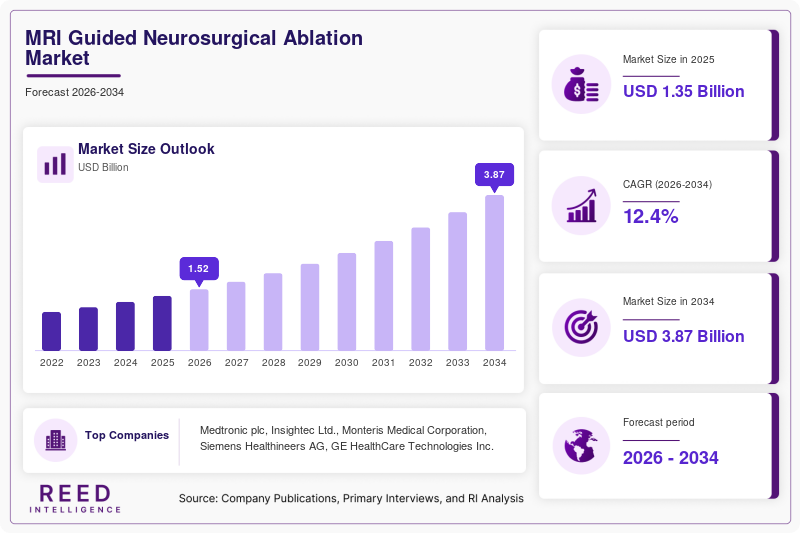
The global MRI Guided Neurosurgical Ablation Market size was valued at approximately USD 1.35 billion in 2025 and is projected to reach around USD 3.85 billion by 2034, expanding at a CAGR of 12.4% during the forecast period (2025–2034). The market has experienced steady expansion due to the increasing adoption of minimally invasive neurosurgical procedures and advancements in real-time imaging technologies. MRI-guided systems provide high precision and improved visualization, enabling surgeons to target abnormal brain tissues with greater accuracy while minimizing damage to surrounding healthy tissues.
One of the key global factors supporting market growth is the rising prevalence of neurological disorders such as brain tumors, epilepsy, and Parkinson’s disease. These conditions require precise and effective treatment approaches, which MRI-guided neurosurgical ablation systems facilitate. Additionally, the integration of artificial intelligence and robotics into MRI-guided procedures has further enhanced clinical outcomes, contributing to broader adoption across developed and emerging healthcare systems.
Key Highlights
- North America dominated the market with a 41.2% share in 2025, while Asia Pacific is expected to register the fastest CAGR of 14.1% through 2034.
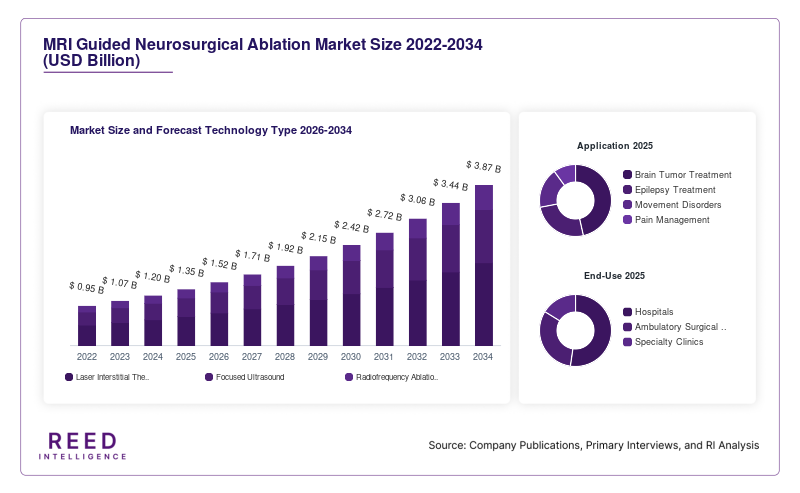
- Among segments, laser interstitial thermal therapy (LITT) led the type segment with a 48.6% share, whereas focused ultrasound is projected to grow at a CAGR of 15.2%.
- In applications, brain tumor treatment held the largest share at 52.3%, while epilepsy treatment is anticipated to grow at a CAGR of 13.8%.
- The United States remained the dominant country, with market values of USD 510 million in 2025 and an estimated USD 565 million in 2026.
Market Trends
Integration of AI and Advanced Imaging Technologies
The MRI Guided Neurosurgical Ablation Market is witnessing a strong trend toward the integration of artificial intelligence and advanced imaging solutions. AI-powered software is being incorporated into MRI systems to enhance image clarity, automate tumor segmentation, and provide predictive analytics during surgical planning. This integration improves procedural accuracy and reduces operation time, leading to better patient outcomes. Healthcare providers are increasingly investing in smart imaging platforms that combine real-time MRI guidance with data-driven decision support systems.
Growing Adoption of Non-Invasive and Outpatient Procedures
Another notable trend shaping the MRI Guided Neurosurgical Ablation Market is the shift toward non-invasive and outpatient treatment procedures. Techniques such as focused ultrasound ablation allow clinicians to treat neurological conditions without incisions, reducing hospital stays and recovery times. Patients are increasingly opting for procedures that offer minimal discomfort and faster return to normal activities. This trend is encouraging hospitals and specialty clinics to expand their capabilities in MRI-guided therapies, thereby accelerating market growth and reshaping treatment paradigms in neurosurgery.
Market Drivers
Rising Burden of Neurological Disorders
The increasing incidence of neurological conditions is a primary driver of the MRI Guided Neurosurgical Ablation Market. Disorders such as brain tumors, epilepsy, and movement disorders are becoming more prevalent due to aging populations and lifestyle factors. These conditions require precise treatment approaches, making MRI-guided ablation an attractive solution. The ability to deliver targeted therapy with minimal collateral damage has positioned MRI-guided procedures as a preferred choice among neurosurgeons.
Technological Advancements in MRI Systems
Continuous innovations in MRI technology are significantly contributing to market growth. Modern MRI systems offer higher resolution imaging, faster scan times, and improved compatibility with surgical instruments. The development of hybrid operating rooms equipped with MRI capabilities enables real-time monitoring during procedures, enhancing surgical precision. Additionally, advancements in thermal monitoring and navigation systems have improved the safety and effectiveness of ablation therapies, encouraging wider adoption across healthcare facilities.
Market Restraint
High Cost of Equipment and Procedures
One of the major challenges facing the MRI Guided Neurosurgical Ablation Market is the high cost associated with advanced MRI systems and ablation equipment. The installation of MRI-compatible operating suites requires substantial capital investment, which may not be feasible for smaller healthcare facilities or those in developing regions. Additionally, the cost of MRI-guided procedures is relatively high compared to conventional treatment methods, limiting patient accessibility.
The requirement for skilled professionals trained in both neurosurgery and MRI technology further adds to operational costs. Hospitals must invest in specialized training programs and infrastructure upgrades, which can slow down adoption rates. While technological advancements are improving efficiency, the overall cost burden remains a significant barrier to widespread implementation, particularly in price-sensitive markets.
Market Opportunities
Expansion in Emerging Markets
Emerging economies present significant growth opportunities for the MRI Guided Neurosurgical Ablation Market. Rapid improvements in healthcare infrastructure, increasing healthcare expenditure, and rising awareness of advanced treatment options are driving demand in these regions. Governments and private investors are actively funding healthcare modernization initiatives, creating a favorable environment for the adoption of MRI-guided technologies.
Development of Portable and Compact MRI Systems
The development of portable and compact MRI systems is expected to open new avenues for market growth. These systems are designed to be cost-effective and space-efficient, making them suitable for smaller hospitals and outpatient centers. Portable MRI-guided ablation solutions can expand access to advanced neurosurgical procedures in remote and underserved areas. As manufacturers continue to innovate in this space, the market is likely to witness increased penetration across diverse healthcare settings.
Segmental Analysis
By Technology Type
The laser interstitial thermal therapy (LITT) segment dominated the MRI Guided Neurosurgical Ablation Market in 2025, accounting for 48.6% of the total share. This dominance was attributed to its proven effectiveness in treating brain tumors and epilepsy with high precision. LITT systems offered real-time thermal monitoring and controlled tissue ablation, making them widely preferred among neurosurgeons.
The focused ultrasound segment is expected to grow at the fastest CAGR of 15.2% during the forecast period. This growth will be driven by its non-invasive nature and ability to treat neurological disorders without surgical incisions. Focused ultrasound technology is gaining traction due to reduced recovery times and lower risk of complications, making it an attractive option for both patients and healthcare providers.
By Application
Brain tumor treatment held the largest share of 52.3% in 2025 within the MRI Guided Neurosurgical Ablation Market. The high prevalence of brain tumors and the need for precise treatment methods contributed to the dominance of this segment. MRI-guided ablation enabled accurate targeting of tumor tissues, improving treatment outcomes and reducing side effects.
Epilepsy treatment is anticipated to grow at the fastest CAGR of 13.8% over the forecast period. This growth will be driven by increasing awareness of minimally invasive treatment options and advancements in imaging technologies. MRI-guided ablation provides an effective alternative for patients who are not suitable candidates for traditional surgical procedures.
By End-Use
Hospitals accounted for the largest share of 64.7% in 2025, reflecting their role as primary providers of advanced neurosurgical procedures. The availability of specialized infrastructure and skilled professionals enabled hospitals to adopt MRI-guided ablation technologies more effectively.
Ambulatory surgical centers are expected to grow at the fastest CAGR of 13.5% during the forecast period. This growth will be driven by the increasing demand for outpatient procedures and cost-effective treatment options. These centers are expanding their capabilities to include advanced imaging and minimally invasive surgical techniques, supporting market growth.
By Product Component
MRI systems represented the dominant subsegment in 2025, holding a share of 46.9%. These systems formed the backbone of MRI-guided procedures, providing high-resolution imaging and real-time guidance during surgeries.
Ablation devices are projected to grow at the fastest CAGR of 14.3% over the forecast period. The growth will be driven by continuous innovations in device design and functionality, enabling more precise and efficient ablation procedures. Manufacturers are focusing on developing advanced devices with enhanced safety features and improved performance.
Regional Analysis
North America
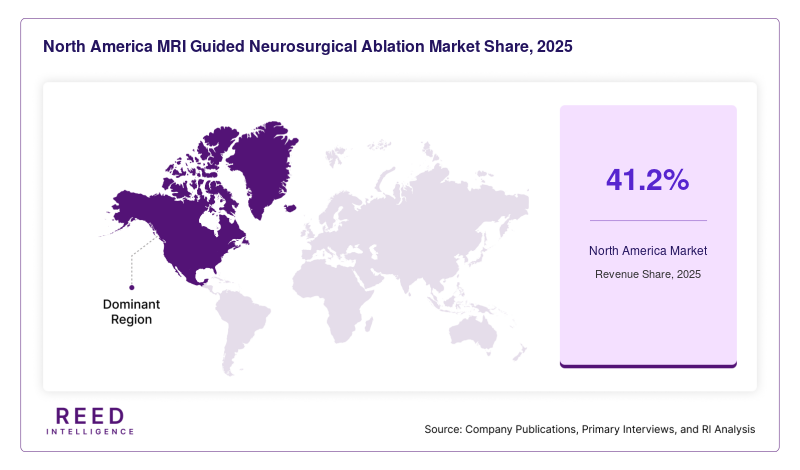
North America accounted for 41.2% of the MRI Guided Neurosurgical Ablation Market share in 2025 and is expected to grow at a CAGR of 11.8% during the forecast period. The region’s dominance was supported by advanced healthcare infrastructure, high adoption of innovative medical technologies, and strong investment in research and development. The presence of well-established healthcare systems facilitated the widespread use of MRI-guided neurosurgical procedures.
The United States emerged as the dominant country due to its robust healthcare spending and early adoption of advanced surgical technologies. A key growth factor was the increasing number of specialized neurosurgical centers equipped with MRI-compatible operating rooms. These facilities enabled the integration of real-time imaging into surgical workflows, improving clinical outcomes and driving market expansion.
Europe
Europe held a 27.5% share of the MRI Guided Neurosurgical Ablation Market in 2025 and is projected to grow at a CAGR of 11.2% through 2034. The region benefited from strong regulatory frameworks and increasing investments in healthcare innovation. Countries across Europe have been focusing on improving access to advanced medical technologies, which supported market growth.
Germany dominated the regional market due to its well-developed healthcare infrastructure and emphasis on precision medicine. A key growth factor was the increasing collaboration between research institutions and medical device manufacturers, leading to the development of advanced MRI-guided systems tailored to neurosurgical applications.
Asia Pacific
Asia Pacific represented 18.6% of the MRI Guided Neurosurgical Ablation Market in 2025 and is expected to register the fastest CAGR of 14.1% during the forecast period. The region’s growth was driven by rising healthcare expenditure, improving medical infrastructure, and increasing awareness of minimally invasive treatment options.
China emerged as the leading country, supported by rapid urbanization and government initiatives aimed at modernizing healthcare facilities. A significant growth factor was the expansion of tertiary care hospitals equipped with advanced imaging technologies, enabling wider adoption of MRI-guided neurosurgical procedures.
Middle East & Africa
The Middle East & Africa accounted for 7.3% of the MRI Guided Neurosurgical Ablation Market in 2025 and is projected to grow at a CAGR of 10.6% over the forecast period. The region’s growth was influenced by ongoing investments in healthcare infrastructure and increasing focus on specialized medical services.
Saudi Arabia dominated the market due to its strategic investments in healthcare modernization. A key growth factor was the establishment of advanced medical centers offering specialized neurosurgical treatments, supported by government initiatives to enhance healthcare quality and accessibility.
Latin America
Latin America held a 5.4% share of the MRI Guided Neurosurgical Ablation Market in 2025 and is expected to grow at a CAGR of 10.9% through 2034. The region’s growth was driven by improving healthcare systems and increasing adoption of advanced medical technologies.
Brazil emerged as the dominant country, supported by a growing number of private healthcare providers investing in modern medical equipment. A key growth factor was the rising demand for minimally invasive procedures, which encouraged hospitals to adopt MRI-guided ablation technologies.
Competitive Landscape
The MRI Guided Neurosurgical Ablation Market is characterized by the presence of several global and regional players focusing on technological innovation and strategic collaborations. Leading companies are investing in research and development to enhance product capabilities and expand their market presence.
Medtronic plc is a key market leader, known for its comprehensive portfolio of neurosurgical solutions. The company recently introduced an advanced MRI-compatible ablation system with enhanced real-time monitoring capabilities, strengthening its position in the market. Other players are focusing on partnerships with healthcare providers and research institutions to develop next-generation technologies.
The competitive landscape remains dynamic, with companies aiming to differentiate themselves through product innovation, clinical effectiveness, and expanded geographic reach.
Key Players List
- Medtronic plc
- Insightec Ltd.
- Monteris Medical Corporation
- Siemens Healthineers AG
- GE HealthCare Technologies Inc.
- Koninklijke Philips N.V.
- Brainlab AG
- Elekta AB
- Stryker Corporation
- Abbott Laboratories
- Boston Scientific Corporation
- Johnson & Johnson MedTech
- Canon Medical Systems Corporation
- Hitachi Medical Systems
- Synaptive Medical Inc.
Recent Developments
- In 2025, Medtronic plc launched an upgraded MRI-guided ablation platform with improved thermal mapping capabilities.
- Insightec Ltd. expanded its focused ultrasound technology for treating neurological disorders in new clinical settings.
- Siemens Healthineers introduced a next-generation MRI system designed specifically for interventional procedures.
- GE HealthCare announced advancements in AI-enabled imaging solutions for neurosurgical applications.
- Brainlab AG partnered with leading hospitals to enhance image-guided surgery platforms.
MRI Guided Neurosurgical Ablation Market Segments
Technology Type
- Laser Interstitial Thermal Therapy (LITT)
- Focused Ultrasound
- Radiofrequency Ablation
Application
- Brain Tumor Treatment
- Epilepsy Treatment
- Movement Disorders
- Pain Management
End-Use
- Hospitals
- Ambulatory Surgical Centers
- Specialty Clinics
Product Component
- MRI Systems
- Ablation Devices
- Software & Navigation Systems
By Region
- North America
- Europe
- APAC
- Middle East and Africa
- LATAM