Mulch Colorants Market Size, Share & Demand Report By Product Type (Water-Based Colorants, Solvent-Based Colorants, Biodegradable Colorants, Powder-Based Colorants), By Application (Residential Landscaping, Commercial Landscaping, Public Infrastructure Landscaping, Recreational and Playground Areas), By Distribution Channel (Direct Industrial Supply, Retail Stores, Online Retail Channels, Distributor Networks), By Region & Segment Forecasts, 2026–2034
USD 3950
Market Overview
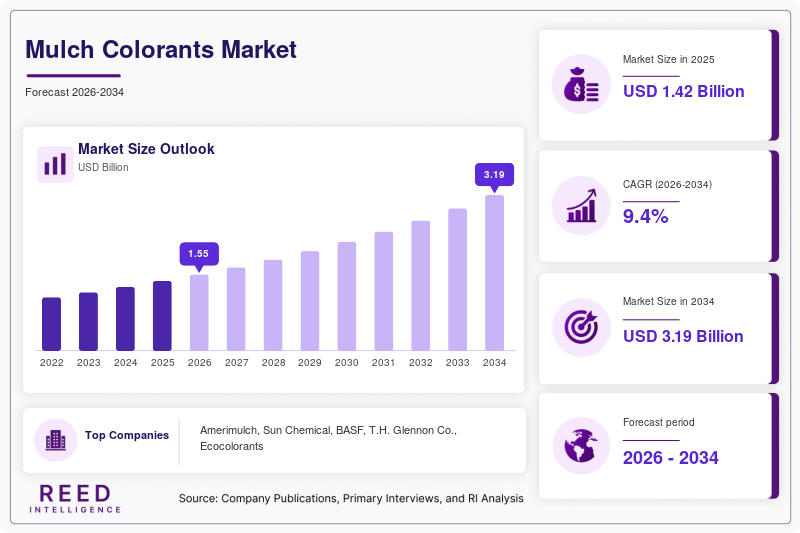
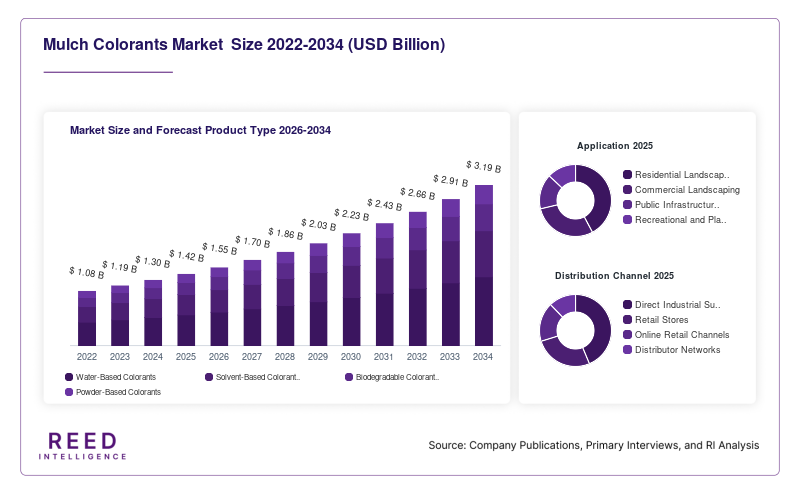
The global Mulch Colorants Market size was valued at USD 1.42 billion in 2026 and is projected to reach USD 2.91 billion by 2034, expanding at a CAGR of 9.4% during the forecast period from 2026 to 2034. The market is witnessing steady expansion due to the rising adoption of decorative landscaping products across residential, commercial, and municipal sectors. Increasing urbanization, growth in outdoor living projects, and rising investment in gardening aesthetics have contributed to stronger demand for colored mulch products and associated colorant solutions. Manufacturers are also investing in environmentally compatible pigments and water-based formulations to align with sustainability regulations and customer preferences.
The growing emphasis on landscape enhancement in residential housing developments has remained a major factor supporting global market growth. Property developers and homeowners are increasingly using mulch colorants to improve visual appeal, retain soil moisture, and reduce weed growth in gardens and outdoor spaces. In addition, landscaping companies are expanding the use of premium mulch products in public parks, hospitality projects, and commercial complexes. Product innovation in fade-resistant formulations and advanced coloring systems has further strengthened market penetration across mature and developing economies.
Key Highlights
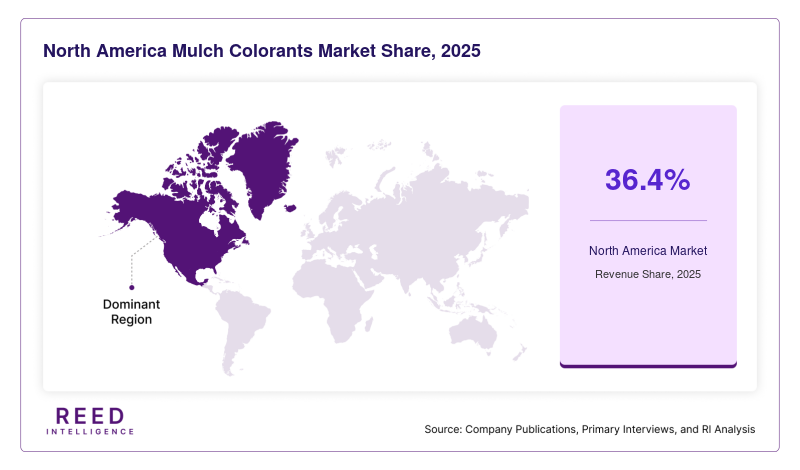
- North America dominated the market with a 36.4% share in 2025, while Asia Pacific is expected to grow at the fastest CAGR of 11.6% during 2026–2034.
- By product type, water-based colorants accounted for the largest share of 48.1%, while biodegradable colorants are projected to grow at a CAGR of 12.3%.
- By application, residential landscaping led with a 44.8% share, whereas commercial landscaping is expected to expand at a CAGR of 10.9%.
- By distribution channel, direct industrial supply held the dominant share of 39.5%, while online retail channels are anticipated to grow at a CAGR of 13.1%.
- The United States remained the dominant country, with market values of USD 392 million in 2024 and USD 428 million in 2025.
Market Trends
Rising Demand for Eco-Friendly and Water-Based Colorant Formulations
The market has experienced a significant shift toward environmentally compatible mulch colorants as consumers and regulatory agencies focus on sustainable landscaping practices. Manufacturers are increasingly replacing solvent-based formulations with water-based alternatives that reduce volatile organic compound emissions and improve user safety. Landscaping contractors and municipal authorities are also preferring colorants with low toxicity levels and biodegradable components to meet environmental compliance standards. This trend has encouraged suppliers to introduce advanced pigment technologies that maintain long-lasting color performance while reducing ecological impact. Demand for organic gardening products has additionally supported adoption across residential users who prefer safer solutions for home gardens and recreational outdoor spaces.
The transition toward sustainable landscaping has also influenced procurement strategies among commercial landscaping companies and property management firms. Many buyers are prioritizing suppliers offering recycled materials and eco-conscious manufacturing processes. As a result, producers are investing in research focused on natural pigment alternatives and improved color retention technologies. Product packaging innovations and reduced water consumption during manufacturing have further aligned with broader sustainability objectives across the landscaping industry.
Expansion of Automated Mulch Coloring Systems in Commercial Landscaping
The adoption of automated mulch coloring equipment has become an important trend shaping the competitive landscape of the Mulch Colorants Market. Commercial landscaping providers and mulch processing facilities are investing in high-capacity coloring systems that improve operational efficiency and reduce labor costs. Automated systems provide consistent pigment application, faster processing rates, and better product quality, which has become essential for large-scale landscaping projects. These systems are increasingly being integrated with digital controls and precision spraying technologies to minimize material waste and improve productivity.
Manufacturers are also introducing mobile coloring equipment designed for regional mulch suppliers and mid-sized landscaping operators. The ability to customize mulch shades and improve color durability has enhanced customer demand for advanced equipment solutions. Furthermore, automation has supported scalability among suppliers serving retail garden centers and bulk commercial buyers. The growing use of automation is expected to strengthen production capacity while reducing operating expenses, particularly in regions experiencing rising infrastructure and residential construction activity.
Market Drivers
Growth in Residential Landscaping and Outdoor Renovation Activities
The increasing popularity of outdoor renovation projects has emerged as a major driver for the Mulch Colorants Market. Homeowners are allocating higher spending toward landscaping improvements to enhance property aesthetics and increase resale value. Decorative mulch products are widely used in gardens, walkways, playgrounds, and outdoor entertainment areas because they provide visual appeal and functional soil protection. Rising disposable income levels and consumer interest in home improvement projects have accelerated the adoption of colored mulch products across urban and suburban residential developments.
The expansion of gardening culture through social media platforms and digital home improvement content has also encouraged consumers to invest in premium landscaping products. Retail chains and e-commerce platforms are promoting ready-to-use colored mulch solutions that simplify gardening maintenance for homeowners. Seasonal demand patterns during spring and summer landscaping periods continue to support recurring sales volumes for mulch colorants across North America and Europe.
Increasing Infrastructure Development and Commercial Landscaping Projects
Large-scale infrastructure development and commercial landscaping investments are significantly contributing to market expansion. Governments and private developers are increasing spending on urban beautification programs, public parks, hospitality facilities, educational campuses, and transportation infrastructure. Colored mulch is increasingly utilized in these projects because it improves landscape appearance while supporting moisture retention and weed control. Commercial landscaping contractors prefer durable colorants capable of maintaining visual consistency in high-traffic public areas.
Rapid urban expansion in developing economies has further strengthened the need for landscaping materials in residential townships, shopping centers, and recreational spaces. The hospitality and tourism industries are also investing in enhanced outdoor aesthetics to improve customer experience and brand image. These factors have encouraged mulch manufacturers to expand production capacities and introduce specialized formulations suitable for large commercial applications. Continuous investment in public infrastructure projects is expected to maintain long-term demand stability for mulch colorants globally.
Market Restraint
Volatility in Raw Material Prices and Environmental Compliance Costs
Fluctuations in the prices of pigments, additives, and chemical intermediates continue to restrain the growth potential of the Mulch Colorants Market. Manufacturers depend on several petroleum-derived and mineral-based raw materials that are subject to pricing instability caused by supply chain disruptions, trade policies, and energy market volatility. Rising transportation and packaging costs have also increased operational expenses for mulch colorant producers. Smaller manufacturers often face profitability pressure because they have limited capacity to absorb sudden increases in raw material prices.
Environmental regulations associated with pigment manufacturing and chemical disposal have added further complexity for industry participants. Regulatory authorities in North America and Europe are tightening standards related to emissions, wastewater management, and chemical composition in landscaping products. Compliance with these regulations requires continuous investment in production upgrades, testing procedures, and sustainable formulation development. In some regions, restrictions on certain synthetic pigments have limited product availability and increased research costs for alternative materials. These challenges may affect pricing competitiveness and slow market penetration in cost-sensitive developing economies.
Market Opportunities
Expansion of Online Retail and Digital Landscaping Platforms
The rapid expansion of online retail platforms presents a major opportunity for mulch colorant manufacturers and distributors. Consumers increasingly purchase landscaping products through digital marketplaces because of broader product selection, convenience, and competitive pricing. Online platforms enable manufacturers to target residential users directly while reducing dependence on traditional retail distribution networks. Product comparison features, customer reviews, and digital marketing campaigns are also improving consumer awareness regarding mulch colorant applications and benefits.
Digital landscaping platforms are further supporting market opportunities by offering customized design recommendations and virtual landscaping tools. These technologies help homeowners visualize outdoor projects and select mulch colors that match their landscaping preferences. The growing use of social commerce and influencer marketing in home improvement sectors has additionally expanded product visibility among younger consumer groups. Companies investing in e-commerce logistics and direct-to-consumer business models are expected to strengthen their competitive position during the forecast period.
Rising Demand for Sustainable Urban Landscaping Projects
Sustainable urban landscaping initiatives are creating new growth opportunities for the Mulch Colorants Market. Governments and municipal agencies are increasingly focusing on green infrastructure development to improve environmental quality and urban aesthetics. Colored mulch products are widely utilized in parks, roadside landscaping, recreational areas, and community gardens because they contribute to soil protection and water conservation. This has generated demand for environmentally compatible colorants with improved durability and low environmental impact.
The development of smart cities and eco-friendly residential communities is also supporting the use of advanced landscaping materials. Property developers are integrating decorative outdoor spaces into mixed-use developments and residential complexes to enhance property value and attract buyers. Demand for recycled wood mulch and biodegradable pigments is expected to increase as sustainability standards become more prominent across construction and urban planning sectors. Manufacturers capable of offering certified sustainable products are likely to gain stronger opportunities in public and private landscaping contracts.
Segmental Analysis
By Product Type
Water-based colorants accounted for the largest share of the Mulch Colorants Market in 2024, representing 48.1% of total revenue. These formulations gained widespread acceptance because they offer lower emissions, improved safety, and compatibility with environmental regulations. Landscaping companies and residential consumers increasingly prefer water-based products due to reduced odor levels and easier application processes. Manufacturers have also improved pigment stability and color retention capabilities, allowing these formulations to compete effectively with conventional solvent-based alternatives. The segment has benefited from increasing adoption across public landscaping projects where environmentally compatible products are required. Furthermore, rising demand for sustainable landscaping materials in residential developments and municipal projects has reinforced the dominant position of water-based colorants within the global market.
Biodegradable colorants are projected to register the fastest CAGR of 12.3% during the forecast period. Growth in this segment is largely driven by increasing consumer preference for eco-conscious gardening products and tightening environmental standards across developed economies. Manufacturers are investing in plant-based pigments and renewable raw materials to improve sustainability performance while maintaining product durability. Commercial landscaping contractors and municipalities are also adopting biodegradable solutions to align with green infrastructure initiatives and environmental certifications. The segment is expected to gain additional momentum from rising demand for organic gardening and environmentally friendly outdoor maintenance products. Expansion of sustainable residential communities and public green spaces is anticipated to create favorable conditions for biodegradable colorant adoption globally.
By Application
Residential landscaping emerged as the dominant application segment in 2024, accounting for 44.8% of the overall market share. Homeowners are increasingly investing in decorative outdoor improvements that enhance property appearance and support low-maintenance gardening practices. Colored mulch products are widely utilized around flower beds, pathways, playgrounds, and backyard entertainment areas because they improve aesthetics while preserving soil moisture. The popularity of gardening content on digital platforms has also encouraged consumers to experiment with landscaping designs and premium mulch products. Retail garden centers and home improvement stores continue to expand product offerings, improving accessibility among residential buyers. Seasonal landscaping activities and rising disposable incomes in urban regions have further strengthened segment demand across developed and emerging economies.
Commercial landscaping is expected to witness the fastest CAGR of 10.9% between 2026 and 2034. The segment is benefiting from increasing investment in hospitality facilities, office complexes, retail developments, and public infrastructure projects. Property developers and municipal authorities are emphasizing landscape aesthetics to improve visitor experiences and enhance urban environments. Commercial users often require high-volume mulch applications with long-lasting color retention and weather resistance, encouraging demand for premium colorant solutions. The rise of smart city initiatives and urban beautification programs is also supporting market expansion. Additionally, landscaping service providers are increasingly adopting automated mulch coloring systems that improve productivity and consistency for large commercial projects.
By Distribution Channel
Direct industrial supply held the leading share of 39.5% in 2024 within the distribution channel segment. Large landscaping contractors, mulch manufacturers, and municipal agencies prefer direct procurement arrangements because they provide cost efficiency, bulk supply stability, and customized product solutions. Industrial buyers frequently establish long-term supply agreements with manufacturers to secure consistent product quality and timely delivery for commercial landscaping projects. Direct distribution channels also allow suppliers to provide technical assistance, formulation customization, and operational support for mulch coloring equipment. The segment has remained dominant because of strong demand from large-scale infrastructure projects and commercial landscaping operations requiring continuous product availability.
Online retail channels are anticipated to expand at the fastest CAGR of 13.1% during the forecast period. Growth in this segment is supported by increasing digital commerce adoption and rising consumer preference for convenient purchasing platforms. E-commerce channels enable buyers to compare products, access customer reviews, and select specialized colorant formulations based on landscaping requirements. Manufacturers are strengthening digital marketing strategies and investing in direct-to-consumer logistics networks to improve online sales performance. The growth of mobile commerce and home improvement marketplaces has also increased product visibility among residential consumers. Additionally, online platforms provide opportunities for small and regional suppliers to reach broader customer bases without extensive physical retail infrastructure.
Regional Analysis
North America
North America accounted for 36.4% of the global Mulch Colorants Market share in 2025 and is expected to maintain a stable growth trajectory with a CAGR of 8.7% through 2034. The region benefits from a mature landscaping industry supported by high consumer spending on home improvement and outdoor living projects. Demand for decorative mulch products remains strong across residential communities, commercial complexes, and municipal landscaping applications. Retail garden centers and home improvement chains continue to expand product availability, while technological advancements in coloring equipment support operational efficiency among mulch processors.
The United States remains the dominant country within the regional market due to widespread landscaping culture and strong investment in residential property enhancement. One unique growth factor supporting the market is the increasing popularity of backyard renovation projects and outdoor entertainment spaces among homeowners. Landscaping contractors across the country are utilizing premium mulch products to improve curb appeal and reduce landscape maintenance requirements. In addition, municipal beautification programs in urban centers continue to support large-scale demand for colored mulch applications.
Europe
Europe represented 24.1% of the global market in 2025 and is projected to expand at a CAGR of 8.4% during the forecast period. The regional market is influenced by strict environmental standards and increasing adoption of sustainable landscaping practices. Demand for water-based and biodegradable mulch colorants has grown significantly across Western European countries where environmental compliance remains a major purchasing criterion. Public green space development and urban landscaping initiatives are also supporting product demand across municipal and commercial sectors.
Germany remains the leading country in the European market due to strong landscaping infrastructure and rising investment in eco-friendly construction projects. A unique growth factor in the country is the integration of sustainable gardening solutions into residential housing developments and urban regeneration projects. German consumers are increasingly adopting decorative landscaping products that combine aesthetic appeal with environmental performance. Furthermore, demand for recycled wood mulch products has increased among commercial property developers and hospitality facilities.
Asia Pacific
Asia Pacific held 21.6% of the global Mulch Colorants Market share in 2025 and is anticipated to register the fastest CAGR of 11.6% between 2026 and 2034. Rapid urbanization, infrastructure expansion, and growing middle-class spending on home improvement activities are supporting regional market growth. Countries across the region are increasing investment in public landscaping projects, recreational parks, and smart city initiatives. Rising awareness regarding soil protection and decorative landscaping has also contributed to expanding product demand among residential consumers.
China remains the dominant market in Asia Pacific due to large-scale infrastructure development and rising urban landscaping expenditure. One distinctive growth factor is the government focus on urban greening projects aimed at improving environmental sustainability in densely populated cities. Commercial real estate developers are integrating decorative outdoor spaces into residential and mixed-use developments, which has increased demand for mulch colorants. In addition, expanding e-commerce penetration has improved product accessibility among homeowners and landscaping professionals.
Middle East & Africa
The Middle East & Africa region accounted for 8.3% of the global market in 2025 and is expected to witness a CAGR of 7.9% over the forecast period. Growth in the region is supported by rising investment in hospitality infrastructure, luxury residential developments, and tourism-oriented landscaping projects. Decorative landscaping is becoming increasingly important across urban developments, resorts, and public recreation facilities. Countries within the Gulf Cooperation Council are investing heavily in green spaces and urban beautification initiatives to enhance tourism appeal and improve living standards.
Saudi Arabia remains the dominant country in the regional market due to large-scale infrastructure modernization and smart city projects. A unique factor driving growth is the expansion of high-end tourism destinations and entertainment complexes that require visually attractive landscaping solutions. Colored mulch products are increasingly utilized in resort landscaping and urban beautification programs because they improve soil moisture retention in arid climates. Demand for durable and heat-resistant colorant formulations is also increasing across commercial landscaping applications.
Latin America
Latin America captured 9.6% of the global Mulch Colorants Market share in 2025 and is forecast to grow at a CAGR of 8.2% through 2034. The region is benefiting from expanding residential construction activities and increasing awareness regarding decorative gardening products. Landscaping adoption has improved across urban households, commercial complexes, and public recreational areas. Local manufacturers are also expanding product portfolios to include cost-effective colorant formulations tailored to regional climate conditions.
Brazil continues to dominate the Latin American market due to strong residential landscaping demand and expanding horticulture activities. One notable growth factor is the increasing use of decorative landscaping materials in gated communities and tourism-oriented infrastructure projects. Landscaping contractors are promoting colored mulch solutions to improve property appearance while reducing soil erosion and maintenance requirements. Additionally, rising participation in gardening and outdoor decoration activities among middle-income households has strengthened market demand across major urban centers.
Competitive Landscape
The Mulch Colorants Market remains moderately fragmented, with competition focused on product quality, color durability, sustainability, and distribution efficiency. Leading manufacturers are investing in advanced pigment technologies and environmentally compatible formulations to strengthen market positioning. Strategic partnerships with landscaping companies and retail distributors continue to play an important role in expanding geographic reach and customer access. Companies are also introducing automated coloring systems and customized mulch shades to differentiate their product portfolios.
Amerimulch remains one of the leading companies in the market due to its extensive product portfolio and strong presence across North America. The company has expanded production capacity and introduced enhanced fade-resistant formulations to support commercial landscaping demand. Other major participants including Sun Chemical, BASF, T.H. Glennon, and Ecocolorants are focusing on sustainable product development and regional expansion strategies. Several companies are increasing investments in water-based and biodegradable formulations to address changing environmental regulations and customer preferences.
Key Players
- Amerimulch
- Sun Chemical
- BASF
- T.H. Glennon Co.
- Ecocolorants
- Applied Minerals Inc.
- Mulch Manufacturing Inc.
- Becker Underwood
- RIT Dye
- Crown Technology
- Organic Dye Solutions
- GreenEdge Colorants
- Geotech Industries
- Colorbiotics
- Specialty Mulch Products
Recent Developments
- Amerimulch introduced a new water-based mulch colorant formulation in 2025 designed to improve UV resistance and reduce fading in high-temperature environments.
- BASF expanded its sustainable pigment manufacturing capacity in Europe to support increasing demand for environmentally compatible landscaping products.
- Sun Chemical partnered with regional landscaping distributors in Asia Pacific during 2025 to strengthen product availability across commercial infrastructure projects.
- Ecocolorants launched biodegradable mulch pigments targeted at municipal landscaping programs and eco-friendly residential developments.
- T.H. Glennon Co. invested in automated mulch coloring equipment upgrades to improve production efficiency and support customized color solutions.
Mulch Colorants Market Segments
Product Type
- Water-Based Colorants
- Solvent-Based Colorants
- Biodegradable Colorants
- Powder-Based Colorants
Application
- Residential Landscaping
- Commercial Landscaping
- Public Infrastructure Landscaping
- Recreational and Playground Areas
Distribution Channel
- Direct Industrial Supply
- Retail Stores
- Online Retail Channels
- Distributor Networks
By Region
- North America
- Europe
- APAC
- Middle East and Africa
- LATAM