MulteFire Market Size, Share, Demand Report By Deployment Type (Private Network Deployment, Hybrid Network Deployment, Public Network Deployment), By Application (Industrial IoT, Smart Cities, Public Safety Networks, Transportation & Logistics), By End-Use Industry (Manufacturing, Healthcare, Energy & Utilities, Retail & E-commerce, Government & Defense), By Frequency Band (Sub-6 GHz, Millimeter Wave), By Region & Segment Forecasts, 2026–2034
USD 3950
Market Overview
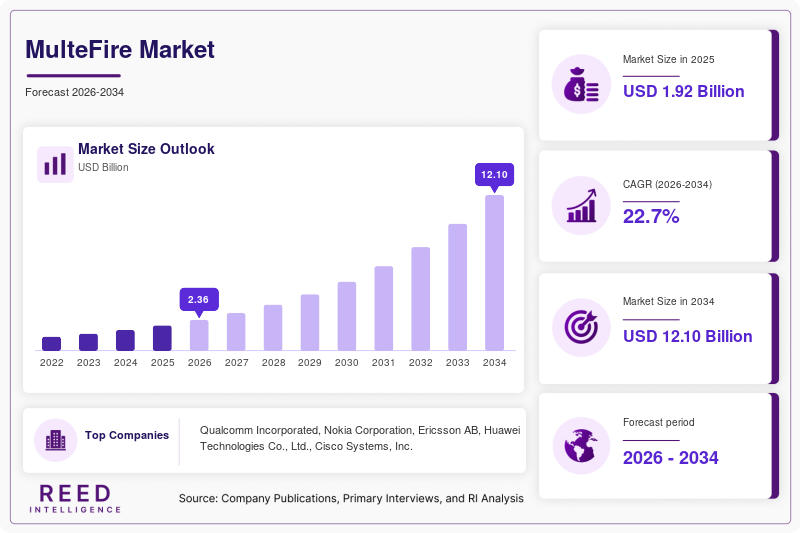
The global MulteFire Market was valued at approximately USD 1.92 billion in 2026 and is projected to reach around USD 9.84 billion by 2034, expanding at a compound annual growth rate (CAGR) of 22.7% during 2026–2034. The market is gaining traction as enterprises increasingly adopt private wireless networks to support mission-critical operations, industrial automation, and secure connectivity without relying on licensed spectrum.
One of the key global factors supporting the growth of the MulteFire Market is the increasing demand for dedicated, low-latency, and high-capacity wireless networks in industrial and enterprise environments. As organizations shift toward Industry 4.0, the need for scalable and interference-resilient communication systems has surged, encouraging adoption of MulteFire technology operating in unlicensed or shared spectrum bands.
Key Highlights
- Asia Pacific dominated the market with a 36.8% share in 2025, while North America is projected to be the fastest-growing region with a CAGR of 24.1% during the forecast period.
- In terms of segments, Private Network Deployment led with 48.5% share in 2025, while Industrial IoT Applications are expected to grow fastest at a CAGR of 25.6%.
- By end-use, the Manufacturing sector dominated with 34.2% share, while the Healthcare sector is anticipated to expand at a CAGR of 23.9%.
- China remained the dominant country, with market values estimated at USD 420 million in 2024 and USD 515 million in 2025, driven by rapid industrial digitization initiatives.
Market Trends
Expansion of Private LTE and 5G Networks in Unlicensed Spectrum
A major trend shaping the MulteFire Market is the rapid deployment of private LTE and emerging 5G networks in unlicensed spectrum bands. Enterprises are increasingly leveraging MulteFire to bypass traditional licensing constraints, enabling faster deployment and cost efficiency. This trend is particularly visible in manufacturing, logistics, and smart city applications where secure, localized connectivity is critical.
Integration with Industry 4.0 and Smart Infrastructure
Another notable trend is the integration of MulteFire technology with Industry 4.0 ecosystems. Smart factories, automated warehouses, and connected infrastructure are increasingly relying on MulteFire-enabled networks to support real-time communication, machine-to-machine connectivity, and predictive maintenance systems. The technology’s ability to deliver reliable connectivity without dependence on mobile network operators is accelerating its adoption across industrial ecosystems.
Market Drivers
Rising Demand for Secure and Dedicated Enterprise Connectivity
The growing need for secure, interference-free communication networks in enterprise environments is a key driver of the MulteFire Market. Organizations handling sensitive data or critical operations prefer private wireless networks that offer enhanced control and security. MulteFire enables enterprises to deploy standalone LTE networks in unlicensed spectrum, ensuring both reliability and data privacy.
Growth of Industrial Automation and IoT Ecosystems
The increasing adoption of industrial automation and IoT devices is driving demand for high-performance wireless networks. MulteFire technology supports massive device connectivity and low-latency communication, making it suitable for complex industrial operations. As IoT ecosystems expand across sectors such as logistics, energy, and utilities, the demand for scalable connectivity solutions continues to grow.
Market Restraint
Limited Ecosystem Maturity and Device Compatibility
Despite its advantages, the MulteFire Market faces challenges related to limited ecosystem maturity and device compatibility. Compared to traditional LTE and 5G networks, the availability of MulteFire-compatible devices and infrastructure remains relatively constrained, which may hinder large-scale adoption in certain regions.
Market Opportunities
Adoption in Smart Cities and Urban Infrastructure
The growing development of smart cities presents significant opportunities for the MulteFire Market. Municipal authorities are increasingly deploying smart traffic systems, surveillance networks, and public safety solutions that require reliable and cost-effective wireless connectivity. MulteFire offers an attractive solution due to its ability to operate independently in unlicensed spectrum.
Expansion in Emerging Economies
Emerging economies present a lucrative opportunity due to the rapid expansion of industrial and digital infrastructure. Countries in Asia Pacific, Latin America, and Africa are investing heavily in connectivity solutions to support economic growth. MulteFire technology provides a cost-efficient alternative to traditional cellular networks, making it suitable for these regions.
Segmental Analysis
By Deployment Type
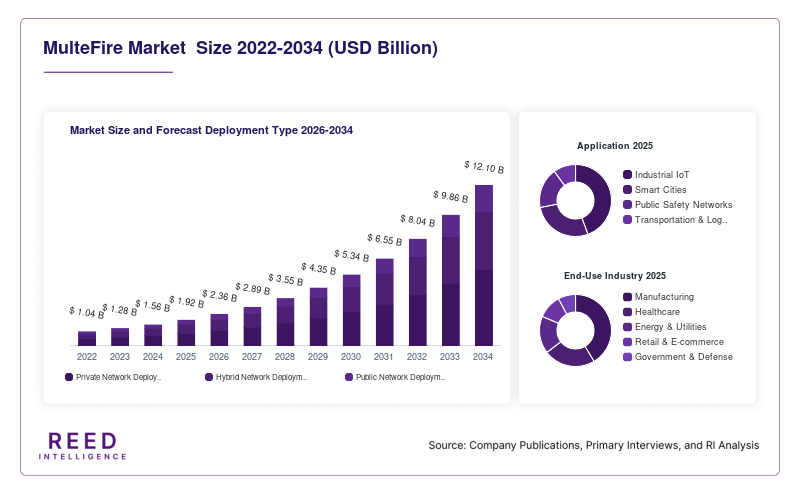
The Private Network Deployment segment dominated the MulteFire Market with a 48.5% share in 2025, as enterprises increasingly opted for dedicated connectivity solutions to enhance operational efficiency and data security.
The Hybrid Deployment segment is expected to grow at the fastest rate, with a projected CAGR of 24.8%. This growth will be driven by the flexibility of combining private and public network capabilities, enabling organizations to balance performance and cost efficiency.
By Application
The Industrial IoT Applications segment held the largest share of 42.7% in 2025, driven by the widespread adoption of connected devices in manufacturing and logistics environments.
The Smart City Applications segment is anticipated to grow at the fastest pace, with a CAGR of 25.6%, supported by increasing investments in urban infrastructure and public safety systems. The need for reliable and scalable connectivity in smart city deployments will drive this growth.
By End-Use Industry
The Manufacturing sector dominated the market with a 34.2% share in 2025, due to the high demand for automation and real-time communication systems in production facilities.
The Healthcare sector is expected to witness the fastest growth, with a CAGR of 23.9%, driven by the adoption of connected medical devices and telemedicine solutions. The need for secure and uninterrupted connectivity in healthcare environments will support this expansion.
By Frequency Band
The Sub-6 GHz band accounted for the largest share of 57.3% in 2025, owing to its wide coverage and suitability for industrial applications.
The Millimeter Wave (mmWave) segment is projected to grow at a CAGR of 26.1%, driven by increasing demand for high-speed data transmission and low-latency communication in advanced applications.
Regional Analysis
North America
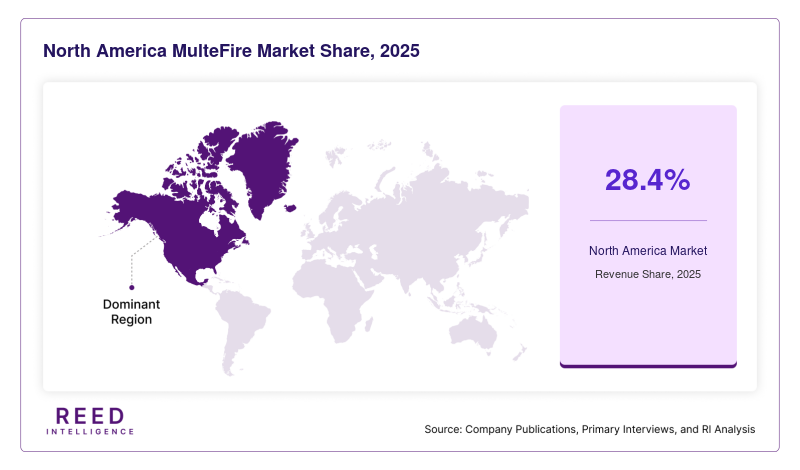
North America accounted for 28.4% of the MulteFire Market share in 2025 and is expected to grow at a CAGR of 24.1% during 2026–2034. The United States dominated the region due to strong adoption of private wireless networks across enterprises. The presence of advanced industrial infrastructure and increasing investments in digital transformation initiatives contributed to market growth. The country’s emphasis on secure enterprise communication systems further accelerated adoption.
Europe
Europe held a 22.1% market share in 2025 and is projected to expand at a CAGR of 21.3% over the forecast period. Germany emerged as the leading country, driven by its strong manufacturing base and adoption of Industry 4.0 practices. The country’s focus on smart factories and industrial automation has significantly boosted the demand for MulteFire-based connectivity solutions.
Asia Pacific
Asia Pacific dominated the global MulteFire Market with a 36.8% share in 2025 and is anticipated to grow at a CAGR of 23.5%. China led the region, supported by rapid industrialization and government initiatives promoting digital infrastructure. The widespread deployment of smart manufacturing units and connected industrial systems has fueled market expansion in the region.
Middle East & Africa
The Middle East & Africa region captured 6.5% of the market share in 2025 and is expected to grow at a CAGR of 20.2%. The United Arab Emirates emerged as a key contributor, driven by investments in smart city projects and advanced infrastructure. The adoption of innovative connectivity solutions in sectors such as oil & gas and logistics has supported regional growth.
Latin America
Latin America accounted for 6.2% of the market share in 2025 and is projected to grow at a CAGR of 19.6%. Brazil led the region due to increasing investments in industrial modernization and digital connectivity. The growing need for efficient communication systems in logistics and manufacturing sectors has driven adoption in the country.
Competitive Landscape
The MulteFire Market is moderately competitive, with several global and regional players focusing on technological advancements and strategic partnerships. Key companies include Qualcomm Incorporated, Nokia Corporation, Ericsson AB, Huawei Technologies Co., Ltd., and Cisco Systems, Inc. Among these, Qualcomm Incorporated is recognized as a market leader due to its strong portfolio of chipsets and continuous innovation in private wireless technologies.
The company recently introduced enhanced MulteFire-compatible platforms to support next-generation industrial applications, strengthening its position in the market. Meanwhile, Nokia and Ericsson are actively expanding their private network solutions, while Huawei focuses on integrated connectivity systems for industrial clients. Cisco is leveraging its networking expertise to deliver end-to-end enterprise solutions. Strategic collaborations, product launches, and investments in R&D remain key strategies adopted by these players to maintain competitiveness in the evolving market landscape.
Key Players List
- Qualcomm Incorporated
- Nokia Corporation
- Ericsson AB
- Huawei Technologies Co., Ltd.
- Cisco Systems, Inc.
- Samsung Electronics Co., Ltd.
- Intel Corporation
- ZTE Corporation
- NEC Corporation
- Fujitsu Limited
- Sierra Wireless, Inc.
- Airspan Networks Holdings Inc.
- Baicells Technologies Co., Ltd.
- CommScope Holding Company, Inc.
- Athonet S.r.l.
Recent Developments
- In 2025, leading players expanded their private network portfolios to support advanced industrial automation use cases.
- Several companies introduced MulteFire-compatible devices aimed at improving interoperability across enterprise environments.
- Strategic partnerships between telecom providers and industrial firms increased, focusing on deploying private wireless networks.
- Investments in R&D for next-generation MulteFire solutions accelerated, particularly in mmWave technology.
- Governments in emerging economies initiated pilot projects to integrate MulteFire technology into smart city infrastructure.
MulteFire Market Segments
Deployment Type
- Private Network Deployment
- Hybrid Network Deployment
- Public Network Deployment
Application
- Industrial IoT
- Smart Cities
- Public Safety Networks
- Transportation & Logistics
End-Use Industry
- Manufacturing
- Healthcare
- Energy & Utilities
- Retail & E-commerce
- Government & Defense
Frequency Band
- Sub-6 GHz
- Millimeter Wave (mmWave)
By Region
- North America
- Europe
- APAC
- Middle East and Africa
- LATAM