Multimodal Models Market Size, Share & Demand Report By Component (Software Platforms, Hardware Infrastructure, AI Services), By Modality (Text and Image, Video and Audio, Sensor and Data Fusion), By End Use (IT and Telecommunications, Healthcare, Retail and E-commerce, Automotive, Media and Entertainment, BFSI, Manufacturing, Government and Defense), By Region & Segment Forecasts, 2026–2034
USD 3950
Market Overview
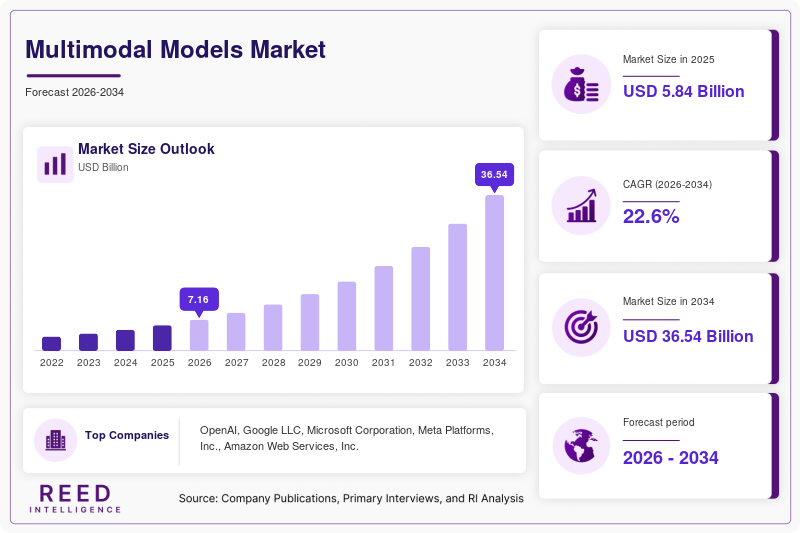
The global Multimodal Models Market size was valued at USD 5.84 billion in 2026 and is projected to reach USD 29.76 billion by 2034, expanding at a CAGR of 22.6% during the forecast period from 2026 to 2034. The market is witnessing strong expansion due to the increasing integration of artificial intelligence across enterprise workflows, customer engagement systems, healthcare diagnostics, autonomous systems, and content generation platforms. Multimodal models combine multiple forms of data, including text, image, audio, video, and sensor inputs, enabling organizations to develop more context-aware and adaptive AI applications. The growing demand for generative AI systems capable of understanding and processing diverse data streams has accelerated investments in multimodal AI infrastructure worldwide.
Rising cloud computing adoption and the expansion of high-performance GPU ecosystems have further strengthened the commercial deployment of multimodal models across industries. Enterprises are increasingly utilizing multimodal architectures to improve automation accuracy, enhance decision-making, and optimize operational intelligence. In addition, the rapid digitalization of industries such as retail, healthcare, automotive, media, and financial services has created substantial demand for advanced AI systems capable of real-time multimodal interpretation. Government support for AI innovation and growing private investments in foundation model development are also contributing to sustained market growth globally.
Key Highlights
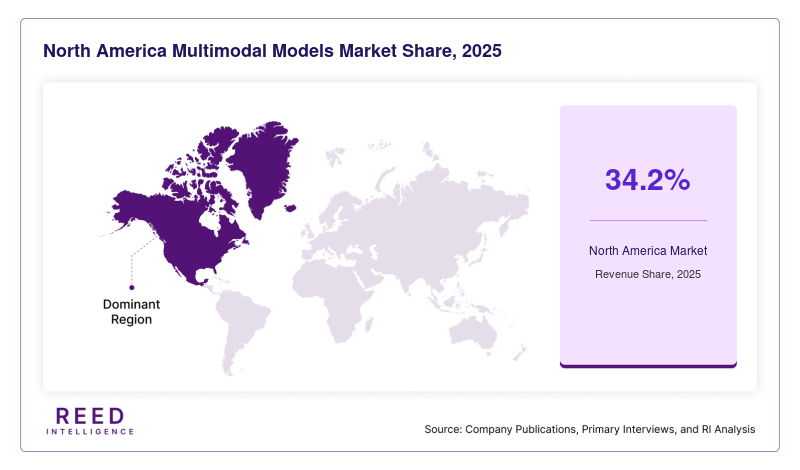
- North America dominated the market with a 34.2% share in 2025.
- Asia Pacific is expected to grow at the fastest CAGR of 24.1% during 2026–2034.
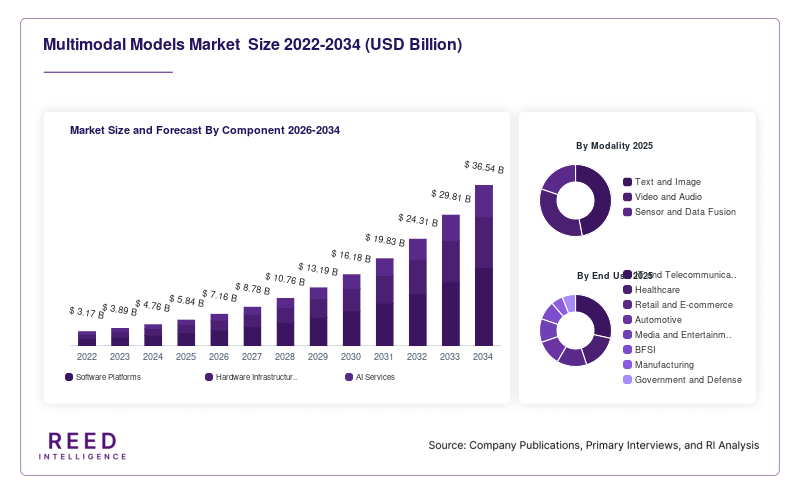
- By component, software platforms accounted for the largest share of 46.8%, while AI services are projected to grow at a CAGR of 25.4%.
- By modality, text and image models led with a 39.6% share, whereas video and audio multimodal systems are expected to expand at a CAGR of 27.2%.
- By end use, IT and telecommunications held a leading share of 31.4%, while healthcare is projected to grow at a CAGR of 26.5%.
- The United States remained the dominant country, with market values of USD 1.62 billion in 2024 and USD 1.98 billion in 2025.
Market Trends
Expansion of Generative AI Across Enterprise Platforms
The growing adoption of generative artificial intelligence across enterprise environments is emerging as a major trend in the Multimodal Models Market. Businesses are increasingly deploying multimodal AI systems capable of processing text, voice, video, and images simultaneously to improve customer interactions and operational efficiency. Enterprises in banking, retail, media, and healthcare are integrating multimodal models into virtual assistants, intelligent automation systems, and content recommendation platforms. These models help organizations generate contextual responses, automate document interpretation, and improve predictive analytics. The demand for unified AI systems that can handle multiple input formats has encouraged software providers to invest in large-scale foundation models optimized for commercial deployment. Cloud-based AI platforms are also enabling faster accessibility for medium-sized enterprises, contributing to wider market penetration globally.
Rising Integration of Multimodal AI in Autonomous Technologies
The integration of multimodal models into autonomous technologies is becoming increasingly significant across transportation, robotics, manufacturing, and defense sectors. Autonomous systems require the ability to process multiple forms of information simultaneously to improve environmental awareness and operational safety. Multimodal AI models combine data from cameras, sensors, voice commands, and navigation systems to enable more accurate real-time decisions. Automotive companies are investing heavily in multimodal architectures for advanced driver assistance systems and autonomous mobility platforms. Industrial robotics manufacturers are also implementing multimodal learning systems to enhance machine adaptability in dynamic production environments. As industries move toward intelligent automation and connected infrastructure, the demand for robust multimodal AI frameworks is expected to increase steadily during the forecast period.
Market Drivers
Increasing Demand for Human-Like AI Interaction Systems
The growing demand for AI systems capable of delivering natural and human-like interactions is driving the expansion of the Multimodal Models Market. Traditional AI systems based on single-input processing often face limitations in understanding complex human communication patterns. Multimodal models address this challenge by integrating text, speech, image, and contextual inputs to improve response accuracy and interaction quality. Organizations are increasingly adopting these models in customer service platforms, intelligent chatbots, digital assistants, and virtual collaboration tools. The ability to analyze multiple data streams simultaneously enables businesses to improve user engagement and personalization. Rising consumer expectations for seamless digital experiences across online platforms are encouraging enterprises to invest in advanced multimodal AI solutions capable of delivering contextual intelligence and adaptive communication.
Growing Investments in AI Infrastructure and Computing Power
The rapid expansion of AI infrastructure and high-performance computing capabilities is significantly supporting the growth of the Multimodal Models Market. Large technology companies and cloud providers are investing heavily in GPU clusters, AI accelerators, and data center expansion to support the training and deployment of multimodal foundation models. The availability of scalable cloud computing environments has reduced barriers for enterprises seeking access to advanced AI capabilities. In addition, semiconductor manufacturers are introducing specialized processors optimized for multimodal AI workloads, improving training efficiency and inference speed. Governments and private organizations are also increasing funding for AI research initiatives, enabling faster innovation in multimodal architectures. These technological advancements are accelerating commercialization opportunities and encouraging wider adoption across industries globally.
Market Restraint
High Computational Costs and Data Complexity Challenges
The Multimodal Models Market faces considerable challenges associated with high computational requirements and complex data integration processes. Training multimodal AI systems requires extensive computing infrastructure, large datasets, and advanced optimization techniques, resulting in significant operational costs for enterprises. Small and medium-sized organizations often encounter financial barriers when attempting to deploy large-scale multimodal models due to expensive GPU resources and cloud processing expenses. In addition, integrating multiple forms of structured and unstructured data creates technical difficulties related to data synchronization, labeling accuracy, and model consistency. Privacy regulations and data governance requirements further complicate the collection and utilization of multimodal datasets across industries such as healthcare and financial services. These challenges can slow adoption rates, particularly in developing economies where AI infrastructure maturity remains limited. Furthermore, concerns regarding model bias, interpretability, and cybersecurity vulnerabilities continue to create operational risks for enterprises implementing multimodal AI systems in mission-critical environments.
Market Opportunities
Growing Adoption of AI in Healthcare Diagnostics
The increasing application of artificial intelligence in healthcare diagnostics is creating strong opportunities for the Multimodal Models Market. Healthcare organizations are utilizing multimodal AI systems to combine medical imaging, patient records, voice analysis, and clinical notes for improved diagnostic accuracy and treatment planning. These models enable physicians to identify disease patterns more efficiently while supporting personalized healthcare recommendations. Hospitals and research institutions are investing in multimodal AI platforms for radiology analysis, drug discovery, and patient monitoring applications. The rising demand for telemedicine and digital healthcare services is also accelerating the adoption of AI systems capable of interpreting multiple forms of medical information simultaneously. As healthcare providers continue to modernize clinical workflows and prioritize precision medicine initiatives, multimodal models are expected to gain substantial commercial traction during the forecast period.
Expansion of Multimodal AI in Media and Entertainment
The media and entertainment industry is presenting significant growth opportunities for multimodal AI solution providers. Content creators and digital platforms are increasingly deploying multimodal models to automate video generation, subtitle creation, voice synthesis, and audience personalization. Streaming companies are using these systems to analyze visual and textual user behavior for targeted content recommendations and advertising optimization. The rising popularity of immersive digital experiences, including virtual reality and interactive gaming, is further driving the need for AI models capable of understanding complex multimedia environments. In addition, advertising agencies and marketing firms are leveraging multimodal AI tools to create personalized campaigns based on consumer interaction patterns across multiple channels. As digital content consumption continues to expand globally, the adoption of multimodal AI technologies within the entertainment ecosystem is expected to accelerate considerably.
Segmental Analysis
By Component
Software platforms accounted for the largest share of the Multimodal Models Market in 2024, contributing approximately 46.8% of total revenue. The dominance of this subsegment is primarily attributed to the growing demand for AI development frameworks, foundation model platforms, and enterprise integration tools. Organizations are increasingly adopting software-based multimodal AI solutions to streamline customer engagement, automate workflows, and enhance data analytics capabilities. These platforms enable enterprises to process text, images, video, and speech data within unified environments, improving operational efficiency and decision-making accuracy. Large technology companies are continuously introducing advanced APIs and AI development ecosystems to support multimodal application deployment. The rising popularity of cloud-native AI platforms and subscription-based deployment models has also accelerated adoption among businesses seeking scalable and flexible AI infrastructure solutions across industries.
AI services are projected to witness the fastest growth during the forecast period, registering a CAGR of 25.4% from 2026 to 2034. The increasing complexity of multimodal AI implementation is encouraging enterprises to rely on consulting, integration, training, and managed services providers for deployment support. Organizations often require specialized expertise to optimize multimodal model performance, ensure regulatory compliance, and manage large-scale AI infrastructure environments. Service providers are expanding offerings related to model customization, data annotation, workflow integration, and cybersecurity optimization. The growing need for industry-specific AI applications in healthcare, finance, retail, and manufacturing is further supporting demand for professional AI services. In addition, small and medium-sized enterprises are increasingly utilizing third-party AI service providers to access advanced multimodal technologies without substantial internal infrastructure investments.
By Modality
Text and image multimodal systems represented the dominant subsegment within the Multimodal Models Market in 2024, accounting for nearly 39.6% of overall market revenue. These systems are widely adopted across industries due to their ability to combine natural language processing with computer vision capabilities. Enterprises are utilizing text and image multimodal models in customer support automation, content moderation, medical imaging analysis, and e-commerce recommendation systems. The strong adoption of generative AI tools capable of interpreting visual and textual inputs simultaneously has further strengthened segment growth. Businesses are also deploying multimodal applications for intelligent document processing, visual search, and sentiment analysis tasks. Continuous improvements in transformer architectures and vision-language learning models have significantly improved accuracy and scalability, encouraging wider implementation across enterprise environments and consumer-facing applications.
Video and audio multimodal systems are expected to record the fastest CAGR of 27.2% during the forecast period. Increasing demand for immersive digital experiences, intelligent surveillance, and real-time communication analytics is driving growth within this subsegment. Enterprises are deploying advanced AI models capable of analyzing voice patterns, facial expressions, and video content to improve customer engagement and operational monitoring. Media companies are utilizing these systems for automated subtitle generation, video indexing, and personalized content delivery. The growing popularity of virtual collaboration tools and AI-powered meeting assistants is also creating strong demand for audio-video multimodal processing capabilities. Furthermore, advancements in speech recognition technologies and edge computing infrastructure are enabling faster deployment of real-time multimodal analytics solutions across industries such as telecommunications, entertainment, and security.
By End Use
IT and telecommunications emerged as the leading end-use segment in the Multimodal Models Market in 2024, capturing approximately 31.4% of total revenue. The dominance of this segment is linked to the rapid integration of AI-driven automation, customer analytics, and intelligent communication systems within digital service environments. Telecommunications providers are utilizing multimodal AI models to improve customer support operations, network optimization, and fraud detection capabilities. IT companies are increasingly integrating multimodal AI into enterprise productivity platforms, virtual assistants, and cybersecurity systems. The expansion of cloud computing ecosystems and digital collaboration tools has also strengthened demand for scalable multimodal AI applications. Businesses operating in the IT and telecommunications sector continue to prioritize advanced AI investments to improve service delivery, reduce operational complexity, and strengthen competitive positioning in rapidly evolving digital markets.
Healthcare is anticipated to witness the fastest growth during the forecast period, registering a CAGR of 26.5% from 2026 to 2034. The growing use of AI-powered diagnostic systems, medical imaging analysis, and clinical decision support platforms is accelerating adoption within healthcare environments. Multimodal AI systems enable healthcare providers to combine radiology scans, patient histories, laboratory data, and physician notes for improved diagnostic accuracy and treatment planning. Hospitals and research institutions are increasingly investing in multimodal foundation models to support personalized medicine initiatives and accelerate drug discovery processes. The rise of telehealth platforms and remote patient monitoring solutions is also contributing to demand for AI systems capable of processing speech, video, and medical data simultaneously. Regulatory advancements supporting digital healthcare transformation are expected to create additional growth opportunities for multimodal AI providers globally.
Regional Analysis
North America
North America accounted for the largest share of the Multimodal Models Market in 2025, representing approximately 34.2% of global revenue. The region is projected to maintain a strong growth trajectory with a CAGR of 21.7% during the forecast period. The presence of major AI technology providers, advanced cloud infrastructure, and substantial investments in generative AI research continues to support regional market expansion. Enterprises across sectors such as healthcare, finance, automotive, and retail are increasingly integrating multimodal AI systems into digital transformation strategies. Strong venture capital activity and government-backed AI initiatives are further accelerating technology commercialization across the region.
The United States remains the dominant country in North America due to its concentration of AI startups, hyperscale cloud providers, and semiconductor manufacturers. One major growth factor is the rapid adoption of multimodal AI across enterprise productivity platforms and autonomous technologies. Businesses in the country are investing heavily in AI copilots, intelligent automation systems, and customer analytics platforms powered by multimodal architectures. In addition, collaborations between universities and private companies are encouraging innovation in large language and vision-based foundation models, strengthening the country's leadership position in the global market.
Europe
Europe held a significant share of the Multimodal Models Market in 2025 and is expected to grow at a CAGR of 20.9% during the forecast period. The region is benefiting from increasing enterprise adoption of AI-driven analytics, smart manufacturing systems, and intelligent automation platforms. Governments across Europe are introducing supportive regulations and funding programs aimed at strengthening regional AI competitiveness. The growing integration of multimodal AI into industrial operations, financial services, and healthcare applications is contributing to market expansion. Cloud service providers and software vendors are also increasing investments in localized AI infrastructure to support enterprise demand across European economies.
Germany emerged as the leading country in the European market due to its advanced industrial ecosystem and strong focus on Industry 4.0 initiatives. A unique growth factor driving the market is the increasing deployment of multimodal AI in manufacturing automation and predictive maintenance systems. Industrial enterprises are utilizing AI models capable of analyzing visual inspection data, sensor outputs, and operational documentation simultaneously to improve production efficiency. The country's automotive sector is also investing significantly in multimodal AI technologies for autonomous driving research and connected mobility solutions.
Asia Pacific
Asia Pacific is expected to register the fastest CAGR of 24.1% in the Multimodal Models Market during the forecast period. Rapid digitalization, expanding internet penetration, and increasing investments in artificial intelligence infrastructure are supporting strong regional growth. Businesses across e-commerce, telecommunications, healthcare, and financial services are deploying multimodal AI solutions to improve customer engagement and operational intelligence. Governments in several Asia Pacific countries are actively promoting AI innovation through strategic investment programs and smart city initiatives. The region is also witnessing growing adoption of AI-enabled consumer applications, including multilingual virtual assistants and intelligent recommendation platforms.
China dominates the Asia Pacific market due to its extensive AI ecosystem, large-scale data availability, and strong government support for emerging technologies. One distinctive growth factor is the rapid expansion of multimodal AI applications in surveillance systems, digital commerce, and social media platforms. Chinese technology companies are investing heavily in multimodal foundation models capable of processing voice, image, and text inputs at scale. The country's semiconductor and cloud computing sectors are also expanding rapidly, enabling faster deployment of AI infrastructure and supporting broader commercialization opportunities across industries.
Middle East & Africa
The Middle East & Africa region is experiencing steady growth in the Multimodal Models Market and is projected to expand at a CAGR of 18.6% during the forecast period. Increasing digital transformation initiatives, cloud adoption, and smart government programs are contributing to regional market development. Enterprises in banking, telecommunications, and public administration are utilizing multimodal AI systems to improve operational efficiency and customer services. Governments are also investing in AI innovation centers and data infrastructure projects to strengthen technological capabilities. Growing demand for intelligent analytics platforms and multilingual AI applications is creating new opportunities for regional market participants.
Saudi Arabia is emerging as a leading market within the Middle East & Africa region due to its national AI strategy and extensive investments in digital infrastructure modernization. A key growth factor is the deployment of multimodal AI technologies across smart city projects and public sector services. Government organizations are integrating AI-driven systems capable of processing speech, visual data, and text-based information to improve citizen engagement and urban management. The country’s growing focus on economic diversification and technology-driven development is further encouraging AI adoption across commercial sectors.
Latin America
Latin America is gradually strengthening its position in the Multimodal Models Market and is anticipated to grow at a CAGR of 17.9% during the forecast period. The increasing adoption of cloud-based AI platforms and digital business solutions is supporting regional market expansion. Companies across retail, banking, and telecommunications sectors are integrating multimodal AI technologies to improve customer interaction and automate operational workflows. Rising smartphone usage and expanding digital payment ecosystems are also generating demand for AI systems capable of processing multiple forms of consumer data. Regional enterprises are increasingly partnering with global technology providers to accelerate AI implementation.
Brazil represents the dominant country within the Latin American market due to its expanding digital economy and growing enterprise technology investments. One notable growth factor is the increasing use of multimodal AI in financial technology and customer service automation. Financial institutions are deploying AI systems capable of analyzing voice interactions, transaction histories, and customer behavior patterns to improve fraud detection and service personalization. The country’s expanding startup ecosystem and rising cloud adoption are also supporting innovation in multimodal AI applications across multiple industries.
Competitive Landscape
The Multimodal Models Market is characterized by intense competition driven by rapid advancements in generative AI technologies and increasing enterprise demand for intelligent automation platforms. Leading companies are focusing on large-scale AI model development, cloud infrastructure expansion, and strategic collaborations to strengthen market positioning. The competitive environment is also witnessing rising investments in AI accelerators, data center expansion, and industry-specific multimodal applications. Technology providers are prioritizing product innovation to improve model efficiency, contextual understanding, and real-time processing capabilities across multimodal environments.
OpenAI remains one of the leading participants in the global market due to its extensive portfolio of multimodal generative AI models and strong enterprise partnerships. The company recently introduced enhanced multimodal reasoning capabilities designed to improve enterprise workflow automation and conversational AI performance. Other major participants including Google LLC, Microsoft Corporation, Meta Platforms, Inc., and Amazon Web Services are also investing heavily in multimodal AI research and cloud-based deployment ecosystems. Strategic acquisitions, collaborative AI research initiatives, and regional expansion strategies continue to shape the competitive dynamics of the market.
Key Players
- OpenAI
- Google LLC
- Microsoft Corporation
- Meta Platforms, Inc.
- Amazon Web Services, Inc.
- NVIDIA Corporation
- IBM Corporation
- Anthropic PBC
- Baidu, Inc.
- Alibaba Cloud
- Tencent Holdings Ltd.
- Oracle Corporation
- Intel Corporation
- SAP SE
- Salesforce, Inc.
Recent Developments
- In February 2026, OpenAI introduced an upgraded multimodal AI framework with enhanced reasoning and real-time image interpretation capabilities for enterprise automation applications.
- In September 2025, Google LLC expanded its multimodal AI cloud infrastructure across Asia Pacific to support large-scale generative AI deployments and multilingual processing systems.
- In November 2025, Microsoft Corporation launched advanced multimodal AI integration features within its productivity ecosystem to improve workflow automation and intelligent collaboration tools.
- In January 2026, NVIDIA Corporation introduced next-generation AI accelerator chips optimized for multimodal foundation model training and high-speed inference workloads.
- In December 2025, Meta Platforms, Inc. expanded its open-source multimodal AI research initiatives focused on video understanding, conversational intelligence, and immersive digital experiences.
Multimodal Models Market Segments
By Component
- Software Platforms
- Hardware Infrastructure
- AI Services
By Modality
- Text and Image
- Video and Audio
- Sensor and Data Fusion
By End Use
- IT and Telecommunications
- Healthcare
- Retail and E-commerce
- Automotive
- Media and Entertainment
- BFSI
- Manufacturing
- Government and Defense
By Deployment Mode
- Cloud-Based
- On-Premise
- Hybrid Deployment
By Region
- North America
- Europe
- APAC
- Middle East and Africa
- LATAM