Multiphoton Microscopy Market Size, Share & Demand Report By Type (Laser Scanning Multiphoton Microscopes, Resonant Scanning Multiphoton Microscopes), By Application (Neuroscience Research, Cancer Research, Immunology Research, Stem Cell Research, Developmental Biology), By End Use (Academic & Research Institutes, Biopharmaceutical Companies, Contract Research Organizations) & Region Forecasts, 2025–2034
USD 3950
Market Overview
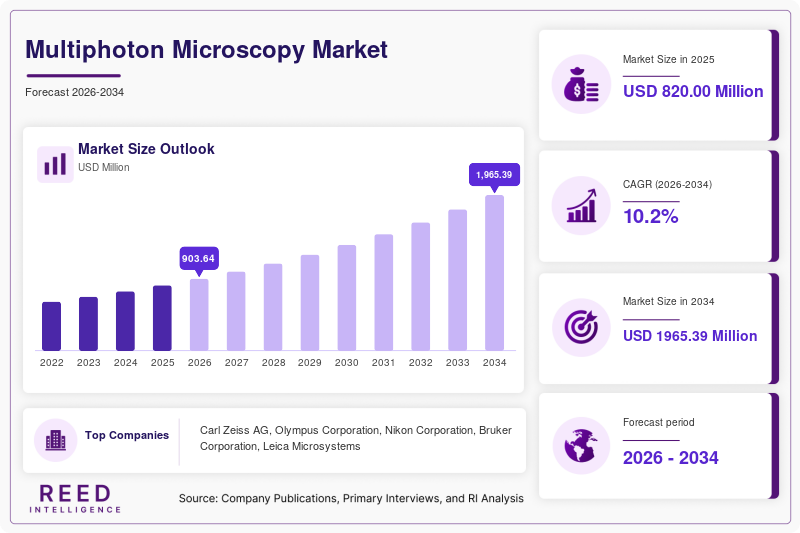
The Multiphoton Microscopy Market size was valued at USD 820 million in 2025 and is projected to reach USD 1.96 billion by 2034, registering a CAGR of 10.2% from 2025 to 2034. Multiphoton microscopy is an advanced fluorescence imaging technique that enables deep tissue visualization with reduced photodamage, making it highly suitable for complex biological research and live tissue imaging. The technology is widely adopted across neuroscience, developmental biology, oncology research, and pharmaceutical development laboratories.
A key global factor supporting the growth of the Multiphoton Microscopy Market is the rapid expansion of biomedical research infrastructure worldwide. Governments, research institutes, and pharmaceutical companies are increasingly investing in high-resolution imaging technologies to accelerate discoveries in disease mechanisms and drug development. Multiphoton microscopy provides superior imaging depth and precision compared with conventional fluorescence microscopy, enabling researchers to analyze dynamic cellular processes in real time.
Key Highlights
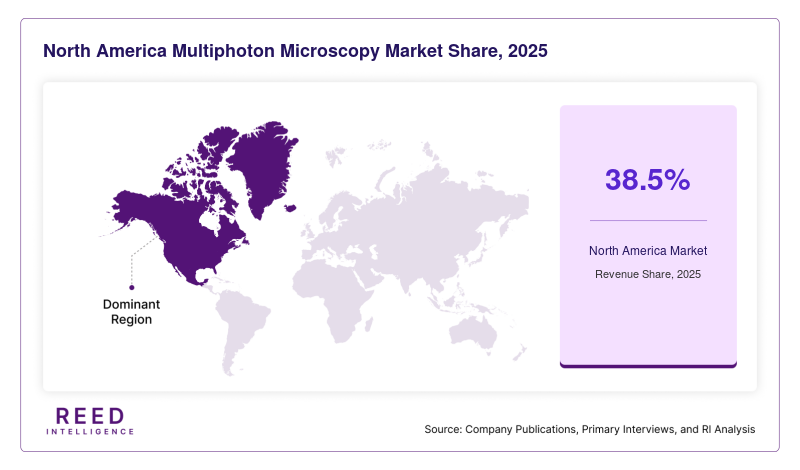
- North America dominated the Multiphoton Microscopy Market with 38.5% share in 2025, while Asia Pacific is projected to grow at the fastest CAGR of 12.1% through 2034.
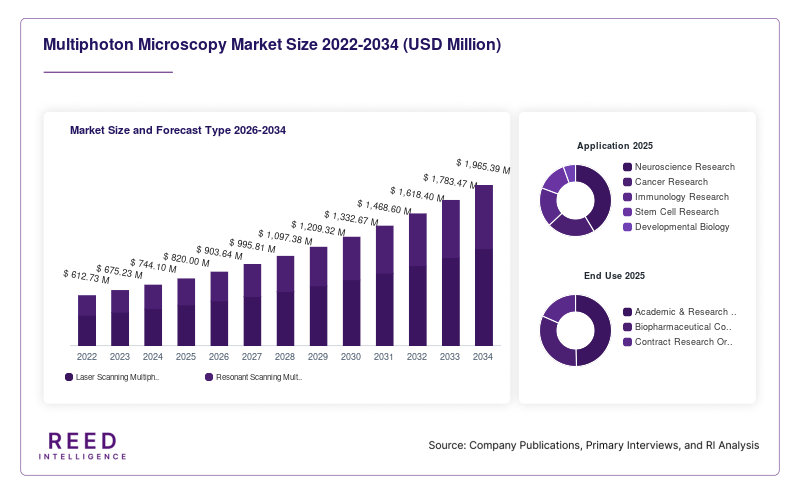
- By Type, Laser Scanning Multiphoton Microscopes held the largest share of 61.3% in 2025, whereas Resonant Scanning Systems are expected to grow at a 12.7% CAGR.
- By Application, Neuroscience Research accounted for 34.2% of market share in 2025, while Cancer Research applications are forecast to expand at 12.4% CAGR.
- By End Use, Academic & Research Institutes dominated with 52.6% share, whereas Biopharmaceutical Companies are expected to grow at 11.8% CAGR.
- The United States led the market, with values of USD 252 million in 2025 and USD 276 million in 2026.
Market Trends
Integration of Artificial Intelligence in Microscopy Imaging
Artificial intelligence and advanced image analysis algorithms are increasingly being integrated into multiphoton microscopy systems. AI-powered image processing enables automated cell tracking, faster image reconstruction, and improved pattern recognition in complex biological samples. As datasets generated from multiphoton imaging become larger and more complex, AI-based analytical tools help researchers extract meaningful biological insights more efficiently. This trend is contributing to increased demand for next-generation imaging platforms that combine high-resolution imaging with intelligent data analysis capabilities.
Development of Compact and User-Friendly Imaging Platforms
Another emerging trend in the Multiphoton Microscopy Market is the development of compact and modular imaging systems. Traditionally, multiphoton microscopes were complex and required specialized laboratories and trained operators. However, manufacturers are now introducing integrated platforms with simplified interfaces, automated calibration features, and reduced system footprint. These innovations allow smaller laboratories and clinical research centers to adopt multiphoton imaging technologies. As accessibility improves, adoption across interdisciplinary research fields is expected to expand during the forecast period.
Market Drivers
Expanding Demand for Advanced Imaging in Life Sciences Research
The growing need for high-resolution imaging technologies in life sciences research is a key driver of the Multiphoton Microscopy Market. Researchers studying cellular interactions, neural activity, and tissue dynamics require imaging systems capable of penetrating deep into biological samples while maintaining minimal phototoxicity. Multiphoton microscopy provides these capabilities, making it particularly valuable for studying living tissues. The increasing number of research initiatives focused on neurological disorders, regenerative medicine, and molecular biology continues to stimulate demand for advanced microscopy platforms.
Growth in Pharmaceutical and Biotechnology R&D Activities
The expanding pharmaceutical and biotechnology sectors are significantly contributing to the demand for multiphoton microscopy technologies. Drug discovery and development processes increasingly rely on high-precision imaging to understand disease mechanisms and evaluate therapeutic efficacy at the cellular level. Multiphoton microscopy enables researchers to observe drug interactions within live tissues and track biological responses over time. As global spending on drug research continues to increase, adoption of high-performance microscopy systems is expected to rise accordingly.
Market Restraint
High Cost of Multiphoton Microscopy Systems
One of the primary restraints affecting the Multiphoton Microscopy Market is the high cost associated with advanced imaging systems. Multiphoton microscopes require specialized femtosecond lasers, high-sensitivity detectors, and complex optical components, which significantly increase system prices compared with conventional microscopy technologies. In addition, installation, maintenance, and operator training further add to operational costs. These factors limit adoption among smaller research laboratories and institutions with constrained budgets. Although technological advancements may gradually reduce costs, pricing remains a notable barrier in several developing regions.
Market Opportunities
Expansion of Multiphoton Imaging in Clinical Research
Clinical research is emerging as an important application area for multiphoton microscopy technologies. The technique allows non-invasive imaging of living tissues with minimal damage, which creates opportunities for its use in dermatology, ophthalmology, and cancer diagnostics research. As translational medicine gains prominence, researchers are increasingly exploring the use of multiphoton microscopy to bridge laboratory discoveries and clinical applications. This shift toward clinical research applications is expected to create new revenue streams in the Multiphoton Microscopy Market.
Rising Adoption in Emerging Research Economies
Emerging economies are witnessing rapid growth in scientific research infrastructure and funding for biotechnology innovation. Governments in several developing countries are investing in national research laboratories and advanced microscopy facilities to strengthen scientific capabilities. As academic institutions expand their imaging capabilities, demand for multiphoton microscopy systems is expected to grow. Manufacturers that develop cost-efficient systems and localized service networks may benefit from the increasing demand in these regions.
Segmental Analysis
By Type
Laser Scanning Multiphoton Microscopes dominated the Multiphoton Microscopy Market in 2025, accounting for 61.3% of the market share. These systems have historically been widely used due to their high imaging precision and ability to capture detailed three-dimensional images of biological tissues. Researchers studying complex biological structures such as neural networks and vascular systems have relied on laser scanning systems for their superior resolution and imaging depth.
Resonant Scanning Multiphoton Microscopes are expected to grow at the fastest CAGR of 12.7% during the forecast period. These systems will gain popularity because they enable faster imaging speeds and improved temporal resolution. This capability will be particularly valuable for studying rapid biological processes such as neuronal signaling and intracellular dynamics.
By Application
Neuroscience Research represented the largest application segment with 34.2% share in 2025. Multiphoton microscopy has historically played a key role in neuroscience research because it allows scientists to visualize neural structures and observe neuronal activity in living brain tissue. This capability has supported numerous studies related to brain connectivity and neurological disorders.
Cancer Research will expand at the fastest CAGR of 12.4% through 2034. The technology will be increasingly used to analyze tumor microenvironments and monitor interactions between cancer cells and surrounding tissues. This capability will support the development of targeted therapies and improve understanding of tumor biology.
By End Use
Academic & Research Institutes accounted for 52.6% of the Multiphoton Microscopy Market in 2025. Universities and research institutes have historically been the primary users of advanced microscopy systems due to their involvement in fundamental biological research and experimental studies.
Biopharmaceutical Companies are projected to grow at a CAGR of 11.8% during the forecast period. The increasing complexity of drug development processes will require advanced imaging technologies capable of analyzing biological responses to therapeutic compounds. Multiphoton microscopy will support drug discovery research by enabling detailed visualization of cellular interactions.
Regional Analysis
North America
North America accounted for 38.5% of the Multiphoton Microscopy Market in 2025, reflecting the region’s strong presence of research universities, biotechnology companies, and advanced laboratory infrastructure. The region will grow at a CAGR of 9.6% between 2025 and 2034 as investments in biomedical imaging technologies continue. Research funding from government agencies and collaborations between academic institutions and biotechnology companies have historically supported the adoption of advanced microscopy technologies.
The United States dominated the regional market due to its large network of life sciences research laboratories and strong pharmaceutical industry presence. The country hosts numerous neuroscience and biomedical research programs that require advanced imaging platforms capable of analyzing complex cellular interactions. Continuous technological innovation and research collaborations between universities and private companies are expected to sustain market demand in the country.
Europe
Europe represented 27.4% of the Multiphoton Microscopy Market in 2025. The region will expand at a CAGR of 9.4% during the forecast period as scientific research institutions increase investments in imaging technologies. European research organizations have historically focused on advanced optical imaging techniques for neuroscience and molecular biology applications.
Germany emerged as the leading country within the region due to its strong engineering capabilities and optical technology expertise. The presence of precision instrument manufacturers and academic research centers has supported the development and adoption of multiphoton microscopy systems. Additionally, collaborative research initiatives across European universities and research institutes have facilitated technological advancement and knowledge exchange.
Asia Pacific
Asia Pacific held 21.6% share of the Multiphoton Microscopy Market in 2025 and will grow at the fastest CAGR of 12.1% through 2034. Rapid expansion of biotechnology research facilities and increasing government support for scientific innovation have contributed to the growth of advanced imaging technologies in the region.
China dominated the regional market due to its significant investments in life sciences research infrastructure. The country has been establishing national research laboratories and technology parks focused on biotechnology and biomedical engineering. Growing collaboration between academic institutions and biotechnology companies has also accelerated the adoption of advanced microscopy platforms.
Middle East & Africa
The Middle East & Africa accounted for 6.5% of the Multiphoton Microscopy Market in 2025. The region is projected to grow at a CAGR of 8.7% from 2025 to 2034 as several countries invest in modernizing research and healthcare facilities. Universities and specialized research centers are gradually integrating advanced imaging technologies into scientific research programs.
Saudi Arabia led the regional market, supported by government initiatives aimed at expanding scientific research and technology development. Investments in biotechnology research centers and academic institutions have encouraged the adoption of advanced laboratory technologies, including multiphoton microscopy systems.
Latin America
Latin America represented 6.0% share of the Multiphoton Microscopy Market in 2025 and will grow at a CAGR of 8.9% through 2034. Research institutions in the region have increasingly focused on biomedical and agricultural research programs that require advanced imaging technologies.
Brazil dominated the regional market due to its extensive academic research network and expanding biotechnology sector. The country has been increasing investments in scientific infrastructure and collaborative research initiatives. These developments are supporting the adoption of multiphoton microscopy platforms in universities and research laboratories.
Competitive Landscape
The Multiphoton Microscopy Market is characterized by the presence of several global microscopy and optical instrument manufacturers. Companies compete through technological innovation, product development, and collaborations with research institutions.
Carl Zeiss AG emerged as a leading market participant due to its extensive microscopy portfolio and continuous investment in optical imaging technologies. The company recently introduced an upgraded multiphoton imaging platform designed to improve imaging speed and deep tissue visualization capabilities.
Other major companies are focusing on improving imaging software, enhancing detector sensitivity, and developing modular microscopy systems that can be adapted for multiple research applications.
Key Players List
- Carl Zeiss AG
- Olympus Corporation
- Nikon Corporation
- Bruker Corporation
- Leica Microsystems
- Femtonics Ltd.
- Scientifica Ltd.
- Thorlabs Inc.
- LaVision BioTec
- Sutter Instrument Company
- Becker & Hickl GmbH
- Meadowlark Optics
- APE GmbH
- Coherent Inc.
- Newport Corporation
- Hamamatsu Photonics
Recent Developments
- Carl Zeiss AG launched a new multiphoton imaging system designed to enhance deep tissue imaging capabilities for neuroscience research.
- Olympus Corporation introduced software upgrades enabling faster image reconstruction and automated cell analysis.
- Nikon Corporation expanded its multiphoton microscopy portfolio with improved laser scanning technologies.
- Bruker Corporation developed an advanced imaging platform focused on live tissue imaging applications.
- Leica Microsystems expanded collaborations with research institutions to support development of next-generation multiphoton imaging systems.
Multiphoton Microscopy Market Segments
Type
- Laser Scanning Multiphoton Microscopes
- Resonant Scanning Multiphoton Microscopes
Application
- Neuroscience Research
- Cancer Research
- Immunology Research
- Stem Cell Research
- Developmental Biology
End Use
- Academic & Research Institutes
- Biopharmaceutical Companies
- Contract Research Organizations
By Region
- North America
- Europe
- APAC
- Middle East and Africa
- LATAM