Museum Software Market Size, Share & Demand Report By Type (Collection Management Software, Exhibit Management Software, Digital Asset Management, Ticketing & Visitor Management), By Deployment (On-Premise, Cloud-Based), By Application (Collection Tracking, Documentation, Visitor Engagement, Inventory Management), By End-Use (Museums, Art Galleries, Cultural Institutions, Archives), By Region & Segment Forecasts, 2026–2034
USD 3950
Market Overview
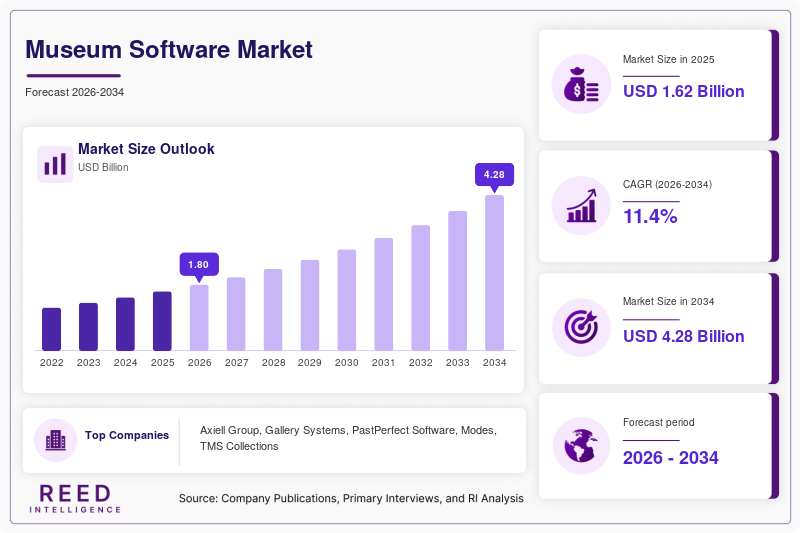
The global Museum Software Market size was valued at USD 1.62 billion in 2026 and is projected to reach USD 3.84 billion by 2034, expanding at a CAGR of 11.4% during the forecast period (2026–2034). The market has witnessed consistent expansion driven by the growing digitization of cultural assets and the increasing need for efficient collection management systems across museums, galleries, and heritage institutions.
A key global factor supporting market growth is the rapid digital transformation of cultural institutions, fueled by government initiatives and funding programs aimed at preserving heritage assets through digital platforms. Museums are increasingly adopting advanced software solutions for cataloging, archiving, visitor engagement, and operational efficiency. This shift toward digitization has enhanced accessibility, improved data management, and enabled institutions to reach global audiences through virtual exhibitions and online archives.
Key Highlights
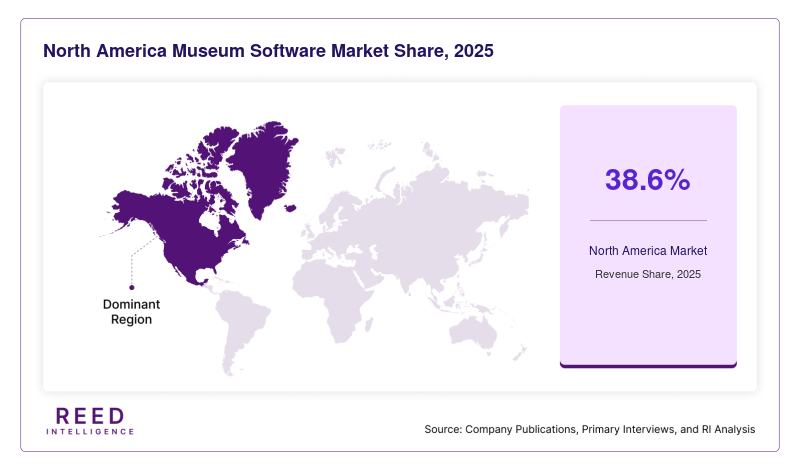
- North America dominated the market with a 38.6% share in 2025, while Asia Pacific is expected to register the fastest CAGR of 13.2% (2026–2034).
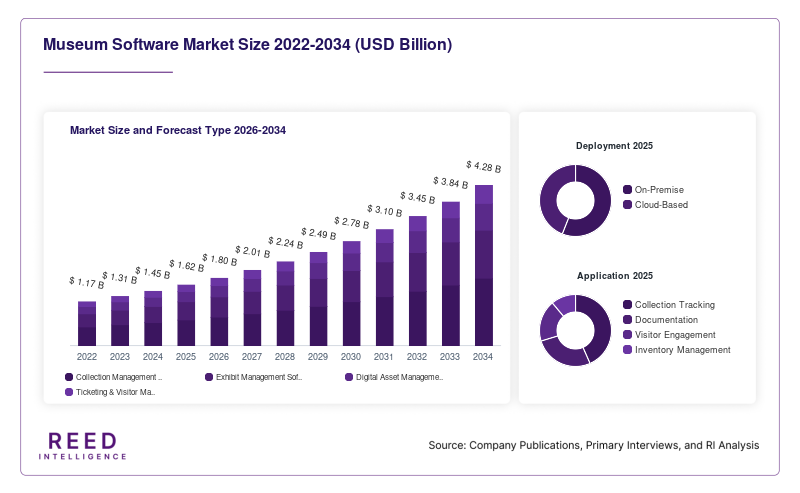
- In segmentation, Collection Management Software led the type segment with a 42.3% share in 2025, while Cloud-Based Solutions are projected to grow fastest at a CAGR of 12.8%.
- By deployment, On-premise solutions held the dominant share of 55.1% in 2025, whereas Cloud deployment is anticipated to grow at a CAGR of 13.6%.
- The United States remained the dominant country, with market values of USD 510 million in 2024 and USD 565 million in 2025.
Market Trends
Rise of Cloud-Based Museum Platforms
Museums are increasingly shifting toward cloud-based software solutions to enhance scalability, remote accessibility, and data security. These platforms enable institutions to manage collections, exhibitions, and visitor interactions from centralized systems, reducing IT infrastructure costs and improving operational flexibility.
Integration of AI and Interactive Technologies
Artificial intelligence and immersive technologies such as augmented reality (AR) and virtual reality (VR) are being integrated into museum software. These technologies support personalized visitor experiences, predictive analytics for audience behavior, and automated cataloging, thereby improving engagement and operational efficiency.
Market Drivers
Increasing Demand for Digital Collection Management
Museums worldwide are facing growing pressure to digitize and manage extensive collections efficiently. Museum software solutions provide structured databases, metadata management, and digital archiving capabilities, enabling institutions to preserve artifacts and improve accessibility. The need for accurate documentation and compliance with international standards has further driven adoption.
Growing Focus on Visitor Engagement and Experience
Modern museums are shifting toward interactive and personalized visitor experiences. Software solutions that enable mobile guides, virtual tours, and real-time engagement tools are becoming essential. These systems help institutions attract diverse audiences and enhance visitor satisfaction, contributing to revenue growth and brand value.
Market Restraint
High Implementation and Maintenance Costs
The adoption of advanced museum software often involves significant initial investment and ongoing maintenance expenses. Smaller museums and institutions with limited budgets face challenges in implementing these systems, which restricts market penetration in certain regions.
Market Opportunities
Expansion of Virtual Museums and Online Exhibitions
The emergence of virtual museums presents a significant opportunity for software providers. Digital platforms allow institutions to showcase collections globally, increasing accessibility and audience reach. This trend is expected to drive demand for advanced software solutions that support virtual exhibitions and digital storytelling.
Adoption of Data Analytics for Decision-Making
Museums are increasingly leveraging data analytics to understand visitor behavior, optimize operations, and improve marketing strategies. Software solutions with integrated analytics capabilities offer valuable insights, enabling institutions to make informed decisions and enhance overall performance.
Segmental Analysis
By Type
Collection Management Software dominated the segment with a 42.3% share in 2025, driven by its critical role in cataloging, organizing, and managing museum collections efficiently.
Exhibit Management Software is projected to be the fastest-growing subsegment, expanding at a CAGR of 12.5%. Growth is driven by the increasing need for dynamic exhibition planning and real-time content updates.
By Deployment
On-premise deployment accounted for 55.1% of the market share in 2025, as many institutions preferred in-house data control and security.
Cloud-based deployment is expected to grow at a CAGR of 13.6%, supported by scalability, cost efficiency, and remote accessibility benefits.
By End-Use
Museums represented the dominant subsegment with a 64.7% share in 2025, as they require comprehensive software solutions for collection and visitor management.
Art Galleries are anticipated to grow at a CAGR of 12.9%, driven by the need for digital cataloging and online exhibition platforms.
By Application
Collection Tracking and Documentation held the largest share of 39.5% in 2025, as it forms the core function of museum software systems.
Visitor Engagement Applications are expected to grow fastest at a CAGR of 13.1%, fueled by increasing demand for personalized and interactive experiences.
Regional Analysis
North America
North America accounted for a 38.6% market share in 2025 and will expand at a CAGR of 10.8% during 2026–2034. The region’s dominance was attributed to the widespread adoption of advanced technologies and the presence of well-established museums with strong financial resources. The United States led the region due to high investment in digital infrastructure and the growing adoption of cloud-based solutions.
Europe
Europe held a 27.4% share in 2025 and is projected to grow at a CAGR of 10.5%. The region’s growth is driven by extensive cultural heritage and government initiatives supporting digitization projects. Germany dominated the region due to its strong focus on preserving historical artifacts and integrating modern technologies into museum operations.
Asia Pacific
Asia Pacific captured a 19.8% share in 2025 and is expected to witness the fastest growth at a CAGR of 13.2%. Rapid urbanization and increasing investments in cultural infrastructure are key growth factors. China led the region, supported by government-funded museum development programs and the adoption of digital solutions.
Middle East & Africa
The Middle East & Africa accounted for a 7.1% share in 2025 and will grow at a CAGR of 11.1%. The region is experiencing growth due to rising investments in tourism and cultural preservation. The United Arab Emirates emerged as a key country, driven by the development of modern museums and smart city initiatives.
Latin America
Latin America held a 7.1% share in 2025 and is projected to grow at a CAGR of 10.9%. Increasing awareness of cultural preservation and gradual adoption of digital technologies are supporting market expansion. Brazil dominated the region due to its large number of museums and growing focus on digital transformation.
Competitive Landscape
The Museum Software Market is moderately fragmented, with several global and regional players competing based on technology innovation, product features, and service offerings. Leading companies are focusing on cloud-based solutions, AI integration, and user-friendly interfaces to enhance their market position.
A key market leader is Axiell Group, known for its comprehensive collection management solutions and strong global presence. The company has recently introduced enhanced cloud-based platforms to improve scalability and accessibility for museums.
Other prominent players include Gallery Systems, PastPerfect Software, Modes, and TMS Collections. These companies are investing in product development and strategic partnerships to expand their customer base. Continuous innovation and customization capabilities remain critical factors for sustaining competitiveness in the evolving market landscape.
Key Players List
- Axiell Group
- Gallery Systems
- PastPerfect Software
- Modes
- TMS Collections
- Vernon Systems
- MuseumPlus
- Adlib Information Systems
- EMu (Electronic Museum)
- Lucidea
- CollectionSpace
- Zetcom Group
- Argus
- Minisis Inc.
- Artlogic
Recent Developments
- In 2025, Axiell Group launched an upgraded cloud-native platform to support scalable museum operations.
- Gallery Systems introduced enhanced analytics tools for visitor behavior insights in 2024.
- PastPerfect Software expanded its mobile application capabilities for remote access and data entry.
- Zetcom Group partnered with cultural institutions to deploy AI-based cataloging systems.
- Lucidea introduced integrated digital asset management solutions for improved archival efficiency.
Museum Software Market Segments
Type
- Collection Management Software
- Exhibit Management Software
- Digital Asset Management
- Ticketing & Visitor Management
Deployment
- On-Premise
- Cloud-Based
Application
- Collection Tracking
- Documentation
- Visitor Engagement
- Inventory Management
End-Use
- Museums
- Art Galleries
- Cultural Institutions
- Archives
By Region
- North America
- Europe
- APAC
- Middle East and Africa
- LATAM