Mushroom Substrate Market Size, Share Demand Report By Type (Compost-Based Substrate, Coco Coir Substrate, Sawdust Substrate, Others), By Application (Button Mushroom, Shiitake Mushroom, Oyster Mushroom, Others), By End-Use (Commercial Farming, Home Farming, Research Institutions) By Region & Segment Forecasts, 2026–2034
USD 3950
Market Overview
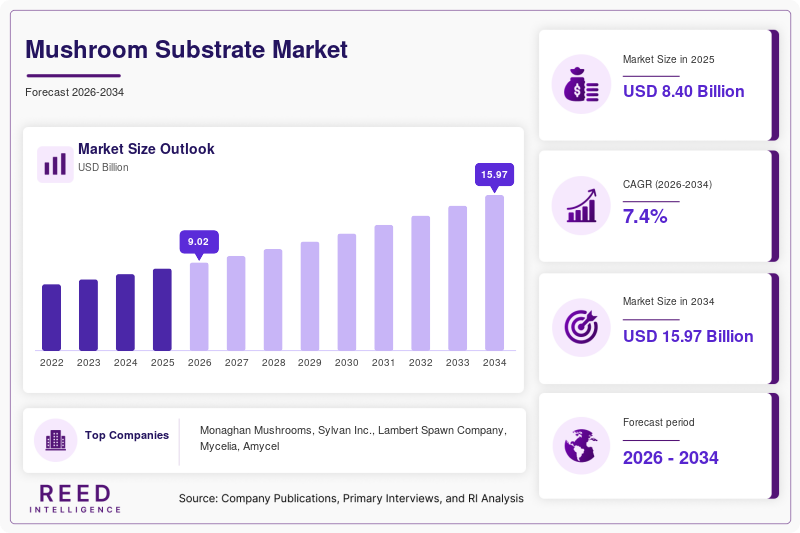
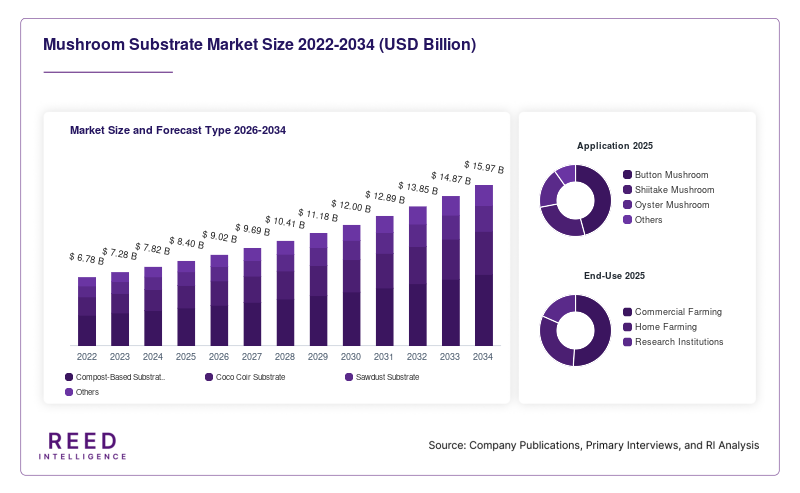
The Mushroom Substrate Market size was valued at USD 8.4 billion in 2026 and is projected to reach USD 14.9 billion by 2034, expanding at a CAGR of 7.4% during the forecast period (2026–2034). The market growth is supported by the rising global demand for edible and medicinal mushrooms, driven by increasing awareness of plant-based nutrition and sustainable food production systems. Mushroom substrates, composed of organic materials such as straw, sawdust, and compost, play a critical role in ensuring high yield and quality production, making them essential in commercial mushroom farming operations.
A major global factor contributing to the growth of the Mushroom Substrate Market is the increasing adoption of circular economy practices in agriculture. Farmers and producers are utilizing agricultural waste such as corn cobs, sugarcane bagasse, and wood chips as substrate materials, reducing waste while improving profitability. This trend aligns with sustainability goals and supports efficient resource utilization across the agricultural value chain.
Key Highlights
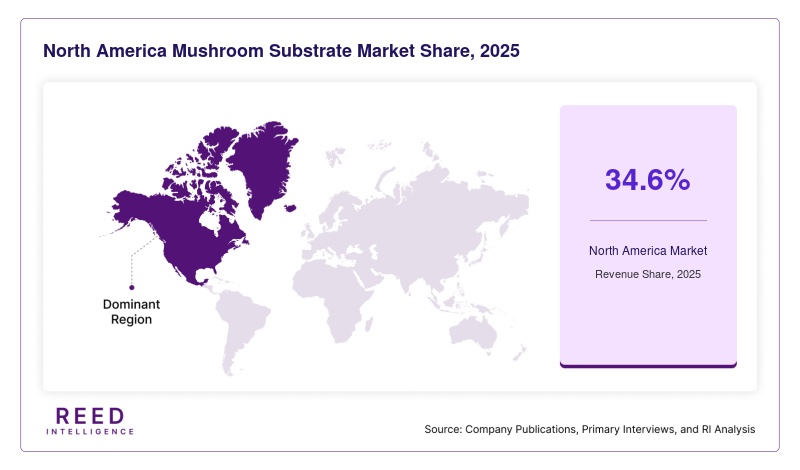
- North America dominated the market with a share of 34.6% in 2025.
- Asia Pacific is projected to register the fastest CAGR of 8.6% during the forecast period.
- Among segments, compost-based substrates accounted for the largest share, whereas coco coir-based substrates are expected to witness the fastest growth at a CAGR of 8.9%.
- China remained the dominant country, with market values estimated at USD 1.9 billion in 2024 and USD 2.1 billion in 2025.
Market Trends
The market is witnessing a notable shift toward eco-friendly and organic substrate formulations. Producers are increasingly focusing on biodegradable and chemical-free substrates to meet consumer demand for organic mushrooms. This trend is influenced by growing regulatory support for sustainable agriculture and rising awareness among consumers regarding food safety. Manufacturers are innovating substrate blends using renewable materials such as coconut husk, coffee grounds, and recycled biomass. These materials not only enhance mushroom yield but also improve soil health when reused as compost. The trend is further supported by certifications and labeling initiatives that promote organic farming practices, encouraging farmers to adopt advanced substrate solutions.
Another significant trend shaping the market is the integration of technology in substrate preparation and management. Automation and controlled environment agriculture are enabling precise monitoring of moisture, temperature, and nutrient levels in substrates. This improves efficiency and reduces production losses. Companies are developing pre-sterilized and ready-to-use substrates that simplify operations for small and medium-scale growers. Additionally, data-driven cultivation techniques are gaining traction, allowing farmers to optimize substrate composition based on mushroom species and environmental conditions. This technological advancement is helping producers achieve consistent quality and scale production efficiently.
Market Drivers
The increasing demand for mushrooms as a functional food is a key factor driving the Mushroom Substrate Market. Mushrooms are rich in nutrients such as vitamins, minerals, and antioxidants, making them popular among health-conscious consumers. The rise in vegetarian and vegan diets has further boosted the consumption of mushrooms as a meat alternative. This growing demand directly influences the need for high-quality substrates that ensure efficient mushroom cultivation. Commercial growers are expanding their production capacities, leading to increased procurement of specialized substrates tailored for different mushroom varieties.
Another important driver is the expansion of commercial mushroom farming across emerging economies. Countries in Asia Pacific and Latin America are investing in modern agricultural practices to improve food security and generate export revenue. Governments are providing subsidies and training programs to promote mushroom cultivation as a profitable agribusiness. This has led to the establishment of large-scale farms that require consistent and reliable substrate supply. Additionally, advancements in substrate processing technologies have made it easier for farmers to produce or procure high-performance substrates, further accelerating market growth.
Market Restraint
The high cost and variability of raw materials used in substrate production present a significant challenge to market growth. Agricultural residues such as straw and sawdust are subject to seasonal availability and price fluctuations, which can impact the cost structure of substrate manufacturers. Inconsistent quality of raw materials can also affect substrate performance, leading to lower yields and financial losses for growers. For instance, variations in moisture content or contamination levels in raw materials can disrupt the cultivation process, requiring additional processing steps and increasing operational costs.
This restraint has a broader impact on small-scale farmers who may lack access to high-quality substrates or the resources to manage production variability. It can also limit market expansion in regions where supply chains are underdeveloped. Companies are addressing this challenge by investing in quality control measures and exploring alternative raw materials, but the issue remains a critical factor influencing market dynamics.
Market Opportunities
The growing interest in medicinal mushrooms presents a strong opportunity for the Mushroom Substrate Market. Varieties such as reishi, shiitake, and lion’s mane are gaining popularity due to their potential health benefits, including immune support and cognitive enhancement. These mushrooms require specialized substrates to optimize growth and potency. This creates a niche market for customized substrate solutions tailored to medicinal mushroom cultivation. Producers are developing formulations enriched with specific nutrients to enhance bioactive compound production, opening new revenue streams for substrate manufacturers.
Another promising opportunity lies in the expansion of urban farming and indoor cultivation systems. As urban populations increase, there is a rising demand for locally produced fresh food. Mushroom cultivation is well-suited for indoor farming due to its low space requirements and ability to grow in controlled environments. This has led to the emergence of vertical farms and container-based cultivation units that rely on standardized substrates. Companies are capitalizing on this trend by offering compact and easy-to-use substrate kits designed for urban growers. This segment is expected to grow steadily as consumers and entrepreneurs adopt innovative farming practices.
Segmental Analysis
By Type
Compost-based substrates dominated the market in 2024, accounting for a significant share due to their widespread use in commercial mushroom cultivation. These substrates are made from organic materials such as straw, manure, and gypsum, providing essential nutrients for mushroom growth. Their effectiveness in supporting high yields and consistent quality makes them the preferred choice for large-scale producers. The availability of raw materials and established production processes further contribute to their dominance. Additionally, compost-based substrates are compatible with a wide range of mushroom species, enhancing their versatility and market demand.
Coco coir-based substrates are expected to witness the fastest growth, with a CAGR of 8.9% during the forecast period. These substrates offer excellent water retention and aeration properties, making them suitable for modern cultivation techniques. The increasing focus on sustainable and renewable materials is driving their adoption. Coco coir is derived from coconut husk, a byproduct of the coconut industry, making it an environmentally friendly option. Its lightweight nature and ease of handling also make it popular among small-scale and urban growers.
By Application
The button mushroom segment held the largest share in 2024, driven by its high consumption and widespread cultivation. Button mushrooms are commonly used in various cuisines and are favored for their mild flavor and nutritional value. The demand for consistent and high-quality substrates is critical for their production, leading to increased use of specialized formulations. Commercial growers rely on optimized substrates to achieve uniform growth and maximize yield, supporting the segment’s dominance.
Shiitake mushrooms represent the fastest-growing application segment, with a CAGR of 8.4%. These mushrooms are valued for their rich flavor and potential health benefits, driving their popularity in both culinary and medicinal markets. Cultivating shiitake mushrooms requires specific substrate compositions, often based on hardwood sawdust. The growing demand for premium and specialty mushrooms is encouraging producers to invest in advanced substrate solutions tailored for shiitake cultivation.
By End-Use
Commercial farming dominated the market in 2024, accounting for the largest share due to the scale of operations and high demand for mushrooms. Large farms require consistent supply of high-quality substrates to maintain productivity and meet market demand. The adoption of mechanized farming techniques and controlled environments further supports the use of standardized substrates. This segment benefits from economies of scale and access to advanced technologies.
Home and small-scale farming is projected to grow at the fastest rate, with a CAGR of 8.1%. The increasing interest in home gardening and urban farming is driving demand for easy-to-use substrate kits. Consumers are exploring mushroom cultivation as a hobby and a source of fresh produce. Manufacturers are offering compact and user-friendly solutions that simplify the cultivation process. This trend is expanding the market base and creating new growth opportunities.
Regional Analysis
North America
North America accounted for a market share of 34.6% in 2025 and is expected to maintain steady growth with a CAGR of 6.8% during the forecast period. The region benefits from well-established mushroom farming infrastructure and strong demand for organic food products. The presence of advanced agricultural technologies and high consumer awareness supports the adoption of premium substrate solutions. Additionally, the growing trend of plant-based diets is contributing to increased mushroom consumption.
The United States remains the dominant country in the region, driven by its large-scale commercial mushroom production. A unique growth factor is the integration of automation in farming operations, which enhances efficiency and reduces labor costs. This technological advancement is encouraging the use of high-quality substrates that deliver consistent performance, supporting market expansion.
Europe
Europe held a significant share of the Mushroom Substrate Market in 2025 and is projected to grow at a CAGR of 6.5%. The region’s focus on sustainable agriculture and strict environmental regulations drives the demand for eco-friendly substrate materials. Countries are actively promoting the use of agricultural waste in substrate production, aligning with circular economy goals.
Germany leads the European market, supported by its strong agricultural sector and emphasis on innovation. A key growth factor is the adoption of organic farming practices, which require chemical-free substrates. This has led to increased investment in research and development to create sustainable and efficient substrate solutions.
Asia Pacific
Asia Pacific is the fastest-growing region, expected to register a CAGR of 8.6% during the forecast period. The region’s large population and increasing demand for nutritious food are driving mushroom consumption. Rapid urbanization and rising income levels are also contributing to market growth. Governments are supporting agricultural development through subsidies and training programs.
China dominates the regional market due to its extensive mushroom cultivation industry. A unique growth factor is the large-scale utilization of agricultural waste as substrate material, which reduces costs and supports sustainability. This approach has enabled China to maintain its position as a leading producer and exporter of mushrooms.
Middle East & Africa
The Middle East & Africa region is experiencing gradual growth, with a projected CAGR of 5.9%. The market is supported by increasing awareness of mushroom cultivation as a viable agricultural activity. Investments in food security initiatives are encouraging the adoption of modern farming techniques, including the use of high-quality substrates.
South Africa is the leading country in the region, driven by its relatively developed agricultural sector. A unique growth factor is the growing interest in controlled environment agriculture, which allows for year-round mushroom production. This trend is boosting demand for standardized substrate solutions.
Latin America
Latin America is expected to grow at a CAGR of 6.7%, supported by expanding agricultural activities and rising export opportunities. The region’s favorable climate conditions and availability of raw materials make it suitable for mushroom cultivation. Governments are promoting agribusiness development to enhance economic growth.
Brazil leads the market in Latin America, benefiting from its large agricultural base. A unique growth factor is the increasing adoption of sustainable farming practices, including the use of organic substrates. This trend is attracting investments and supporting market expansion.
Competitive Landscape
The Mushroom Substrate Market is moderately fragmented, with several regional and global players competing based on product quality, innovation, and pricing. Leading companies are focusing on developing sustainable and high-performance substrates to meet evolving market demands. Strategic partnerships, acquisitions, and product launches are common strategies adopted to strengthen market presence.
A leading player in the market is Monaghan Mushrooms, known for its integrated approach to mushroom production and substrate manufacturing. The company recently invested in expanding its substrate production capacity to support growing demand. Other key players are also investing in research and development to create customized solutions for different mushroom varieties. The competitive landscape is expected to remain dynamic as companies continue to innovate and expand their product portfolios.
Key Players
- Monaghan Mushrooms
- Sylvan Inc.
- Lambert Spawn Company
- Mycelia
- Amycel
- Hawkins Watts
- Scelta Mushrooms
- Drinkwater Mushrooms
- Okechamp Group
- Bonduelle Group
- CMP Mushrooms
- Hirano Mushroom LLC
- South Mill Champs
- Italspawn
- Mushroom Media Online
Recent Developments
- Several companies have expanded their production facilities to meet rising demand for mushroom substrates, particularly in Asia Pacific and Europe.
- New product launches focusing on organic and ready-to-use substrate solutions have gained traction among small-scale and urban growers.
- Strategic collaborations between substrate manufacturers and mushroom producers have increased, aiming to develop customized solutions and improve supply chain efficiency.
Mushroom Substrate Market Segments
Type
- Compost-Based Substrate
- Coco Coir Substrate
- Sawdust Substrate
- Others
Application
- Button Mushroom
- Shiitake Mushroom
- Oyster Mushroom
- Others
End-Use
- Commercial Farming
- Home Farming
- Research Institutions
By Region
- North America
- Europe
- APAC
- Middle East and Africa
- LATAM