Music App Market Size, Share & Trends Analysis Report By App Type (Music Streaming Apps, Music Discovery & Identification Apps, Music Creation & Editing Apps), By Operating System (Android, iOS), By Monetization Model (Subscription, Ad-Supported, Freemium & In-App Purchases), By End User (Individual Consumers, Commercial & Professional Users) and By Region (North America, Europe, APAC, Middle East and Africa, LATAM) Forecasts, 2026-2034
USD 3950
Music App Market Size
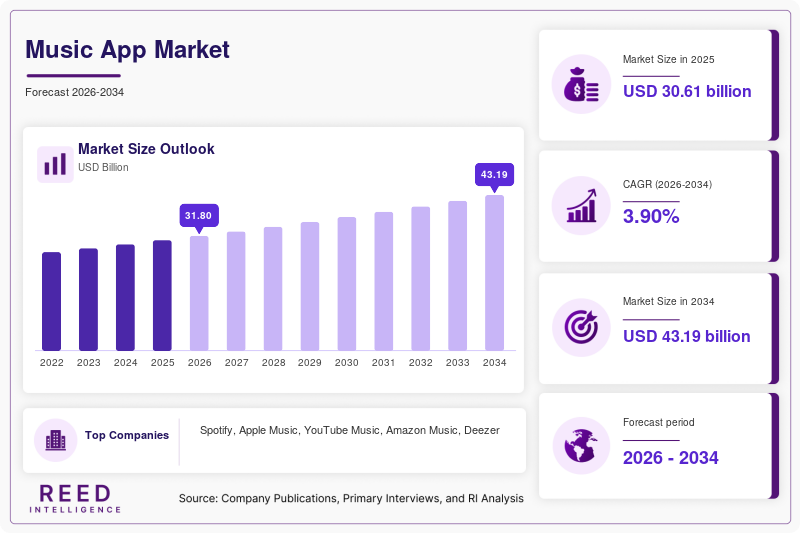
The Music App Market was valued at USD 30.61 billion in 2025 and is estimated at USD 31.80 billion in 2026. Based on the supplied forecast, the market is projected to reach USD 43.19 billion by 2034, representing a CAGR of 3.90% during 2026–2034.
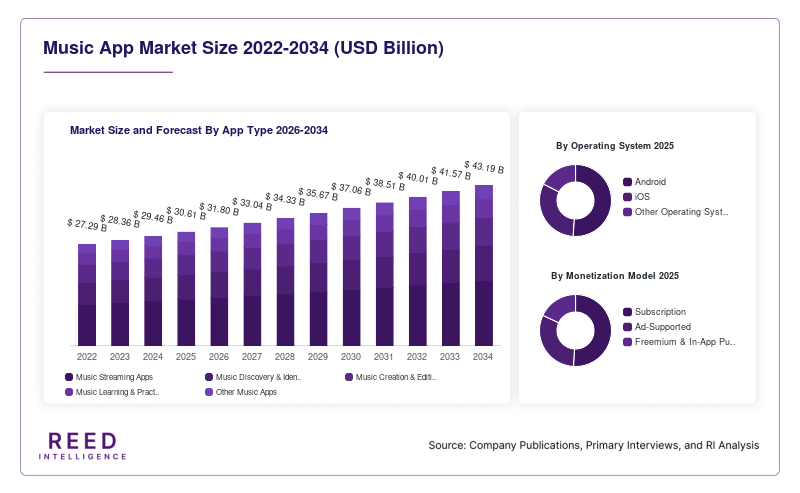
The 2026 market represents approximately 3.9% growth over 2025. Applying the supplied CAGR backward gives an analytical market trajectory of approximately USD 29.46 billion in 2024, USD 28.35 billion in 2023 and USD 27.31 billion in 2022. These historical figures are back-calculated estimates, not independently reported historical market sizes.
The underlying music ecosystem continues to expand even though the Music App Market is modeled at a more moderate rate than the broader recorded-music streaming segment. IFPI reported that global recorded-music revenue reached USD 31.7 billion in 2025, up 6.4%, with total streaming revenue exceeding USD 22 billion and accounting for 69.6% of recorded-music revenue. Paid subscription streaming revenue increased 8.8%, while the number of users of paid subscription accounts reached 837 million.
The difference between industry-level streaming growth and the modeled music-app market CAGR reflects the broader definition of a music app market, where monetization is affected by advertising, subscription pricing, app-store economics, freemium usage, competition for consumer attention and mature-market penetration.
Music apps have evolved from basic digital playback utilities into multifunctional platforms for streaming, discovery, personalization, social listening, music identification, creation, learning and creator interaction.
Streaming remains the commercial center of the ecosystem. IFPI reported that subscription streaming accounted for 52.4% of global recorded-music revenue in 2025, while total streaming represented 69.6%. The number of paid subscription accounts increased to 837 million globally.
The competitive basis is consequently shifting from simply providing catalog access toward improving discovery and personalization. Spotify's 2026 strategy, for example, emphasizes moving from conventional curation toward interactive and generative experiences, including Prompted Playlists, Taste Profile, conversational discovery and other AI-enabled features.
Music App Market Drivers
Paid streaming remains the principal monetization engine
Paid streaming continues to provide the strongest economic foundation for music applications. IFPI reported that subscription streaming revenue grew 8.8% in 2025, accounting for 52.4% of global recorded-music revenue, while the number of paid subscription accounts reached 837 million.
For music-app operators, subscriptions provide recurring revenue and stronger user identification than purely ad-supported models. They also create room for premium features such as high-quality audio, offline listening, AI personalization, family plans and exclusive experiences.
Spotify reached 300 million Premium subscribers in Q2 2026, illustrating the scale that subscription-based music applications can achieve.
Personalization is becoming a primary product differentiator
Large music applications increasingly compete on how effectively they convert enormous catalogs into relevant individual listening experiences.
Spotify's 2026 Investor Day described a strategy centered on AI, Prompted Playlists, Taste Profile and real-time personalization. The company stated that it was moving beyond conventional recommendation toward experiences shaped by users' taste, context and intent.
This changes the competitive mechanism. A large catalog is no longer sufficient; apps must reduce discovery friction and help users find appropriate music quickly.
Social discovery feeds music-app acquisition
Short-form video has become an important upstream discovery channel. TikTok and Luminate reported that 84% of songs entering the Billboard Global 200 in 2024 had gone viral on TikTok first, while TikTok's Add to Music App feature had generated more than one billion track saves.
The integration of YouTube Music into TikTok's Add to Music App in July 2025 further strengthened the connection between social discovery and dedicated music services.
Higher-quality audio supports premium differentiation
Spotify began rolling out lossless audio in 2025, allowing Premium users to stream music at up to 24-bit/44.1 kHz FLAC in supported markets. The company positioned lossless as an additional Premium-value feature alongside AI Playlist, DJ, Jam and other personalization functions.
Higher-quality audio gives music applications another way to justify premium subscriptions beyond ad removal and offline access.
Music applications are expanding into broader audio ecosystems
The leading platforms are increasingly becoming broader audio destinations. Spotify has expanded into podcasts and audiobooks, and in 2026 introduced additional features for audiobooks, narrated articles and personalized audio experiences.
The strategic mechanism is higher engagement: users who consume multiple audio formats can spend more time inside the same application, improving retention and creating additional monetization opportunities.
Music App Market Restraints
App-store economics constrain monetization
Music applications face significant economics around app-store distribution, particularly where subscriptions are purchased through mobile platforms.
The European Commission concluded in 2026 that Apple had breached the Digital Markets Act's anti-steering requirements and fined Apple EUR 500 million, requiring it to remove restrictions that prevented developers from fully informing consumers about alternative purchasing options.
This matters for music applications because subscription businesses operate on relatively tight margins and mobile distribution can influence pricing and conversion economics.
Mature markets limit subscriber growth
The global music-streaming ecosystem already has hundreds of millions of paid accounts. IFPI reported 837 million paid subscription-account users in 2025.
As penetration increases in mature markets, incremental growth increasingly depends on price increases, plan upgrades, emerging markets, family accounts, bundled services and new product features rather than simply acquiring first-time subscribers.
Streaming fraud threatens platform economics
Artificial streams distort recommendation systems and redirect royalty income away from legitimate artists and rights holders. IFPI identifies streaming fraud as a major threat to the digital music economy, particularly as AI makes it cheaper to generate large volumes of artificial content.
The problem creates costs for platforms through detection, content moderation, account verification and royalty reconciliation.
AI-generated content increases catalog-management complexity
Generative AI can increase music supply faster than human-created music can be reviewed, marketed and consumed.
In July 2026, IFPI introduced global principles for AI-developed recordings entering official charts, requiring authorized AI services, substantial human contribution and the absence of manipulation concerns.
Music applications therefore face a balance between accepting legitimate AI-assisted creativity and preventing unauthorized, low-quality or fraudulent content from overwhelming discovery systems.
Licensing costs remain structurally important
Music applications must license recorded music and other rights while simultaneously investing in technology, content moderation, cloud infrastructure, personalization and user acquisition.
This creates a structural constraint: revenue can rise through subscriptions and advertising, but a significant portion of the economic value must flow back to rights holders.
Music App Market Opportunities
AI-powered conversational music discovery
Conversational interfaces represent a new way to reduce the friction between user intent and music selection.
Spotify introduced Talk to Spotify in July 2026, allowing eligible Premium users to type or speak requests and have a back-and-forth interaction around music, podcasts and audiobooks.
The opportunity is to transform music discovery from browsing menus into natural-language interaction.
Premium audio tiers
Lossless audio creates opportunities for higher-value subscription packages and differentiated premium tiers.
Spotify's rollout of lossless audio demonstrates that sound quality can be packaged alongside personalization and other exclusive features to strengthen the perceived value of paid subscriptions.
Social-to-streaming conversion
The continued integration between TikTok, YouTube Music and other platforms creates opportunities for music apps to acquire listeners directly from social discovery environments.
This model is commercially attractive because the social platform generates discovery while the music app captures the longer-term listening relationship.
Creator tools and music-making applications
Music creation, editing and AI-assisted production applications can capture value outside traditional streaming. These products can monetize through subscriptions, professional tools, sound libraries, sample packs and creator-oriented services.
Family and youth-focused accounts
Family plans provide a pathway to increase account penetration while allowing several users to remain within a single subscription relationship.
Spotify expanded managed accounts to its free tier in selected countries in May 2026, giving parents enhanced controls and allowing younger listeners to develop individual listening habits.
Cross-format audio platforms
Music applications can increase customer lifetime value by combining music with podcasts, audiobooks, fitness and other audio formats.
Spotify reported at its 2026 Investor Day that users engaging across music, podcasts and audiobooks were among its most active and retained audiences.
Segmental Analysis
By App Type
Music Streaming Apps represent approximately 62% of the 2025 market, equivalent to about USD 18.98 billion under the internal analytical allocation. The segment is modeled at approximately 3.5% CAGR through 2034, producing an indicative USD 25.87 billion by 2034. Streaming remains the core application category because subscription and ad-supported streaming are directly connected to the dominant digital format in recorded music. IFPI reported that streaming accounted for 69.6% of global recorded-music revenue in 2025.
Music Discovery & Identification Apps represent approximately 12% of the 2025 market, equivalent to about USD 3.67 billion. The segment is modeled at approximately 5.5% CAGR, reaching about USD 5.95 billion by 2034. Discovery applications benefit from the increasing importance of recommendation, music identification and social-media-driven discovery. Apple reported that Shazam generated more than one billion recognitions per month during 2025.
Music Creation & Editing Apps represent approximately 10% of the 2025 market, or about USD 3.06 billion. The segment is modeled at approximately 4.8% CAGR, reaching approximately USD 4.67 billion by 2034. Growth is supported by mobile creation tools, AI-assisted production, editing capabilities and the increasing accessibility of music production outside professional studios.
Music Learning & Practice Apps represent approximately 8% of the 2025 market, equivalent to about USD 2.45 billion. The segment is modeled at approximately 4.5% CAGR, reaching approximately USD 3.64 billion by 2034. Digital learning tools benefit from mobile access to lessons, practice exercises, instrument training and personalized learning programs.
By Operating System
Android represents approximately 60% of the 2025 market, equivalent to about USD 18.37 billion under the internal analytical allocation. It is modeled at approximately 3.8% CAGR, reaching about USD 25.69 billion by 2034. Android's broad device footprint and penetration across emerging markets support its large installed base.
iOS represents approximately 38% of the 2025 market, equivalent to about USD 11.63 billion. It is modeled at approximately 3.7% CAGR, reaching approximately USD 16.13 billion by 2034. Apple's ecosystem supports premium monetization because of strong integration among devices, services and subscriptions, while Apple Music continues to expand features and partnerships beyond Apple's traditional hardware environment.
Other Operating Systems represent approximately 2% of the 2025 market, or about USD 0.61 billion, and are modeled at approximately 2.0% CAGR, reaching approximately USD 0.73 billion by 2034. The category includes smaller mobile and specialized operating environments.
By Monetization Model
Subscription represents approximately 52% of the 2025 market, equivalent to about USD 15.92 billion under the internal allocation. It is modeled at approximately 4.3% CAGR, reaching approximately USD 23.25 billion by 2034. Subscription remains the most commercially important model because it creates recurring revenue and supports premium features. IFPI reported that paid subscription streaming revenue grew 8.8% in 2025 and represented 52.4% of global recorded-music revenue.
Ad-Supported represents approximately 32% of the 2025 market, equivalent to about USD 9.80 billion. It is modeled at approximately 3.0% CAGR, reaching approximately USD 12.78 billion by 2034. The model remains important for reaching users unwilling to pay, while providing platforms with a large funnel for converting free listeners into premium subscribers.
Freemium & In-App Purchases represent approximately 16% of the 2025 market, or about USD 4.90 billion. The segment is modeled at approximately 4.2% CAGR, reaching approximately USD 7.09 billion by 2034. This model allows users to access core functionality for free while monetizing premium tools, virtual goods, creator features, enhanced content or additional functionality.
By End User
Individual Consumers represent approximately 86% of the 2025 market, equivalent to about USD 26.33 billion under the internal analytical allocation. The segment is modeled at approximately 3.8% CAGR, reaching around USD 36.83 billion by 2034. Individual listeners remain the primary market because music apps are fundamentally consumer-oriented services, with personalization, subscriptions, advertising and discovery driving engagement.
Commercial & Professional Users represent approximately 14% of the 2025 market, or about USD 4.29 billion. The segment is modeled at approximately 4.5% CAGR, reaching approximately USD 6.37 billion by 2034. It includes musicians, creators, educators, studios, venues, fitness providers and other professional users relying on specialized music software and services.
Regional Analysis
North America Music App Market
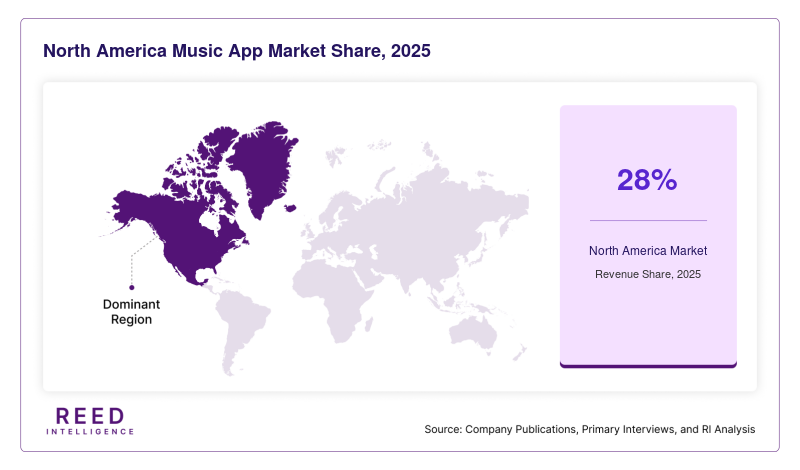
North America represents approximately 28% of the 2025 market, equivalent to about USD 8.57 billion under the internal analytical allocation. It is modeled at approximately 3.0% CAGR, reaching approximately USD 11.18 billion by 2034.
The region has high music-streaming penetration, strong subscription monetization and a mature ecosystem of music, podcast and creator applications. Spotify, Apple Music, YouTube Music and specialized discovery and creation apps compete for a highly engaged consumer base.
Product differentiation is therefore increasingly important. Premium audio, AI personalization, family plans, creator tools and integration with connected devices provide ways for established services to increase value without depending entirely on first-time subscriber acquisition.
Europe Music App Market
Europe represents approximately 25% of the 2025 market, equivalent to about USD 7.65 billion. It is modeled at approximately 3.2% CAGR, reaching approximately USD 10.16 billion by 2034.
Europe is a mature digital music market with high streaming adoption. IFPI reported that European recorded-music revenue grew 5.6% in 2025, with Europe accounting for 30.4% of global recorded-music revenue.
Regulatory conditions are particularly important in the region. The European Commission's 2026 action against Apple concerning app-store steering and alternative purchasing channels can affect the commercial relationship between music apps and mobile-platform operators.
APAC Music App Market
APAC represents approximately 27% of the 2025 market, equivalent to about USD 8.26 billion. It is modeled at approximately 5.3% CAGR, the fastest regional rate, reaching approximately USD 13.15 billion by 2034.
The region combines large populations, expanding smartphone usage, growing digital-payment adoption and rapidly developing streaming markets. IFPI reported that Asia's recorded-music revenues increased 10.9% in 2025, with China becoming the world's fourth-largest recorded-music market after growing 20.1%.
The region also contains diverse local-language music ecosystems, creating opportunities for platforms capable of combining global catalogs with regional content and culturally relevant recommendations.
Middle East and Africa Music App Market
The Middle East and Africa represent approximately 8% of the 2025 market, equivalent to about USD 2.45 billion. The segment is modeled at approximately 4.0% CAGR, reaching around USD 3.49 billion by 2034.
Growth opportunities are associated with smartphone adoption, digital entertainment consumption, local music catalogs and increasing availability of subscription services. However, affordability, payment infrastructure and differences in digital-market maturity remain constraints.
LATAM Music App Market
LATAM represents approximately 12% of the 2025 market, equivalent to about USD 3.67 billion. It is modeled at approximately 4.0% CAGR, reaching approximately USD 5.23 billion by 2034.
Latin America is one of the strongest recorded-music growth regions. IFPI reported 17.1% revenue growth in 2025, with streaming accounting for 88.1% of recorded-music revenues in the region. Brazil and Mexico also moved higher in the global market rankings.
This provides a strong foundation for music-app expansion, particularly for mobile-first services and platforms that support local-language catalogs, regional pricing and ad-supported access.
Competitive Landscape
The Music App Market is dominated by large streaming platforms but includes a wider ecosystem of discovery, identification, creation, learning and creator applications.
Spotify has one of the broadest music-app ecosystems, combining music, podcasts, audiobooks, personalization, social listening and creator features. In Q2 2026, Spotify reached 300 million Premium subscribers, while its product roadmap increasingly emphasized AI, conversational discovery and higher-value subscription experiences.
Apple Music competes through ecosystem integration, premium audio, discovery tools and exclusive features. Apple reported that Apple Music had its best year ever in 2025 and expanded its reach through partnerships beyond Apple's hardware ecosystem.
YouTube Music benefits from YouTube's enormous video ecosystem and its integration with social discovery. Its July 2025 integration with TikTok's Add to Music App strengthened the connection between short-form discovery and streaming conversion.
Key Market Players
- Spotify
- Apple Music
- YouTube Music
- Amazon Music
- Deezer
- TIDAL
- SoundCloud
- Pandora
- Shazam
- BandLab
- Tencent Music Entertainment
- NetEase Cloud Music
Recent Market Developments
September 2026 – Music Companies Launch Streaming Integrity Initiative
In September 2026, IFPI launched the Streaming Integrity Initiative (SII) with major music companies, distributors and industry organizations. The initiative establishes baseline practices for preventing, detecting and responding to streaming fraud. Participating organizations include Sony Music Group, Universal Music Group, Warner Music Group, The Orchard, CD Baby, HYBE and other music-industry participants.
August 2026 – Spotify Reaches 300 Million Premium Subscribers
In August 2026, Spotify reported that Premium subscribers reached 300 million in Q2 2026, representing 9% year-over-year growth. Monthly active users reached 777 million, while revenue increased 14% year-over-year to €4.8 billion. Spotify also highlighted new personalized products including Personal Podcasts, Studio by Spotify Labs, expanded DJ functionality and Talk to Spotify.
Music App Market Segments
By App Type
- Music Streaming Apps
- Music Discovery & Identification Apps
- Music Creation & Editing Apps
- Music Learning & Practice Apps
- Other Music Apps
By Operating System
- Android
- iOS
- Other Operating Systems
By Monetization Model
- Subscription
- Ad-Supported
- Freemium & In-App Purchases
By End User
- Individual Consumers
- Commercial & Professional Users
By Region
- North America
- Europe
- APAC
- Middle East and Africa
- LATAM