Musical Instrument Insurance Market Size, Share & Demand Report By Coverage Type (Comprehensive Insurance, Theft Insurance, Transit Insurance, Event-Specific Insurance, Liability Insurance), By Instrument Type (String Instruments, Percussion Instruments, Wind Instruments, Electronic Instruments, Keyboard Instruments), By End User (Professional Musicians, Music Schools and Academies, Orchestras and Bands, Instrument Collectors, Recording Studios), By Region & Segment Forecasts, 2026–2034
USD 3950
Market Overview
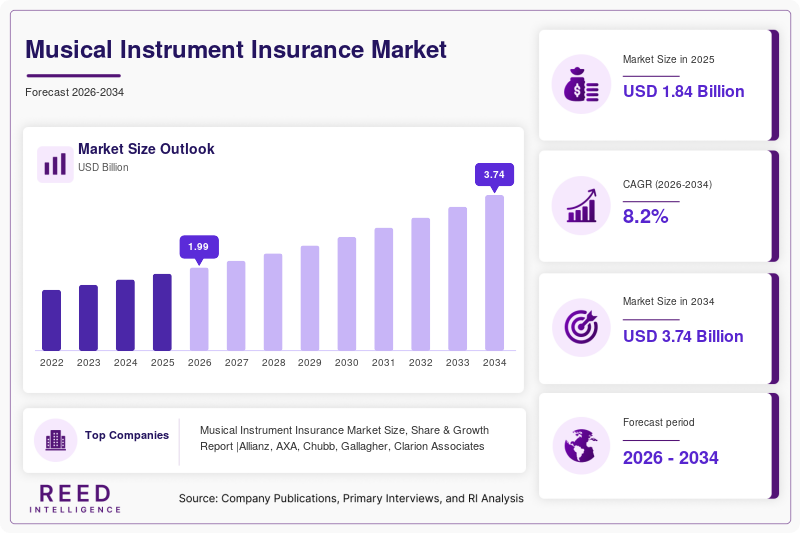
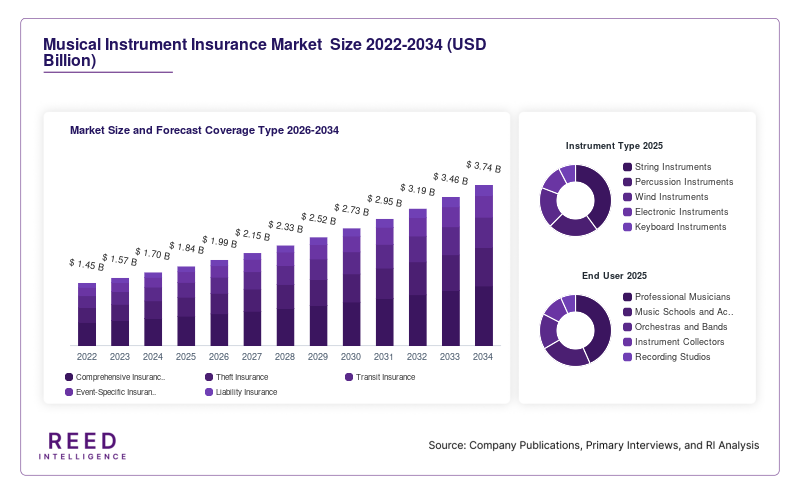
The Musical Instrument Insurance Market size was valued at approximately USD 1.84 billion in 2026 and is projected to reach nearly USD 3.46 billion by 2034, expanding at a CAGR of 8.2% during 2026–2034. The market is gaining traction as musicians, orchestras, educational institutions, collectors, and live entertainment companies increasingly seek financial protection against instrument theft, accidental damage, transportation loss, and environmental deterioration. Growing ownership of premium instruments and the expansion of global music events have contributed significantly to market growth across developed and emerging economies.
One major global factor supporting the market is the continued expansion of the live entertainment and digital music ecosystem. Rising concert activity, touring events, independent music production, and music education programs have increased the number of high-value instruments in circulation. Professional musicians and music schools are prioritizing insurance coverage to reduce financial risks associated with instrument maintenance and replacement. Additionally, insurers are developing specialized policies tailored for vintage instruments, studio equipment, and touring professionals, which is improving customer adoption and retention rates.
Key Highlights
- North America dominated the market with a 36.4% share in 2025.
- Asia Pacific is expected to grow at the fastest CAGR of 11.6% during 2026–2034.
- By coverage type, comprehensive insurance accounted for the largest share of 42.7%, while event-specific insurance is projected to grow at a CAGR of 12.8%.
- By end user, professional musicians led with a 39.8% share, whereas music schools and academies are expected to expand at a CAGR of 11.9%.
- The United States remained the dominant country, with market values of USD 720 million in 2024 and USD 790 million in 2025.
Market Trends
Expansion of Digital Insurance Platforms for Musicians
The Musical Instrument Insurance Market is experiencing a significant shift toward digital insurance platforms designed specifically for musicians and entertainment professionals. Insurance providers are increasingly offering mobile-based policy management systems that allow customers to purchase coverage, upload instrument valuations, and file claims through digital applications. This trend is particularly important for independent musicians and touring artists who require flexible insurance services while traveling across multiple locations. Digital onboarding processes are reducing paperwork and improving policy accessibility for younger musicians who prefer online financial services. Insurers are also integrating AI-driven pricing models and automated claims assessment systems to improve operational efficiency and reduce processing delays. These developments are helping companies improve customer engagement while expanding their reach among freelance performers, music educators, and collectors of premium instruments.
Growing Demand for Coverage of Vintage and High-Value Instruments
Demand for insurance products covering vintage, rare, and collectible instruments is increasing steadily across global markets. Professional musicians and collectors are investing heavily in historical violins, handcrafted guitars, pianos, and limited-edition instruments with substantial financial value. As the value of these instruments rises, owners are seeking specialized policies that provide protection against theft, accidental damage, environmental exposure, and transportation risks. Insurance companies are responding by introducing customized valuation services and restoration coverage options. This trend is particularly visible in developed markets where auction activity and private ownership of premium instruments continue to rise. Additionally, growing awareness regarding preservation of cultural and artistic assets is encouraging orchestras, museums, and educational institutions to purchase long-term insurance protection for their instrument collections.
Market Drivers
Increasing Number of Professional Musicians and Touring Events
The rising number of professional musicians, independent performers, and live entertainment events is a major factor driving the Musical Instrument Insurance Market. Global expansion of music festivals, concerts, and touring performances has increased the movement of valuable instruments across cities and countries. Frequent transportation exposes instruments to risks such as accidental damage, theft, humidity-related deterioration, and airline mishandling. As a result, musicians are increasingly investing in specialized insurance policies to reduce financial uncertainty. Music production companies and event organizers are also encouraging performers to maintain insurance coverage before participating in large-scale events. The growth of streaming platforms and social media has further expanded opportunities for independent artists, contributing to increased ownership of high-value musical instruments that require long-term financial protection.
Rising Awareness Regarding Financial Protection for Musical Assets
Growing awareness regarding asset protection is supporting market growth among musicians, schools, orchestras, and collectors. High-quality instruments often require significant financial investment, especially handcrafted or vintage products that appreciate in value over time. Instrument repair and replacement costs can be substantial, particularly for professional-grade pianos, violins, and brass instruments. Insurance providers are conducting educational campaigns and partnering with music institutions to increase awareness about policy benefits and risk management strategies. Additionally, many educational institutions and performance venues now require proof of insurance coverage before allowing musicians to use their facilities. This changing industry environment is encouraging broader adoption of comprehensive insurance products across professional and amateur music communities.
Market Restraint
Limited Awareness and High Premium Costs in Emerging Economies
One of the primary restraints affecting the Musical Instrument Insurance Market is the limited awareness of specialized insurance products in emerging economies combined with relatively high premium costs for premium instruments. Many musicians in developing regions continue to rely on personal savings instead of purchasing formal insurance coverage, particularly among independent performers and small music schools with constrained budgets. In addition, insurers often face challenges in accurately assessing the value of custom-made or antique instruments, which can increase underwriting complexity and premium pricing. This issue becomes more significant for instruments frequently transported across international borders where risk exposure is higher. For example, touring musicians carrying vintage guitars or violins may face elevated premiums due to theft and transit risks. As a result, some potential customers postpone insurance purchases or opt for limited coverage policies, restricting overall market penetration in cost-sensitive regions.
Market Opportunities
Increasing Adoption of Insurance Services by Educational Institutions
Music schools, universities, conservatories, and training academies are creating strong growth opportunities for the Musical Instrument Insurance Market. Educational institutions maintain large inventories of instruments that are frequently used by multiple students, increasing the risk of accidental damage and maintenance costs. As institutions modernize their music programs and invest in advanced instruments, the need for comprehensive insurance solutions is expanding steadily. Insurers are developing institutional policies that provide broader coverage for classroom use, transportation, performance activities, and storage-related risks. In addition, governments and private educational organizations are increasing investments in music education initiatives, particularly in Asia Pacific and Latin America. This trend is expected to create sustained demand for long-term institutional insurance contracts and bundled protection services designed for academic environments.
Growth Potential in Customized and Event-Based Insurance Policies
Customized and event-based insurance policies present considerable opportunities for insurers seeking to expand their customer base. Musicians participating in short-term tours, festivals, recording sessions, or temporary exhibitions often prefer flexible insurance products with limited-duration coverage. Insurance companies are increasingly offering modular policies that allow customers to select specific protections such as transit insurance, performance liability coverage, or temporary theft protection. This flexibility is particularly attractive to freelance artists and independent bands that may not require annual insurance contracts. Furthermore, the growing popularity of international music festivals and destination events is creating additional demand for short-term policies tailored to touring professionals. Insurers that provide digital policy issuance and quick claims processing are expected to gain competitive advantages within this evolving market environment.
Segmental Analysis
Coverage Type Segment
Comprehensive insurance held the dominant position within the Musical Instrument Insurance Market, accounting for approximately 42.7% share in 2024. This segment includes protection against theft, accidental damage, transit loss, fire, and environmental exposure, making it the preferred option among professional musicians and educational institutions. Comprehensive policies are particularly popular among owners of premium instruments because repair and replacement expenses can be substantial. Insurance providers are also expanding coverage to include restoration services and depreciation protection for vintage instruments. Growing awareness regarding financial risk management and increasing ownership of high-value instruments continue to support the dominance of this segment. Additionally, comprehensive coverage often includes worldwide protection, which is important for touring artists and orchestras participating in international performances.
Event-specific insurance is expected to record the fastest growth, expanding at a CAGR of 12.8% during the forecast period. This subsegment is gaining popularity among freelance performers, festival organizers, and temporary exhibition participants who require short-duration protection instead of annual contracts. Event-specific policies provide flexible coverage options for transportation, performance liability, backstage theft, and accidental damage occurring during concerts or recording sessions. Growth in international music festivals and destination entertainment events is supporting adoption of these policies. Digital policy issuance platforms are also making short-term coverage more accessible for independent artists. Insurance providers are increasingly introducing customizable event packages that allow musicians to select coverage duration and risk categories according to performance schedules and travel requirements.
Instrument Type Segment
String instruments accounted for the largest market share of approximately 37.9% in 2024 due to the high financial value and widespread use of violins, guitars, cellos, and bass instruments among professional musicians and collectors. Many handcrafted and vintage string instruments appreciate in value over time, increasing the need for specialized insurance protection. Frequent transportation of these instruments for concerts, competitions, and studio recording sessions further contributes to insurance demand. Insurance providers often offer tailored appraisal and restoration services specifically for rare string instruments. Additionally, rising participation in guitar-based contemporary music and orchestral performances continues to support the growth of this segment across both developed and emerging markets.
Electronic instruments are expected to grow at the fastest CAGR of 11.7% through 2034. Increasing use of synthesizers, digital keyboards, electronic drum systems, and studio production equipment in modern music production is driving demand for specialized insurance coverage. These instruments are often highly sensitive to electrical failure, accidental damage, and transportation-related risks, creating a need for comprehensive protection policies. Growth in home-based music production and independent content creation is also supporting demand for insurance solutions among digital musicians and studio operators. Insurance companies are responding by introducing policies covering software integration failures, cyber-related production disruptions, and electronic equipment replacement services, which are attracting younger music creators and production professionals.
End User Segment
Professional musicians held the dominant share of approximately 39.8% in 2024 due to their reliance on expensive instruments for touring, recording, and live performances. This customer group frequently travels across domestic and international locations, increasing exposure to theft, accidental damage, and transit-related risks. Many professional artists also own multiple instruments and studio equipment, encouraging adoption of broader insurance policies. Insurance providers are introducing premium plans with worldwide coverage, emergency repair assistance, and replacement support designed specifically for touring musicians. The growth of digital streaming platforms and independent music production has further increased the number of self-employed performers seeking financial protection for their professional assets.
Music schools and academies are projected to expand at the fastest CAGR of 11.9% during the forecast period. Educational institutions often manage large inventories of instruments used by students in classrooms, rehearsals, and performances, increasing the likelihood of accidental damage and maintenance costs. Governments and private organizations are investing more heavily in arts education and community music programs, leading to higher instrument procurement across schools and training centers. Insurance providers are developing institutional packages that cover multiple instruments under single policies while including transportation and event-related protection. Growing enrollment in music education programs across Asia Pacific and Latin America is expected to create long-term demand for institutional insurance solutions.
Regional Analysis
North America
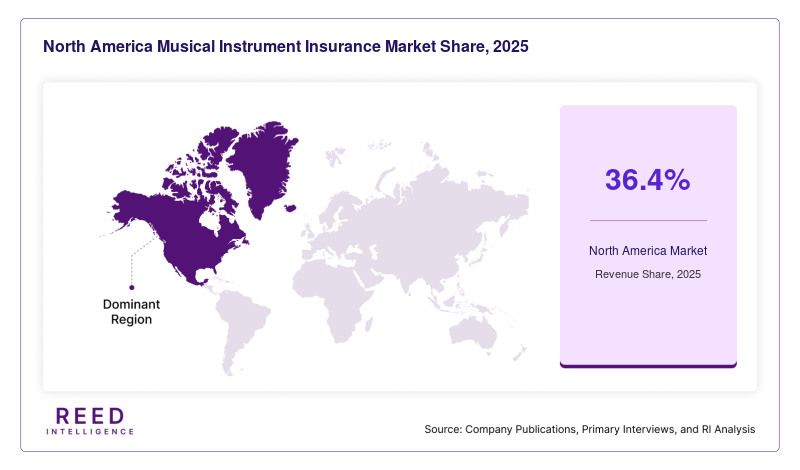
North America accounted for approximately 36.4% of the Musical Instrument Insurance Market share in 2025 and is expected to maintain steady growth at a CAGR of 7.4% during 2026–2034. The region benefits from a mature entertainment industry, high ownership of premium musical instruments, and strong awareness regarding financial asset protection. Insurance providers in the region are increasingly introducing customized policies designed for professional musicians, touring artists, and educational institutions. The expansion of digital insurance platforms is also supporting market accessibility among independent performers and freelance artists.
The United States dominates the regional market due to its extensive music production industry and large concentration of live entertainment events. The country hosts numerous music festivals, recording studios, orchestras, and touring performances that involve transportation of valuable instruments across states and international locations. A unique growth factor supporting the market is the increasing adoption of insurance coverage by independent musicians who distribute content through streaming platforms and social media channels. These artists are investing in premium instruments and seeking financial protection against loss and damage risks.
Europe
Europe held around 28.1% share of the Musical Instrument Insurance Market in 2025 and is projected to grow at a CAGR of 7.1% through 2034. The region has a strong cultural association with classical music, orchestras, and instrument preservation, which supports consistent demand for insurance products. Many European countries maintain active music education systems and public arts funding programs that encourage investment in high-value musical instruments. Insurance providers are also offering specialized restoration and appraisal coverage for antique instruments, contributing to market expansion.
Germany represents the dominant country within the European market due to its established music education infrastructure and strong presence of orchestras and live performance venues. A unique factor driving growth in the country is the increasing demand for insurance policies covering vintage and handcrafted instruments used in classical performances and museum exhibitions. The presence of large-scale music events and international touring activity further strengthens demand for instrument transportation and liability coverage solutions.
Asia Pacific
Asia Pacific accounted for nearly 20.6% market share in 2025 and is expected to register the fastest CAGR of 11.6% during the forecast period. Rising disposable income, increasing participation in music education, and rapid expansion of entertainment industries are supporting regional market growth. Countries across the region are witnessing increased sales of premium guitars, keyboards, violins, and studio equipment. As ownership of expensive instruments increases, musicians and institutions are becoming more aware of financial protection solutions.
China dominates the Asia Pacific market due to rapid growth in music education centers, live entertainment venues, and digital music production activities. A unique growth factor in the country is the expansion of online music learning platforms, which has encouraged more consumers to purchase advanced instruments for professional and personal use. Insurance companies are leveraging digital platforms to introduce affordable policies targeting students, educators, and freelance performers across urban and semi-urban areas.
Middle East & Africa
The Middle East & Africa region represented approximately 7.5% share of the Musical Instrument Insurance Market in 2025 and is anticipated to grow at a CAGR of 7.8% during 2026–2034. Market development is supported by rising investments in cultural tourism, entertainment infrastructure, and live performance venues. Several countries are increasing support for music festivals and artistic events as part of broader economic diversification initiatives. This has contributed to growing demand for insurance solutions covering instruments used in concerts, exhibitions, and educational programs.
Saudi Arabia leads the regional market due to ongoing investments in entertainment and cultural development projects. A unique factor driving growth is the expansion of international music events and tourism-focused entertainment activities under national modernization programs. The increasing entry of international performers and event organizers into the country is encouraging demand for temporary insurance policies covering transportation, theft, and performance-related liabilities associated with musical instruments and sound equipment.
Latin America
Latin America captured nearly 7.4% share of the Musical Instrument Insurance Market in 2025 and is projected to grow at a CAGR of 7.3% over the forecast period. Increasing participation in music education programs and the growing popularity of regional music festivals are supporting market expansion. Insurance providers are gradually introducing affordable policies tailored for independent musicians and small performance groups. In addition, expansion of local recording industries and music production activities is creating new opportunities for specialized instrument insurance products.
Brazil dominates the Latin American market due to its strong music culture and large number of live entertainment events throughout the year. A unique growth factor supporting the market is the rising investment in community music programs and educational initiatives focused on youth participation in performing arts. These programs often involve institutional ownership of musical instruments, encouraging schools and training centers to purchase insurance policies that protect against accidental damage and theft risks.
Competitive Landscape
The Musical Instrument Insurance Market is moderately fragmented, with global insurers and specialized entertainment insurance providers competing through customized coverage options, digital services, and flexible policy structures. Companies are focusing on partnerships with music schools, orchestras, instrument retailers, and touring organizations to expand customer reach. Digital transformation has become a major competitive factor, with insurers investing in online policy issuance systems, AI-based claims processing, and mobile customer support platforms to improve user experience and operational efficiency.
Leading companies operating in the market include Allianz, AXA, Chubb, Gallagher, and Clarion Associates. Among these, Allianz maintains a strong market position due to its broad global insurance network and specialized coverage solutions for musicians, touring performers, and entertainment organizations. In 2025, the company expanded its digital claims management platform to support faster processing of instrument theft and transit damage claims. Other market participants are focusing on niche policies covering antique instruments, short-term event protection, and institutional music education programs. Strategic collaborations with music associations and instrument manufacturers are also increasing as insurers seek to strengthen customer acquisition and retention.
Key Players
- Allianz
- AXA
- Chubb
- Gallagher
- Clarion Associates
- Heritage Insurance Services
- Hiscox
- Travelers Insurance
- Zurich Insurance Group
- Liberty Mutual
- Aviva
- Marsh McLennan
- Aon
- State Farm
- Progressive Corporation
Recent Developments
- In 2025, several insurance providers introduced AI-based digital claims systems designed specifically for musicians traveling internationally with high-value instruments.
- In 2025, leading insurers expanded customized coverage plans for vintage violins, handcrafted guitars, and collectible orchestral instruments with restoration support services.
- In 2026, multiple companies launched flexible short-term insurance products targeting music festivals, touring artists, and temporary live entertainment events.
Musical Instrument Insurance Market Segments
Coverage Type
- Comprehensive Insurance
- Theft Insurance
- Transit Insurance
- Event-Specific Insurance
- Liability Insurance
Instrument Type
- String Instruments
- Percussion Instruments
- Wind Instruments
- Electronic Instruments
- Keyboard Instruments
End User
- Professional Musicians
- Music Schools and Academies
- Orchestras and Bands
- Instrument Collectors
- Recording Studios
By Region
- North America
- Europe
- APAC
- Middle East and Africa
- LATAM