Myclobutanil Market Size, Share & Demand Report By Type (Granular, Liquid, Powder), By Application (Crop Protection, Ornamental Plants, Others), By End-Use (Commercial Agriculture, Greenhouse & Smallholder Farming), By Distribution Channel (Direct Sales, Distributors & Retailers, Online / E-Commerce) By Region & Segment Forecasts, 2025–2034
USD 3950
Market Overview
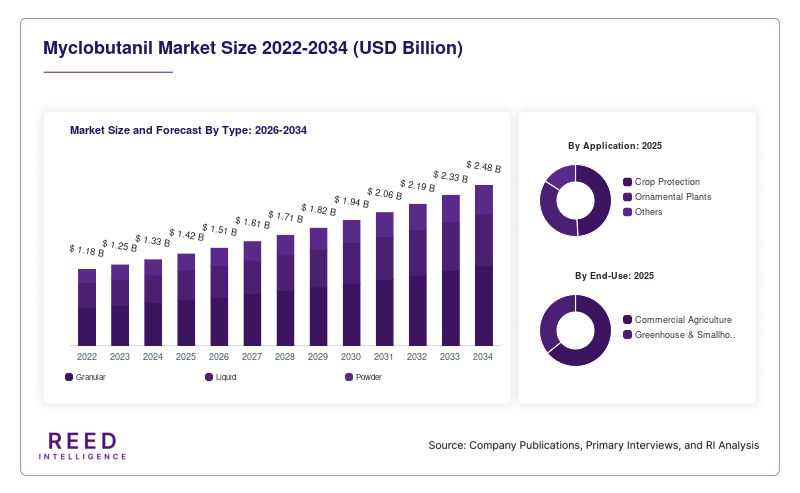
The global Myclobutanil Market size was valued at approximately USD 1.42 billion in 2025 and is projected to reach USD 2.37 billion by 2033, registering a CAGR of 6.4% during the forecast period (2025–2034). Myclobutanil, a systemic triazole fungicide, is widely utilized in agriculture for controlling fungal diseases in cereal crops, fruits, vegetables, and ornamental plants. Increasing global demand for high-quality crop yields, coupled with the rising adoption of modern agricultural practices, has supported market growth. Additionally, the emphasis on plant protection and crop disease management has prompted farmers and agribusinesses to integrate advanced fungicidal solutions into their operations.
One of the key global factors fueling the market expansion is the growing trend toward sustainable crop protection methods that ensure high productivity while reducing environmental impact. Regulatory support in various regions, promoting safe fungicide usage, has also contributed to stabilizing demand and encouraging innovation in formulation technologies.
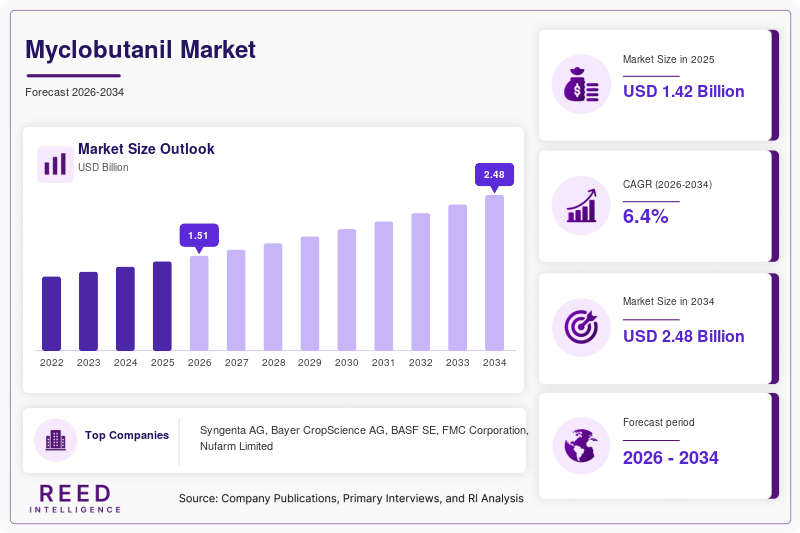
Key Highlights:
- Dominant region share: Asia Pacific accounted for 42% of the market in 2025, with North America expected to witness the fastest growth at a CAGR of 7.1% through 2034.
- Leading subsegments: Among application types, cereal crops dominated with 38% share in 2025, while fruits and vegetables are projected to exhibit the fastest CAGR of 7.5%. In formulation, wettable powders held 46% market share, whereas soluble concentrates are expected to grow fastest at 7.2% CAGR.
- Dominant country: China held a market value of USD 510 million in 2025, projected to increase to USD 600 million by 2026.
Market Trends
Digital Agriculture Integration
The integration of digital farming technologies, including precision agriculture platforms and automated crop monitoring systems, is shaping the Myclobutanil Market. Farmers are leveraging data-driven insights to optimize fungicide application, reducing overuse and improving yield quality. This trend is particularly prominent in technologically advanced regions such as North America and Europe, where digital adoption enhances decision-making and operational efficiency in plant protection.
Sustainable Formulation Development
The market is witnessing a shift toward eco-friendly and low-toxicity Myclobutanil formulations. Manufacturers are investing in water-soluble granules and biodegradable carriers to minimize environmental impact and meet regulatory compliance. Sustainable formulation trends align with the global push for responsible chemical use in agriculture, influencing purchasing decisions among agribusinesses and distributors.
Market Drivers
Rising Demand for Food Security
Global population growth and increasing food demand are driving the adoption of effective fungicides such as Myclobutanil. Farmers require reliable crop protection solutions to reduce losses from fungal diseases, ensuring stable supply chains and maintaining quality standards for domestic and export markets.
Regulatory Support and Compliance
Governmental initiatives supporting safe fungicide usage, including registration approvals and residue guidelines, have promoted Myclobutanil adoption. Policies encouraging integrated pest management (IPM) practices provide a conducive environment for growth, as Myclobutanil fits into controlled, scientifically guided crop protection programs.
Market Restraint
Stringent Environmental Regulations
Strict environmental regulations regarding pesticide residues and chemical usage are a major restraint for the Myclobutanil Market. Some regions have imposed limitations on active ingredient concentrations, leading to increased compliance costs for manufacturers. Regulatory scrutiny, combined with public concerns over fungicide safety, may slow adoption rates and create challenges for market participants, particularly in Europe and North America.
Market Opportunities
Expansion in Emerging Markets
Emerging economies in Africa and Southeast Asia present significant growth potential. Increasing investments in modern agriculture infrastructure, coupled with government subsidies for crop protection, offer manufacturers an opportunity to expand distribution networks and capture untapped demand.
Product Innovation in Formulations
Innovative formulations, such as microencapsulated Myclobutanil and combination products, provide growth opportunities by enhancing efficacy and reducing environmental impact. Companies investing in R&D for advanced formulations can differentiate themselves, meeting the evolving preferences of environmentally conscious farmers and regulatory bodies.
Segmental Analysis
By Application
Cereal crops dominated the Myclobutanil Marketin 2025, accounting for 38% of the application segment. High consumption in wheat, rice, and barley cultivation supported this share due to consistent fungal threats and the need for quality yield.
Fruits and vegetables are projected to witness the fastest CAGR of 7.5% from 2025 to 2034. Rising consumption of fresh produce and export-oriented cultivation in Asia Pacific and Latin America will drive demand for effective fungicides, particularly for crops such as tomatoes, grapes, and apples.
By Formulation
Wettable powders held the leading share of 46% in 2025, favored for ease of handling, water dispersion, and cost-effectiveness. The broad acceptance among farmers in developing regions contributed to their dominant status.
Soluble concentrates are expected to exhibit the fastest CAGR of 7.2% through 2034. Their efficiency in reducing residue levels, compatibility with automated spraying systems, and improved solubility support adoption in regions emphasizing precision agriculture.
By Distribution Channel
Direct sales dominated in 2025, accounting for 55% of the distribution segment. Manufacturer-to-farmer channels ensured timely supply, technical support, and proper guidance for fungicide application, consolidating market share.
E-commerce channels are projected to grow fastest at a CAGR of 8.0% due to increasing digital penetration, online purchase convenience, and access to product information, particularly in North America and Asia Pacific.
By End-Use
Agricultural use dominated the market with a 92% share in 2025, driven by extensive crop cultivation and the necessity to manage fungal diseases across cereals, fruits, and vegetables. Ornamental horticulture represents the fastest-growing subsegment with an anticipated CAGR of 6.9% during the forecast period. Rising urban landscaping projects and greenhouse flower cultivation are boosting demand for Myclobutanil in decorative plant applications.
By Type
Technical grade Myclobutanil led in 2025, contributing 60% of the market. It served as the raw material for various formulations, enabling consistent fungicidal performance and supply chain integration.
Formulated products are expected to grow fastest at a CAGR of 7.3% through 2034. Innovations in ready-to-use formulations, including granules, liquids, and encapsulated forms, will meet evolving farmer preferences for application convenience and environmental safety.
Regional Analysis
North America
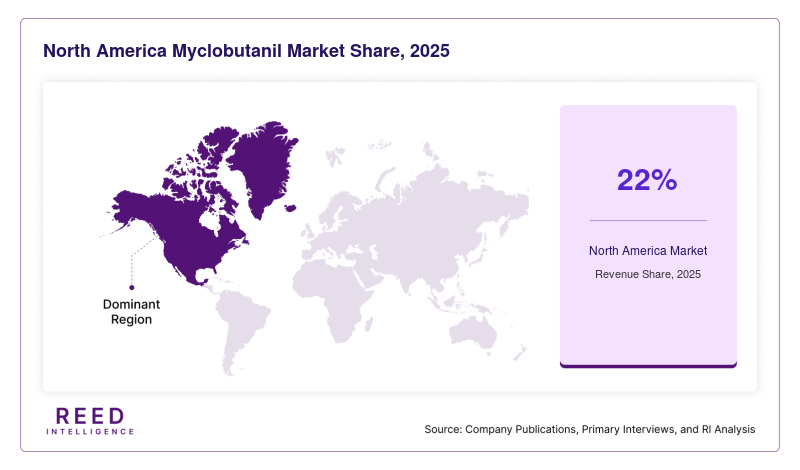
North America accounted for 22% of the Myclobutanil Marketin 2025 and is expected to grow at a CAGR of 7.1% through 2034. The region benefits from advanced agricultural practices, extensive mechanization, and widespread adoption of integrated pest management solutions.
The United States dominated the region, driven by extensive corn, soybean, and wheat cultivation. Technological adoption, such as precision spraying and crop health monitoring, has enabled more efficient fungicide use, reducing crop loss and boosting demand for Myclobutanil.
Europe
Europe held 18% of the market share in 2025 and is projected to grow at a CAGR of 6.0% from 2025 to 2034. The European market is characterized by stringent regulations on pesticide residues, prompting manufacturers to innovate in low-toxicity formulations and eco-friendly products.
Germany emerged as a dominant country due to strong agricultural R&D investment and high demand for cereal crops and vineyards. Precision farming techniques and sustainable crop protection programs are key growth factors in the country.
Asia Pacific
Asia Pacific led the global market with a 42% share in 2025 and is forecasted to expand at a CAGR of 6.3% during the forecast period. Rising population and food demand, coupled with increasing adoption of modern agriculture, have driven Myclobutanil usage in this region.
China, the dominant country, benefited from large-scale cultivation of rice, wheat, and vegetables. Government initiatives promoting safe pesticide use and subsidies for plant protection chemicals have contributed to steady market growth.
Middle East & Africa
The Middle East & Africa accounted for 8% of the market in 2025 and is projected to grow at a CAGR of 5.8% through 2034. The region faces water scarcity and arid climates, requiring specialized fungicides to protect high-value crops and maintain agricultural productivity.
Saudi Arabia led the regional market due to investment in modern irrigation systems and controlled-environment agriculture. Increased focus on horticulture and greenhouse farming has fueled demand for Myclobutanil formulations.
Latin America
Latin America represented 10% of the market in 2025 and is expected to grow at a CAGR of 6.2% during the forecast period. Brazil and Argentina are major contributors, with strong cultivation of soybeans, corn, and coffee.
Brazil dominated due to increasing awareness among farmers about fungal disease management and favorable government policies promoting sustainable crop protection practices. Adoption of integrated fungicide programs has strengthened market growth in the country.
Competitive Landscape
The Myclobutanil Marketis moderately consolidated, with leading players adopting strategic initiatives such as mergers, acquisitions, and R&D investments to expand market presence. Key players include Syngenta AG, Bayer CropScience, BASF SE, FMC Corporation, and ADAMA Agricultural Solutions.
Syngenta AGemerged as the market leader, introducing a new low-toxicity Myclobutanil wettable powder in 2025, aimed at minimizing environmental impact while maintaining efficacy. Bayer CropScience focuses on precision agriculture solutions and integrated fungicide programs. BASF SE continues to innovate in microencapsulated formulations, while FMC Corporation enhances distribution networks across emerging markets. ADAMA Agricultural Solutions leverages regional expertise to strengthen presence in Asia Pacific and Latin America. Competitive strategies revolve around product innovation, geographical expansion, and sustainability initiatives to meet regulatory and consumer demands.
Key Players List
- Syngenta AG
- Bayer CropScience
- BASF SE
- FMC Corporation
- ADAMA Agricultural Solutions
- Nufarm Limited
- Sumitomo Chemical Co., Ltd.
- UPL Limited
- Dow AgroSciences
- Arysta LifeScience
- Makhteshim Agan
- Isagro S.p.A.
- Inovatec Group
- Sharda Cropchem Ltd.
- Lallemand Plant Care
Recent Developments
- 2025: Syngenta launched an eco-friendly Myclobutanil wettable powder with reduced residue levels.
- 2025: FMC Corporation expanded its distribution network in Southeast Asia.
- 2026: BASF SE introduced a microencapsulated Myclobutanil product for precision agriculture.
- 2026: ADAMA Agricultural Solutions invested in R&D for water-soluble formulations.
- 2026: UPL Limited acquired regional distributors in Latin America to strengthen market coverage.
Myclobutanil Market Segments
By Type:
- Granular
- Liquid
- Powder
By Application:
- Crop Protection
- Ornamental Plants
- Others
By End-Use:
- Commercial Agriculture
- Greenhouse & Smallholder Farming
By Distribution Channel:
- Direct Sales
- Distributors & Retailers
- Online / E-Commerce
By Geography:
- North America
- Europe
- Asia Pacific
- Middle East & Africa
- Latin America
By Region
- North America
- Europe
- APAC
- Middle East and Africa
- LATAM