N Methyldiethanolamine Market Size, Share Demand Report By Type (Liquid, Solid), By Application (Gas Treatment, Surfactants, Coatings, Personal Care, Others), By End-Use Industry (Oil & Gas, Chemical Manufacturing, Personal Care, Industrial Cleaning, Others), By Region & Segment Forecasts, 2025–2034
USD 3950
Market Overview
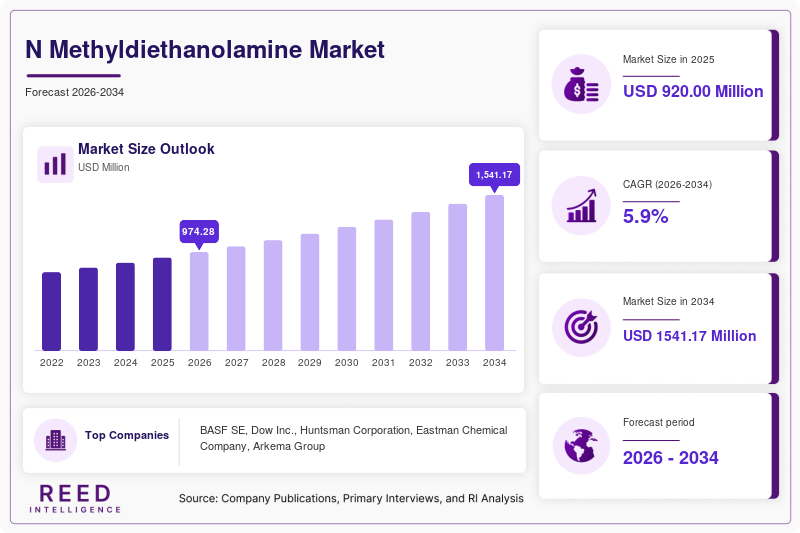
The N Methyldiethanolamine Market size is estimated at approximately USD 920 million, with a modest increase to USD 970 million in 2026. The market is projected to reach around USD 1.55 billion by 2034, expanding at a compound annual growth rate (CAGR) of 5.9% from 2025 to 2034. This growth reflects increasing industrialization, rising demand for clean energy, and expanding applications in personal care and coatings industries.
One of the primary growth factors is the rising demand for natural gas as a transitional fuel, particularly in emerging economies. MDEA plays a critical role in gas sweetening processes, which are essential for meeting environmental regulations. Another contributing factor is the expansion of the personal care industry, where MDEA is used as an emulsifier and pH adjuster in formulations. Additionally, advancements in industrial processing technologies are improving the efficiency of MDEA-based systems, further boosting adoption.
Key Highlights
- Market size valued at USD 920 million in 2025 and projected to reach USD 1.55 billion by 2034, reflecting an absolute growth of over USD 630 million during the forecast period
- CAGR of 5.9% during the forecast period (2025–2034), supported by steady demand across oil & gas and chemical sectors
- Strong demand from natural gas processing and petrochemical industries, contributing to over 55% of total application share in 2024
- Increasing adoption in personal care and coatings applications, with the segment expected to grow at a CAGR exceeding 6.5%
- Regulatory emphasis on emission control supporting market growth, with over 60% of industrial facilities adopting advanced gas treatment solutions by 2030
Market Trends
Increasing Adoption in Gas Sweetening Applications
The growing reliance on natural gas as a cleaner alternative to coal and oil is significantly influencing the N Methyldiethanolamine market. MDEA is increasingly being used in gas sweetening processes due to its ability to selectively remove hydrogen sulfide while minimizing carbon dioxide absorption. This selectivity improves process efficiency and reduces operational costs. As countries invest in liquefied natural gas (LNG) infrastructure, demand for MDEA-based systems is rising. Technological advancements in gas processing equipment are also enhancing the effectiveness of MDEA solutions, making them more attractive to industrial operators seeking cost-efficient and environmentally compliant processes.
Expansion in Personal Care and Industrial Formulations
Another emerging trend is the growing use of MDEA in personal care and industrial formulations. The compound acts as a pH stabilizer, emulsifier, and intermediate in the production of surfactants. With the expansion of the cosmetics and skincare industry, particularly in Asia Pacific, the demand for multifunctional chemical ingredients is increasing. Additionally, MDEA is being incorporated into coatings and cleaning products, driven by the need for improved product performance. Manufacturers are focusing on developing high-purity grades of MDEA to cater to specialized applications, which is expected to support market growth over the forecast period.
Market Drivers
Rising Demand for Natural Gas Processing
The increasing global demand for natural gas is a major driver for the N Methyldiethanolamine market. As industries transition toward cleaner energy sources, natural gas has emerged as a preferred option due to its lower carbon emissions. MDEA is widely used in gas treatment plants to remove acidic contaminants, ensuring compliance with environmental standards. The expansion of LNG projects and cross-border pipeline networks is further boosting demand for efficient gas sweetening solutions. Additionally, the cost-effectiveness and high selectivity of MDEA compared to other amines make it a preferred choice among operators, supporting its widespread adoption.
Growth in Personal Care and Chemical Industries
The rapid growth of the personal care and chemical manufacturing industries is another significant driver. MDEA is used in the production of surfactants, emulsifiers, and corrosion inhibitors, which are essential components in cosmetics, detergents, and industrial cleaning products. Increasing consumer awareness regarding personal hygiene and grooming is fueling demand for these products, thereby driving MDEA consumption. Furthermore, the expansion of chemical manufacturing capacities in emerging economies is contributing to higher production and utilization of MDEA, strengthening overall market growth.
Market Restraint
Environmental and Health Concerns
Despite its advantages, the N Methyldiethanolamine market faces challenges related to environmental and health concerns. Prolonged exposure to MDEA can pose health risks, including skin and eye irritation, which has led to stricter handling and safety regulations. Additionally, the disposal of MDEA-containing waste requires careful management to prevent environmental contamination. Regulatory bodies in developed regions are imposing stringent guidelines on chemical usage and waste treatment, increasing compliance costs for manufacturers. For instance, industries operating in Europe must adhere to rigorous chemical safety standards, which can limit production and usage. These factors may restrain market growth, particularly for smaller manufacturers with limited resources to invest in compliance and safety measures.
Market Opportunities
Expansion in Emerging Economies
Emerging economies present significant growth opportunities for the N Methyldiethanolamine market. Rapid industrialization, urbanization, and infrastructure development in regions such as Asia Pacific and Latin America are driving demand for chemicals used in construction, coatings, and gas processing. Governments in these regions are investing heavily in energy infrastructure, including natural gas pipelines and processing plants. This creates a favorable environment for MDEA adoption. Additionally, the rising middle-class population is increasing demand for personal care products, further supporting market expansion. Manufacturers are establishing production facilities in these regions to capitalize on cost advantages and growing demand.
Technological Advancements in Chemical Processing
Advancements in chemical processing technologies offer another promising opportunity. Innovations in amine-based gas treatment systems are improving efficiency, reducing energy consumption, and enhancing selectivity. These advancements make MDEA more attractive for industrial applications. Furthermore, research and development activities are focused on developing environmentally friendly and high-performance formulations. The integration of digital monitoring and automation in chemical plants is also improving process optimization, leading to increased adoption of MDEA. Companies investing in advanced production techniques and product innovation are likely to gain a competitive edge in the market.
Segmental Analysis
By Type
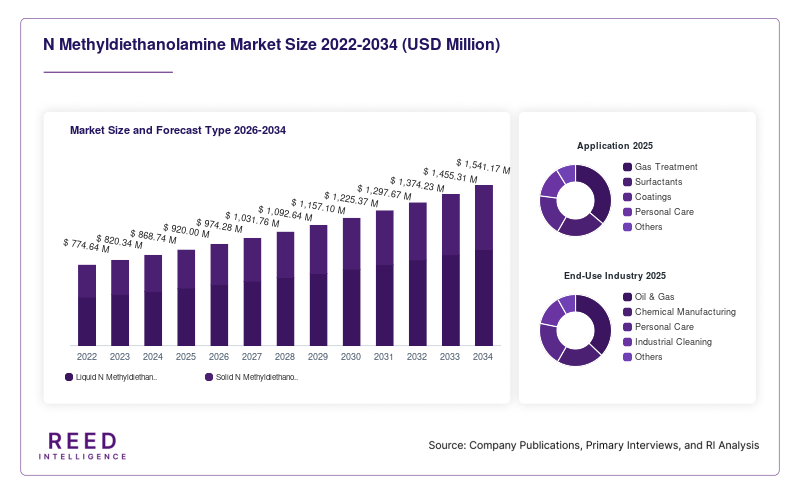
The liquid MDEA segment dominated the market in 2024, accounting for approximately 68% of the total share. Liquid MDEA is widely preferred due to its ease of handling, high solubility, and compatibility with various industrial processes. It is extensively used in gas treatment plants, where efficient absorption of acidic gases is required. The segment’s dominance is further supported by its cost-effectiveness and availability. Manufacturers are focusing on improving the purity and performance of liquid MDEA to meet the evolving needs of end-users, particularly in the oil and gas sector.
The solid MDEA segment is expected to be the fastest-growing, with a CAGR of around 6.5% during the forecast period. The growth of this segment is driven by its advantages in storage and transportation, especially in regions with limited infrastructure. Solid MDEA offers longer shelf life and reduced risk of spillage, making it suitable for specialized applications. Increasing demand from niche industries and advancements in packaging technologies are contributing to the growth of this segment.
By Application
Gas treatment remains the dominant application segment, accounting for nearly 55% of the market share in 2024. MDEA is widely used in removing hydrogen sulfide and carbon dioxide from natural gas and refinery streams. The segment’s growth is driven by increasing demand for clean energy and stringent environmental regulations. The expansion of LNG projects and pipeline networks is further supporting demand. Continuous improvements in gas treatment technologies are enhancing the efficiency of MDEA-based systems, reinforcing the segment’s leading position.
The surfactants and personal care segment is projected to be the fastest-growing, with a CAGR of 6.7%. The increasing demand for cosmetics, detergents, and cleaning products is driving the use of MDEA as an intermediate in surfactant production. Rising consumer awareness regarding personal hygiene and grooming is further supporting growth. Manufacturers are developing high-purity grades of MDEA to meet the specific requirements of this segment, contributing to its expansion.
By End-Use Industry
The oil and gas industry dominated the market in 2024, accounting for approximately 60% of the total share. The widespread use of MDEA in gas sweetening and refining processes is the primary factor driving this segment. The increasing focus on reducing sulfur emissions and improving fuel quality is further boosting demand. The expansion of exploration and production activities in emerging regions is also contributing to growth.
The chemical manufacturing industry is expected to be the fastest-growing segment, with a CAGR of 6.3%. The growth is driven by increasing demand for MDEA in the production of surfactants, coatings, and corrosion inhibitors. The expansion of chemical manufacturing facilities in emerging economies is creating new opportunities for market players. Additionally, advancements in production technologies are improving efficiency and reducing costs, supporting segment growth.
Regional Analysis
North America
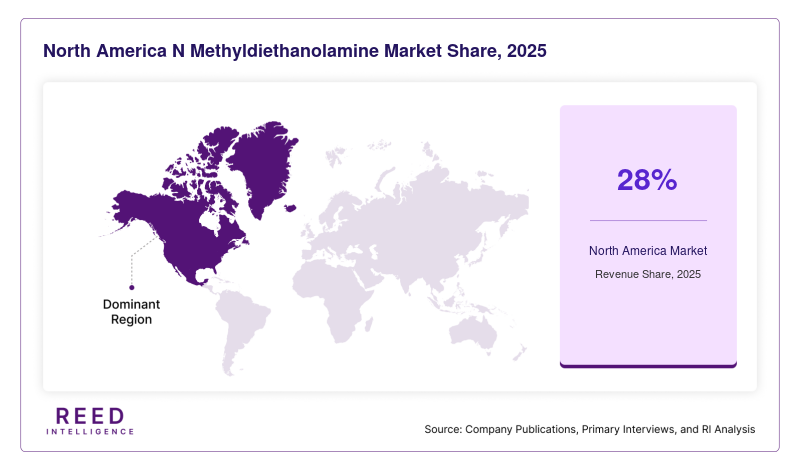
North America accounted for a significant share of the N Methyldiethanolamine market in 2025, contributing approximately 28% of the global market. The region is expected to grow at a CAGR of around 5.2% during the forecast period. The presence of well-established oil and gas infrastructure and advanced chemical manufacturing capabilities supports steady demand. Increasing investments in LNG export terminals and pipeline projects are further driving the adoption of MDEA in gas processing applications.
The United States dominates the regional market due to its extensive natural gas reserves and advanced refining sector. A key growth factor is the rising focus on reducing sulfur emissions from industrial processes. This has led to increased adoption of MDEA-based gas treatment solutions, as companies seek to comply with environmental regulations while maintaining operational efficiency.
Europe
Europe held approximately 22% of the global market share in 2025 and is projected to grow at a CAGR of 4.8%. The region’s growth is influenced by stringent environmental regulations and a strong focus on sustainability. The demand for efficient gas treatment solutions is increasing as industries aim to reduce emissions and comply with regulatory standards.
Germany leads the European market due to its robust chemical manufacturing industry. A unique growth factor is the region’s emphasis on green chemistry and sustainable production methods. This has encouraged the development of advanced MDEA formulations with reduced environmental impact, supporting market expansion.
Asia Pacific
Asia Pacific emerged as the largest regional market, accounting for around 34% of the global share in 2025. The region is expected to register the highest CAGR of 6.8% during the forecast period. Rapid industrialization, urbanization, and increasing energy demand are key factors driving market growth. The expansion of petrochemical and natural gas industries further supports demand.
China dominates the Asia Pacific market, driven by its large-scale industrial base and growing energy needs. A unique growth factor is the rapid expansion of LNG infrastructure, which requires efficient gas treatment solutions. This has significantly increased the adoption of MDEA in the region.
Middle East & Africa
The Middle East & Africa region accounted for approximately 10% of the global market share in 2025 and is expected to grow at a CAGR of 5.6%. The region’s abundant oil and gas reserves and ongoing investments in energy infrastructure are key drivers of market growth. The demand for gas sweetening solutions remains strong.
Saudi Arabia is the dominant market in this region, supported by its extensive oil and gas industry. A unique growth factor is the increasing focus on gas processing and refining activities aimed at maximizing resource utilization. This is driving demand for MDEA in industrial applications.
Latin America
Latin America held around 6% of the global market share in 2025 and is projected to grow at a CAGR of 5.4%. The region is experiencing gradual growth due to increasing investments in energy and chemical industries. The development of natural gas infrastructure is supporting demand for MDEA.
Brazil leads the Latin American market, driven by its expanding industrial sector. A unique growth factor is the growing focus on energy diversification and infrastructure development. This is encouraging the adoption of advanced gas treatment solutions, including MDEA-based systems.
Competitive Landscape
The N Methyldiethanolamine market is moderately consolidated, with key players focusing on product innovation, capacity expansion, and strategic partnerships. The leading companies are investing in research and development to enhance product quality and meet evolving industry requirements. The market is characterized by the presence of both global chemical manufacturers and regional players.
BASF SE is considered a leading player due to its extensive product portfolio and strong global presence. The company has recently expanded its amine production capacity to meet growing demand from the oil and gas industry. Other major players are also focusing on sustainability initiatives and the development of eco-friendly formulations to align with regulatory requirements. Competitive strategies include mergers, acquisitions, and collaborations aimed at strengthening market position and expanding geographic reach.
Key Players
- BASF SE
- Dow Inc.
- Huntsman Corporation
- Eastman Chemical Company
- Arkema Group
- Clariant AG
- Akzo Nobel N.V.
- SABIC
- Mitsubishi Chemical Corporation
- INEOS Group
- Lanxess AG
- Celanese Corporation
- Air Products and Chemicals Inc.
- Solvay S.A.
- Nouryon
Recent Developments
- In 2024, BASF SE expanded its amine production facility to increase output capacity for gas treatment applications.
- In 2023, Huntsman Corporation introduced a high-purity grade of MDEA targeting personal care and specialty chemical markets.
- In 2024, Arkema Group invested in research and development to enhance the efficiency of amine-based gas treatment solutions.
N Methyldiethanolamine Market Segments
Type
- Liquid N Methyldiethanolamine
- Solid N Methyldiethanolamine
Application
- Gas Treatment
- Surfactants
- Coatings
- Personal Care
- Others
End-Use Industry
- Oil & Gas
- Chemical Manufacturing
- Personal Care
- Industrial Cleaning
- Others
By Region
- North America
- Europe
- APAC
- Middle East and Africa
- LATAM