Market Overview
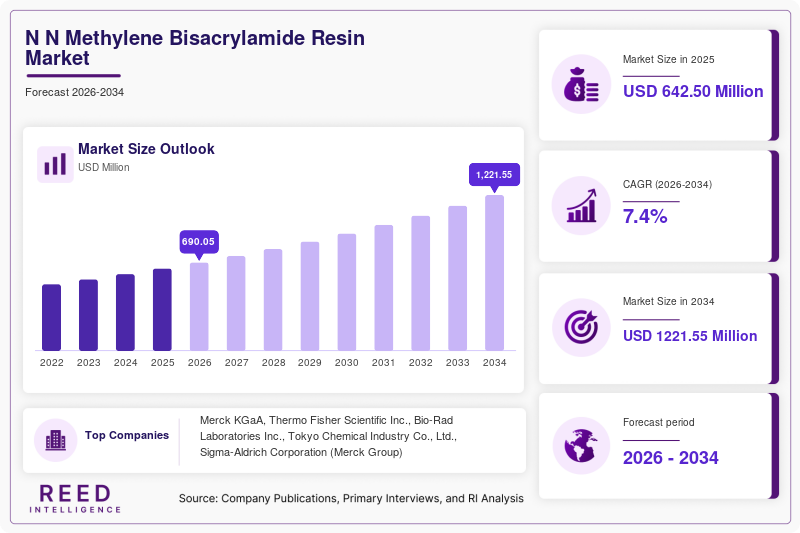
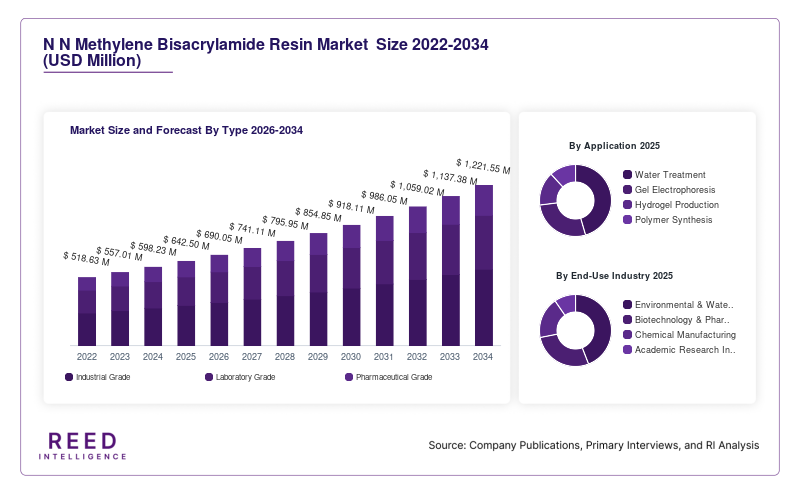
The N N Methylene Bisacrylamide Resin Market size was valued at USD 642.5 million in 2025 and is projected to reach USD 1.21 billion by 2033, expanding at a compound annual growth rate (CAGR) of 7.4% from 2025 to 2034. N N methylene bisacrylamide resin is widely used as a cross-linking agent in polymer synthesis, particularly in gel electrophoresis, water treatment polymers, and hydrogel formulations. Its ability to enhance polymer network stability and mechanical strength has made it a critical material across biotechnology, environmental engineering, and advanced materials manufacturing.
The N N Methylene Bisacrylamide Resin Market has experienced stable expansion due to increasing demand for high-performance polymer materials used in water purification, pharmaceuticals, and biochemical analysis. Rapid advancements in molecular biology techniques and the expansion of life science laboratories worldwide have accelerated the adoption of acrylamide-based polymer matrices, further supporting the market outlook.
Key Highlights
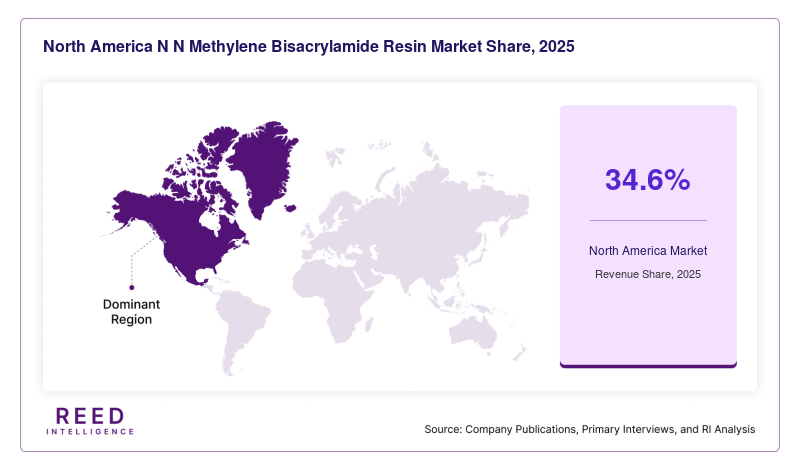
- North America dominated the market with 34.6% share in 2025, while Asia Pacific is projected to register the fastest CAGR of 8.6% (2025–2034).
- Industrial-grade resin represented the largest type segment with 41.3% share, while laboratory-grade resin is projected to grow at 9.2% CAGR.
- Water treatment applications accounted for 38.7% of total demand, whereas biotechnology research applications are forecast to expand at 9.5% CAGR.
- The United States remained the dominant country, with market values of USD 168.2 million in 2025 and USD 179.6 million in 2026
Market Trends
Expansion of Hydrogel-Based Biomedical Materials
A key trend influencing the N N Methylene Bisacrylamide Resin Market is the growing use of hydrogel materials in biomedical applications. Hydrogels produced using cross-linking agents such as N N methylene bisacrylamide are widely applied in drug delivery systems, tissue engineering scaffolds, and wound care materials. The increasing research focus on biocompatible polymers has encouraged laboratories and medical material manufacturers to integrate advanced hydrogel formulations into product development pipelines. This shift toward polymer-based biomaterials is steadily expanding the market size and creating new research-driven demand across academic and commercial biotechnology sectors.
Rising Use in Advanced Aalnytical Techniques
Another notable trend shaping the N N Methylene Bisacrylamide Resin Market is the increasing adoption of high-resolution gel electrophoresis technologies. N N methylene bisacrylamide acts as a crucial cross-linker in polyacrylamide gels used for protein and nucleic acid separation. As genomic research, proteomics studies, and pharmaceutical discovery programs expand globally, laboratories are demanding higher-purity and more consistent resin formulations. This trend has encouraged manufacturers to develop specialized grades tailored for precision laboratory environments, thereby enhancing product differentiation and supporting overall market growth.
Market Drivers
Growing Global Demand for Water Treatment Chemicals
The rising requirement for effective water purification solutions has become a major driver of the N N Methylene Bisacrylamide Resin Market. Industrial wastewater treatment plants increasingly use polymer-based flocculants to remove suspended particles and contaminants from water systems. N N methylene bisacrylamide is commonly used in the synthesis of cross-linked polymer structures that improve flocculation efficiency. With urbanization and industrial expansion increasing water consumption and wastewater generation, governments and industries are investing heavily in advanced water treatment technologies. This development has significantly increased demand for polymer cross-linking materials.
Expansion of Life Sciences Research Infrastructure
The growth of biotechnology and pharmaceutical research facilities worldwide has also contributed to the expansion of the N N Methylene Bisacrylamide Resin Market. Research laboratories rely on polyacrylamide gel electrophoresis for protein characterization, genetic analysis, and molecular diagnostics. N N methylene bisacrylamide plays a central role in forming the gel matrices required for these processes. The rising number of genomic research programs, clinical laboratories, and academic institutes has therefore strengthened demand for laboratory-grade resin products.
Market Restraints
Handling and Safety Concerns in Chemical Processing
One of the primary challenges affecting the N N Methylene Bisacrylamide Resin Market is the handling complexity associated with acrylamide-based chemicals. N N methylene bisacrylamide is often manufactured and processed alongside acrylamide compounds, which require strict safety protocols due to potential toxicity risks during production and laboratory use.
Chemical manufacturers and research facilities must implement specialized handling systems, ventilation controls, and protective equipment to ensure safe usage. These safety requirements can increase operational costs and create regulatory compliance burdens for manufacturers. In addition, stricter chemical safety regulations in several developed economies may influence production processes and supply chain operations.
Such factors can create barriers for smaller chemical producers entering the market and may limit rapid expansion in certain regions. As a result, regulatory compliance and safe chemical management remain key considerations for companies operating within the N N Methylene Bisacrylamide Resin Market.
Market Opportunities
Growth in Biomedical Research Applications
A significant opportunity emerging within the N N Methylene Bisacrylamide Resin Market lies in expanding biomedical research applications. Research institutions increasingly require high-purity polymer cross-linking agents for advanced laboratory techniques such as DNA sequencing, proteomics analysis, and molecular diagnostics. As biotechnology innovation accelerates globally, demand for specialized laboratory-grade resin products is expected to increase steadily.
Manufacturers focusing on ultra-pure chemical formulations designed for research and clinical laboratories can capitalize on this trend. Product differentiation based on purity, consistency, and performance characteristics will likely provide competitive advantages in the evolving research materials market.
Development of Smart Polymer Materials
Another promising opportunity for the N N Methylene Bisacrylamide Resin Market is the development of smart polymer systems. Researchers are exploring responsive polymer networks that can react to temperature, pH, or chemical stimuli. These materials are used in advanced drug delivery systems, biosensors, and controlled-release technologies.
N N methylene bisacrylamide is often used as a cross-linking component in such polymer networks. As smart materials research expands across healthcare, electronics, and environmental applications, the demand for specialized cross-linking agents is expected to increase significantly.
Segmental Analysis
By Type
Industrial-grade N N methylene bisacrylamide resin represented the dominant type segment in the N N Methylene Bisacrylamide Resin Market, accounting for 41.3% of global demand in 2025. Industrial-grade resin is widely used in polymer synthesis for water treatment chemicals, hydrogel production, and specialty coatings. Its relatively lower production cost and broad industrial applications have supported high consumption levels across manufacturing sectors.
The laboratory-grade resin segment is expected to register the fastest CAGR of 9.2% during the forecast period. This growth will be driven by the increasing demand for high-purity reagents in research laboratories and biotechnology facilities. Laboratory-grade products are specifically designed to provide consistent polymerization performance and minimal contamination during gel electrophoresis processes.
By Application
The water treatment segment held the largest share of the N N Methylene Bisacrylamide Resin Market in 2025, representing 38.7% of total demand. Water treatment applications involve the use of polymer-based flocculants and filtration materials that rely on cross-linking agents for structural stability. Municipal and industrial treatment plants have widely adopted such polymer systems to improve sedimentation efficiency and reduce contaminants in wastewater streams.
The biotechnology research application segment is projected to grow at a CAGR of 9.5% from 2025 to 2034. Growth in this segment will be driven by increasing molecular biology research programs that rely on gel electrophoresis and polymer gel matrices for analyzing proteins and nucleic acids. The expansion of genomic and proteomic research activities will further increase demand for laboratory-grade resin products.
By End-Use Industry
The environmental and water management industry accounted for the largest share of the N N Methylene Bisacrylamide Resin Market in 2025, contributing 36.4% of total revenue. Organizations involved in wastewater treatment and environmental management commonly use cross-linked polymer systems to remove suspended solids and improve filtration performance.
The biotechnology and pharmaceutical industry segment is expected to experience the fastest growth with a projected CAGR of 9.1% during the forecast period. Pharmaceutical research organizations increasingly rely on advanced analytical techniques to support drug discovery and development. Polyacrylamide gels used in laboratory experiments require reliable cross-linking agents to maintain structural consistency during electrophoresis and biochemical testing.
Regional Analysis
North America
North America accounted for 34.6% of the N N Methylene Bisacrylamide Resin Market share in 2025, reflecting strong demand from research laboratories, water treatment facilities, and specialty chemical manufacturers. The region has historically maintained a significant presence in the global polymer and biotechnology industries. Over the forecast period, the regional market is expected to expand at a CAGR of 6.9% from 2025 to 2034.
The United States represented the dominant country in the regional market due to its extensive network of biotechnology companies and research institutions. The country hosts a large number of pharmaceutical development laboratories that rely on polyacrylamide gel systems for molecular analysis. Continuous investment in scientific research infrastructure and laboratory technologies has supported stable demand for high-purity resin products across academic, government, and private research sectors.
Europe
Europe represented 27.8% of the global N N Methylene Bisacrylamide Resin Market in 2025. The region benefits from well-established chemical manufacturing industries and advanced environmental infrastructure. The market in Europe is projected to grow at a CAGR of 6.7% through 2034.
Germany emerged as the leading country in the region due to its strong specialty chemical manufacturing base. German chemical companies have traditionally maintained expertise in polymer chemistry and industrial chemical production. In addition, the country’s emphasis on environmental protection and water quality management has supported the adoption of advanced polymer-based treatment technologies.
Asia Pacific
Asia Pacific accounted for 24.5% of the global N N Methylene Bisacrylamide Resin Market in 2025 and is forecast to register the fastest CAGR of 8.6% during the forecast period. The region has witnessed rapid industrialization, urban expansion, and increased research investments, all of which contribute to rising demand for specialty polymer chemicals.
China remained the dominant country in the region due to its large chemical manufacturing sector and expanding water treatment infrastructure. The country has invested heavily in wastewater treatment facilities to address environmental concerns linked to industrial development. This expansion of treatment infrastructure has increased the consumption of polymer-based flocculants and cross-linking agents.
Middle East & Africa
The Middle East & Africa region accounted for 7.2% of the N N Methylene Bisacrylamide Resin Market in 2025. Although smaller compared with other regions, the market is expected to grow at a CAGR of 6.5% from 2025 to 2034.
Saudi Arabia represented the dominant country within the region due to its expanding petrochemical and industrial sectors. The country’s efforts to diversify its economy and invest in advanced chemical manufacturing have contributed to growing demand for polymer intermediates and specialty resins used in industrial processes.
Latin America
Latin America held 5.9% share of the global N N Methylene Bisacrylamide Resin Market in 2025 and is projected to grow at a CAGR of 6.3% during the forecast period. Regional demand has been influenced by the gradual expansion of environmental management systems and chemical manufacturing industries.
Brazil emerged as the leading country in the region due to its developing industrial infrastructure and increasing focus on water treatment initiatives. Industrial wastewater management in sectors such as mining, agriculture processing, and manufacturing has encouraged the adoption of polymer-based treatment solutions.
Regional Growth Insights Download Free Sample
Competitive Landscape
The N N Methylene Bisacrylamide Resin Market features a moderately competitive structure with several global specialty chemical manufacturers and laboratory reagent suppliers operating in the industry. Companies compete primarily on product purity, manufacturing capabilities, and distribution networks targeting research laboratories and industrial polymer producers.
Merck KGaA is recognized as one of the leading participants in the market due to its extensive portfolio of high-purity laboratory chemicals and strong global distribution channels. The company recently expanded its specialty reagent production capacity to support increasing demand from biotechnology laboratories.
Other prominent companies include Thermo Fisher Scientific, Bio-Rad Laboratories, Tokyo Chemical Industry, and Sigma-Aldrich. These companies focus on supplying research-grade reagents used in molecular biology laboratories worldwide. Market participants are also investing in advanced purification technologies and expanding product portfolios to address evolving research and industrial polymer applications.
Key Players
- Merck KGaA
- Thermo Fisher Scientific Inc.
- Bio-Rad Laboratories Inc.
- Tokyo Chemical Industry Co., Ltd.
- Sigma-Aldrich Corporation
- Alfa Aesar
- Santa Cruz Biotechnology Inc.
- Spectrum Chemical Manufacturing Corp.
- Wako Pure Chemical Industries Ltd.
- TCI America
- Central Drug House Pvt. Ltd.
- Sisco Research Laboratories Pvt. Ltd.
- Loba Chemie Pvt. Ltd.
- MP Biomedicals
- Avantor Inc
Recent Developments
- 2024: Several specialty chemical manufacturers expanded production capacity for polymer cross-linking agents to support rising water treatment demand.
- 2023: Biotechnology reagent suppliers introduced higher-purity grades of N N methylene bisacrylamide for advanced genomic research applications.
- 2022: Chemical companies invested in improved synthesis processes to enhance product consistency and reduce impurity levels in polymer cross-linking materials.
N N Methylene Bisacrylamide Resin Market Segments
By Type
-
Industrial Grade
-
Laboratory Grade
-
Pharmaceutical Grade
By Application
-
Water Treatment
-
Gel Electrophoresis
-
Hydrogel Production
-
Polymer Synthesis
By End-Use Industry
-
Environmental & Water Management
-
Biotechnology & Pharmaceuticals
-
Chemical Manufacturing
-
Academic Research Institutes
By Region
-
North America
-
Europe
-
APAC
-
Middle East and Africa
-
LATAM
Frequently Asked Questions
According to Reed Intelligence , the N N Methylene Bisacrylamide Resin Market was valued at USD 642.5 million in 2025 and is projected to reach USD 1.21 billion by 2033, expanding at a CAGR of 7.4% during 2025–2034.What are the key opportunities in the market?
Biomedical research applications and the development of smart polymer materials represent key opportunities in the market.
Merck KGaA, Thermo Fisher Scientific Inc., Bio-Rad Laboratories Inc., Tokyo Chemical Industry Co., Ltd., Sigma-Aldrich Corporation, Avantor Inc., and MP Biomedicals are among the leading players in the market.
Growing demand for water treatment chemicals and expansion of life sciences research infrastructure are major factors driving market growth.
The market report is segmented as follows: By Type, By Application, and By End-Use Industry.