N Propyl Bromide Market Size, Share & Demand Report By Type (Industrial Grade, Pharmaceutical Grade), By Application (Vapor Degreasing, Adhesives & Coatings, Metal Cleaning, Electronics Cleaning), By End-Use Industry (Manufacturing, Electronics, Automotive, Aerospace), By Distribution Channel (Direct Sales, Distributors, Online Sales), By Region & Segment Forecasts, 2025–2034
USD 3950
Market Overview
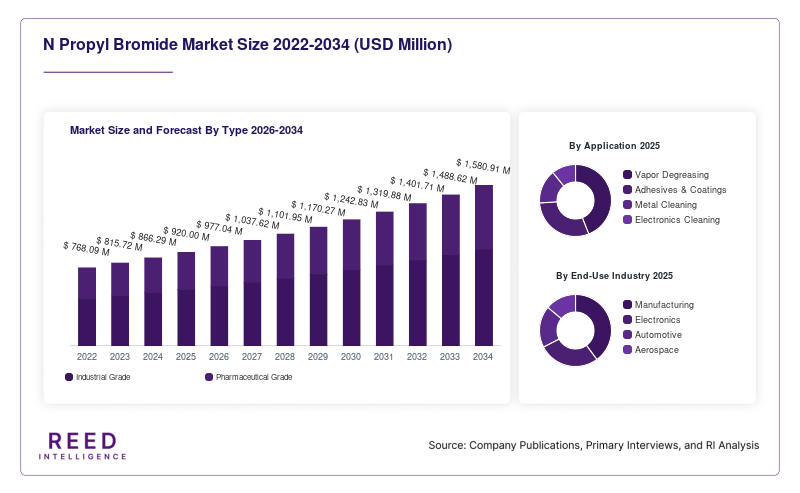
The N Propyl Bromide Market size was valued at approximately USD 920 million in 2025 and is projected to reach USD 1.58 billion by 2034, expanding at a CAGR of 6.2% during the forecast period (2025–2034). The market has experienced steady growth due to its widespread use as a solvent in industrial cleaning, adhesives, coatings, and degreasing applications. N-propyl bromide (nPB) is valued for its effectiveness in dissolving oils, greases, and other contaminants, making it suitable for precision cleaning processes across multiple industries.
A key global factor supporting the growth of the N Propyl Bromide Market is the rising demand for efficient industrial cleaning solutions. As manufacturing industries continue to expand and adopt advanced production technologies, the need for high-performance solvents that can ensure product quality and operational efficiency has increased. This has contributed to the sustained demand for nPB-based formulations across sectors such as electronics, aerospace, and automotive manufacturing.
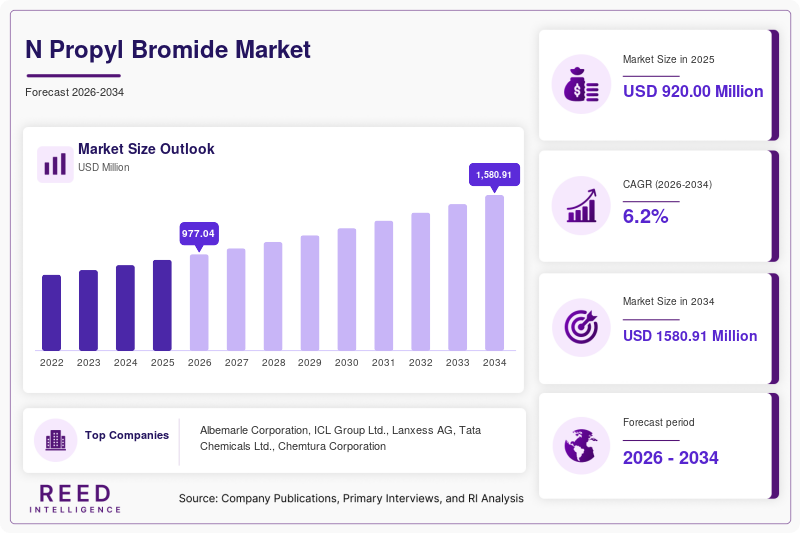
Key Highlights:
- Asia Pacific dominated the market with a 38% share in 2025, while North America is expected to grow at the fastest CAGR of 6.8%.
- Industrial-grade nPB led the type segment with a 62% share, while pharmaceutical-grade nPB is projected to grow at a CAGR of 6.9%.
- Vapor degreasing accounted for 44% of the application segment, while adhesives and coatings are expected to grow at a CAGR of 6.7%.
- China remained the leading country with a market value of USD 210 million in 2025 and is estimated to reach USD 225 million in 2026.
Market Trends
Shift Toward Safer and Regulated Solvent Alternatives
The N Propyl Bromide Market is witnessing a gradual shift toward safer and more regulated solvent usage. Regulatory authorities across regions are implementing stricter guidelines regarding the use of chemicals with potential environmental and health risks. This has prompted manufacturers to improve product formulations and adopt safer handling practices. Companies are investing in research to develop modified versions of nPB with reduced toxicity, ensuring compliance with evolving regulations while maintaining performance efficiency.
Increasing Adoption in Electronics Cleaning Applications
Another key trend shaping the N Propyl Bromide Market is the growing use of nPB in electronics cleaning applications. The miniaturization of electronic components and the increasing complexity of circuit designs require precise cleaning solutions. NPB offers high solvency power and low residue, making it suitable for cleaning sensitive electronic parts. The expansion of the electronics manufacturing sector is supporting this trend, particularly in regions with strong semiconductor production.
Market Drivers
Growing Demand for High-Performance Industrial Solvents
The increasing demand for efficient and high-performance solvents is a major driver of the N Propyl Bromide Market. Industries such as aerospace, automotive, and manufacturing require effective cleaning solutions to maintain product quality and operational efficiency. NPB’s strong solvency properties and ability to clean complex components make it a preferred choice, thereby driving market growth.
Expansion of Manufacturing and Industrial Activities
The expansion of manufacturing activities globally is contributing to the growth of the N Propyl Bromide Market. Industrial development in emerging economies is increasing the demand for cleaning and degreasing agents. As production volumes rise, the need for reliable and efficient solvents continues to grow, supporting the adoption of nPB across various industries.
Market Restraint
Environmental and Health Concerns Associated with nPB
One of the key restraints in the N Propyl Bromide Market is the growing concern regarding its environmental and health impacts. Prolonged exposure to nPB has been associated with potential health risks, including neurological effects and respiratory issues. Regulatory agencies in several regions have introduced restrictions on its use, particularly in occupational settings.
These regulatory challenges can limit market growth by reducing the adoption of nPB in certain applications. Additionally, companies may face increased compliance costs and the need to invest in safer alternatives. The shift toward environmentally friendly solvents further adds pressure on manufacturers, potentially restraining market expansion over the forecast period.
Market Opportunities
Development of Low-Toxicity Formulations
The development of low-toxicity and environmentally compliant formulations presents a significant opportunity for the N Propyl Bromide Market. Manufacturers are focusing on improving product safety while maintaining performance efficiency. Innovations in chemical formulations can help address regulatory concerns and expand the application scope of nPB.
Growth in Emerging Industrial Markets
Emerging markets in Asia Pacific, Latin America, and the Middle East offer substantial growth opportunities for the N Propyl Bromide Market. Rapid industrialization and increasing investments in manufacturing infrastructure are driving demand for industrial solvents. As industries in these regions continue to modernize, the adoption of efficient cleaning solutions is expected to rise, supporting market growth.
Segmental Analysis
By Type
Industrial-grade nPB dominated the N Propyl Bromide Market with a 62% share in 2025. Its widespread use in cleaning and degreasing applications across industries contributed to its leading position.
Pharmaceutical-grade nPB is expected to grow at the fastest CAGR of 6.9%, driven by increasing demand for high-purity solvents in pharmaceutical manufacturing. Stringent quality standards will support growth in this segment.
By Application
Vapor degreasing accounted for the largest share of 44% in 2025 due to its effectiveness in removing contaminants from metal and electronic components.
Adhesives and coatings are projected to grow at a CAGR of 6.7%, supported by increasing demand in construction and automotive industries. NPB’s solvent properties make it suitable for these applications.
By End-Use Industry
Manufacturing held the dominant share of 40% in 2025, driven by the need for efficient cleaning solutions in production processes.
Electronics will grow at a CAGR of 6.6%, supported by the increasing complexity of electronic components and the need for precision cleaning solutions.
By Distribution Channel
Direct sales dominated the market with a 55% share in 2025, as large industrial buyers prefer direct procurement from manufacturers.
Online distribution channels are expected to grow at a CAGR of 6.4%, driven by increasing digitalization and ease of procurement.
Regional Analysis
North America
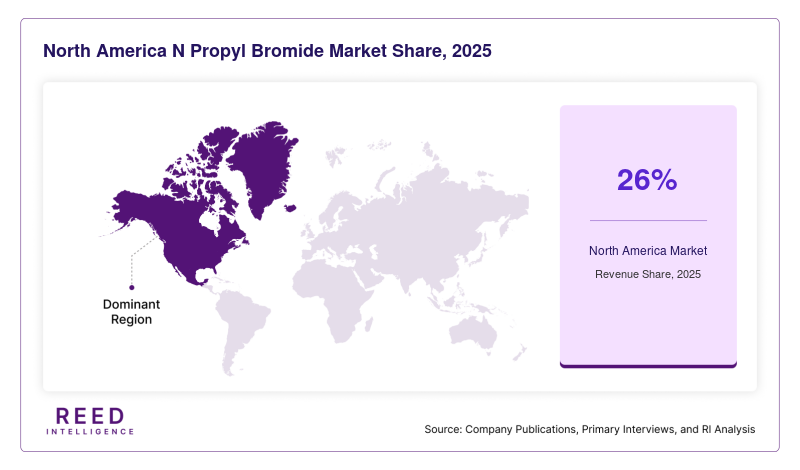
North America accounted for approximately 26% of the N Propyl Bromide Market share in 2025 and will grow at a CAGR of 6.8% during the forecast period. The region has a strong industrial base and high adoption of advanced cleaning technologies.
The United States dominated the regional market due to its well-established manufacturing and aerospace sectors. The demand for precision cleaning solutions in high-tech industries has supported the adoption of nPB-based products.
Europe
Europe held around 24% of the market share in 2025 and will expand at a CAGR of 6.0% through 2034. The region is characterized by strict environmental regulations and a focus on sustainable practices.
Germany emerged as the dominant country, driven by its advanced industrial sector and emphasis on quality manufacturing. The demand for efficient cleaning solutions in automotive and engineering industries has supported market growth.
Asia Pacific
Asia Pacific represented nearly 38% of the market in 2025 and is expected to grow at a CAGR of 6.5%. The region benefits from rapid industrialization and expanding manufacturing activities.
China led the region due to its large-scale industrial production and strong presence in electronics manufacturing. The demand for cleaning solvents in high-volume production processes has driven market growth.
Middle East & Africa
The Middle East & Africa accounted for about 7% of the market share in 2025 and will grow at a CAGR of 5.8%. The region is gradually expanding its industrial base.
The United Arab Emirates dominated the regional market due to its focus on industrial diversification and infrastructure development. Investments in manufacturing sectors have supported demand for industrial solvents.
Latin America
Latin America held approximately 5% of the market share in 2025 and will grow at a CAGR of 5.9%. The region is experiencing steady industrial growth.
Brazil led the region due to its expanding manufacturing sector and increasing adoption of industrial cleaning solutions. The need for efficient production processes has supported market expansion.
Competitive Landscape
The N Propyl Bromide Market is moderately competitive, with key players focusing on product innovation and regulatory compliance. Albemarle Corporation is a leading player, known for its strong chemical manufacturing capabilities and extensive product portfolio. The company has recently focused on developing safer solvent formulations to address environmental concerns.
Other major companies are investing in research and development to improve product safety and expand application areas. Strategic collaborations and regional expansion are common strategies adopted by market participants. The competitive landscape is shaped by evolving regulatory standards and the need for sustainable chemical solutions.
Key Players List
- Albemarle Corporation
- ICL Group Ltd.
- Lanxess AG
- Tata Chemicals Ltd.
- Chemtura Corporation
- Solaris ChemTech Industries Ltd.
- Gulf Resources, Inc.
- Tokyo Chemical Industry Co., Ltd.
- Shandong Weitai Fine Chemical Co., Ltd.
- Yancheng Longsheng Chemical Co., Ltd.
- Perekop Bromine
- TETRA Technologies, Inc.
- Hindustan Salts Limited
- Morre-Tec Industries, Inc.
- Sontara Corporation
Recent Developments
- Albemarle Corporation introduced improved solvent formulations with enhanced safety profiles.
- ICL Group expanded its bromine derivatives production capacity.
- Lanxess AG focused on sustainable chemical solutions for industrial applications.
- Tata Chemicals increased investment in specialty chemical production.
- Gulf Resources, Inc. expanded operations to meet growing global demand.
N Propyl Bromide Market Segments
By Type
- Industrial Grade
- Pharmaceutical Grade
By Application
- Vapor Degreasing
- Adhesives & Coatings
- Metal Cleaning
- Electronics Cleaning
By End-Use Industry
- Manufacturing
- Electronics
- Automotive
- Aerospace
By Distribution Channel
- Direct Sales
- Distributors
- Online Sales
By Region
- North America
- Europe
- APAC
- Middle East and Africa
- LATAM