Nanocrystalline Soft Magnetic Material Market Size, Share & Trends Analysis Report By Type (Iron-Based, Cobalt-Based, Nickel-Based), By Application (Transformers, Inductors, Motors, Generators), By End-User Industry (Automotive, Electronics, Energy, Aerospace) and By Region (North America, Europe, Asia Pacific, Latin America, Middle East & Africa) Forecasts, 2026–2034
USD 3950
Nanocrystalline Soft Magnetic Material Market Size
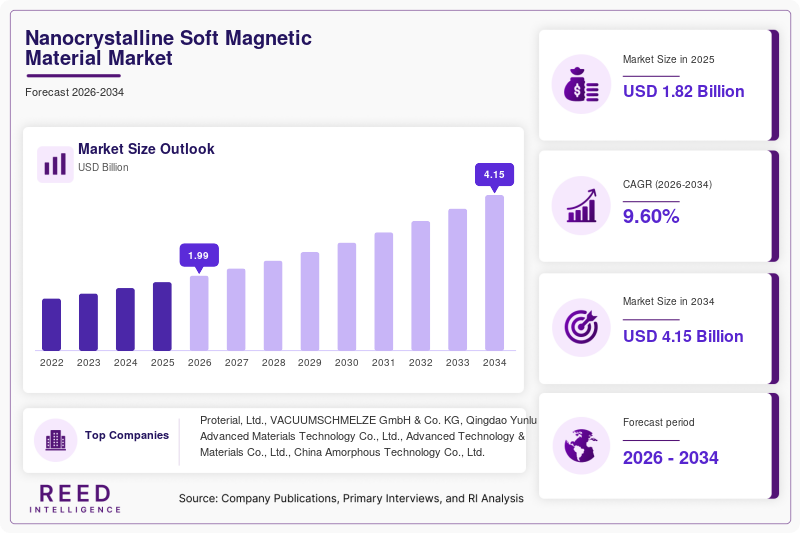
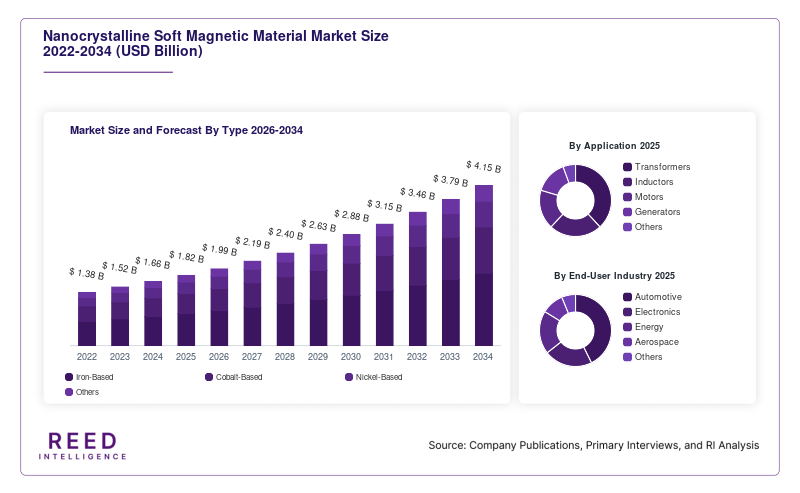
The global nanocrystalline soft magnetic material market size was valued at USD 1.82 billion in 2025 and is projected to grow from USD 1.995 billion in 2026 to USD 4.15 billion by 2034, registering a CAGR of 9.60% during the forecast period from 2026 to 2034.
Nanocrystalline soft magnetic materials are Fe-based and other advanced magnetic alloys characterized by extremely fine crystalline grains embedded in an amorphous matrix. Their combination of high permeability, high saturation flux density, low coercivity and low magnetostriction allows manufacturers to develop compact magnetic components with favorable high-frequency performance. Commercial products such as Proterial's FINEMET and VACUUMSCHMELZE's VITROPERM are supplied as thin ribbons and subsequently processed into cores, chokes, transformers and other magnetic components.
The technology is increasingly important as electrical systems move toward higher power density. EV onboard chargers, DC-DC converters, renewable-energy inverters, data-center power supplies and advanced grid equipment require magnetic components that operate efficiently at elevated frequencies. The resulting design mechanism is straightforward: higher-frequency operation can reduce magnetic-component size, but it also increases the importance of core losses, thermal behavior and saturation characteristics. Nanocrystalline materials address this trade-off more effectively than many conventional magnetic materials in targeted operating ranges.
Nanocrystalline Soft Magnetic Material Market Drivers
Electrification of Vehicles and Power Electronics
Electric vehicles require multiple magnetic components in onboard chargers, DC-DC converters, inverter systems and electromagnetic-interference filters. Nanocrystalline cores can provide high permeability and flux density while supporting compact designs, making them suitable for automotive power electronics. Proterial specifically positions FINEMET products for xEV inverter and onboard-charger applications and for common-mode filtering in EV and hybrid-vehicle systems.
The commercial impact extends beyond vehicle production to charging infrastructure. Higher-power chargers and increasingly compact converter architectures increase the importance of magnetic components that can manage high-frequency switching losses. This creates recurring demand for specialized ribbons and finished cores, while automotive qualification requirements raise barriers to entry for suppliers without demonstrated thermal, reliability and electromagnetic performance.
Expansion of Renewable Energy and Grid Modernization
Solar and wind installations require power-conversion equipment containing transformers, inductors and filtering components. Renewable generation also increases the need for efficient grid interfaces and power-quality equipment. Nanocrystalline materials are particularly relevant where compact, high-frequency conversion stages can reduce the size and weight of magnetic components. Research on transformer materials highlights the relationship between increasing renewable-energy deployment, higher-frequency conversion and demand for advanced magnetic cores.
Grid modernization creates another demand channel through smart transformers, power-quality equipment, energy meters and advanced distribution infrastructure. Lower magnetic losses can reduce energy consumption over equipment operating lifetimes, while higher permeability can support compact electromagnetic components. These characteristics strengthen the value proposition in applications where efficiency regulations and total operating costs influence component selection.
Miniaturization of Electronic and Industrial Equipment
The continuing reduction in the size of power supplies, chargers, telecommunications equipment and industrial electronics is increasing demand for magnetic components that deliver higher performance within smaller footprints. Proterial states that FINEMET contributes to downsizing and lightening electronic and electrical devices, while its common-mode choke products are designed for noise suppression and component-size reduction.
Higher switching frequencies create a parallel technical requirement for lower core losses. Wide-bandgap semiconductor technologies based on silicon carbide and gallium nitride enable faster switching, increasing the need for magnetic materials capable of maintaining acceptable losses at higher frequencies. This expands the addressable market for nanocrystalline inductors, transformers and EMI components across automotive, industrial and data-center power architectures.
Nanocrystalline Soft Magnetic Material Market Restraints
High Manufacturing Complexity and Processing Requirements
Nanocrystalline materials require tightly controlled rapid solidification, ribbon formation and subsequent heat treatment to achieve the desired nanoscale microstructure. VACUUMSCHMELZE, for example, describes VITROPERM ribbons that undergo annealing at temperatures typically between approximately 480°C and 580°C to transform the material into its nanocrystalline state.
These process requirements create higher technical barriers than conventional magnetic-material manufacturing. Ribbon thickness, surface quality, alloy composition, annealing conditions and magnetic-field treatment can materially influence final performance. Manufacturers therefore need specialized production equipment, process-control capabilities and application expertise, limiting the number of suppliers capable of consistently producing high-performance material.
Competition from Alternative Magnetic Materials
Nanocrystalline materials compete with ferrites, silicon steel, amorphous alloys and other soft magnetic technologies. Selection depends on operating frequency, saturation flux density, core losses, temperature, component geometry and cost. Ferrites can remain attractive in applications where their cost and established manufacturing ecosystem outweigh the performance advantages of nanocrystalline materials.
The higher material and processing complexity of nanocrystalline products can therefore limit penetration in price-sensitive applications. Suppliers must demonstrate system-level benefits through smaller components, lower losses, improved electromagnetic compatibility or reduced thermal requirements to justify substitution of established magnetic materials.
Nanocrystalline Soft Magnetic Material Market Opportunities
Solid-State Transformers and High-Frequency Grid Equipment
Solid-state transformers represent an emerging application for high-performance magnetic materials because they use power-electronic conversion stages operating at substantially higher frequencies than conventional grid transformers. Research on medium-frequency transformers indicates that increasing operating frequency can reduce magnetic-component size and weight, creating a technical pathway for advanced magnetic materials in high-power conversion.
Commercialization of solid-state transformers would create demand for specialized nanocrystalline cores capable of operating efficiently under high-frequency and high-power conditions. Suppliers with control over ribbon properties, core geometry, insulation and thermal management can participate higher in the value chain rather than competing solely on material price.
EV Wireless Charging and Advanced Power Transfer
Wireless charging creates another specialized opportunity because magnetic materials are required to manage flux, shielding and losses around power-transfer structures. Proterial developed FINEMET-based magnetic sheets and MS-HiQ panels for EV wireless charging systems, targeting improved efficiency and reductions in system size and weight.
The application can broaden demand beyond conventional ribbon and wound-core products toward engineered magnetic sheets and laminated structures. As wireless charging standards and vehicle integration progress, application-specific materials with controlled magnetic properties can create higher-value opportunities for suppliers capable of meeting automotive reliability and thermal requirements.
Nanocrystalline Soft Magnetic Material Market Segmental Analysis
By Type
Iron-based nanocrystalline materials dominate the market with 54.3% share in 2025. Their combination of commercial scalability, high saturation flux density, high permeability and relatively favorable material economics supports adoption in transformers, inductors and automotive power electronics. FINEMET is a leading example of this material family and is used in high-frequency transformers and noise-suppression components.
The Others category is the fastest-growing type at 11.2% CAGR. It includes emerging alloy compositions and next-generation materials being developed to improve frequency performance, temperature stability and cost characteristics. Cobalt-based materials held 24.6% share and nickel-based materials 13.4% in 2025, while cobalt-based materials continue to serve higher-performance sensing and specialized magnetic applications.
By Application
Transformers represent the dominant application with 36.8% market share in 2025. Distribution, isolation, pulse and high-frequency transformers use nanocrystalline cores where low losses, high permeability and compact designs provide system-level advantages. The technology is particularly relevant to high-frequency power-conversion architectures and renewable-energy equipment.
Inductors are the fastest-growing major application, registering approximately 10.3% CAGR. Their use in power-factor correction, EMI filters, common-mode chokes, EV chargers, renewable-energy inverters and data-center power systems benefits from the high permeability and flux-density characteristics of nanocrystalline materials. The expansion of high-frequency switching architectures reinforces this demand.
By End-User Industry
Automotive is the dominant end-user industry, accounting for 31.4% share in 2025. EV onboard chargers, DC-DC converters, traction-related power electronics and electromagnetic-interference suppression systems create multiple points of material consumption per vehicle. Proterial specifically identifies FINEMET applications across xEV inverters, onboard chargers and automotive common-mode filtering.
Electronics accounts for 26.8% and energy for 24.1%, reflecting demand from consumer electronics, telecommunications, industrial power supplies, renewable-energy conversion and grid equipment. Aerospace represents 9.3%, where high-performance magnetic materials can support compact and efficient electronic systems. Publicly available evidence reviewed for this report does not provide sufficiently consistent CAGR figures for every individual end-user subsegment to assign an unsupported fastest-growing label.
Nanocrystalline Soft Magnetic Material Market Regional Analysis
Asia Pacific Nanocrystalline Soft Magnetic Material Market
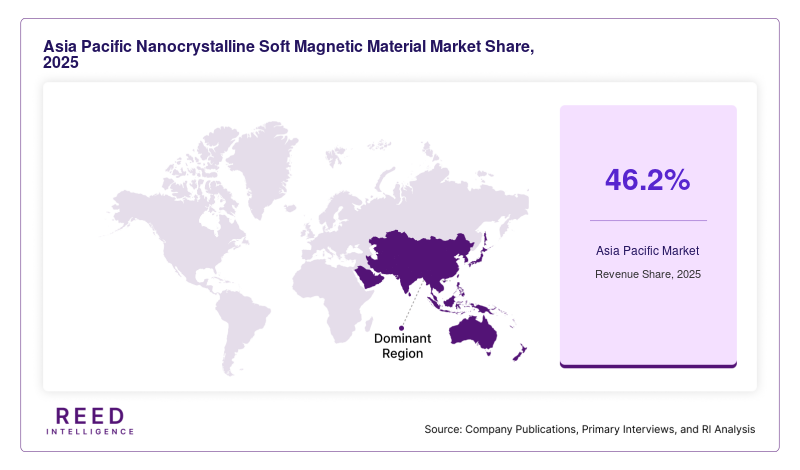
Asia Pacific is the dominant regional market with 46.2% global market share in 2025 and is also the fastest-growing region at 10.8% CAGR through 2034. China and Japan form the core of regional demand and supply, supported by transformer manufacturing, EV production, consumer electronics, renewable-energy deployment and industrial power electronics.
China's large electrical-equipment manufacturing base creates demand for transformers, inductors and magnetic cores, while Japan maintains strong high-specification material capabilities through companies such as Proterial. South Korea and India add demand through semiconductor, electronics, EV and smart-grid investments. The concentration of both producers and downstream manufacturers gives Asia Pacific a substantial supply-chain advantage.
Europe Nanocrystalline Soft Magnetic Material Market
Europe represents approximately 26.4% market share in 2025 and is projected to expand at a 9.1% CAGR through 2034. Demand is supported by automotive electrification, industrial automation, renewable-energy systems and energy-efficiency requirements. Germany, France and the Netherlands are important markets, while European producers maintain strong positions in premium nanocrystalline materials.
Germany provides an important manufacturing and technology base through companies such as VACUUMSCHMELZE, while EV charging infrastructure across Germany, the Netherlands and Scandinavia creates additional demand for compact transformer and inductor cores. Energy-efficiency requirements also favor magnetic materials capable of reducing losses in power-conversion and distribution equipment.
North America Nanocrystalline Soft Magnetic Material Market
North America accounts for approximately 18.7% of global market share in 2025 and is projected to grow at an 8.9% CAGR through 2034. The United States is the principal regional market, supported by aerospace and defense electronics, EV infrastructure, renewable-energy investment and advanced power-electronics manufacturing.
U.S. demand is also supported by the development of higher-frequency power converters using SiC and GaN semiconductors. Domestic and regional suppliers serve transformer, electronics and automotive customers, while nanocrystalline cores are increasingly relevant to EMI filtering, current sensing, onboard charging and high-efficiency power supplies.
Latin America Nanocrystalline Soft Magnetic Material Market
Latin America accounts for a smaller share of global demand but is projected to grow at approximately 8.2% CAGR through 2034. Market development is linked primarily to electrical-grid investment, industrial electrification, renewable-energy deployment and expansion of electronics manufacturing.
Brazil and Mexico represent the principal demand centers, with Brazil supported by energy and industrial applications and Mexico benefiting from electronics and automotive manufacturing. Adoption remains more project-driven than in Asia Pacific, Europe and North America, making supplier availability, pricing and technical support important purchasing factors.
Middle East & Africa Nanocrystalline Soft Magnetic Material Market
Middle East & Africa represents an emerging regional market with approximately 7.6% CAGR through 2034. Demand is concentrated around grid infrastructure, industrial electrification, renewable-energy projects and selected electronics applications.
Gulf countries provide opportunities through power infrastructure and renewable-energy investments, while South Africa contributes through industrial and electrical applications. Market development remains dependent on infrastructure spending and availability of specialized magnetic components, with imported materials and technical qualification influencing procurement decisions.
Nanocrystalline Soft Magnetic Material Market Competitive Landscape
The competitive landscape is concentrated around companies with proprietary alloy compositions, rapid-solidification processes, controlled annealing capabilities and established relationships with power-electronics and electrical-equipment manufacturers. Proterial, Ltd. is a leading participant through its FINEMET family, which was commercialized as the world's first nanocrystalline soft magnetic material. The company combines material development with finished magnetic components, including common-mode choke cores and magnetic shielding products.
VACUUMSCHMELZE GmbH & Co. KG competes through its VITROPERM nanocrystalline portfolio, offering ribbons, toroidal and oval cores, common-mode chokes and current transformers. Its product range spans different permeability, magnetostriction and loss characteristics, allowing the company to address EMI suppression, current measurement, transformers and high-frequency power applications.
Key Market Players
- Proterial, Ltd.
- VACUUMSCHMELZE GmbH & Co. KG
- Qingdao Yunlu Advanced Materials Technology Co., Ltd.
- Advanced Technology & Materials Co., Ltd.
- China Amorphous Technology Co., Ltd.
- Londerful New Material
- Toshiba Materials Co., Ltd.
- Daido Steel Co., Ltd.
- Magnetec GmbH
- Bomatec AG
- Henan Zhongyue Amorphous New Materials Co., Ltd.
- Foshan Huaxin
Nanocrystalline Soft Magnetic Material Market Recent Developments
-
October 2025 -Proterial: At Auto Shanghai 2026, Proterial showcased FINEMET common-mode choke coils and cores and FINEMET shield-yoke sheets for inverter and onboard-charger applications, reinforcing the company's focus on automotive electrification.
-
April 2026 - Proterial: At Hannover Messe 2026, Proterial presented FINEMET nanocrystalline soft-magnetic cut cores alongside other advanced materials, highlighting the material's continued positioning in high-performance electrical and energy applications.
Nanocrystalline Soft Magnetic Material Market Segments
By Type
- Iron-Based
- Cobalt-Based
- Nickel-Based
- Others
By Application
- Transformers
- Inductors
- Motors
- Generators
- Others
By End-User Industry
- Automotive
- Electronics
- Energy
- Aerospace
- Others
By Region
- North America
- Europe
- APAC
- Middle East and Africa
- LATAM