Global Nanoparticle Synthesis System Market Size, Share & Trends Analysis Report By Technology Type (Chemical Reduction Systems, Microfluidic Synthesis Systems, Sol-Gel Process Systems, Laser Ablation Systems), By Scale of Operation (Laboratory-Scale Systems, Pilot-Scale Systems, Industrial-Scale Systems), By Country (North America, Europe, APAC, Middle East and Africa, Latin America) and Forecast, 2026-2034
USD 3950
Nanoparticle Synthesis System Market Size
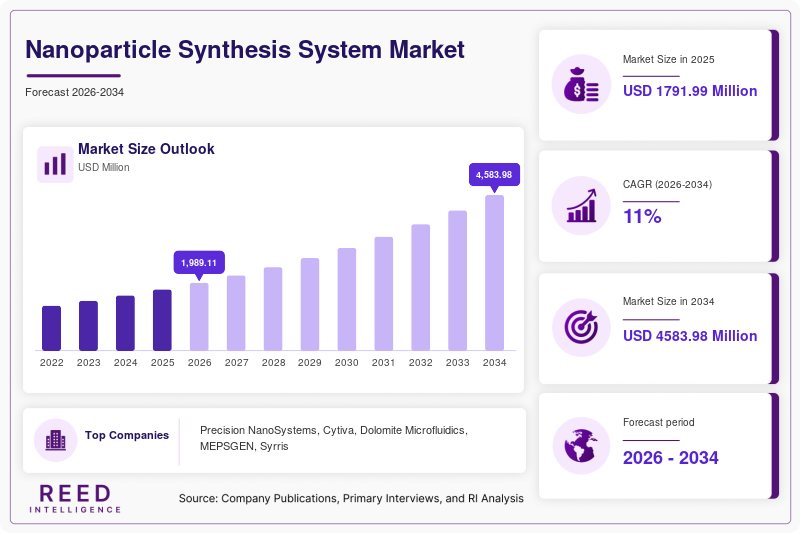
Global Nanoparticle Synthesis System Market size is projected at USD 1,989.11 million in 2026 and is expected to hit USD 4,539.22 million by 2034 with a CAGR of 11%. The industry expands from USD 1,794.23 million in 2025, adding approximately USD 2,550.11 million during 2026–2034. Market assessment requires detailed technology, operating-scale, end-use, material and geographic segmentation alongside supplier positioning and competitive benchmarking.
Key Takeaways
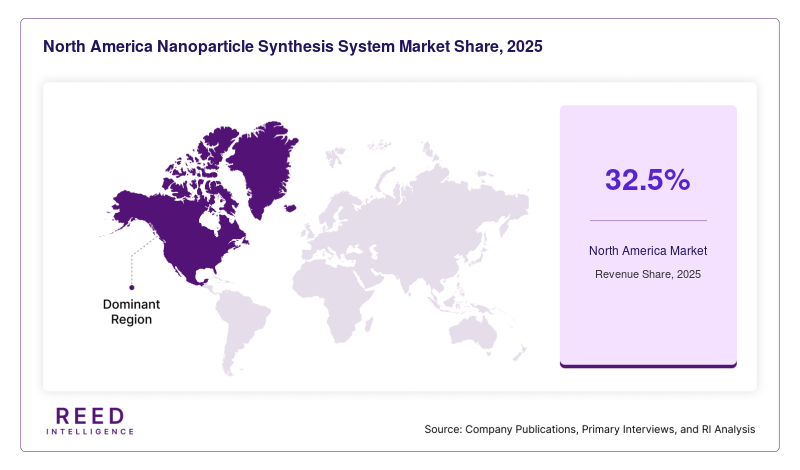
- North America dominates regional revenue with USD 647.22 million in 2026, equivalent to approximately 32.54% of the regional total, while Latin America records the fastest CAGR at 11.62%.
- Asia Pacific reaches USD 542.26 million in 2026 and USD 1,252.36 million by 2034, expanding at an 11.03% CAGR.
- Chemical Reduction Systems dominate technology revenue at USD 653.85 million in 2026, representing approximately 32.79% of the technology total, and also record the highest technology CAGR of 11.41%.
- Microfluidic Synthesis Systems generate USD 366.85 million in 2026 and are forecast at USD 849.09 million by 2034, with an 11.06% CAGR.
- Country-level emerging-market forecasts were not supplied in the mandatory dataset; consequently, no unsupported country revenue or CAGR estimate has been introduced.
The nanoparticle synthesis system industry comprises laboratory, pilot and industrial equipment designed to manufacture metallic, polymeric, lipid, ceramic/oxide and carbon-based nanoparticles through controlled chemical, physical, microfluidic, plasma, biological and related processes. The supplied regional dataset places 2026 revenue at USD 1,989.11 million versus USD 1,794.23 million in 2025, an increase of about 10.86%. North America contributes 32.54%, Asia Pacific 27.26%, Europe 26.51%, Middle East and Africa 8.59%, and Latin America 5.10% of the 2026 regional total. In the technology dataset, Chemical Reduction Systems contribute approximately 32.79% of USD 1,993.97 million in 2026, followed by Microfluidic Synthesis Systems at 18.40% and Sol-Gel Process Systems at 14.18%.
Nanoparticle Synthesis System Market Trends
Automation, Continuous Processing and Microfluidic Manufacturing
Continuous-flow synthesis is replacing portions of conventional batch processing as users seek tighter particle-size distributions, repeatability and scale-up flexibility. Commercial microfluidic platforms can provide mixing below 3 milliseconds, formulation times below 2 minutes, processing volumes of 1–15 mL per run and flow rates of 1–18 mL/min. Research is increasingly integrating thermal, electrical, electromagnetic and acoustic actuation with passive hydrodynamic, vortex and chaotic-advection techniques.
Nanomedicine is accelerating this transition because lipid, polymer and hybrid particles require reproducible control of size, dispersity and encapsulation. In 2025, research advanced toward high-throughput milli/microfluidic reactors, while 2026 work demonstrated predictive models intended to reduce experimental screening across different lipid concentrations, flow rates and mixing ratios. These developments are shifting system requirements toward automated parameter control, continuous processing and digitally optimized synthesis rather than purely manual batch operation.
Nanoparticle Synthesis System Market Drivers
Expansion of Nanomedicine and Precision Nanoparticle Manufacturing
Pharmaceutical and biotechnology applications are strengthening equipment demand as developers require reproducible lipid nanoparticles, liposomes and polymeric carriers for nucleic acids, small molecules and proteins. Commercial systems already support 1–15 mL preparation volumes per run, 1–18 mL/min flow rates, 20–70°C heating and sub-3-millisecond mixing. In April 2025, MEPSGEN launched NanoCalibur in the United States following its Q4 2024 Korean introduction, targeting laboratory-to-preclinical production of lipid, lipid-polymer and lipid-protein nanoparticles. These capabilities reduce formulation variability while enabling multiple material classes on a single platform.
Nanoparticle Synthesis System Market Restraints
Scale-Up Complexity and Reproducibility Constraints
Moving from milliliter-scale research to continuous industrial production remains technically demanding because particle size, morphology and polydispersity can shift with minor changes in flow rate, concentration, temperature and mixing ratio. Conventional batch routes continue to face batch-to-batch reproducibility limitations, while microfluidic platforms may operate at formulation scales such as 1–15 mL per run and require carefully controlled flows of 1–18 mL/min. Research published in 2025 specifically identified reproducibility as a persistent problem affecting downstream toxicology and application performance, reinforcing the need for precision process controls.
Nanoparticle Synthesis System Market Opportunities
Intelligent Microfluidics and Automated Laboratories
Integration of machine learning, robotics and continuous-flow synthesis creates an opportunity to shorten formulation development cycles. A 2025 review identified machine-learning-enabled intelligent microfluidics as an emerging direction, while 2026 research demonstrated robotic execution of multi-step gold and magnetite nanoparticle synthesis using reusable motion primitives. Predictive continuous-flow research is simultaneously targeting reduced experimental workload by modeling particle size and dispersity across multiple concentrations, flow rates and aqueous-to-organic ratios. Together, these technologies can improve utilization, reproducibility and automated optimization across research and scale-up workflows.
Challenges in Global Nanoparticle Synthesis System Market
Maintaining Particle Quality During Commercial Scale-Up
The central challenge is preserving nanoscale properties when production moves from small research batches toward higher-throughput operation. Millisecond-scale mixing, multiple fluid ratios, temperature windows and formulation concentrations can independently influence particle size and dispersity. Current commercial research platforms demonstrate mixing below 3 milliseconds and flows reaching 18 mL/min, yet industrial applications require substantially greater throughput without sacrificing reproducibility. High-throughput reactor research in 2025 therefore focused on controlling laminar, transitional, turbulent and micro-vortex flow regimes to overcome nonhomogeneous particle characteristics associated with conventional production.
Nanoparticle Synthesis System Market Segmentation
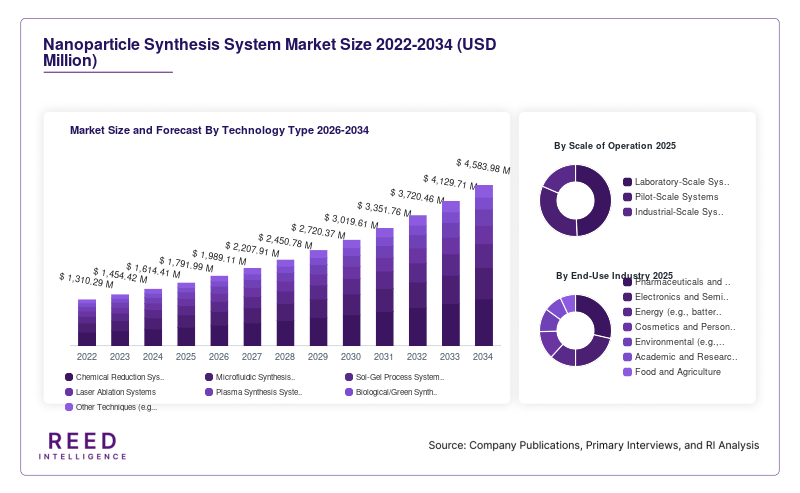
Technology segmentation shows Chemical Reduction Systems leading with approximately 32.79% of 2026 technology revenue, followed by Microfluidic Synthesis Systems at 18.40%, Sol-Gel at 14.18%, Laser Ablation at 11.08%, Biological/Green Synthesis at 9.33%, Plasma Synthesis at 8.55% and other techniques at approximately 5.66%.
By Technology Type
Chemical Reduction Systems increase from USD 586.89 million in 2025 to USD 653.85 million in 2026 and USD 1,551.94 million by 2034, registering an 11.41% CAGR. They are both the largest and fastest-growing technology category in the supplied dataset.
Microfluidic Synthesis Systems advance at 11.06%, Sol-Gel Process Systems at 11.24%, Laser Ablation Systems at 11.04%, Plasma Synthesis Systems at 10.63%, Biological/Green Synthesis Systems at 11.07%, and other techniques at 10.56%. Their respective 2034 revenues reach USD 849.09 million, USD 663.12 million, USD 510.65 million, USD 382.57 million, USD 431.11 million and USD 251.98 million.
By Scale of Operation
Laboratory-Scale Systems, Pilot-Scale Systems and Industrial-Scale Systems represent the progression from formulation screening through process validation to commercial manufacturing. Numerical subsegment revenue, dominance and CAGR values were not provided for this segmentation, so no unsupported allocation of the USD 1,989.11 million 2026 regional total or 11% overall CAGR has been made.
The segment nevertheless spans systems ranging from milliliter research operation to higher-throughput continuous configurations. Commercial research equipment can process 1–15 mL per run at 1–18 mL/min, while scale-up research increasingly targets continuous manufacturing and rapid mixing below 3 milliseconds.
By End-Use Industry
The end-use structure covers Pharmaceuticals and Biotechnology, Electronics and Semiconductors, Energy, Cosmetics and Personal Care, Environmental applications, Academic and Research Institutes, and Food and Agriculture. End-use revenue and CAGR splits were not included in the mandatory numerical tables; accordingly, percentages have not been inferred from the USD 1,989.11 million 2026 total.
Pharmaceutical applications are particularly associated with lipid, polymer and hybrid nanoparticle production, while environmental and agricultural applications extend into sensing, contaminant treatment and functional nanomaterials. Systems increasingly support multiple particle chemistries and continuous processing parameters rather than single-purpose production configurations.
By Material Type Synthesized
Material segmentation comprises Metallic Nanoparticles, Polymeric Nanoparticles, Lipid-Based Nanoparticles, Ceramic/Oxide Nanoparticles and Carbon-Based Nanoparticles. Material-specific market values and CAGRs were not supplied, preventing defensible allocation of either the USD 1,794.23 million 2025 base or the USD 4,539.22 million 2034 forecast.
Platform versatility is expanding: microfluidic equipment can manufacture nucleic-acid lipid nanoparticles, liposomes, polymer particles and organic/inorganic nanoparticles, with operating parameters including 20–70°C heating and flows up to 18 mL/min. This multi-material capability supports pharmaceutical, electronics, energy and research applications from one configurable synthesis architecture.
Nanoparticle Synthesis System Market Regional Outlook
North America
North America leads with USD 647.22 million in 2026, approximately 32.54% of the regional total, rising from USD 584.56 million in 2025 to USD 1,461.72 million by 2034 at 10.72% CAGR. The United States anchors regional activity through pharmaceutical R&D, nanomedicine, electronics and academic infrastructure; country-specific revenue splits were not supplied.
Europe
Europe accounts for approximately 26.51% of 2026 regional revenue at USD 527.29 million. The region progresses from USD 476.37 million in 2025 to USD 1,188.28 million by 2034 at a 10.69% CAGR, supported by pharmaceutical, materials, energy and university research applications across major European research economies.
APAC
Asia Pacific generates USD 542.26 million in 2026, representing approximately 27.26%, and is projected to reach USD 1,252.36 million by 2034 from USD 488.39 million in 2025. Its 11.03% CAGR reflects expanding nanotechnology research, semiconductor manufacturing, pharmaceutical development and advanced-material production across China, Japan, South Korea and India; country-specific monetary contributions were not supplied.
Middle East and Africa
Middle East and Africa contributes approximately 8.59% in 2026, with revenue increasing from USD 153.94 million in 2025 to USD 170.80 million in 2026 and USD 392.19 million in 2034 at 10.95% CAGR. Research institutes, environmental treatment, energy materials and pharmaceutical development constitute relevant adoption areas, although country and sector revenue splits are unavailable.
Latin America
Latin America represents approximately 5.10% of 2026 revenue but records the fastest regional CAGR at 11.62%. Revenue rises from USD 90.97 million in 2025 to USD 101.54 million in 2026 and USD 244.67 million by 2034, indicating increasing deployment across academic research, pharmaceuticals, environmental technologies and advanced materials.
Top players in Global Nanoparticle Synthesis System Market
- Precision NanoSystems
- Cytiva
- Dolomite Microfluidics
- MEPSGEN
- Syrris
- Microfluidics International Corporation
- Chemspeed Technologies
- CEM Corporation
- Anton Paar
- HORIBA
- Malvern Panalytical
- Particle Works
- Micronit
- Elveflow
- Fluigent
Top Two Companies
-
Precision NanoSystems: Precision NanoSystems is positioned strongly in microfluidic nanoparticle formulation through the NanoAssemblr platform, which supports lipid nanoparticles, liposomes, polymer nanoparticles and hybrid formulations. Available institutional specifications show mixing below 3 milliseconds, preparation volumes of 1–15 mL per run, flow rates of 1–18 mL/min and temperatures of 20–70°C. These capabilities position the platform across discovery and development workflows for RNA medicines and other nanomedicines. A verified company-specific percentage of global industry revenue was not provided in the mandatory dataset; therefore, no fabricated supplier share has been assigned.
-
MEPSGEN: MEPSGEN strengthened its commercial position with NanoCalibur, introduced in Korea during Q4 2024 and launched in the United States on April 1, 2025. The system targets scalable production from laboratory research through preclinical development and supports lipid nanoparticles, liposomes, lipid-polymer nanoparticles and lipid-protein nanoparticles using microfluidic processing. Its positioning reflects the broader transition toward reproducible continuous nanoparticle manufacturing. The supplied numerical tables contain regional and technology values but no company revenue distribution; consequently, an evidence-based percentage supplier share cannot be calculated.
Recent Developments in Global Nanoparticle Synthesis System Market
- 2026: Researchers demonstrated predictive modeling for continuous-flow liposome and lipid nanoparticle production, targeting reductions in empirical experiments while evaluating concentration, flow-rate and mixing-ratio effects.
- 2026: Research on robotic solution-based synthesis demonstrated automated multi-step preparation of gold and magnetite nanoparticles using programming-by-demonstration and reusable robotic motion primitives.
- 2025: MEPSGEN launched NanoCalibur in the United States on April 1 after its Q4 2024 Korean debut, extending microfluidic nanoparticle production capabilities into U.S. laboratory and preclinical workflows.
- 2025: MIT researchers reported a microfluidic approach designed for rapid, larger-scale manufacturing of specialized drug-delivery nanoparticles, addressing translation from research production toward scalable therapeutic manufacturing.
- 2025: Research on high-throughput co-flow millifluidic synthesis demonstrated controlled mixing across laminar, transitional, turbulent and micro-vortex regimes to improve nanoparticle synthesis and encapsulation consistency.
Nanoparticle Synthesis System Market Segments
By Technology Type
- Chemical Reduction Systems
- Microfluidic Synthesis Systems
- Sol-Gel Process Systems
- Laser Ablation Systems
- Plasma Synthesis Systems
- Biological/Green Synthesis Systems
- Other Techniques (e.g., vapor deposition, electrochemical methods)
By Scale of Operation
- Laboratory-Scale Systems
- Pilot-Scale Systems
- Industrial-Scale Systems
By End-Use Industry
- Pharmaceuticals and Biotechnology
- Electronics and Semiconductors
- Energy (e.g., batteries, solar cells)
- Cosmetics and Personal Care
- Environmental (e.g., wastewater treatment)
- Academic and Research Institutes
- Food and Agriculture
By Material Type Synthesized
- Metallic Nanoparticles (e.g., gold, silver)
- Polymeric Nanoparticles
- Lipid-Based Nanoparticles
- Ceramic/Oxide Nanoparticles
- Carbon-Based Nanoparticles (e.g., fullerenes, graphene)
By Region
- North America
- Europe
- APAC
- Middle East and Africa
- LATAM