Naphthenic Acid Market Size, Share & Demand Report By Type (Industrial Grade, High-Purity Grade), By Application (Corrosion Inhibitors, Lubricant Additives, Wood Preservatives, Paints & Coatings, Catalysts), By End-Use Industry (Oil & Gas, Chemical Manufacturing, Automotive, Construction, Marine), By Form (Liquid, Solid), By Region & Segment Forecasts, 2025–2034
USD 3950
Market Overview
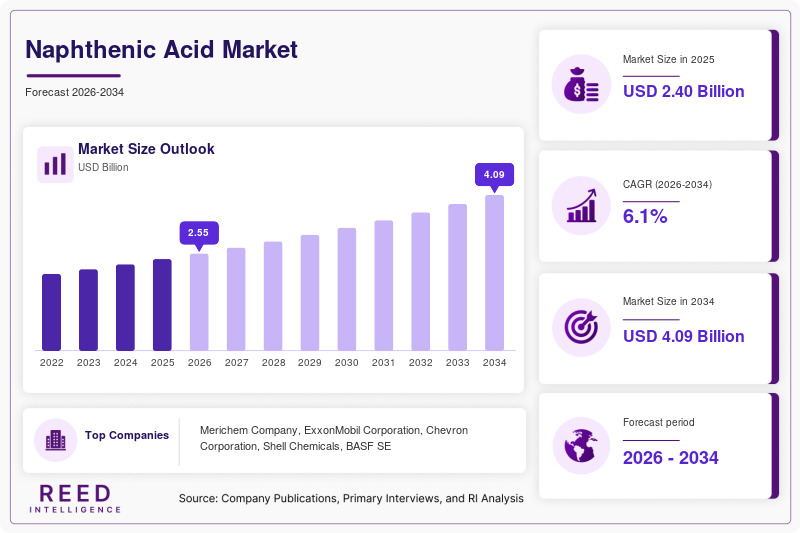
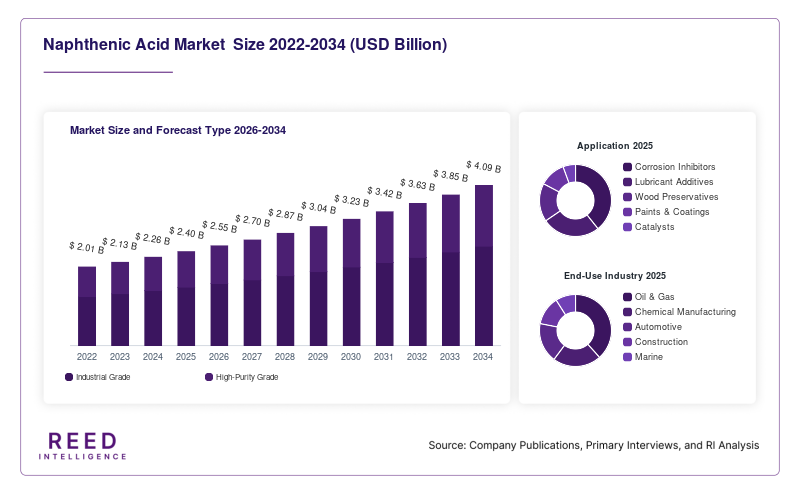
The global Naphthenic Acid Market size was valued at approximately USD 2.4 billion in 2025 and is projected to reach USD 4.1 billion by 2034, expanding at a CAGR of 6.1% during 2025–2034. The market growth is supported by increasing industrial demand for corrosion inhibitors, lubricants, and metal naphthenates, particularly across oil & gas and chemical manufacturing sectors.
A key global factor driving the expansion of the Naphthenic Acid Market is the steady rise in crude oil refining activities. As naphthenic acids are naturally occurring components in crude oil and are also derived during refining processes, increased refinery throughput has directly contributed to greater availability and downstream utilization. This has enabled manufacturers to integrate naphthenic acid derivatives into coatings, wood preservatives, and fuel additives, supporting broader industrial applications.
Key Highlights
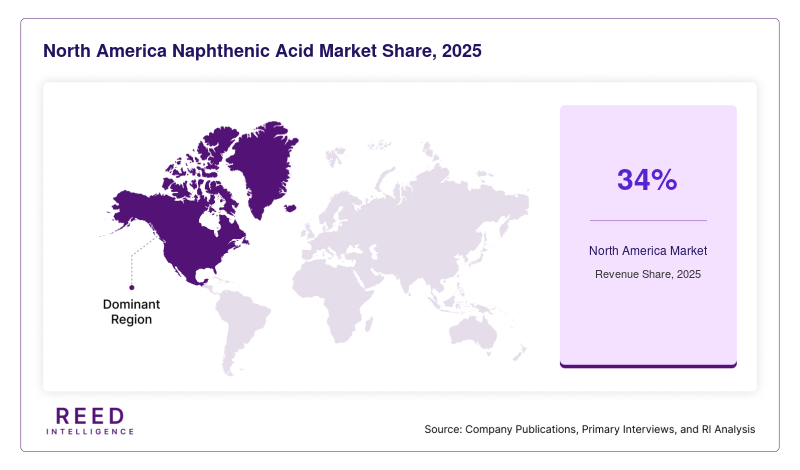
- North America dominated the market with a 34% share in 2025, while Asia Pacific is projected to grow at the fastest CAGR of 7.3%.
- The industrial grade segment led with 52% share, while high-purity grade is expected to grow at a CAGR of 6.8%.
- Corrosion inhibitors application held the largest share at 38%, while lubricant additives are expected to expand at a CAGR of 6.9%.
- The U.S. market was valued at USD 680 million in 2025 and is estimated to reach USD 710 million in 2026.
Market Trends
Increasing Demand for Metal Naphthenates
The growing use of metal naphthenates in paints, coatings, and catalysts is shaping the Naphthenic Acid Market. These derivatives are widely utilized as drying agents and stabilizers due to their solubility and reactivity. Industries are shifting toward efficient chemical intermediates that enhance performance while maintaining cost efficiency. This trend is particularly strong in infrastructure development projects, where coatings with improved durability and corrosion resistance are required.
Shift Toward Sustainable and Refined Products
The market is witnessing a gradual shift toward environmentally improved refining processes. Manufacturers are focusing on reducing impurities and enhancing biodegradability in naphthenic acid products. This shift aligns with evolving environmental standards and industrial sustainability goals. Advanced refining technologies are being adopted to produce cleaner grades of naphthenic acids, enabling their use in more sensitive applications such as specialty lubricants and high-performance coatings.
Market Drivers
Expansion of Oil & Gas Refining Activities
The steady expansion of global oil refining capacity has been a primary driver for the Naphthenic Acid Market. As refining output increases, the availability of naphthenic acids also rises, enabling consistent supply for downstream industries. Refineries are optimizing processes to extract value-added byproducts, including naphthenic acids, thereby enhancing overall profitability and supporting market growth.
Rising Demand for Corrosion Protection Solutions
Industries such as marine, construction, and energy are increasingly adopting corrosion inhibitors to extend asset lifespan. Naphthenic acids are widely used in the formulation of such inhibitors due to their effectiveness in harsh environments. This demand has been further amplified by the need for maintenance cost reduction and operational efficiency, driving consistent consumption across multiple industrial sectors.
Market Restraint
Environmental and Toxicity Concerns
One of the key challenges in the Naphthenic Acid Market is the environmental and health concerns associated with certain grades of naphthenic acids. These compounds can exhibit toxicity depending on their composition and concentration, which has raised regulatory scrutiny in several regions. Environmental agencies have introduced stricter guidelines for handling, disposal, and emissions related to these substances.
As a result, manufacturers are required to invest in advanced treatment and purification systems, increasing operational costs. Additionally, compliance with regulatory standards can slow down product approvals and market entry for new formulations. These constraints may limit the adoption of conventional naphthenic acid products, particularly in regions with stringent environmental frameworks.
Market Opportunities
Growth in Specialty Chemicals Segment
The increasing demand for specialty chemicals presents a significant opportunity for the Naphthenic Acid Market. Naphthenic acids serve as key intermediates in producing high-value specialty products such as catalysts, additives, and stabilizers. As industries move toward customized chemical solutions, the demand for tailored naphthenic acid derivatives is expected to rise, opening new revenue streams.
Emerging Markets Industrialization
Rapid industrialization in emerging economies offers substantial growth potential. Expanding manufacturing sectors, infrastructure development, and rising investments in oil & gas projects are creating strong demand for naphthenic acid-based products. These regions provide opportunities for market players to establish production facilities and distribution networks, enhancing market penetration and long-term growth prospects.
Segmental Analysis
By Type
The industrial grade naphthenic acid segment dominated the Naphthenic Acid Market with a 52% share in 2025. This dominance was attributed to its widespread use in corrosion inhibitors, wood preservatives, and metal treatment applications. Industrial grade products offer cost efficiency and adequate performance for large-scale applications, making them suitable for various industries.
The high-purity grade segment is expected to grow at the fastest CAGR of 6.8% during the forecast period. This growth will be driven by increasing demand for refined and specialized chemical applications. High-purity naphthenic acids provide enhanced performance characteristics, making them suitable for advanced industrial uses such as specialty lubricants and catalysts.
By Application
The corrosion inhibitors segment held the largest share at 38% in 2025. This segment benefited from widespread adoption in oil & gas, marine, and infrastructure industries. The ability of naphthenic acids to prevent metal degradation has made them essential in maintaining operational efficiency.
The lubricant additives segment is projected to grow at a CAGR of 6.9%. This growth will be supported by increasing demand for high-performance lubricants in automotive and industrial applications. Naphthenic acid derivatives improve lubrication efficiency and reduce wear, enhancing equipment lifespan.
By End-Use Industry
The oil & gas industry dominated the market with a 45% share in 2025. The sector utilized naphthenic acids in refining processes and corrosion protection applications. The consistent demand from upstream and downstream operations has sustained market growth.
The chemical manufacturing industry is expected to grow at a CAGR of 6.7%. This growth will be driven by increasing use of naphthenic acids as intermediates in producing specialty chemicals. The shift toward value-added chemical products will further support segment expansion.
By Form
The liquid form segment dominated with a 60% share in 2025 due to its ease of handling and compatibility with various industrial processes. Liquid naphthenic acids are widely used in blending and formulation applications.
The solid form segment is anticipated to grow at a CAGR of 6.4%. This growth will be driven by its stability and suitability for specific applications requiring controlled usage and storage.
Regional Analysis
North America
North America accounted for 34% of the Naphthenic Acid Market share in 2025 and is expected to grow at a CAGR of 5.8% through 2034. The region benefited from a mature oil refining industry and strong demand for industrial chemicals. The presence of advanced infrastructure and established supply chains contributed to consistent consumption patterns.
The United States emerged as the dominant country due to its extensive refining capacity and focus on value-added petroleum derivatives. The country’s emphasis on optimizing refinery outputs and integrating downstream chemical production supported sustained demand for naphthenic acids. Additionally, industrial applications such as coatings and lubricants have reinforced market stability.
Europe
Europe held approximately 26% share in 2025 and is projected to grow at a CAGR of 5.6%. The region demonstrated steady demand driven by industrial applications and regulatory-driven product innovation. The emphasis on environmentally compliant chemicals has influenced product development strategies across the region.
Germany led the market due to its strong chemical manufacturing base. The country’s focus on high-quality industrial chemicals and advanced production technologies supported the adoption of refined naphthenic acid products. Continuous investment in research and development has enabled manufacturers to align with regulatory requirements.
Asia Pacific
Asia Pacific captured around 22% share in 2025 and is expected to grow at the fastest CAGR of 7.3%. The region experienced rapid industrial expansion and increasing demand for chemicals in manufacturing and infrastructure projects. Growing refinery capacities have also contributed to market growth.
China dominated the region due to its large-scale industrial base and expanding refining sector. The country’s strong demand for coatings, lubricants, and chemical intermediates has driven the consumption of naphthenic acids. Government initiatives supporting industrial development further strengthened market prospects.
Middle East & Africa
The Middle East & Africa accounted for 10% share in 2025 and is anticipated to grow at a CAGR of 6.2%. The region’s growth was supported by expanding oil production and refining activities. Increasing investments in petrochemical infrastructure have enhanced market potential.
Saudi Arabia led the region due to its extensive oil reserves and focus on downstream diversification. The country’s efforts to develop value-added petrochemical products have contributed to increased utilization of naphthenic acids.
Latin America
Latin America held around 8% share in 2025 and is expected to grow at a CAGR of 5.9%. The region showed moderate growth supported by industrial development and energy sector activities.
Brazil emerged as the dominant country due to its growing industrial base and refining capabilities. The country’s expanding demand for industrial chemicals and coatings has supported the adoption of naphthenic acid products.
Competitive Landscape
The Naphthenic Acid Market is moderately consolidated, with key players focusing on product innovation, refining efficiency, and strategic partnerships. Leading companies are investing in advanced purification technologies to improve product quality and expand application scope.
One of the prominent market leaders, Merichem Company, has strengthened its position through advancements in extraction and refining technologies. The company recently introduced enhanced purification processes to improve product consistency and meet evolving industrial requirements.
Other players are emphasizing regional expansion and collaboration with end-use industries to strengthen their market presence. Competitive strategies include capacity expansion, product portfolio diversification, and technological upgrades aimed at improving operational efficiency.
Key Players
- Merichem Company
- Umicore N.V.
- ExxonMobil Corporation
- Chevron Corporation
- Shell Chemicals
- Merck KGaA
- Lanxess AG
- Clariant AG
- Eastman Chemical Company
- King Industries, Inc.
- Shepherd Chemical Company
- Penta Manufacturing Company
- Innophos Holdings Inc.
- Arkema Group
- BASF SE
Recent Developments
- 2024: Merichem Company expanded its refining capabilities to enhance high-purity naphthenic acid production.
- 2024: Lanxess AG introduced improved metal naphthenate formulations for coatings applications.
- 2023: Eastman Chemical Company increased investment in specialty chemical intermediates.
- 2023: BASF SE focused on sustainable chemical production processes.
- 2023: Clariant AG strengthened its product portfolio with advanced additive solutions.
Naphthenic Acid Market Segments
Type
- Industrial Grade
- High-Purity Grade
Application
- Corrosion Inhibitors
- Lubricant Additives
- Wood Preservatives
- Paints & Coatings
- Catalysts
End-Use Industry
- Oil & Gas
- Chemical Manufacturing
- Automotive
- Construction
- Marine
Form
- Liquid
- Solid
Distribution Channel
- Direct Sales
- Distributors & Traders
- Online Sales
By Region
- North America
- Europe
- APAC
- Middle East and Africa
- LATAM