Natural Butyric Acid Market Size, Share & Demand Report By Type (Calcium Butyrate, Sodium Butyrate, Other Butyrate Salts), By Application (Animal Feed, Pharmaceuticals, Food & Beverages, Nutraceuticals), By End-Use (Livestock Industry, Food Industry, Healthcare Sector, Research & Laboratories), By Region & Segment Forecasts, 2026–2034
USD 3950
Market Overview
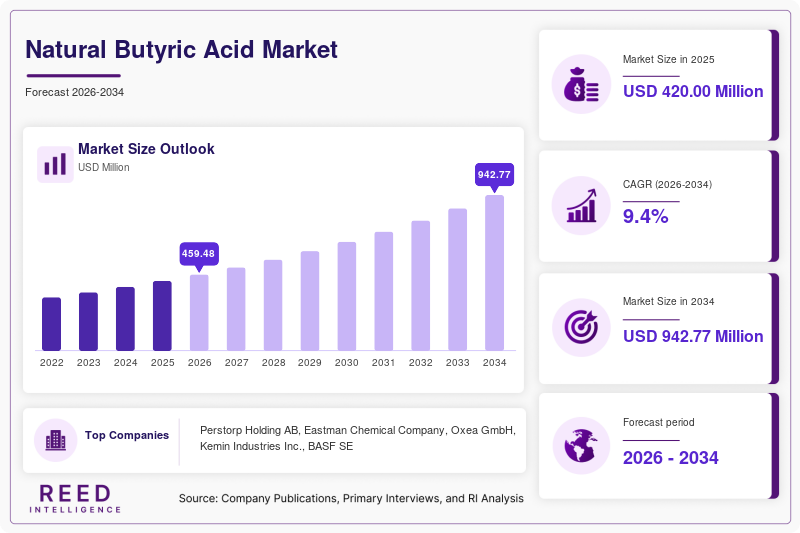
The Natural Butyric Acid Market size was valued at approximately USD 420 million in 2026 and is projected to reach USD 860 million by 2034, expanding at a CAGR of 9.4% during the forecast period (2026–2034). The market is experiencing steady growth due to increasing demand for naturally derived feed additives, pharmaceuticals, and food preservation solutions. Natural butyric acid, typically sourced from fermentation processes, is gaining preference over synthetic alternatives due to its bioavailability, sustainability, and regulatory acceptance in food and animal nutrition applications.
One of the major global factors supporting market growth is the rising focus on gut health across both human and animal nutrition sectors. Increasing awareness of digestive health, microbiome balance, and immunity has driven the use of natural butyric acid in dietary supplements and functional foods. Additionally, the shift toward antibiotic-free livestock production has encouraged the adoption of natural feed additives, further strengthening demand.
Key Highlights
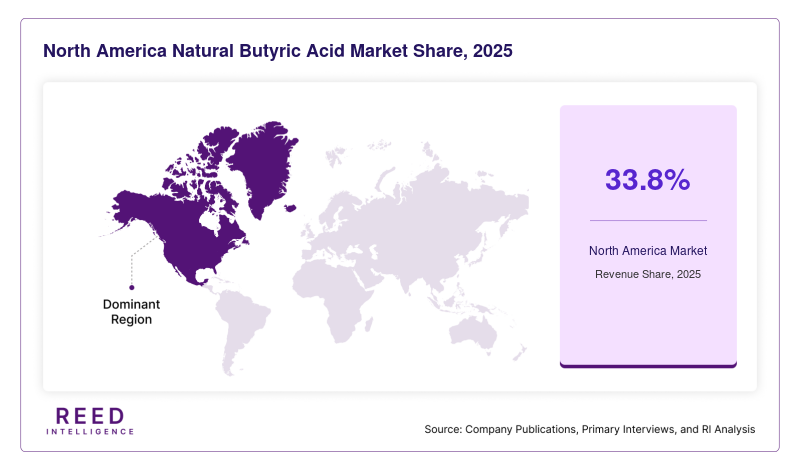
- North America dominated the market with a 33.8% share in 2025.
- Asia Pacific is expected to grow at the fastest CAGR of 10.8% during 2026–2034.
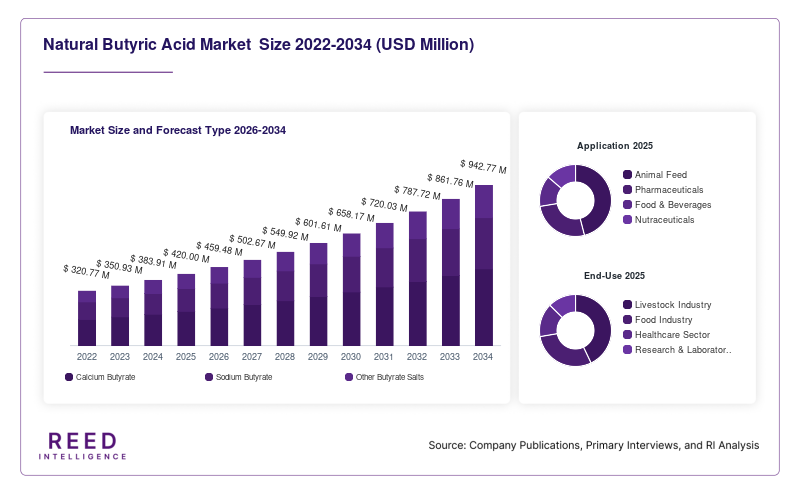
- By type, calcium butyrate accounted for the largest share of 39.2%, while sodium butyrate is projected to grow at a CAGR of 10.6%.
- By application, animal feed led with a 44.5% share, whereas pharmaceuticals are expected to expand at a CAGR of 10.9%.
- The United States remained the dominant country, with market values of USD 140 million in 2024 and USD 155 million in 2025.
Market Trends
Rising adoption of natural feed additives in livestock production
The increasing shift toward antibiotic-free livestock production is significantly influencing the Natural Butyric Acid Market. Regulatory restrictions on antibiotic growth promoters in several regions have compelled producers to explore alternative solutions that support animal health and performance. Natural butyric acid, known for improving gut integrity and nutrient absorption, has emerged as a viable solution in this context. Feed manufacturers are incorporating butyric acid derivatives to enhance feed efficiency and reduce disease incidence. This trend is particularly evident in poultry and swine industries, where gut health plays a critical role in productivity. The growing emphasis on sustainable and residue-free animal products is further reinforcing this trend.
Expansion of applications in functional foods and nutraceuticals
Another notable trend is the increasing use of natural butyric acid in functional foods and nutraceutical products. Consumers are becoming more health-conscious and are seeking products that support digestive health and immunity. Natural butyric acid, as a short-chain fatty acid, plays a key role in maintaining intestinal health and reducing inflammation. Food manufacturers are incorporating it into fortified foods, dietary supplements, and probiotic formulations. Advances in encapsulation technologies have improved the stability and delivery of butyric acid, making it suitable for human consumption. This trend is expected to drive innovation and product development across the food and pharmaceutical sectors.
Market Drivers
Increasing demand for gut health solutions
The growing awareness of gut health and its impact on overall well-being is a major driver for the Natural Butyric Acid Market. Consumers and healthcare professionals are recognizing the importance of maintaining a balanced gut microbiome to prevent digestive disorders and enhance immunity. Natural butyric acid plays a crucial role in nourishing colon cells and supporting intestinal barrier function. This has led to increased demand in both dietary supplements and pharmaceutical formulations. The rise in gastrointestinal disorders and lifestyle-related health issues has further accelerated adoption. As preventive healthcare gains importance, the demand for natural and effective gut health solutions is expected to continue rising.
Growth in sustainable and natural product demand
The global shift toward sustainable and natural products is another key driver for the market. Consumers are increasingly avoiding synthetic chemicals and opting for naturally derived ingredients in food, pharmaceuticals, and personal care products. Natural butyric acid, produced through fermentation processes, aligns with this trend by offering a cleaner and environmentally friendly alternative. Regulatory bodies are also encouraging the use of natural additives, especially in food and animal nutrition. This has prompted manufacturers to invest in sustainable production technologies and expand their natural product portfolios. The growing preference for clean-label products is expected to sustain market growth.
Market Restraint
High production costs and limited scalability
One of the primary restraints affecting the Natural Butyric Acid Market is the relatively high production cost associated with natural fermentation processes. Compared to synthetic butyric acid, natural variants require specialized microbial strains, controlled fermentation environments, and additional purification steps. These factors increase operational costs and limit scalability, especially for small and medium-sized manufacturers. The price sensitivity of end-use industries such as animal feed further complicates adoption. For instance, feed producers operating on tight margins may prefer lower-cost synthetic alternatives despite the benefits of natural products. This cost barrier can hinder market penetration, particularly in developing regions where affordability is a key concern.
Market Opportunities
Technological advancements in fermentation processes
Advancements in biotechnology and fermentation processes present significant opportunities for the Natural Butyric Acid Market. Innovations in microbial engineering and process optimization are enabling higher yields and improved efficiency in butyric acid production. Companies are investing in research to develop cost-effective fermentation techniques that can compete with synthetic production methods. The integration of automation and digital monitoring systems is also enhancing process control and reducing production costs. These advancements are expected to improve scalability and make natural butyric acid more accessible to a broader range of industries. As technology continues to evolve, it will play a crucial role in shaping market growth.
Emerging demand in pharmaceutical applications
The expanding use of natural butyric acid in pharmaceutical applications offers another promising opportunity. Research studies have highlighted its potential in treating conditions such as inflammatory bowel disease, colorectal cancer, and metabolic disorders. Pharmaceutical companies are exploring its therapeutic properties and incorporating it into drug formulations and clinical trials. The growing focus on personalized medicine and microbiome-based therapies is further supporting this trend. As regulatory approvals increase and clinical evidence strengthens, the adoption of natural butyric acid in the pharmaceutical sector is expected to rise significantly, creating new revenue streams for market participants.
Segmental Analysis
By Type
Calcium butyrate emerged as the dominant subsegment, accounting for a 39.2% share in 2024. Its widespread use in animal feed applications is a key factor driving its dominance. Calcium butyrate is preferred due to its stability, ease of handling, and effectiveness in improving gut health in livestock. It enhances nutrient absorption and supports intestinal integrity, leading to better growth performance. The subsegment is also benefiting from increasing demand for high-quality feed additives in poultry and swine industries. Additionally, its compatibility with various feed formulations makes it a preferred choice among manufacturers.
Sodium butyrate is the fastest-growing subsegment, projected to expand at a CAGR of 10.6% during the forecast period. Its rapid growth is attributed to its higher bioavailability and effectiveness in both animal and human applications. Sodium butyrate is widely used in dietary supplements and pharmaceuticals due to its role in promoting gut health and reducing inflammation. Advances in encapsulation technologies have improved its stability and delivery, further boosting its adoption. The increasing demand for functional foods and nutraceuticals is also contributing to its growth.
By Application
Animal feed dominated the application segment, accounting for a 44.5% share in 2024. The use of natural butyric acid in feed formulations has gained traction due to its ability to improve gut health, enhance nutrient absorption, and reduce disease incidence in livestock. The shift toward antibiotic-free production practices has further increased its adoption. Feed manufacturers are incorporating butyric acid derivatives to improve feed efficiency and overall animal performance. The growing demand for high-quality animal products is also supporting this subsegment.
Pharmaceuticals represent the fastest-growing application, with a CAGR of 10.9%. The increasing focus on gut health and microbiome research is driving the use of natural butyric acid in drug formulations. It is being studied for its potential in treating various gastrointestinal and metabolic disorders. The rising prevalence of chronic diseases and the growing demand for preventive healthcare solutions are further supporting this growth. Pharmaceutical companies are investing in research and development to explore new applications and expand their product portfolios.
By End-Use
The livestock industry accounted for the largest share of 41.8% in 2024. The increasing demand for high-quality meat and dairy products has driven the adoption of natural feed additives. Natural butyric acid plays a crucial role in improving animal health and productivity, making it an essential component in modern livestock farming. The shift toward sustainable and antibiotic-free production practices is further boosting its use in this segment.
The food and beverage industry is the fastest-growing end-use segment, with a CAGR of 10.3%. The increasing demand for functional foods and clean-label products is driving the adoption of natural butyric acid. It is being used as a flavoring agent and preservative in various food products. Advances in food processing technologies and the growing consumer preference for natural ingredients are expected to support this segment’s growth.
Regional Analysis
North America
North America accounted for a significant share of 33.8% in 2025 and is expected to grow at a CAGR of 8.9% during the forecast period. The region’s growth is driven by strong demand for natural and sustainable products across food, feed, and pharmaceutical industries. The presence of established manufacturers and advanced research infrastructure further supports market expansion.
The United States dominates the regional market due to its well-developed healthcare and food industries. A key growth factor is the increasing adoption of antibiotic-free livestock production practices, which has boosted demand for natural feed additives such as butyric acid.
Europe
Europe held a market share of 27.5% in 2025 and is projected to grow at a CAGR of 9.1%. Strict regulations on synthetic additives and antibiotics have accelerated the adoption of natural alternatives. The region’s focus on sustainability and clean-label products is also contributing to market growth.
Germany leads the European market, supported by strong industrial and agricultural sectors. A unique growth factor is the region’s stringent regulatory framework, which encourages the use of natural and safe ingredients in food and animal nutrition.
Asia Pacific
Asia Pacific is expected to witness the fastest growth, with a CAGR of 10.8% during the forecast period. The region accounted for a 23.6% market share in 2025. Rapid urbanization, rising disposable incomes, and increasing awareness of health and nutrition are key drivers.
China dominates the region due to its large livestock industry and growing pharmaceutical sector. A major growth factor is the increasing demand for high-quality animal feed and dietary supplements, driven by a growing population and changing consumption patterns.
Middle East & Africa
The Middle East & Africa region held a smaller share of 7.2% in 2025 but is expected to grow at a CAGR of 8.5%. The market is gradually expanding due to increasing investments in agriculture and food production.
South Africa is the leading country in the region. A key growth factor is the rising focus on improving livestock productivity and reducing dependency on antibiotics, which is driving demand for natural feed additives.
Latin America
Latin America accounted for a 7.9% market share in 2025 and is projected to grow at a CAGR of 9.0%. The region’s growth is supported by its strong agricultural base and increasing exports of animal products.
Brazil dominates the market in Latin America. A unique growth factor is the country’s expanding poultry and swine industries, which are adopting natural additives to enhance feed efficiency and meet international quality standards.
Competitive Landscape
The Natural Butyric Acid Market is moderately competitive, with the presence of several global and regional players. Companies are focusing on product innovation, strategic partnerships, and expansion of production capacities to strengthen their market position. The market is characterized by increasing investments in research and development to improve product quality and reduce production costs.
A leading player in the market is Perstorp Holding AB, known for its strong product portfolio and global presence. The company has recently expanded its production capacity for natural feed additives to meet growing demand. Other key players are also investing in advanced fermentation technologies and exploring new applications in pharmaceuticals and nutraceuticals. The competitive landscape is expected to intensify as new entrants and technological advancements reshape the market.
Key Players
- Perstorp Holding AB
- Eastman Chemical Company
- Oxea GmbH
- Kemin Industries Inc.
- BASF SE
- Tokyo Chemical Industry Co., Ltd.
- Blue Marble Biomaterials
- Alfa Aesar
- Merck KGaA
- Thermo Fisher Scientific Inc.
- Penta Manufacturing Company
- Snowco Industrial Co., Ltd.
- Hefei TNJ Chemical Industry Co., Ltd.
- Hangzhou Dayangchem Co., Ltd.
- Zhengzhou Bainafo Bioengineering Co., Ltd.
Recent Developments
- A leading manufacturer expanded its fermentation-based production facility in 2025 to increase output of natural butyric acid for feed applications.
- A biotechnology company introduced an encapsulated sodium butyrate product aimed at improving stability and targeted delivery in dietary supplements.
- A pharmaceutical firm initiated clinical trials to explore the therapeutic potential of butyric acid in treating inflammatory bowel disease.
Natural Butyric Acid Market Segments
Type
- Calcium Butyrate
- Sodium Butyrate
- Other Butyrate Salts
Application
- Animal Feed
- Pharmaceuticals
- Food & Beverages
- Nutraceuticals
End-Use
- Livestock Industry
- Food Industry
- Healthcare Sector
- Research & Laboratories
By Region
- North America
- Europe
- APAC
- Middle East and Africa
- LATAM