Natural Dyes Market Size, Share & Demand Report By Source (Plant-Based Dyes, Animal-Based Dyes, Mineral-Based Dyes, Microbial Dyes), By Application (Textiles, Food and Beverages, Cosmetics and Personal Care, Packaging, Home Furnishing, Others), By End Use (Industrial Manufacturing, Household and Artisan, Commercial Institutions, Research and Specialty Applications), By Region & Segment Forecasts, 2026–2034
USD 3950
Market Overview
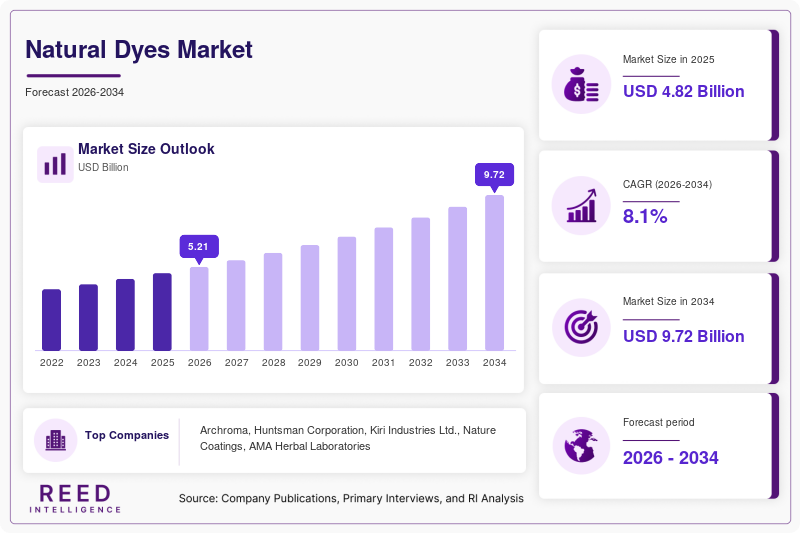
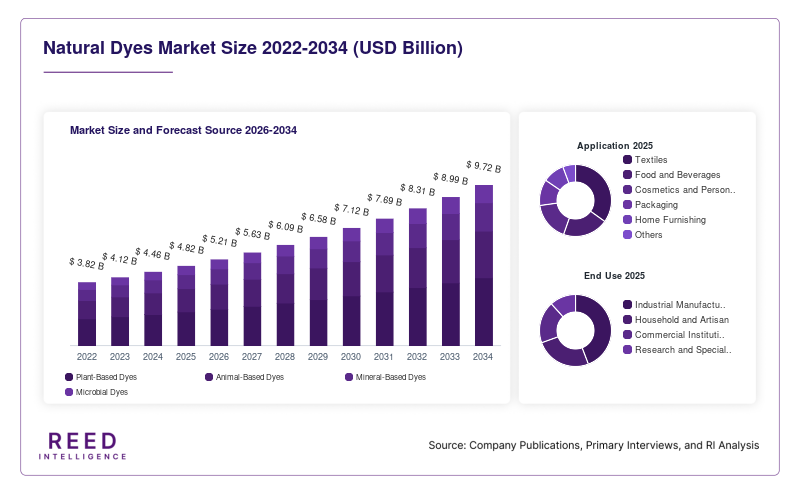
The global Natural Dyes Market was valued at USD 4.82 billion in 2026 and is projected to reach USD 8.97 billion by 2034, expanding at a CAGR of 8.1% during the forecast period from 2026 to 2034. The market continues to gain momentum as manufacturers across textile, food, cosmetics, and packaging industries shift toward environmentally responsible raw materials and sustainable production systems. Natural dyes, derived from plants, insects, minerals, and microorganisms, are increasingly preferred because they reduce chemical discharge, support biodegradable manufacturing practices, and align with global sustainability goals.
Growing environmental awareness among consumers and stricter regulations on synthetic chemical disposal have supported the expansion of the Natural Dyes Market across both developed and emerging economies. Textile producers are increasingly integrating plant-based colorants into apparel manufacturing to address demand for organic and eco-friendly fashion products. In addition, food and beverage companies are replacing synthetic additives with naturally sourced pigments to improve clean-label positioning and consumer trust. Technological advancements in extraction methods and color stabilization techniques are also improving product consistency and expanding commercial adoption.
Key Highlights
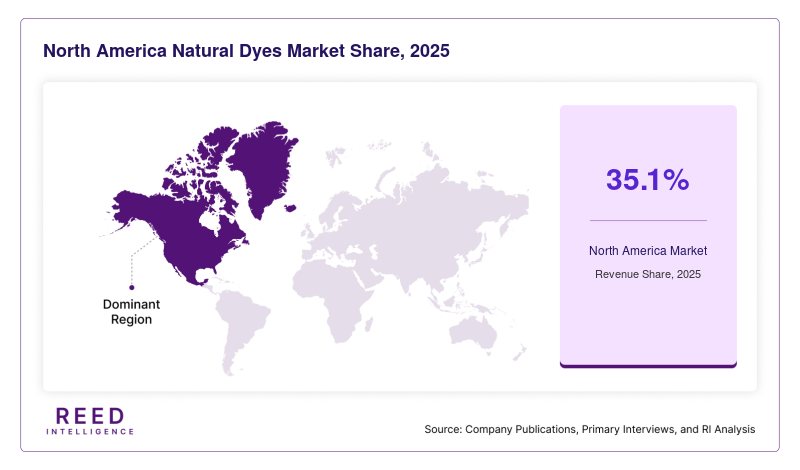
- North America dominated the market with a 35.1% share in 2025.
- Asia Pacific is expected to grow at the fastest CAGR of 10.8% during 2026–2034.
- By source, plant-based dyes accounted for the largest share of 48.6%.
- while microbial dyes are projected to grow at a CAGR of 11.9%.
- By application, textiles led with a 44.3% share, whereas food and beverages are expected to expand at a CAGR of 10.6%.
- India remained the dominant country, with market values of USD 610 million in 2024 and USD 670 million in 2025.
Market Trends
Expansion of Sustainable Fashion and Eco-Textile Manufacturing
The growing popularity of sustainable fashion has become a major trend shaping the Natural Dyes Market. Apparel manufacturers are increasingly adopting natural dyeing methods to reduce environmental impact and improve brand positioning among environmentally conscious consumers. Major fashion labels are introducing organic clothing collections that emphasize low-impact production and biodegradable raw materials. Natural indigo, turmeric, madder root, and pomegranate-based dyes are gaining attention because they reduce toxic wastewater discharge compared to synthetic alternatives. Textile mills are also investing in water-saving dyeing systems and bio-based mordants to improve commercial scalability.
The trend is further supported by consumer preference for ethically produced apparel and stricter sustainability standards in international trade. Several global clothing brands are integrating traceability systems into supply chains to ensure responsible sourcing of botanical dyes. In addition, fashion startups specializing in plant-based textiles are collaborating with local farming communities to secure consistent raw material supplies. The expansion of eco-label certifications and green textile standards is expected to strengthen the adoption of natural dyes in premium apparel manufacturing over the coming years.
Rising Demand for Clean-Label Food Colorants
The increasing use of natural pigments in food and beverage applications represents another major trend influencing the Natural Dyes Market. Food manufacturers are replacing artificial additives with natural alternatives derived from beetroot, spirulina, annatto, saffron, and paprika to meet clean-label requirements. Consumers are paying closer attention to ingredient transparency and are increasingly avoiding products containing synthetic colorants associated with health concerns. As a result, beverage producers, confectionery companies, and dairy manufacturers are reformulating products using plant-derived color ingredients.
Innovation in extraction technologies and encapsulation methods is improving the stability and shelf life of natural food dyes, encouraging broader commercial adoption. Companies are also developing customized color formulations for bakery products, functional beverages, and plant-based foods. The demand for organic packaged foods and minimally processed ingredients is particularly strong in North America and Europe, where regulatory authorities continue to tighten restrictions on synthetic additives. This shift toward naturally sourced food coloring systems is expected to support long-term market expansion.
Market Drivers
Increasing Regulatory Pressure on Synthetic Chemical Usage
Government regulations limiting the use of hazardous synthetic chemicals in textiles, cosmetics, and food products are driving the growth of the Natural Dyes Market. Regulatory agencies in multiple countries are implementing stricter wastewater discharge standards and chemical safety requirements, compelling manufacturers to adopt environmentally safer alternatives. Synthetic dyes are often associated with toxic residues and environmental pollution, particularly in large-scale textile processing operations. Natural dyes provide a viable solution because they are biodegradable and typically generate lower levels of harmful emissions during manufacturing.
The regulatory environment has encouraged producers to invest in research focused on improving the durability and commercial performance of natural pigments. Textile exporters are increasingly adopting eco-certified dyeing methods to comply with international trade requirements and sustainability benchmarks. In addition, several food safety agencies are reviewing synthetic additives and encouraging the use of plant-based coloring agents in packaged products. The combination of environmental regulation and rising public awareness is accelerating the transition toward naturally sourced colorants across multiple industries.
Growth of Organic Personal Care and Cosmetic Products
The expansion of the organic cosmetics and personal care sector is another important driver supporting the Natural Dyes Market. Cosmetic manufacturers are increasingly using botanical pigments in skincare, haircare, and makeup products to appeal to health-conscious consumers seeking safer and naturally derived ingredients. Natural dyes sourced from hibiscus, henna, chlorophyll, and fruit extracts are widely used in lip products, soaps, facial masks, and hair coloring applications.
The growth of vegan and cruelty-free beauty products has further increased the demand for bio-based colorants. Consumers are becoming more cautious about synthetic ingredients linked to skin irritation and allergic reactions, encouraging brands to reformulate products using plant-derived alternatives. Social media marketing and rising awareness of sustainable beauty routines are also influencing purchasing behavior among younger consumers. In addition, premium beauty brands are investing in product innovation and sustainable packaging strategies that complement the use of natural dyes. These developments are expected to strengthen market demand during the forecast period.
Market Restraint
Limited Color Consistency and Higher Production Costs
Despite increasing adoption across multiple industries, the Natural Dyes Market faces challenges related to color consistency, scalability, and production costs. Natural dyes are heavily influenced by climatic conditions, raw material quality, harvesting methods, and extraction processes, which can create variations in shade intensity and product performance. Textile and food manufacturers often require standardized color outputs to maintain brand consistency, making large-scale adoption difficult in some industrial applications.
In comparison with synthetic alternatives, natural dyes also involve higher cultivation, processing, and storage costs. Botanical raw materials may require larger agricultural areas, seasonal harvesting cycles, and specialized extraction technologies that increase operational expenses. Small and medium-sized manufacturers may struggle to invest in advanced stabilization systems needed to improve color durability and shelf life. In addition, certain natural dyes exhibit lower resistance to heat, ultraviolet exposure, and repeated washing, limiting their suitability for mass-market textile applications.
The industry also faces supply chain complexities associated with sourcing large quantities of plant-based materials without affecting agricultural sustainability. Price volatility in raw botanical ingredients can impact profitability and create procurement challenges for manufacturers. Although technological innovation is improving extraction efficiency and color stabilization, commercial scalability remains a concern for several end-use industries. These limitations may slow adoption among cost-sensitive manufacturers, particularly in regions where synthetic dyes remain economically dominant.
Market Opportunities
Development of Microbial and Biotechnology-Based Dyes
Advancements in biotechnology and microbial fermentation are creating new opportunities in the Natural Dyes Market. Researchers and manufacturers are increasingly exploring bacteria, fungi, algae, and yeast as alternative sources of sustainable pigments. Microbial dyes can provide improved color consistency, faster production cycles, and lower dependence on seasonal agricultural supply chains. Biotechnology-based production systems also reduce land and water usage, supporting sustainable manufacturing objectives.
Several companies are investing in bioengineering technologies to develop customized pigments with enhanced stability and broader color ranges. The integration of precision fermentation techniques is expected to support commercial scalability while lowering long-term production costs. Demand for microbial dyes is particularly strong in cosmetics and food applications, where manufacturers seek stable and naturally derived colorants with traceable sourcing. As research and industrial partnerships continue to expand, biotechnology-driven innovation is expected to create substantial growth opportunities for market participants.
Expansion of Natural Dye Applications in Packaging and Home Furnishing
The increasing use of sustainable materials in packaging and home furnishing products is opening additional growth opportunities for the Natural Dyes Market. Manufacturers of biodegradable packaging, paper products, rugs, curtains, and upholstery fabrics are incorporating plant-based colorants to strengthen environmental positioning and comply with sustainability goals. Consumer demand for eco-friendly interior products has encouraged home furnishing companies to adopt naturally dyed textiles and organic fabric collections.
Packaging companies are also exploring natural pigments for printed labels, paper-based packaging, and compostable materials to reduce reliance on petroleum-derived chemicals. The expansion of sustainable hospitality projects and environmentally conscious residential construction is supporting demand for naturally dyed decorative materials. In emerging economies, government support for traditional handicrafts and artisan textile production is creating additional commercial opportunities for regional dye producers. These developments are expected to diversify application areas and strengthen long-term market growth.
Segmental Analysis
By Source
Plant-based dyes accounted for the largest share of the Natural Dyes Market in 2024, contributing approximately 48.6% of total revenue. These dyes are widely used across textile, food, cosmetic, and packaging industries because of their biodegradable properties and broad availability. Common plant-derived pigments include indigo, turmeric, annatto, saffron, beetroot, and madder root. Textile manufacturers continue to prefer plant-based dyes for organic apparel production because they align with sustainability goals and reduce environmental pollution associated with synthetic chemicals. In the food sector, naturally sourced pigments are increasingly used in confectionery, dairy products, sauces, and beverages to support clean-label positioning. Cosmetic manufacturers also utilize botanical pigments in skincare and makeup formulations to appeal to health-conscious consumers. Strong consumer awareness regarding sustainable sourcing and environmental safety has strengthened demand for plant-derived colorants across developed and emerging economies.
Microbial dyes are expected to witness the fastest growth during the forecast period, registering a CAGR of 11.9% from 2026 to 2034. The rapid growth of this subsegment is supported by advancements in biotechnology, fermentation processes, and precision bioengineering systems. Microbial pigments produced from algae, fungi, bacteria, and yeast provide improved consistency and reduced dependence on agricultural cultivation cycles. These dyes also require lower land and water consumption, supporting environmentally sustainable manufacturing practices. Food and cosmetic companies are increasingly investing in microbial pigments because they offer stable color performance and traceable sourcing. In addition, biotechnology firms are collaborating with textile manufacturers to develop scalable commercial applications for fermentation-based colorants. Continuous research aimed at improving pigment yield and cost efficiency is expected to accelerate adoption across multiple industrial sectors.
By Application
The textile segment held the dominant share of the Natural Dyes Market in 2024, accounting for approximately 44.3% of overall revenue. Growing demand for sustainable apparel, organic fabrics, and environmentally responsible fashion products has significantly increased the use of natural dyes in textile manufacturing. Fashion brands are increasingly incorporating naturally dyed cotton, wool, silk, and linen into premium clothing collections to improve sustainability positioning. Traditional dyeing methods using indigo, pomegranate, turmeric, and henna are gaining commercial relevance as consumers seek products with lower environmental impact. Textile producers are also investing in water-efficient dyeing systems and eco-certified processing methods to meet international sustainability standards. The growth of ethical fashion movements and consumer preference for biodegradable fabrics continue to support the expansion of naturally dyed textile products across global markets.
The food and beverage segment is projected to expand at the fastest CAGR of 10.6% during the forecast period. Increasing demand for clean-label products and growing consumer concerns regarding synthetic additives are driving the adoption of naturally sourced food pigments. Beverage companies, dairy manufacturers, bakery producers, and confectionery brands are reformulating products using natural colorants derived from spirulina, beetroot, paprika, saffron, and fruit extracts. Regulatory authorities in several countries are also encouraging the reduction of artificial additives in packaged foods, supporting long-term segment growth. Technological advancements in encapsulation and extraction methods are improving the stability and shelf life of natural pigments, enabling broader industrial adoption. Rising demand for organic and minimally processed foods is expected to create additional opportunities for manufacturers operating within this segment.
By End Use
The industrial manufacturing segment represented the largest share of the Natural Dyes Market in 2024, contributing nearly 46.8% of total revenue. Large-scale textile processors, food ingredient manufacturers, packaging companies, and cosmetic producers are increasingly integrating natural dyes into commercial production systems. Industrial buyers prefer natural dyes because they support sustainability targets, improve regulatory compliance, and enhance brand perception among environmentally conscious consumers. Large manufacturing facilities are investing in advanced extraction technologies, color stabilization methods, and automated dyeing equipment to improve efficiency and consistency. The increasing focus on reducing carbon emissions and wastewater pollution has encouraged industrial users to adopt bio-based coloring solutions. Furthermore, multinational companies are establishing long-term sourcing agreements with agricultural suppliers and biotechnology firms to secure stable supplies of naturally derived pigments.
The household and artisan segment is anticipated to register the fastest CAGR of 9.8% during the forecast period due to growing consumer interest in handmade products, natural crafts, and home-based sustainable production activities. Small-scale artisans and independent textile designers are increasingly utilizing botanical dyes to create eco-friendly fabrics, decorative products, and handmade apparel. The rise of online marketplaces and social commerce platforms has enabled local producers to reach wider consumer audiences interested in naturally crafted goods. Educational workshops focused on sustainable dyeing techniques and traditional handicrafts are also contributing to market growth. In addition, rising awareness regarding chemical-free home products is encouraging consumers to purchase naturally dyed furnishings, handmade accessories, and organic fabric products. This segment is expected to benefit from continued interest in artisanal and environmentally responsible consumer goods.
Regional Analysis
North America
North America accounted for 35.1% of the global Natural Dyes Market in 2025 and maintained its position as the leading regional market due to strong demand for sustainable textiles, organic food products, and eco-friendly cosmetics. The region is projected to expand at a CAGR of 7.6% during the forecast period as manufacturers continue to replace synthetic additives with plant-based alternatives. Regulatory pressure regarding chemical disposal and growing consumer awareness about sustainable consumption patterns have encouraged large-scale adoption across food processing and apparel industries.
The United States remained the dominant country in the regional market because of its established organic food sector and advanced sustainable fashion industry. One unique growth factor supporting the market is the increasing collaboration between biotechnology companies and textile manufacturers to develop scalable natural dye extraction technologies. Several domestic brands are also investing in transparent supply chains and carbon-neutral manufacturing systems, which further supports the adoption of botanical and microbial dyes across multiple commercial applications.
Europe
Europe represented a significant share of the Natural Dyes Market in 2025 and is expected to register a CAGR of 7.9% through 2034. The region benefits from strong environmental regulations, advanced textile manufacturing infrastructure, and rising demand for biodegradable consumer products. European consumers increasingly prefer organic clothing, sustainable home décor products, and naturally formulated cosmetics, encouraging companies to expand investment in bio-based colorant technologies. The growth of circular economy initiatives across the region is also supporting the adoption of environmentally responsible dyeing processes.
Germany remained the dominant country within the European market due to its advanced chemical processing industry and strong focus on sustainable manufacturing innovation. A unique growth factor in the country is the integration of natural dyes into automotive interior fabrics and premium furnishing materials. German research institutions and industrial manufacturers are collaborating on advanced stabilization technologies that improve the durability and commercial performance of plant-derived pigments, strengthening the regional market outlook.
Asia Pacific
Asia Pacific is expected to witness the fastest growth in the Natural Dyes Market, expanding at a CAGR of 10.8% during the forecast period. The region benefits from abundant agricultural resources, growing textile exports, and increasing government support for sustainable manufacturing practices. Countries across Asia Pacific are witnessing rising consumer demand for eco-friendly apparel, naturally colored packaged foods, and herbal cosmetic products. The region also serves as a major production hub for cotton textiles and traditional dyeing techniques, which supports large-scale commercialization.
India dominated the Asia Pacific market because of its long-standing heritage in botanical dye production and expanding organic textile industry. One distinctive growth factor supporting the country is the government-backed promotion of natural farming and handloom exports. Several domestic textile clusters are reviving traditional dyeing practices using indigo, turmeric, marigold, and madder root. Increasing export demand for sustainable fabrics and handcrafted apparel is further encouraging investment in modern natural dye extraction and processing facilities.
Middle East & Africa
The Middle East & Africa region accounted for a moderate share of the Natural Dyes Market in 2025 and is projected to grow at a CAGR of 6.8% over the forecast period. Market expansion is supported by increasing awareness regarding sustainable textiles, rising tourism-related hospitality projects, and gradual adoption of eco-friendly personal care products. Governments in several countries are promoting diversification away from oil-dependent industries, creating opportunities for sustainable manufacturing and agricultural value-added production.
South Africa emerged as the dominant country within the regional market due to its growing organic cosmetics sector and increasing investments in sustainable agriculture. A unique growth factor in the country is the use of indigenous plant species for pigment extraction in artisan textile and skincare applications. Local manufacturers are increasingly partnering with rural farming communities to secure naturally sourced raw materials while supporting community development initiatives. These partnerships are helping expand regional production capacity and product differentiation.
Latin America
Latin America held a developing share of the Natural Dyes Market in 2025 and is expected to expand at a CAGR of 7.1% through 2034. The region is benefiting from increasing cultivation of dye-producing plants, rising demand for sustainable food ingredients, and growth in environmentally responsible textile manufacturing. Regional governments and industry associations are promoting eco-friendly agricultural practices and supporting small-scale producers involved in botanical extraction and traditional handicraft production.
Brazil remained the dominant country in the Latin American market because of its extensive biodiversity and growing bioeconomy initiatives. One unique growth factor supporting the market is the expansion of naturally derived pigments in food processing and beverage manufacturing. Brazilian companies are investing in research focused on tropical plant extracts that provide stable and vibrant coloring solutions for processed foods and natural beverages. The country’s strong agricultural base and export-oriented food industry are expected to support long-term market development.
Competitive Landscape
The Natural Dyes Market remains moderately fragmented, with established chemical companies, biotechnology firms, and regional botanical dye producers competing across multiple application industries. Companies are increasingly focusing on sustainable sourcing, product innovation, and strategic partnerships to strengthen market presence. Leading manufacturers are investing in advanced extraction technologies and fermentation-based production systems to improve color stability, scalability, and cost efficiency. Expansion into clean-label food ingredients and sustainable textile applications remains a key competitive strategy.
Archroma emerged as one of the leading companies in the market because of its extensive portfolio of sustainable textile color solutions and global distribution capabilities. The company recently expanded its plant-based dye collection for apparel manufacturers focused on eco-certified fashion products. Other major participants such as Huntsman Corporation, Kiri Industries Ltd., AMA Herbal Laboratories, and Nature Coatings are also increasing investment in biotechnology research and environmentally responsible pigment production.
Several companies are entering collaborations with fashion brands, food processors, and cosmetic manufacturers to develop customized natural dye formulations for commercial-scale applications. Regional manufacturers in Asia Pacific and Latin America are focusing on expanding raw material cultivation and improving supply chain integration to secure long-term growth opportunities. Competitive differentiation is increasingly centered on product consistency, traceability, sustainability certifications, and innovation in microbial dye technologies.
Key Players
- Archroma
- Huntsman Corporation
- Kiri Industries Ltd.
- Nature Coatings
- AMA Herbal Laboratories
- Organic Dyes and Pigments LLC
- Green Matters Natural Dye Company
- Stony Creek Colors
- Earthues Natural Dyes
- Wild Colours Ltd.
- Sensient Technologies Corporation
- ROHA Dyechem Pvt. Ltd.
- Botanical Colors
- Aakash Chemicals and Dyestuffs Inc.
- Dyeing and Textile Chemicals Pvt. Ltd.
Recent Developments
- In February 2026, Archroma introduced an expanded range of biodegradable textile dyes developed from renewable botanical sources to support sustainable apparel manufacturing.
- In July 2025, Nature Coatings announced the commercial expansion of its bio-based black pigment production facility to meet rising demand from packaging and textile industries.
- In November 2025, Huntsman Corporation partnered with sustainable fashion manufacturers to develop low-water natural dyeing technologies for industrial textile applications.
- In March 2026, Sensient Technologies Corporation launched a new portfolio of plant-derived food colorants designed for clean-label beverage and confectionery products.
Natural Dyes Market Segments
Source
- Plant-Based Dyes
- Animal-Based Dyes
- Mineral-Based Dyes
- Microbial Dyes
Application
- Textiles
- Food and Beverages
- Cosmetics and Personal Care
- Packaging
- Home Furnishing
- Others
End Use
- Industrial Manufacturing
- Household and Artisan
- Commercial Institutions
- Research and Specialty Applications
By Region
- North America
- Europe
- APAC
- Middle East and Africa
- LATAM