Natural Solubilizer Market Size, Share & Demand Report By Type (Plant-Derived Solubilizers, Sugar-Based Solubilizers, Bio-Fermented Solubilizers, Oil-Based Solubilizers), By Application (Cosmetics and Personal Care, Food and Beverage, Pharmaceutical Formulations, Household Products), By End-Use Industry (Personal Care Industry, Food Processing Industry, Pharmaceutical Industry, Nutraceutical Industry), By Region & Segment Forecasts, 2026–2034
USD 3950
Market Overview
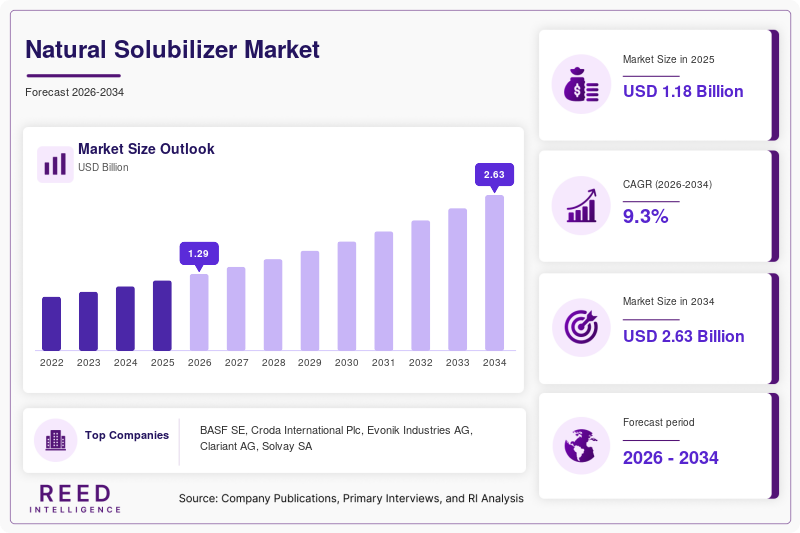
The global Natural Solubilizer Market size was valued at USD 1.18 billion in 2026 and is projected to reach USD 2.41 billion by 2034, expanding at a CAGR of 9.3% during the forecast period from 2026 to 2034. Natural solubilizers are increasingly used across cosmetics, food and beverages, pharmaceuticals, and personal care products to improve the dispersion of oil-based ingredients in water-based formulations. Rising demand for clean-label ingredients and plant-derived additives continues to support market expansion across developed and emerging economies. Manufacturers are focusing on replacing synthetic emulsifiers and chemical stabilizers with bio-based alternatives to comply with evolving consumer preferences and regulatory standards.
One of the primary global factors supporting market growth is the rapid expansion of clean beauty and natural ingredient-based product formulations. Consumers are paying closer attention to ingredient transparency, sustainability claims, and eco-friendly sourcing practices. This trend has encouraged manufacturers to increase the use of naturally derived solubilizers from sunflower, coconut, sugar esters, and botanical oils. In addition, food manufacturers are adopting natural solubilizers to improve flavor stability and shelf life without compromising product labeling standards. Pharmaceutical companies are also investing in plant-based excipients for oral liquids and nutraceutical formulations.
Key Highlights
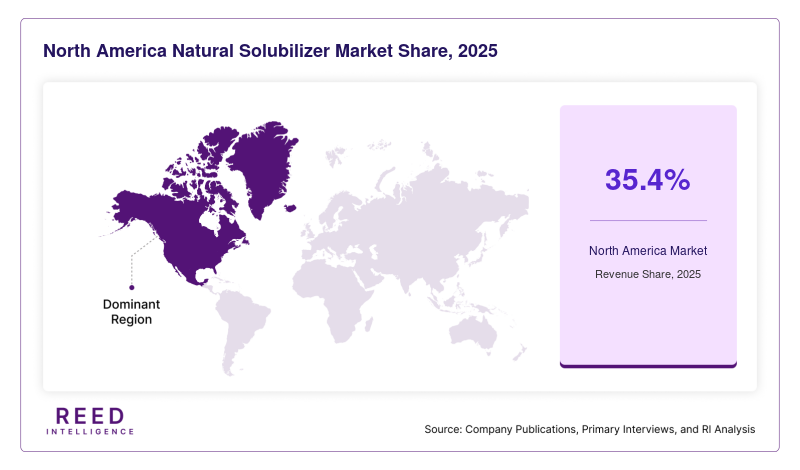
- North America dominated the market with a 35.4% share in 2025.
- Asia Pacific is expected to grow at the fastest CAGR of 10.8% during 2026–2034.
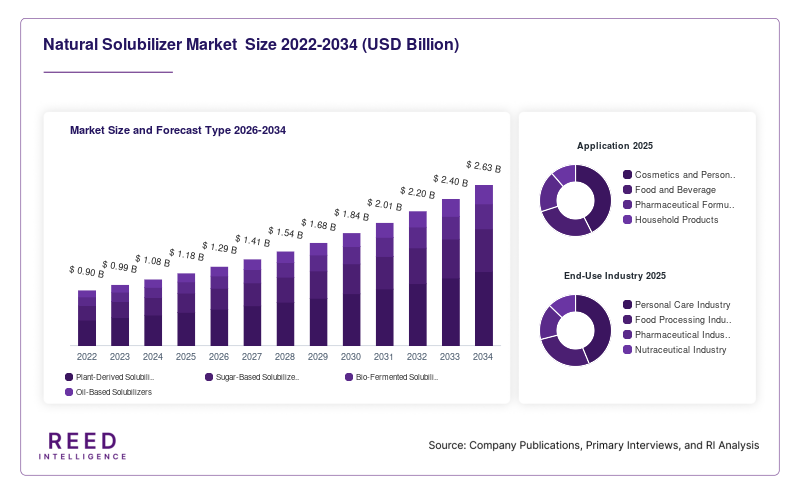
- By type, plant-derived solubilizers accounted for the largest share of 44.1%, while bio-fermented solubilizers are projected to grow at a CAGR of 11.5%.
- By application, cosmetics and personal care led with a 39.7% share, whereas pharmaceutical formulations are expected to expand at a CAGR of 10.9%.
- The United States remained the dominant country, with market values of USD 295 million in 2024 and USD 326 million in 2025.
Market Trends
Rising Preference for Multifunctional Natural Ingredients
Manufacturers in the cosmetics and personal care industry are increasingly integrating multifunctional ingredients into product formulations to reduce formulation complexity and improve sustainability claims. Natural solubilizers are being used not only for emulsification but also for improving texture, fragrance stability, and ingredient compatibility. This trend is especially visible in skin care serums, facial mists, essential oil blends, and sulfate-free cleansing products. Companies are investing in advanced botanical extraction methods to improve the performance of natural solubilizers while maintaining biodegradability and low toxicity profiles. As consumers continue to prefer ingredient lists with recognizable components, demand for multifunctional natural solubilizers is expected to increase steadily across premium and mass-market product categories.
Expansion of Clean-Label Food and Beverage Formulations
The food and beverage industry is witnessing a strong shift toward clean-label and minimally processed products, creating favorable conditions for natural solubilizer adoption. Beverage manufacturers are using plant-based solubilizers to stabilize flavors, colors, vitamins, and essential oils in functional drinks and flavored water products. Demand is also increasing in dairy alternatives, nutritional supplements, and fortified beverages. Consumers are increasingly avoiding artificial emulsifiers and synthetic additives, which has encouraged food producers to reformulate products with naturally sourced ingredients. In addition, regulatory agencies in multiple countries are promoting safer ingredient standards, encouraging the adoption of natural alternatives. This trend is expected to strengthen as health-conscious consumers continue to influence purchasing behavior globally.
Market Drivers
Increasing Demand for Sustainable Cosmetic Ingredients
The growing demand for sustainable and environmentally friendly cosmetic ingredients is a major driver for the Natural Solubilizer Market. Cosmetic brands are reformulating existing products to reduce reliance on petrochemical-based ingredients and synthetic surfactants. Natural solubilizers derived from renewable feedstocks are gaining traction because they support eco-friendly product positioning and improve brand value. Consumers are increasingly selecting products with vegan, cruelty-free, and biodegradable claims, which has encouraged manufacturers to adopt plant-derived formulation ingredients. Premium skin care and hair care companies are particularly focused on using natural solubilizers in fragrance oils, essential oils, and active ingredient delivery systems. The increasing availability of certified organic raw materials is also supporting broader adoption across global cosmetic manufacturing operations.
Growth of Functional Food and Nutraceutical Products
The rapid growth of functional foods and nutraceutical products is contributing significantly to market expansion. Natural solubilizers help improve the stability and bioavailability of vitamins, herbal extracts, omega oils, and botanical ingredients in liquid formulations. Consumers are increasingly purchasing immunity-boosting beverages, dietary supplements, and wellness products that contain naturally sourced ingredients. Food manufacturers are therefore investing in formulation technologies that improve product shelf life while maintaining clean-label standards. In addition, demand for fortified beverages and plant-based nutrition products is increasing across North America, Europe, and Asia Pacific. As health awareness continues to rise among urban populations, manufacturers are expected to increase their use of natural solubilizers in nutraceutical and wellness-focused formulations.
Market Restraint
High Production Costs and Raw Material Price Volatility
High production costs associated with natural ingredient extraction and processing remain a key restraint for the Natural Solubilizer Market. Compared with synthetic alternatives, natural solubilizers often require more complex sourcing, purification, and quality control procedures, which increases manufacturing expenses. Fluctuations in the prices of botanical oils, sugar derivatives, and agricultural feedstocks can also impact profit margins for manufacturers. Small and medium-sized enterprises may face challenges in maintaining consistent product pricing due to seasonal variations in raw material supply. In addition, some natural solubilizers have shorter shelf stability and require advanced formulation techniques to maintain product performance. These challenges may limit adoption in cost-sensitive industries such as mass-market packaged foods and low-cost personal care products. For example, manufacturers relying on coconut-based derivatives have experienced supply disruptions linked to climate-related agricultural fluctuations, increasing production uncertainty and procurement costs.
Market Opportunities
Emerging Demand Across Pharmaceutical Formulations
The pharmaceutical industry presents a significant growth opportunity for natural solubilizer manufacturers. Pharmaceutical companies are increasingly using naturally derived excipients in oral liquids, syrups, topical creams, and nutraceutical formulations to improve compatibility with active pharmaceutical ingredients. Regulatory agencies are encouraging the use of safer and biocompatible ingredients, particularly in pediatric and wellness-oriented formulations. Natural solubilizers can improve ingredient dispersion and absorption while reducing irritation risks associated with certain synthetic surfactants. The increasing development of herbal medicines and plant-based therapeutic products is also creating demand for natural solubilization technologies. As pharmaceutical companies continue to focus on patient-friendly and clean-label formulations, adoption of plant-derived solubilizers is expected to expand steadily.
Expansion of Green Household and Industrial Cleaning Products
The growing popularity of green cleaning products is creating new opportunities for natural solubilizer suppliers. Consumers and commercial buyers are increasingly selecting biodegradable cleaning products with low environmental impact. Natural solubilizers are being used in eco-friendly detergents, surface cleaners, air fresheners, and aromatherapy cleaning products to stabilize fragrances and essential oils. Regulatory restrictions on harsh chemicals and synthetic surfactants are encouraging manufacturers to invest in bio-based cleaning ingredients. Hospitality companies, healthcare facilities, and institutional cleaning service providers are also adopting sustainable cleaning solutions to support environmental goals. This shift toward green chemistry and environmentally responsible manufacturing practices is expected to create long-term growth opportunities for suppliers operating in the natural ingredient ecosystem.
Segmental Analysis
By Type
Plant-derived solubilizers accounted for the largest share of the Natural Solubilizer Market, representing 44.1% of total revenue in 2024. These solubilizers are widely used across cosmetic, food, and pharmaceutical applications due to their compatibility with clean-label and sustainable product positioning. Ingredients derived from coconut oil, sunflower oil, sugar esters, and other botanical sources are increasingly preferred because they provide effective emulsification while maintaining biodegradability. Cosmetic manufacturers use plant-derived solubilizers extensively in skin care creams, facial mists, shampoos, and essential oil formulations. Food and beverage companies are also integrating these ingredients into flavored drinks and fortified beverages to stabilize oil-based nutrients. Strong consumer preference for recognizable ingredients and environmentally responsible products continues to support the dominance of this segment.
By Application
Cosmetics and personal care represented the dominant application segment, accounting for 39.7% of the market share in 2024. Natural solubilizers are widely used in skin care products, shampoos, body washes, perfumes, and aromatherapy formulations to improve ingredient dispersion and product texture. Consumers are increasingly choosing products with plant-based and biodegradable ingredients, encouraging cosmetic brands to reformulate products with natural alternatives. Premium beauty brands are especially focused on reducing the use of synthetic surfactants and petrochemical-based ingredients. The growing popularity of clean beauty products, vegan cosmetics, and essential oil-based formulations has further strengthened demand within this segment. In addition, e-commerce expansion and social media-driven beauty trends are increasing consumer awareness regarding ingredient transparency and sustainability.
By End-Use Industry
The personal care industry held the largest share of the Natural Solubilizer Market in 2024, accounting for 36.8% of total revenue. Manufacturers in this industry are increasingly incorporating natural solubilizers into skin care, hair care, and fragrance products to meet changing consumer expectations regarding sustainability and ingredient transparency. Rising disposable income and increasing interest in wellness-oriented beauty products have encouraged premium and mass-market brands to invest in plant-based formulations. Natural solubilizers also support the stability and sensory performance of essential oils and botanical extracts commonly used in personal care products. The rapid growth of online beauty retailing and influencer-driven product marketing has further accelerated demand for naturally derived formulation ingredients across developed and emerging economies.
Regional Analysis
North America
North America accounted for 35.4% of the global Natural Solubilizer Market in 2025 and maintained its position as the largest regional market. The region is expected to expand at a CAGR of 8.7% during the forecast period due to increasing demand for clean-label cosmetics, organic beverages, and sustainable formulation ingredients. Major manufacturers in the United States and Canada are investing in advanced bio-based ingredient technologies to improve product functionality and environmental performance. Growing consumer awareness regarding ingredient safety and sustainability standards continues to support the adoption of naturally derived solubilizers across multiple industries.
Europe
Europe represented 27.1% of the global Natural Solubilizer Market in 2025 and is projected to witness steady growth at a CAGR of 8.4% through 2034. Strict environmental regulations and increasing restrictions on synthetic additives are encouraging manufacturers to adopt naturally sourced formulation ingredients. Demand is especially strong in Germany, France, Italy, and the United Kingdom, where consumers are increasingly selecting clean-label and environmentally responsible products. European cosmetic and food manufacturers are investing in advanced emulsification and stabilization technologies to improve product quality while complying with regional sustainability standards.
Asia Pacific
Asia Pacific accounted for 22.8% of the global Natural Solubilizer Market in 2025 and is expected to register the fastest CAGR of 10.8% during the forecast period. Rapid urbanization, increasing disposable income, and expanding demand for natural personal care products are driving market growth across the region. Countries such as China, India, Japan, and South Korea are witnessing rising demand for herbal cosmetics, fortified beverages, and botanical wellness products. Manufacturers are expanding production capacity and establishing regional partnerships to meet increasing demand for natural formulation ingredients.
Middle East & Africa
The Middle East & Africa region held 7.6% of the global Natural Solubilizer Market in 2025 and is anticipated to grow at a CAGR of 7.9% between 2026 and 2034. Increasing consumer awareness regarding natural ingredients and expanding demand for halal-certified cosmetics and food products are contributing to regional growth. Manufacturers are introducing naturally sourced emulsifiers and solubilizers to align with regional preferences for safer and environmentally friendly ingredients. Growth in tourism, hospitality, and premium wellness sectors is also supporting demand for sustainable personal care and cleaning products.
Latin America
Latin America captured 7.1% of the global Natural Solubilizer Market in 2025 and is expected to grow at a CAGR of 8.1% over the forecast period. Rising demand for natural cosmetics, botanical extracts, and clean-label food products is contributing to regional market expansion. Brazil, Mexico, and Argentina are among the key markets witnessing increasing adoption of plant-derived formulation ingredients. Local manufacturers are focusing on naturally sourced raw materials to differentiate products in competitive consumer markets. The growing influence of wellness and sustainability trends is also encouraging retailers to expand their natural product portfolios.
Competitive Landscape
The Natural Solubilizer Market is characterized by moderate competition with the presence of global ingredient manufacturers, specialty chemical companies, and regional bio-based formulation suppliers. Companies are focusing on product innovation, sustainable sourcing strategies, and expansion of biotechnology capabilities to strengthen their market positions. Partnerships with cosmetic, pharmaceutical, and food manufacturers are becoming increasingly important as demand for clean-label ingredients continues to grow. Manufacturers are also investing in fermentation technologies and biodegradable ingredient development to improve product differentiation and regulatory compliance.
BASF SE remained one of the leading participants in the market due to its extensive portfolio of plant-derived and bio-based formulation ingredients. The company continues to invest in sustainable ingredient technologies and global production expansion. Other key companies are strengthening distribution networks and expanding regional manufacturing operations to meet growing demand from emerging economies. In 2025, Croda International introduced a new range of fermentation-derived natural solubilizers designed for premium skin care and nutraceutical applications, reflecting the increasing industry focus on biotechnology-driven ingredient innovation.
Key Players
- BASF SE
- Croda International Plc
- Evonik Industries AG
- Clariant AG
- Solvay SA
- Ashland Inc.
- Gattefossé SAS
- Dow Inc.
- Cargill Incorporated
- Innospec Inc.
- Lonza Group AG
- Corbion NV
- Stepan Company
- Lucas Meyer Cosmetics
- Ingredion Incorporated
Recent Developments
- In February 2025, Croda International expanded its biotechnology ingredient portfolio with the launch of fermentation-derived natural solubilizers for clean beauty applications.
- In July 2025, BASF SE announced capacity expansion for bio-based cosmetic ingredients at its European production facility to meet increasing regional demand.
- In October 2024, Evonik Industries AG introduced a new plant-derived solubilizer range designed for functional beverage and nutraceutical applications.
- In March 2025, Clariant AG partnered with a botanical extraction company to strengthen its sustainable ingredient sourcing capabilities for personal care formulations.
Natural Solubilizer Market Segments
Type
- Plant-Derived Solubilizers
- Sugar-Based Solubilizers
- Bio-Fermented Solubilizers
- Oil-Based Solubilizers
Application
- Cosmetics and Personal Care
- Food and Beverage
- Pharmaceutical Formulations
- Household Products
End-Use Industry
- Personal Care Industry
- Food Processing Industry
- Pharmaceutical Industry
- Nutraceutical Industry
By Region
- North America
- Europe
- APAC
- Middle East and Africa
- LATAM