Natural Vanillin Market Size, Share & Demand Report By Source (Vanilla Bean Derived, Ferulic Acid Derived, Lignin Derived, Biotechnology-Derived Natural Vanillin), By Form (Powder, Liquid, Crystal), By Application (Food & Beverages, Nutraceuticals, Pharmaceuticals, Personal Care & Cosmetics, Fragrances), By Distribution Channel (Direct Sales, Distributors & Wholesalers, Online Distribution) and By Region & Segment Forecasts, 2026–2034
USD 3950
Market Overview
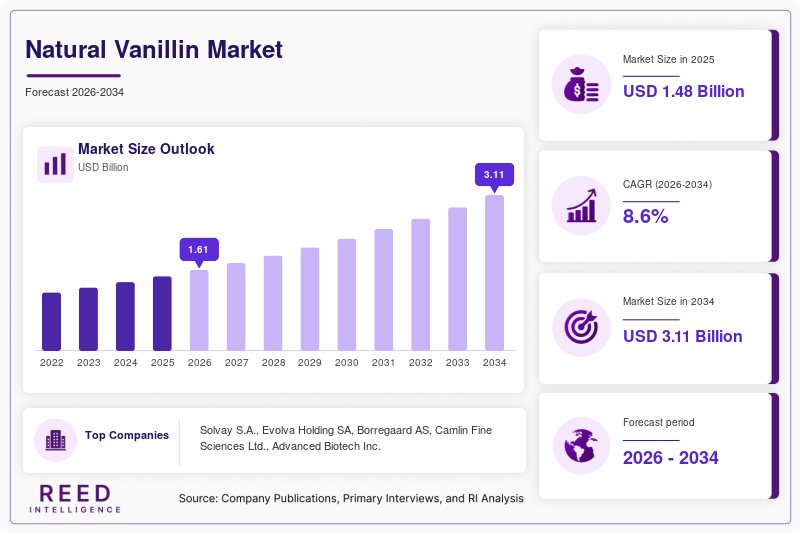
The Natural Vanillin Market size was valued at USD 1.48 billion in 2026 and is projected to reach USD 2.87 billion by 2034, expanding at a CAGR of 8.6% during 2026–2034. Market growth is being supported by the increasing global preference for naturally sourced food ingredients and clean-label products across food, beverage, cosmetic, and pharmaceutical applications. Consumers are increasingly scrutinizing ingredient labels and favoring products formulated with recognizable and naturally derived flavoring compounds. This shift has encouraged manufacturers to replace synthetic flavor ingredients with natural alternatives, creating sustained demand for natural vanillin across developed and emerging economies.
Natural vanillin is widely utilized as a flavoring and fragrance ingredient due to its characteristic aroma profile and compatibility with numerous formulations. The ingredient is derived from vanilla beans, ferulic acid, rice bran, lignin, and biotechnological fermentation processes. Rising investment in sustainable extraction technologies and biotechnology-based production methods has further enhanced commercial viability. In addition, growing demand for premium bakery products, flavored dairy products, nutritional supplements, and personal care formulations continues to strengthen market penetration.
Key Highlights
- North America dominated the market with 35.8% share in 2025, while Asia Pacific is projected to register the fastest CAGR of 10.4% during 2026–2034.
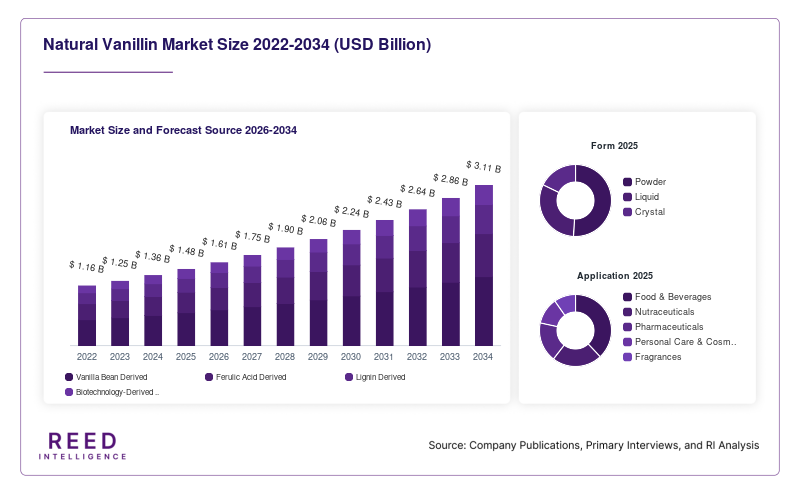
- By Source, Ferulic Acid-Based Natural Vanillin accounted for 42.6% market share in 2025, while Biotechnology-Derived Natural Vanillin is expected to grow at a CAGR of 11.8%.
- By Form, Powder Natural Vanillin held 61.4% share in 2025, whereas Liquid Natural Vanillin is forecast to expand at a CAGR of 9.9%.
- By Application, Food & Beverages represented 58.7% share in 2025, while Nutraceuticals are anticipated to grow at a CAGR of 10.8%.
- By Distribution Channel, Direct Sales held 55.2% market share in 2025, while Online Distribution is projected to grow at a CAGR of 11.2%.
- The United States, the dominant country, recorded a market value of USD 344 million in 2024, which increased to USD 373 million in 2025.
Market Trends
Expansion of Biotechnology-Based Vanillin Production
Biotechnology-driven production techniques are becoming increasingly important across the Natural Vanillin Market. Manufacturers are adopting microbial fermentation and enzyme-assisted conversion technologies to produce natural vanillin efficiently while reducing dependency on traditional vanilla bean cultivation. These methods improve production consistency, support scalability, and enhance sustainability credentials. Growing commercial acceptance of fermentation-derived natural ingredients is expected to reshape production economics and supply chain structures across the industry.
Growing Premiumization in Food and Beverage Products
Premium bakery products, gourmet confectionery, artisanal dairy products, and specialty beverages are increasingly incorporating natural vanillin to strengthen product differentiation. Brands are emphasizing authentic flavor profiles and natural ingredient declarations to attract health-conscious consumers. This trend is encouraging ingredient suppliers to develop customized natural vanillin formulations tailored to specific food categories, thereby expanding market opportunities across premium consumer segments.
Market Drivers
Increasing Consumer Preference for Clean-Label Ingredients
Consumers are actively seeking food products formulated with natural and recognizable ingredients. Regulatory attention toward ingredient transparency and growing awareness regarding synthetic additives have accelerated demand for natural flavor compounds. Natural vanillin aligns with clean-label product positioning and supports manufacturers in meeting evolving consumer expectations, thereby contributing significantly to market growth.
Growth of Natural Personal Care and Cosmetic Products
Natural fragrances and plant-derived ingredients are gaining popularity across skincare, haircare, and cosmetic formulations. Natural vanillin provides fragrance enhancement and compatibility with various natural formulations. Rising demand for botanical-based cosmetics and premium personal care products has created substantial opportunities for natural vanillin suppliers, particularly within premium consumer markets.
Market Restraint
Limited Availability and Cost Volatility of Natural Raw Materials
Natural vanillin production remains influenced by fluctuations in raw material availability, agricultural output, climate conditions, and extraction costs. Dependence on specific natural feedstocks can create supply constraints and pricing volatility, limiting widespread adoption among cost-sensitive manufacturers and affecting overall market expansion.
Market Opportunities
Development of Sustainable Bio-Based Flavor Ingredients
The growing emphasis on sustainability presents significant opportunities for producers investing in environmentally responsible extraction and fermentation technologies. Sustainable production methods can reduce environmental impact while addressing increasing demand for ethically sourced ingredients across global consumer markets.
Rising Demand from Functional Nutrition Products
Functional foods, dietary supplements, and wellness-oriented beverages are increasingly incorporating natural flavor systems to improve consumer acceptance. Natural vanillin offers flavor enhancement without compromising natural product positioning, creating attractive growth prospects within expanding health and nutrition categories.
Segmental Analysis
By Source
Ferulic Acid-Based Natural Vanillin
Ferulic acid-based natural vanillin accounted for 42.6% of market share in 2025. The segment benefited from commercial scalability, reliable production processes, and widespread adoption across food manufacturing applications. Its ability to provide consistent flavor quality supported strong market penetration.
Biotechnology-Derived Natural Vanillin
Biotechnology-derived natural vanillin is projected to expand at a CAGR of 11.8% through 2034. Growth will be supported by advances in microbial fermentation technologies that enable efficient production while reducing dependence on agricultural feedstocks. Enhanced sustainability credentials will further increase commercial adoption.
By Form
Powder
Powder natural vanillin held 61.4% share in 2025. The segment remained preferred due to longer shelf life, ease of transportation, formulation flexibility, and compatibility with dry food manufacturing processes.
Liquid
Liquid natural vanillin is expected to grow at a CAGR of 9.9% during the forecast period. Increasing use in beverage formulations and ready-to-use flavor systems will drive expansion. Improved blending characteristics and convenience advantages will support broader adoption.
By Application
Food & Beverages
Food & beverages represented 58.7% market share in 2025. The segment benefited from extensive utilization in bakery products, confectionery, dairy items, beverages, and frozen desserts where natural flavor enhancement remains critical for product differentiation.
Nutraceuticals
Nutraceutical applications are forecast to expand at a CAGR of 10.8% through 2034. Growth will result from increasing consumer interest in functional nutrition products requiring pleasant flavor profiles without compromising natural ingredient positioning.
By Distribution Channel
Direct Sales
Direct sales accounted for 55.2% share in 2025. Large food manufacturers preferred direct procurement arrangements to secure stable supply, quality consistency, and customized ingredient specifications.
Online Distribution
Online distribution channels are projected to grow at a CAGR of 11.2%. Digital procurement platforms will improve accessibility for small-scale manufacturers and specialty food producers seeking flexible purchasing options.
Regional Analysis
North America
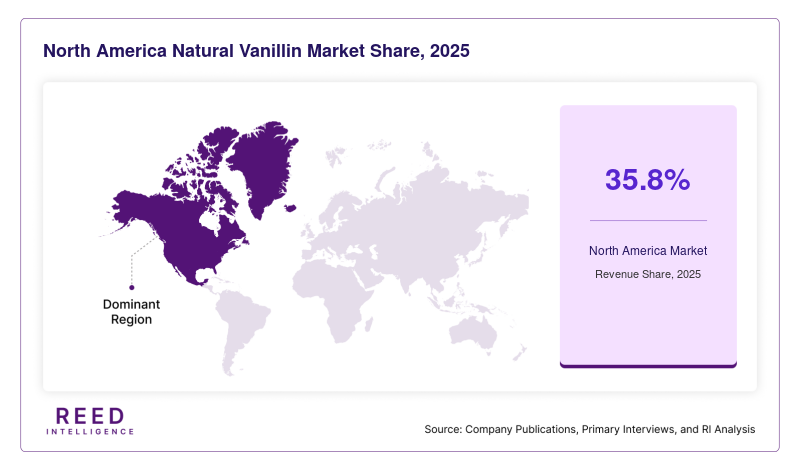
North America accounted for 35.8% of the Natural Vanillin Market share in 2025 and is expected to grow at a CAGR of 7.9% through 2034. The region benefited from mature clean-label food industries, extensive premium product adoption, and strong consumer awareness regarding ingredient transparency. The United States remained the leading country due to substantial demand from specialty food manufacturers that increasingly incorporated naturally derived flavor ingredients into premium product portfolios.
Europe
Europe represented 28.4% market share in 2025 and is projected to expand at a CAGR of 8.1% during the forecast period. Regulatory emphasis on natural ingredient labeling and sustainability initiatives supported regional demand. Germany dominated the regional market owing to strong adoption of natural flavoring ingredients within processed foods and premium confectionery manufacturing industries.
Asia Pacific
Asia Pacific held 22.1% share in 2025 and is forecast to witness the fastest CAGR of 10.4% between 2026 and 2034. Rising disposable incomes, increasing urbanization, and growing demand for premium packaged foods contributed to regional expansion. China led the regional market due to rapid growth in food processing industries and increasing consumption of premium bakery and beverage products.
Middle East & Africa
The Middle East & Africa accounted for 6.2% market share in 2025 and is anticipated to grow at a CAGR of 7.6% through 2034. Increasing demand for imported premium food products and expanding hospitality sectors supported market development. Saudi Arabia emerged as the leading country due to growing consumption of premium confectionery and flavored beverage products.
Latin America
Latin America captured 7.5% market share in 2025 and is expected to register a CAGR of 8.3% during the forecast period. Expanding processed food industries and changing consumer preferences toward natural ingredients supported regional demand. Brazil dominated the market owing to its expanding food manufacturing sector and increasing incorporation of natural flavor ingredients into consumer products.
Competitive Landscape
The Natural Vanillin Market remains moderately consolidated with manufacturers focusing on sustainable sourcing, biotechnology innovation, capacity expansion, and strategic partnerships. Competition centers on product purity, flavor consistency, regulatory compliance, and sustainable production capabilities.
Solvay S.A. maintained a leading market position through its diversified natural flavor portfolio and continuous investment in bio-based ingredient development. The company recently expanded production capabilities dedicated to naturally sourced aroma ingredients, strengthening its presence across food and fragrance industries.
Evolva Holding SA continues to emphasize fermentation-based vanillin production technologies designed to improve sustainability and production efficiency.
Borregaard AS leverages lignin-derived production expertise to serve global food and fragrance manufacturers seeking natural ingredient solutions.
Camlin Fine Sciences Ltd. focuses on expanding flavor ingredient portfolios and strengthening distribution networks across emerging markets.
Advanced Biotech Inc. remains active in customized flavor ingredient development, supporting food, beverage, and nutraceutical manufacturers worldwide.
Key Players List
- Solvay S.A.
- Evolva Holding SA
- Borregaard AS
- Camlin Fine Sciences Ltd.
- Advanced Biotech Inc.
- Givaudan SA
- Symrise AG
- International Flavors & Fragrances Inc.
- Firmenich SA
- Sensient Technologies Corporation
- Archer Daniels Midland Company
- Prova SAS
- Omega Ingredients Ltd.
- Apple Flavor & Fragrance Group Co., Ltd.
- Lesaffre Group
Natural Vanillin Market Segments
Source
- Vanilla Bean Derived
- Ferulic Acid Derived
- Lignin Derived
- Biotechnology-Derived Natural Vanillin
Form
- Powder
- Liquid
- Crystal
Application
- Food & Beverages
- Nutraceuticals
- Pharmaceuticals
- Personal Care & Cosmetics
- Fragrances
Distribution Channel
- Direct Sales
- Distributors & Wholesalers
- Online Distribution
By Region
- North America
- Europe
- APAC
- Middle East and Africa
- LATAM