Natural Wax Emulsion Market Size, Share, Demand Report by Type (Carnauba Wax Emulsions, Beeswax Emulsions), By Application (Coatings and Paints, Packaging, Textiles, Cosmetics and Personal Care), By End-Use Industry (Packaging, Construction, Automotive, Textile, Personal Care), By Formulation Type (Anionic, Non-Ionic, Cationic Emulsions), By Distribution Channel (Direct Sales, Distributors, Online Platforms) & Regional Forecasts, 2026–2034
USD 3950
Market Overview
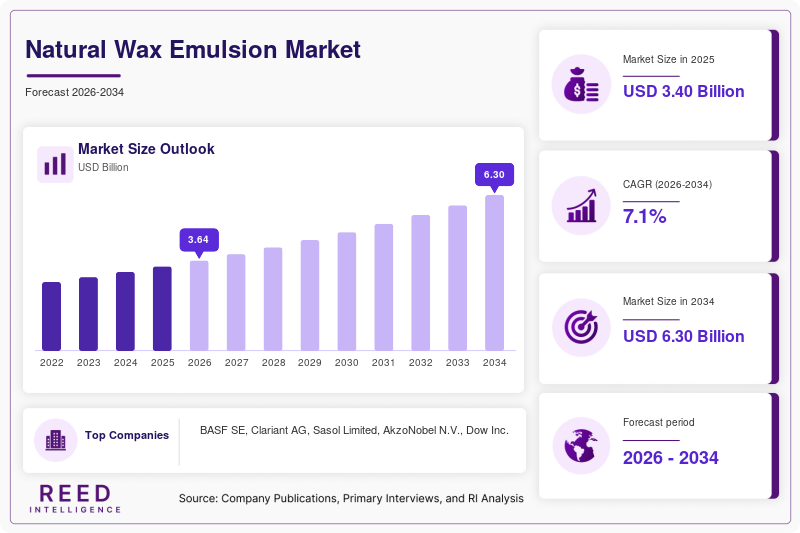
The Natural Wax Emulsion Market Size was valued at approximately USD 3.4 billion in 2026 and projected to reach around USD 5.9 billion by 2034, registering a CAGR of 7.1% (2026–2034). Growth in the Natural Wax Emulsion Market is primarily driven by increasing demand for bio-based and sustainable coating solutions across packaging, construction, and industrial applications.
A key global factor supporting the Natural Wax Emulsion Market growth is the rising regulatory push toward VOC-free and environmentally compliant chemical formulations, which is accelerating the replacement of petroleum-based waxes with natural alternatives across multiple industries.
The Natural Wax Emulsion Market is witnessing strong adoption due to increasing sustainability initiatives and the shift toward biodegradable raw materials in industrial manufacturing processes.
Key Highlights
- Dominant region share (2025): Europe held 34% share of the Natural Wax Emulsion Market
- Fastest-growing region CAGR (2026–2034): Asia Pacific projected at 8.3% CAGR
- Type segment leader: Carnauba wax emulsions dominated in 2025
- Fastest-growing type segment: Beeswax emulsions projected highest CAGR due to food-grade applications
- Application leader: Coatings and paints segment dominated in 2025
- Fastest-growing application segment: Packaging coatings expected to expand rapidly
Market Trends
Shift Toward Bio-Based Industrial Formulations
A major trend shaping the Natural Wax Emulsion Market is the transition toward bio-based chemical formulations. Manufacturers are increasingly adopting plant-derived wax emulsions such as carnauba, soy, and candelilla wax due to their biodegradability and compliance with environmental standards. This trend is strongly supported by sustainability certifications in packaging and construction industries.
Rising Demand in Food-Grade and Cosmetic Applications
Another notable trend in the Natural Wax Emulsion Market is increasing adoption in food coatings and personal care formulations. Natural wax emulsions are being used as protective coatings for fruits, confectionery items, and cosmetics due to their non-toxic and moisture-resistant properties, improving product safety and shelf life.
Market Drivers
Growing Demand for Sustainable Coating Materials
One of the key drivers of the Natural Wax Emulsion Market is the increasing demand for eco-friendly coating materials in industrial applications. Industries such as packaging, paper, and construction are shifting toward sustainable coatings that reduce environmental impact while maintaining performance efficiency.
Expansion of Packaging and Paper Industry
The rapid expansion of the packaging and paper industry is significantly driving the Natural Wax Emulsion Market. With rising e-commerce activities and demand for biodegradable packaging solutions, natural wax emulsions are increasingly used for moisture resistance, surface protection, and enhanced durability.
Market Restraint
Limited Raw Material Availability and Price Volatility
A major restraint impacting the Natural Wax Emulsion Market is the limited availability and fluctuating cost of natural wax raw materials such as carnauba and beeswax. Seasonal production variations and agricultural dependency create supply chain inconsistencies, affecting pricing stability.
Market Opportunities
Expansion in Sustainable Packaging Solutions
The increasing shift toward recyclable and compostable packaging materials presents a strong opportunity for the Natural Wax Emulsion Market. Natural wax emulsions are increasingly used as barrier coatings in food packaging, replacing synthetic polymer-based coatings.
Growth in Emerging Industrial Applications
The expansion of emerging industrial applications such as textiles, adhesives, and wood coatings is creating new opportunities in the Natural Wax Emulsion Market. These sectors are adopting natural wax emulsions to enhance surface finish, water resistance, and environmental compliance.
Segmental Analysis
By Type
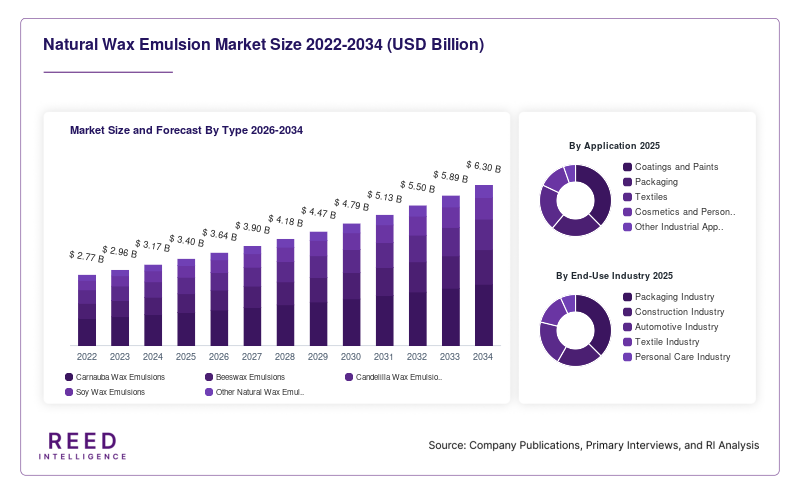
The Natural Wax Emulsion Market is segmented into carnauba wax, beeswax, candelilla wax, soy wax, and others. Carnauba wax emulsions dominated the market in 2025 with a 38% share, driven by high gloss properties and strong adoption in coatings and automotive polish applications.
Beeswax emulsions are expected to be the fastest-growing subsegment with a 7.9% CAGR (2026–2034). Growth is driven by increasing demand in food-grade coatings and cosmetics due to its natural and non-toxic properties, making it highly suitable for sensitive applications.
By Application
Key applications include coatings and paints, packaging, textiles, cosmetics, and others. Coatings and paints dominated the Natural Wax Emulsion Market in 2025 with a 41% share, supported by rising demand for protective and decorative surface finishes.
Packaging applications are expected to be the fastest-growing segment with a 8.2% CAGR (2026–2034). Growth is driven by increasing demand for biodegradable and moisture-resistant packaging materials in food and e-commerce industries.
By End-Use Industry
End-use industries include packaging, construction, automotive, textiles, and personal care. Packaging held the largest share at 37% in 2025, driven by strong adoption of eco-friendly barrier coatings.
Personal care is the fastest-growing end-use segment with a projected 8.0% CAGR, supported by increasing demand for natural ingredients in skincare and cosmetic formulations.
By Formulation Type
Formulation types include anionic, non-ionic, and cationic emulsions. Non-ionic emulsions dominated the market in 2025 with a 45% share, due to compatibility with a wide range of industrial applications.
Cationic emulsions are expected to be the fastest-growing segment with a 7.6% CAGR, driven by increasing use in textile finishing and wood coating applications.
By Distribution Channel
Distribution channels include direct sales, distributors, and online platforms. Direct sales dominated the Natural Wax Emulsion Market in 2025 with a 52% share, particularly for large-scale industrial buyers.
Online distribution channels are expected to grow fastest at a 9.1% CAGR, supported by increasing digital procurement trends and small-scale manufacturer accessibility.
Regional Analysis
North America
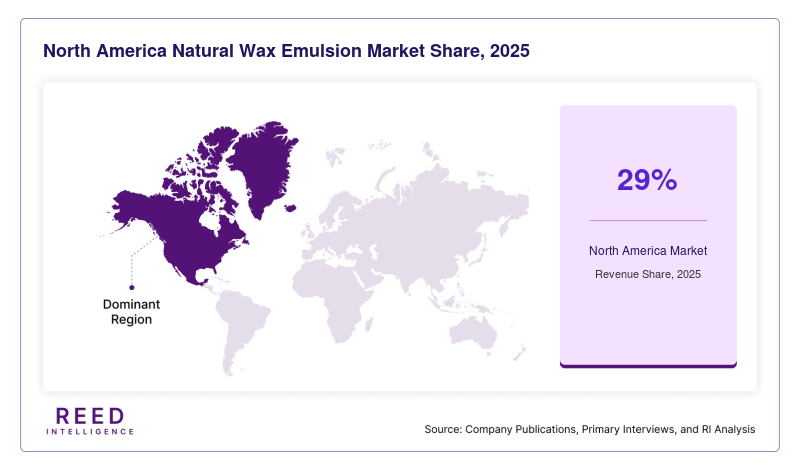
North America accounted for 29% share of the Natural Wax Emulsion Market in 2025 and is projected to grow at a 6.8% CAGR (2026–2034). The United States leads regional demand due to strong adoption in packaging and industrial coatings industries, supported by stringent environmental regulations promoting low-VOC materials.
Europe
Europe held the largest 34% market share in 2025 and is expected to grow at a 7.0% CAGR (2026–2034). Germany remains the dominant country due to its advanced chemical manufacturing base and strong focus on sustainable industrial formulations across automotive and packaging sectors.
Asia Pacific
Asia Pacific accounted for 23% share in 2025 and is expected to register the fastest growth at 8.3% CAGR (2026–2034). China is the leading contributor, driven by rapid expansion in packaging, textile, and construction industries along with rising environmental compliance initiatives.
Middle East & Africa
This region held 7% share in 2025 and is projected to grow at a 6.5% CAGR (2026–2034). Growth is driven by increasing demand for sustainable construction coatings in the UAE and Saudi Arabia, supported by infrastructure development projects.
Latin America
Latin America accounted for 7% share in 2025 and is expected to grow at a 6.7% CAGR (2026–2034). Brazil leads the region due to expanding agricultural processing industries and rising adoption of eco-friendly packaging materials.
Competitive Landscape
The Natural Wax Emulsion Market is moderately consolidated, with leading players focusing on product innovation, bio-based formulations, and regional expansion strategies. Companies are increasingly investing in sustainable chemistry solutions to meet environmental compliance requirements.
BASF SE remains a leading player in the Natural Wax Emulsion Market, with continuous expansion of its bio-based product portfolio and recent advancements in high-performance wax emulsion formulations for coatings and packaging applications.
Other key players are focusing on capacity expansion and partnerships with packaging manufacturers to strengthen market presence and improve supply chain efficiency.
Key Players List
- BASF SE
- Clariant AG
- Sasol Limited
- AkzoNobel N.V.
- Dow Inc.
- Michelman Inc.
- Koster Keunen Inc.
- Paramelt B.V.
- Munzing Chemie GmbH
- S.C. Johnson & Son Inc.
- Foncepi S.A.
- Stroever GmbH & Co. KG
- Kahl GmbH & Co. KG
- Norevo GmbH
- Frank B. Ross Co.
Recent Developments
- Manufacturers in the Natural Wax Emulsion Market are increasing investment in plant-based wax extraction technologies.
- Expansion of biodegradable coating product lines has been observed among key chemical companies.
- Strategic partnerships between packaging firms and wax emulsion producers are increasing.
- New product launches focusing on food-safe wax emulsions are gaining traction.
- R&D activities are focused on improving emulsion stability and multi-industry compatibility.
Natural Wax Emulsion Market Segments
By Type
- Carnauba Wax Emulsions
- Beeswax Emulsions
- Candelilla Wax Emulsions
- Soy Wax Emulsions
- Other Natural Wax Emulsions
By Application
- Coatings and Paints
- Packaging
- Textiles
- Cosmetics and Personal Care
- Other Industrial Applications
By End-Use Industry
- Packaging Industry
- Construction Industry
- Automotive Industry
- Textile Industry
- Personal Care Industry
By Formulation Type
- Anionic Emulsions
- Non-Ionic Emulsions
- Cationic Emulsions
By Distribution Channel
- Direct Sales
- Distributors
- Online Platforms
By Region
- North America
- Europe
- APAC
- Middle East and Africa
- LATAM