Neat Cutting Oil Market Size, Share, Demand Report By Product Type (Synthetic-based Neat Cutting Oils, Bio-based Neat Cutting Oils), By Application (Grinding Applications, Drilling Operations, Milling Processes), By End-Use Industry (Automotive, Aerospace, Machinery & Equipment Manufacturing, Metal Fabrication, Energy & Heavy Engineering) & Regional Forecasts, 2026–2034
USD 3950
Market Overview
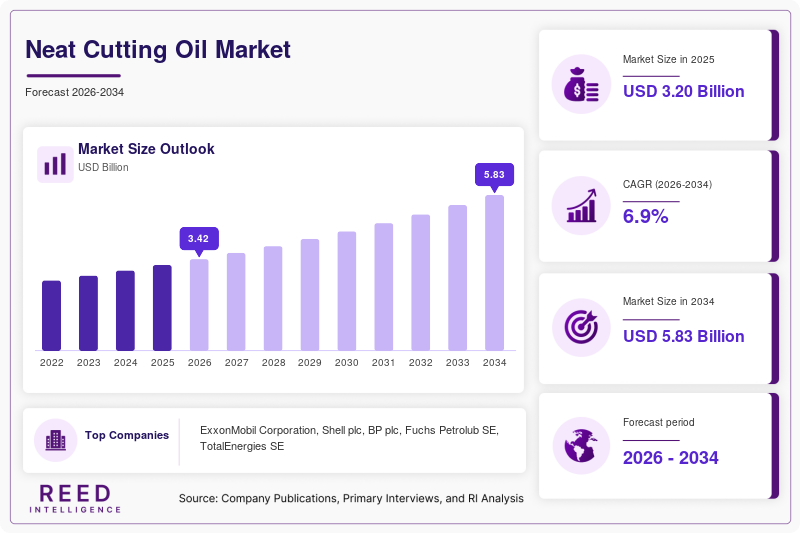
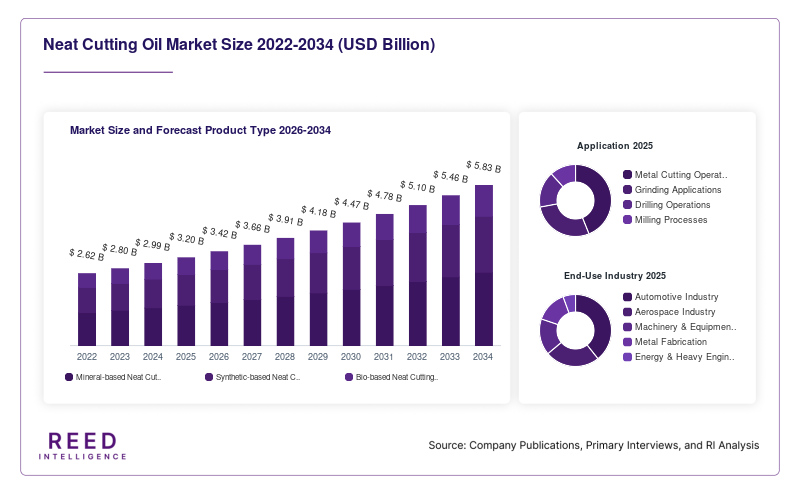
The Neat Cutting Oil Market size is projected to reach approximately USD 3.42 billion in 2026, and is expected to attain a value of USD 5.87 billion by 2034, expanding at a CAGR of 6.9% during the forecast period (2026–2034). Growth in the market is primarily driven by increasing precision machining activities across automotive, aerospace, and general manufacturing industries. The rising demand for improved surface finish quality, extended tool life, and reduced thermal deformation in high-speed machining operations has significantly supported the adoption of neat cutting oils globally. Additionally, a global shift toward high-performance metalworking fluids with better lubrication efficiency and lower operational downtime has further strengthened market expansion.
A key global factor influencing market growth is the rapid industrial automation trend across emerging and developed economies. As CNC machining systems and advanced manufacturing lines become more widely deployed, the requirement for stable, non-emulsifiable lubricants such as neat cutting oils has increased. These oils provide superior lubrication under extreme pressure conditions and are widely used in applications where water-based emulsions are unsuitable. Furthermore, environmental considerations and regulatory pressure to improve workplace safety have encouraged manufacturers to develop low-mist, low-odor, and high-stability formulations.
Key Highlights
- North America dominated the market with a 34.2% share in 2025.
- Asia Pacific is expected to grow at the fastest CAGR of 11.2% during 2026–2034.
- By product type, mineral-based neat cutting oils accounted for the largest share of 38.5%.
- while bio-based formulations are projected to grow at a CAGR of 12.4%.
- By application, metal cutting operations led with a 41.7% share.
- whereas precision grinding applications are expected to expand at a CAGR of 11.8%.
- The United States remained the dominant country, with market values of USD 620 million in 2024 and USD 665 million in 2025.
Market Trends
Increasing Shift Toward High-Performance Synthetic Formulations
One of the key trends shaping the Neat Cutting Oil Market is the growing transition from conventional mineral oils to high-performance synthetic and semi-synthetic formulations. Manufacturers are increasingly focusing on improving thermal stability, oxidation resistance, and lubrication efficiency to meet the requirements of modern machining processes. Synthetic neat cutting oils are gaining traction in high-speed CNC operations due to their ability to reduce friction and maintain consistent performance under elevated temperatures. Industries such as aerospace and automotive manufacturing are particularly adopting these advanced formulations to enhance machining precision and extend tool life. Additionally, regulatory pressure to reduce volatile organic compound emissions has encouraged innovation in cleaner and more environmentally compatible cutting oil solutions, further supporting this transition.
Integration of Sustainable and Bio-Based Cutting Fluids
Another significant trend is the rising adoption of bio-based neat cutting oils derived from renewable feedstocks such as vegetable oils and synthetic esters. Sustainability goals across industrial sectors are pushing manufacturers to reduce dependency on petroleum-based lubricants. Bio-based cutting oils offer advantages such as biodegradability, reduced toxicity, and improved worker safety, making them suitable for long-term industrial usage. Companies are also investing in additive technologies that enhance oxidation resistance and microbial stability of bio-based fluids. This trend is particularly strong in Europe and parts of Asia Pacific, where environmental compliance standards are stringent. As industries continue to prioritize green manufacturing practices, bio-based neat cutting oils are expected to capture a larger share of the global market.
Market Drivers
Expansion of Precision Manufacturing Industries
The growing expansion of precision manufacturing industries is a major driver for the Neat Cutting Oil Market. Sectors such as automotive, aerospace, medical devices, and heavy machinery require highly accurate machining processes where surface finish quality and dimensional accuracy are critical. Neat cutting oils provide superior lubrication under extreme pressure conditions, reducing tool wear and improving operational efficiency. The increasing production of lightweight and high-strength metal components has further intensified demand for advanced machining fluids. Additionally, the rise in CNC machining centers and automated production lines has reinforced the need for stable lubricants that ensure consistent performance. As global manufacturing output continues to grow, especially in developing economies, the demand for neat cutting oils is expected to rise steadily.
Rising Demand for Extended Tool Life and Operational Efficiency
Another significant driver is the increasing focus on reducing machining costs through extended tool life and improved operational efficiency. Industrial operators are under constant pressure to minimize downtime and maintenance costs while maximizing production output. Neat cutting oils play a crucial role in reducing friction between cutting tools and workpieces, thereby minimizing wear and tear. This leads to longer tool life and fewer tool replacements, which directly impacts production economics. Furthermore, their superior heat dissipation properties help maintain stable machining conditions, reducing the risk of thermal damage to components. As industries continue to adopt lean manufacturing practices, the demand for high-performance cutting fluids that improve efficiency and reduce total operating costs is expected to strengthen.
Market Restraint
Environmental Compliance and Disposal Challenges
One of the primary restraints affecting the Neat Cutting Oil Market is the increasing stringency of environmental regulations related to industrial waste disposal and emissions. Neat cutting oils, being petroleum-based in many cases, require careful handling and disposal to prevent soil and water contamination. Regulatory authorities in regions such as Europe and North America have imposed strict guidelines on industrial lubricant usage, disposal, and recycling. Compliance with these regulations often increases operational costs for manufacturers and end-users. Additionally, improper disposal of used cutting oils can lead to environmental hazards, which has led to increased scrutiny and monitoring. This regulatory pressure is pushing companies to invest in cleaner alternatives, but it also restricts market expansion in cost-sensitive industries.
Market Opportunities
Growing Adoption in Emerging Manufacturing Economies
Emerging economies in Asia Pacific, Latin America, and parts of the Middle East present significant growth opportunities for the Neat Cutting Oil Market. Rapid industrialization, infrastructure development, and expansion of automotive and machinery manufacturing sectors are driving demand for efficient machining solutions. Countries such as India, Vietnam, and Brazil are witnessing increased investments in manufacturing facilities, which directly boosts consumption of metalworking fluids. Neat cutting oils are increasingly being adopted due to their ability to enhance machining precision and reduce tool wear in cost-sensitive production environments. Additionally, government initiatives supporting industrial growth and foreign direct investment are expected to further accelerate market penetration in these regions.
Technological Advancements in Additive and Lubrication Chemistry
Advancements in additive chemistry and lubrication technology are creating new opportunities for product innovation in the Neat Cutting Oil Market. Manufacturers are developing advanced formulations with enhanced anti-wear, anti-corrosion, and extreme pressure properties. The integration of nanotechnology-based additives is improving performance efficiency and thermal stability, making cutting oils suitable for high-speed and heavy-duty machining operations. Furthermore, innovations aimed at reducing mist formation and improving operator safety are gaining traction. These technological developments are enabling companies to differentiate their products and cater to highly specialized industrial applications. As machining processes become more complex, demand for customized and high-performance cutting oils is expected to rise.
Segmental Analysis
By Product Type
Mineral-based neat cutting oils dominated the global market with approximately 38.5% share in 2024 due to their cost-effectiveness, high lubrication efficiency, and broad industrial applicability. These oils are widely used in heavy-duty machining operations such as tapping, broaching, and gear cutting where strong boundary lubrication is required. Automotive and machinery manufacturers continue to prefer mineral-based oils because they provide reliable cooling and friction reduction during high-load metalworking operations. Additionally, their established supply chain and compatibility with existing industrial systems support widespread adoption across both developed and emerging economies.
Bio-based neat cutting oils are projected to witness the fastest growth, registering a CAGR of nearly 12.4% during 2026–2034. Increasing environmental regulations and sustainability initiatives are encouraging industries to shift toward biodegradable and low-toxicity lubrication solutions. Manufacturers are developing advanced bio-based formulations using vegetable oils and synthetic esters to improve oxidation stability and thermal performance. These oils are gaining popularity in Europe and Asia Pacific due to strict workplace safety regulations and rising awareness regarding eco-friendly manufacturing practices. Their ability to reduce operator exposure to harmful emissions and improve waste management efficiency is also driving adoption.
By Application
Metal cutting operations accounted for approximately 41.7% market share in 2024, making it the dominant application segment within the Neat Cutting Oil Market. These operations require high lubrication efficiency to minimize friction, improve surface finish, and extend tool life during machining processes. Industries such as automotive, industrial machinery, and heavy engineering rely heavily on neat cutting oils in turning, milling, and threading applications. Rising global demand for precision-machined components and increased deployment of CNC machining systems have further strengthened the segment’s growth trajectory. The ability of neat cutting oils to withstand extreme pressure conditions also supports their extensive use in demanding industrial environments.
Grinding applications are expected to register the fastest CAGR of around 11.8% during the forecast period, driven by increasing demand for ultra-precision surface finishing processes. Aerospace, medical device manufacturing, and advanced electronics industries require highly accurate grinding operations to maintain dimensional consistency and component reliability. Neat cutting oils used in grinding applications help reduce heat generation, improve wheel life, and achieve smoother surface finishes. Additionally, manufacturers are investing in specialized grinding fluid formulations that reduce mist formation and improve thermal conductivity. The growing use of advanced materials such as titanium alloys and hardened steels is also contributing to increased demand for high-performance grinding oils.
By End-Use Industry
The automotive industry held the largest share of approximately 36.2% in 2024 within the Neat Cutting Oil Market. High-volume production of engines, transmission systems, bearings, and precision automotive components requires extensive machining and lubrication processes. Neat cutting oils are widely used to reduce friction, improve machining accuracy, and maintain production efficiency in automotive manufacturing facilities. Increasing production of electric vehicles and lightweight automotive parts has further intensified the need for advanced metalworking fluids capable of supporting complex machining operations. The segment also benefits from rising automation and robotic machining integration across automotive production lines.
The aerospace industry is expected to grow at the fastest CAGR of approximately 11.5% during 2026–2034, supported by increasing aircraft production and rising demand for lightweight structural components. Aerospace machining involves difficult-to-machine materials such as titanium, nickel-based alloys, and composite metals that require superior lubrication performance. Neat cutting oils help maintain dimensional precision, reduce heat buildup, and improve cutting tool stability during high-speed machining operations. Additionally, increasing investments in defense manufacturing and commercial aviation maintenance facilities are supporting lubricant demand. Growing adoption of five-axis machining systems and precision grinding technologies is expected to further accelerate segment growth.
Regional Analysis
North America
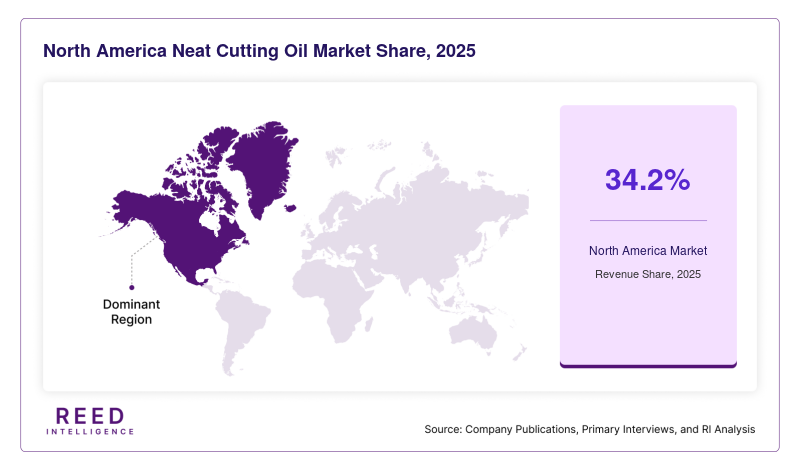
North America accounted for approximately 34.2% of the global Neat Cutting Oil Market share in 2025 and is projected to expand at a CAGR of 6.5% during 2026–2034. The region benefits from strong industrial automation adoption and widespread use of CNC machining systems across automotive, aerospace, and heavy engineering industries. Demand for high-performance cutting oils continues to rise as manufacturers focus on extending tool life, improving machining precision, and minimizing operational downtime. The presence of advanced manufacturing infrastructure and established lubricant suppliers further supports regional market expansion.
The United States dominates the North American market, supported by extensive investments in precision manufacturing and industrial modernization initiatives. The country recorded an estimated market value of USD 620 million in 2024, increasing to nearly USD 665 million in 2025. A major growth factor in the U.S. is the increasing production of lightweight automotive components and aerospace alloys that require superior lubrication performance during machining operations. Canada also contributes steadily through expanding metal fabrication and industrial equipment manufacturing activities.
Europe
Europe represented nearly 27.8% of the global market share in 2025 and is anticipated to grow at a CAGR of 6.2% through 2034. Strong environmental regulations and high adoption of sustainable manufacturing practices are influencing demand for advanced neat cutting oils across the region. European industries are increasingly adopting low-mist and bio-based formulations to comply with stringent workplace safety and environmental standards. Additionally, precision machining demand from automotive, aerospace, and industrial equipment sectors continues to drive lubricant consumption across Germany, France, Italy, and the United Kingdom.
Germany remains the dominant country within Europe due to its extensive automotive production capacity and advanced engineering ecosystem. The country benefits from high demand for premium cutting oils used in high-speed machining and robotic manufacturing systems. A unique growth factor in Germany is the rapid integration of Industry 4.0 technologies into machining operations, requiring cutting fluids capable of supporting automated and continuous production cycles. France and Italy also contribute significantly through aerospace component manufacturing and industrial machinery production.
Asia Pacific
Asia Pacific captured approximately 25.6% of the global Neat Cutting Oil Market in 2025 and is expected to register the fastest CAGR of 11.2% during the forecast period. Rapid industrialization, increasing export-oriented manufacturing, and rising investments in automotive and electronics production are key contributors to regional growth. Countries across the region are expanding industrial capacity and upgrading metalworking operations, which is increasing demand for high-performance machining lubricants. Growing adoption of CNC systems and automated production technologies is further accelerating market expansion in Asia Pacific.
China dominates the regional market due to its extensive manufacturing base and strong presence in machinery, automotive, and industrial equipment production. A significant growth factor in China is the increasing demand for precision-machined components in electric vehicle and renewable energy industries. India is also emerging as a major market due to expanding industrial corridors and government initiatives supporting domestic manufacturing activities. Japan and South Korea continue to generate strong demand through advanced robotics, semiconductor equipment, and aerospace manufacturing sectors.
Middle East & Africa
The Middle East & Africa region accounted for nearly 7.1% of the global market share in 2025 and is projected to grow at a CAGR of 7.4% during 2026–2034. Industrial diversification strategies and infrastructure development programs are supporting demand for machining lubricants across the region. Governments are investing heavily in manufacturing expansion to reduce dependency on oil exports, which is increasing demand for industrial metalworking fluids. Rising activity in steel fabrication, industrial maintenance, and heavy machinery sectors is also contributing to market growth.
Saudi Arabia leads the regional market due to increasing investments in non-oil industrial sectors and machinery manufacturing projects. One major growth factor in the country is the expansion of industrial cities and engineering facilities under long-term economic diversification initiatives. The United Arab Emirates is also witnessing steady growth in metal fabrication and aerospace maintenance operations. South Africa contributes through mining equipment manufacturing and industrial machining activities, further strengthening regional demand for neat cutting oils.
Latin America
Latin America held approximately 5.3% of the global Neat Cutting Oil Market share in 2025 and is forecast to grow at a CAGR of 6.8% through 2034. Expanding automotive assembly operations and increasing industrial manufacturing investments are supporting regional market development. Demand for cutting oils is rising in response to growth in metalworking, industrial machinery production, and maintenance operations. Manufacturers across the region are gradually adopting higher-performance lubricants to improve machining efficiency and reduce operational costs.
Brazil dominates the Latin American market due to its strong automotive manufacturing industry and growing industrial production base. A unique growth factor in Brazil is the increasing modernization of industrial workshops and machining facilities aimed at improving production efficiency and export competitiveness. Mexico also contributes significantly through automotive component manufacturing linked to North American supply chains. Argentina and Chile are witnessing gradual adoption of advanced metalworking fluids in industrial engineering and mining-related equipment manufacturing activities.
Competitive Landscape
The global Neat Cutting Oil Market is moderately consolidated, with leading companies competing through product innovation, sustainability initiatives, strategic partnerships, and regional expansion strategies. Major players are increasingly investing in high-performance synthetic and bio-based cutting oil formulations to address evolving industrial requirements and tightening environmental regulations. Companies are also focusing on improving lubrication efficiency, reducing mist formation, and extending tool life to strengthen their competitive position. The market is characterized by continuous research and development activities aimed at enhancing thermal stability and operational efficiency in advanced machining applications.
ExxonMobil Corporation remains one of the leading participants in the market due to its extensive industrial lubricant portfolio and strong global distribution network. Other major companies include Shell plc, BP plc, FUCHS Group, and TotalEnergies SE. Recent developments include increased investments in sustainable lubricant technologies and expansion of synthetic cutting fluid product lines targeting precision machining industries. Several manufacturers are also collaborating with CNC machine producers to develop customized lubrication solutions optimized for automated manufacturing systems.
Key Players List
ExxonMobil Corporation
Shell plc
BP plc
Fuchs Petrolub SE
TotalEnergies SE
Chevron Corporation
Castrol Limited
Idemitsu Kosan Co., Ltd.
Indian Oil Corporation Limited
Houghton International Inc.
Quaker Houghton
ENEOS Corporation
Petro-Canada Lubricants
Lukoil Lubricants
Blaser Swisslube AG
Segmentation Listing
By Product Type: Mineral-based, Synthetic-based, Bio-based
By Application: Metal cutting, Grinding, Drilling, Milling
By End-Use Industry: Automotive, Aerospace, Machinery, Metal fabrication, Energy
Recent Developments
- Several manufacturers have introduced next-generation low-mist neat cutting oils designed to improve workplace safety and reduce airborne particulate emissions in machining environments.
- Companies are increasingly investing in bio-based lubricant production facilities, aiming to expand sustainable product portfolios and meet tightening environmental regulations.
- Strategic collaborations between lubricant manufacturers and CNC machine producers have increased, focusing on optimizing fluid performance for advanced machining systems and high-speed production lines.
Neat Cutting Oil Market Segments
Product Type
- Mineral-based Neat Cutting Oils
- Synthetic-based Neat Cutting Oils
- Bio-based Neat Cutting Oils
Application
- Metal Cutting Operations
- Grinding Applications
- Drilling Operations
- Milling Processes
End-Use Industry
- Automotive Industry
- Aerospace Industry
- Machinery & Equipment Manufacturing
- Metal Fabrication
- Energy & Heavy Engineering
By Region
- North America
- Europe
- APAC
- Middle East and Africa
- LATAM