Nephrology Stents Catheter Market Size, Share & Demand Report By Product Type (Ureteral Stents, Nephrostomy Catheters, Dialysis Catheters, Ureteral Access Sheaths), By Application (Kidney Stone Management, Chronic Kidney Disease Access Management, Urinary Obstruction, Post-Surgical Drainage), By End User (Hospitals, Ambulatory Surgical Centers, Dialysis Centers, Specialty Clinics) By Region & Segment Forecasts, 2026–2034
USD 3950
Market Overview
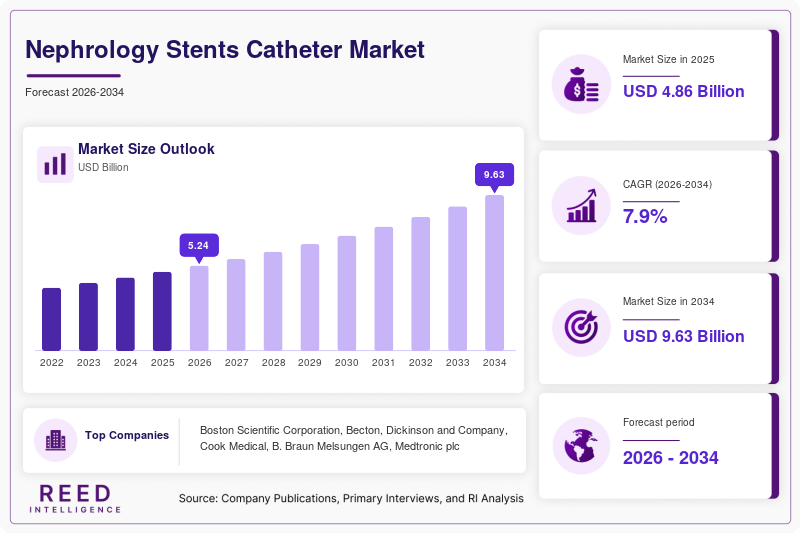
The global Nephrology Stents Catheter Market size was valued at USD 4.86 billion in 2026 and is projected to reach USD 8.94 billion by 2034, expanding at a CAGR of 7.9% during the forecast period. The market is advancing steadily due to the growing burden of chronic kidney disease, urinary obstructions, nephrolithiasis, and rising demand for minimally invasive urological and nephrological procedures. Increasing global aging demographics, combined with higher prevalence of diabetes and hypertension, has significantly expanded the patient pool requiring nephrostomy catheters, ureteral stents, dialysis catheters, and associated renal intervention devices. Healthcare systems are also investing more heavily in advanced interventional nephrology infrastructure, which supports procedural volume across developed and emerging economies.
One of the major global factors supporting market expansion is the broader shift toward outpatient and image-guided procedures. Hospitals and specialty clinics are increasingly adopting biocompatible, antimicrobial-coated, and long-dwell nephrology stents and catheters that reduce infection rates and improve patient comfort. Technological innovation in silicone-based, polyurethane, and hydrogel-coated devices is improving treatment outcomes while reducing repeat interventions. Regulatory support for renal care expansion and improving reimbursement in many countries are also contributing to market maturity.
Key Highlights
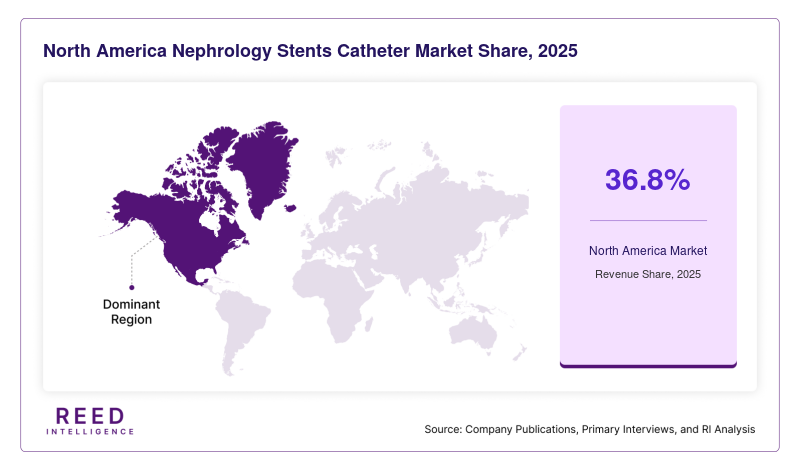
- North America dominated the market with a 36.8% share in 2025.
- Asia Pacific is expected to grow at the fastest CAGR of 9.8% during 2026–2034.
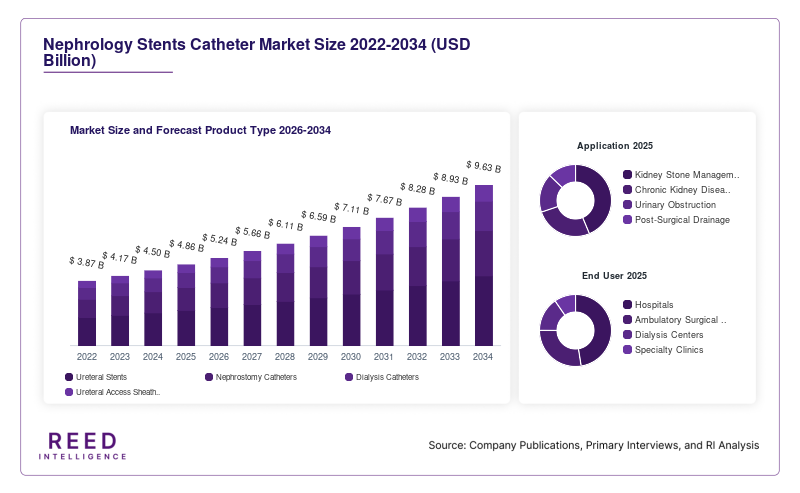
- By product type, ureteral stents accounted for the largest share of 34.6%, while antimicrobial dialysis catheters are projected to grow at a CAGR of 10.6%.
- By application, kidney stone management led with a 39.4% share, whereas chronic kidney disease access management is expected to expand at a CAGR of 10.1%.
- The United States remained the dominant country, with market values of USD 1.42 billion in 2024 and USD 1.53 billion in 2025.
Market Trends
Rising adoption of antimicrobial and drug-eluting catheter technologies
A significant trend shaping the Nephrology Stents Catheter Market is the transition from conventional devices toward antimicrobial-coated, hydrogel-enhanced, and drug-eluting stents and catheters. Device-associated urinary tract infections, bloodstream infections, and catheter encrustation remain major clinical concerns, prompting manufacturers to prioritize product innovations that reduce complications. Silver-ion coatings, antibiotic-embedded surfaces, and anti-biofilm technologies are increasingly being integrated into premium nephrology devices. Hospitals are showing stronger preference for these products because they lower hospitalization time and readmission rates. This trend is especially visible in dialysis access catheters where infection prevention is directly tied to survival outcomes. As healthcare providers focus on long-term cost reduction and patient safety, technologically advanced catheters are moving from niche adoption to broader institutional purchasing strategies.
Expansion of ambulatory nephrology and minimally invasive renal procedures
Another major trend is the increasing migration of nephrology stent and catheter procedures from large inpatient hospitals to ambulatory surgery centers and specialized renal clinics. Improved fluoroscopic guidance, ultrasound-assisted insertion, and compact intervention systems have enabled faster and safer catheter placements outside traditional surgical settings. Patients increasingly prefer minimally invasive procedures due to shorter recovery periods, lower procedural costs, and reduced hospital exposure. This trend is supporting demand for flexible, patient-friendly, and easy-placement catheter systems. Emerging markets are also adopting portable renal intervention technologies to improve procedural access in secondary healthcare centers. Manufacturers are therefore designing simplified deployment systems and disposable kits tailored for outpatient nephrology, creating broader product diversification and accelerating market penetration.
Market Drivers
Growing global prevalence of chronic kidney disease and urinary obstruction disorders
The increasing incidence of chronic kidney disease, kidney stones, ureteral blockages, and renal failure is a major driver for the Nephrology Stents Catheter Market. Rising rates of obesity, diabetes, hypertension, and sedentary lifestyles have significantly elevated nephrological disease burden worldwide. Chronic kidney disease alone affects millions of patients annually, many of whom require dialysis access catheters or long-term stent placement. Kidney stone prevalence has also increased due to dietary changes and dehydration patterns. This growing patient population is creating sustained procedural demand for nephrostomy tubes, ureteral stents, and central venous dialysis catheters. Healthcare systems are prioritizing renal intervention capacity to manage rising patient volumes, which directly strengthens product utilization across acute and chronic care settings.
Increasing healthcare infrastructure investments in renal care
Expanding healthcare expenditure and modernization of renal care facilities are accelerating product adoption across global markets. Governments and private healthcare groups are investing in dialysis centers, nephrology departments, and specialized interventional radiology capabilities. This is particularly important in developing countries where renal disease diagnosis and treatment infrastructure were historically underdeveloped. Expanded insurance coverage and reimbursement for dialysis and urinary intervention procedures are also improving affordability. Additionally, hospital procurement is shifting toward premium nephrology devices due to better durability and reduced complication rates. These investments are creating stronger purchasing cycles for advanced nephrology stents and catheter systems while supporting market expansion in both urban and semi-urban care ecosystems.
Market Restraint
High complication rates and product replacement burden limiting broader adoption
Despite strong growth potential, the Nephrology Stents Catheter Market faces constraints due to complications such as infection, encrustation, migration, thrombosis, and patient discomfort. Long-term catheterization often requires frequent replacements, increasing procedural burden and healthcare costs. In lower-income healthcare systems, these replacement cycles can create affordability barriers, limiting adoption of premium products. Clinical hesitation may also arise when recurrent catheter-associated infections increase morbidity. For example, dialysis catheter infections can significantly impact patient survival and create expensive hospitalization episodes. Additionally, regulatory scrutiny for device safety has intensified, extending product approval timelines and increasing manufacturing costs. These factors can slow innovation commercialization, particularly for smaller manufacturers, and create market pressure despite rising disease prevalence.
Market Opportunities
Untapped growth in emerging economies through renal care expansion
Emerging economies present substantial opportunities due to improving diagnosis rates and healthcare access for nephrology disorders. Countries across Asia, Latin America, and Africa are witnessing higher kidney disease prevalence but still maintain relatively low intervention penetration. Public-private partnerships are increasing dialysis center construction, nephrology training, and access to imaging technologies. As these healthcare ecosystems mature, demand for affordable ureteral stents, nephrostomy catheters, and dialysis access systems is expected to expand considerably. Manufacturers that offer cost-effective product lines while maintaining quality standards may capture significant market share. Localization of manufacturing and strategic distribution partnerships can further improve market reach in these underserved regions.
Personalized and smart catheter technologies creating premium product segments
The development of next-generation nephrology devices with sensor integration, patient monitoring capability, and personalized sizing offers a promising opportunity for premiumization. Smart catheters capable of monitoring flow dynamics, pressure, or infection biomarkers may improve treatment precision and reduce emergency interventions. Customized stent geometry designed for specific anatomical requirements can also improve patient comfort and clinical efficacy. As precision medicine expands, nephrology devices are expected to evolve beyond basic drainage solutions into advanced therapeutic platforms. This innovation pathway could create higher-margin segments for manufacturers and strengthen differentiation in a competitive market.
Segmental Analysis
By Product Type
Ureteral stents held the dominant share of 34.6% in 2024 due to widespread use in kidney stone management, ureteral obstruction relief, and postoperative drainage. Their broad procedural application across hospitals, ambulatory centers, and specialty clinics makes them a foundational nephrology intervention product. Rising kidney stone prevalence and increasing endourological procedures have sustained strong utilization. Product innovations such as softer polymers and anti-encrustation coatings have further improved patient tolerance and procedural outcomes.
Antimicrobial dialysis catheters are projected to be the fastest-growing product subsegment, expanding at a CAGR of 10.6% through 2034. This growth is linked to infection control priorities in long-term dialysis patients. Hospitals increasingly favor antimicrobial products to reduce bloodstream infection risks, improve patient outcomes, and lower hospitalization costs. As dialysis populations rise globally, demand for safer vascular access devices is expected to strengthen.
By Application
Kidney stone management accounted for the largest share of 39.4% in 2024, supported by rising nephrolithiasis prevalence and higher rates of ureteroscopy procedures. Increasing dehydration, dietary shifts, and metabolic disorders are driving stone incidence globally. Ureteral stents and nephrostomy catheters remain critical for drainage and postoperative recovery, making this application segment highly significant.
Chronic kidney disease access management is expected to register the fastest CAGR of 10.1% through 2034. The rising burden of end-stage renal disease and broader dialysis accessibility are major drivers. Expansion of home dialysis and long-term treatment planning is increasing demand for durable, infection-resistant access solutions. Healthcare systems are investing more heavily in chronic renal care continuity.
By End User
Hospitals represented the leading end-user segment with 52.8% market share in 2024 due to high patient inflow, procedural diversity, and comprehensive renal care capabilities. Hospitals remain primary centers for complex nephrology interventions, emergency urinary obstruction cases, and dialysis access placements. Their access to advanced imaging and specialist teams supports higher product consumption.
Ambulatory surgical centers are projected to grow fastest at a CAGR of 9.9% through 2034. Cost efficiency, shorter recovery times, and rising preference for outpatient nephrology procedures are supporting expansion. Technological advancements enabling simplified placements are increasing procedural migration from hospitals to ambulatory settings, creating substantial device demand.
Regional Analysis
North America
North America accounted for 36.8% of the global Nephrology Stents Catheter Market in 2025, making it the leading regional market. The region is projected to maintain stable growth at a CAGR of 7.1% through 2034 due to advanced healthcare infrastructure, high chronic kidney disease prevalence, and robust adoption of minimally invasive renal interventions. The presence of specialized nephrology centers and favorable reimbursement systems further supports strong device utilization.
The United States dominates the regional market due to high procedural volumes and strong investment in advanced dialysis and urinary intervention technologies. A unique growth factor is the rapid integration of infection-resistant catheter technologies across hospital procurement systems. Rising adoption of home dialysis and outpatient intervention models is also contributing to broader demand for specialized nephrology catheter systems.
Europe
Europe held 28.4% of the global market share in 2025 and is forecast to expand at a CAGR of 7.4% from 2026 to 2034. The region benefits from aging demographics, increasing prevalence of renal disorders, and strong public healthcare frameworks. Adoption of high-quality biocompatible nephrology devices is widespread, particularly in Western Europe where regulatory standards emphasize patient safety and long-term outcomes.
Germany remains the dominant European country due to its advanced hospital systems and substantial nephrology procedure volumes. A unique growth factor is the region’s strong emphasis on early renal disease management, which drives timely intervention and device placement. Research collaborations between medical institutions and device manufacturers are also strengthening innovation pipelines.
Asia Pacific
Asia Pacific represented 22.7% of the market in 2025 and is expected to register the fastest CAGR of 9.8% during the forecast period. Rising healthcare access, increasing kidney disease prevalence, and improving interventional radiology capabilities are major contributors. Countries across the region are rapidly expanding dialysis infrastructure and nephrology care accessibility.
China leads the regional market due to its large patient base and accelerating healthcare modernization. A unique growth factor is the rapid expansion of secondary and tertiary hospitals equipped for nephrology interventions. Government-backed chronic disease programs and growing domestic device manufacturing are also improving affordability and accessibility.
Middle East & Africa
Middle East & Africa captured 6.1% of global market share in 2025 and is projected to grow at a CAGR of 8.1% through 2034. The market remains comparatively smaller but is gaining traction due to increasing kidney disease burden linked to diabetes and hypertension. Healthcare infrastructure modernization is steadily improving nephrology procedure availability.
Saudi Arabia dominates the region due to higher healthcare expenditure and specialized renal care investments. A unique growth factor is national expansion of dialysis networks and advanced specialty hospitals. Increasing medical tourism for renal procedures in Gulf countries is also strengthening regional demand.
Latin America
Latin America accounted for 6.0% of the market in 2025 and is anticipated to grow at a CAGR of 8.4% over the forecast period. Improving healthcare access, rising chronic disease prevalence, and broader awareness of renal interventions are supporting market expansion. Public health investments are gradually improving procedural accessibility.
Brazil remains the dominant market due to large population size and expanding nephrology care services. A unique growth factor is the increasing penetration of private dialysis chains and specialty clinics. Growing focus on early diagnosis and intervention is supporting higher demand for stents and catheter products.
Competitive Landscape
The Nephrology Stents Catheter Market is moderately consolidated, with leading players focusing on product innovation, antimicrobial technologies, and regional expansion. Major companies include Boston Scientific Corporation, Becton Dickinson and Company, Cook Medical, B. Braun Melsungen AG, and Medtronic plc. Boston Scientific remains a market leader due to its extensive urology and nephrology intervention portfolio and broad global distribution capabilities.
Recent industry competition has increasingly centered on advanced coating technologies, patient comfort improvements, and strategic acquisitions. Companies are investing in hydrogel-coated and infection-resistant solutions to strengthen differentiation. Partnerships with hospitals and dialysis providers are also expanding market reach. Mid-sized manufacturers are focusing on emerging markets with cost-effective product portfolios, while larger players continue prioritizing premium innovation and regulatory expansion.
Key Players
- Boston Scientific Corporation
- Becton Dickinson and Company
- Cook Medical
- B. Braun Melsungen AG
- Medtronic plc
- Teleflex Incorporated
- Coloplast Group
- Cardinal Health
- AngioDynamics
- Merit Medical Systems
- Terumo Corporation
- Nipro Corporation
- Fresenius Medical Care
- Baxter International Inc.
- Olympus Corporation
Recent Developments
- Boston Scientific expanded its antimicrobial ureteral stent portfolio with enhanced anti-encrustation design in 2025.
- Becton Dickinson introduced advanced dialysis catheter infection prevention technology for long-dwell applications in 2024.
- Cook Medical expanded Asia Pacific distribution partnerships to strengthen nephrology intervention product penetration in 2025.
Nephrology Stents Catheter Market Segments
Product Type
- Ureteral Stents
- Nephrostomy Catheters
- Dialysis Catheters
- Ureteral Access Sheaths
Application
- Kidney Stone Management
- Chronic Kidney Disease Access Management
- Urinary Obstruction
- Post-Surgical Drainage
End User
- Hospitals
- Ambulatory Surgical Centers
- Dialysis Centers
- Specialty Clinics
By Region
- North America
- Europe
- APAC
- Middle East and Africa
- LATAM