Nephrostomy Devices Market Size, Share & Demand Report By Product Type (Nephrostomy Catheters, Guidewires, Drainage Bags, Dilators, Access Needles, Sheaths and Introducers), By Application (Kidney Stone Management, Cancer-Related Urinary Drainage, Urinary Tract Obstruction, Post-Surgical Drainage, Trauma-Related Renal Procedures), By End Use (Hospitals, Ambulatory Surgical Centers, Specialty Urology Clinics, Diagnostic and Interventional Centers) By Region & Segment Forecasts, 2026–2034
USD 3950
Market Overview
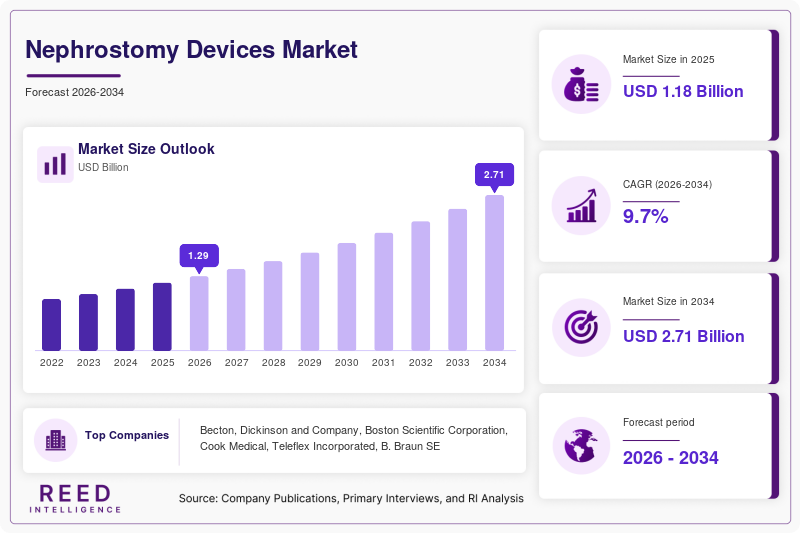
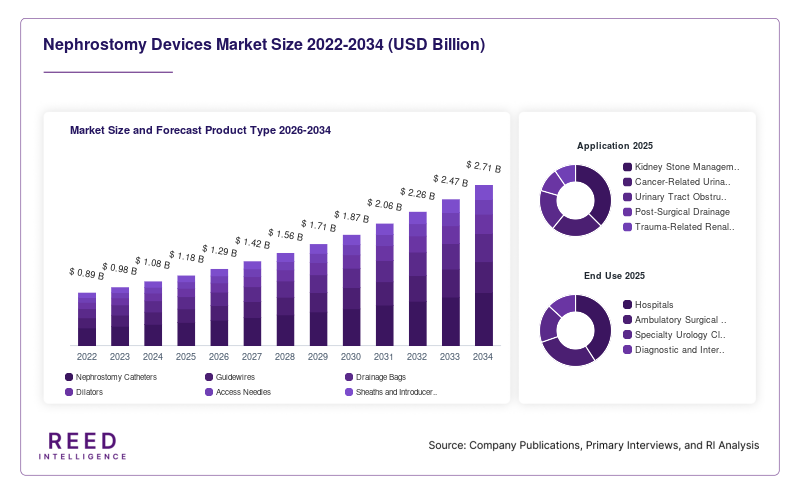
The global Nephrostomy Devices Market size was valued at USD 1.18 billion in 2026 and is projected to reach USD 2.47 billion by 2034, expanding at a CAGR of 9.7% during the forecast period from 2026 to 2034. The market is witnessing stable expansion due to the growing prevalence of kidney disorders, urinary obstructions, and chronic urological complications across both developed and emerging economies. Increasing hospital admissions related to renal stones, bladder cancer, ureteral blockage, and post-surgical urinary drainage procedures continue to create sustained demand for nephrostomy devices worldwide.
One of the major global factors supporting market growth is the rising burden of chronic kidney disease and age-related urinary tract complications. Healthcare systems are increasingly focusing on minimally invasive interventional procedures to reduce hospital stays and improve patient recovery rates. Nephrostomy procedures are becoming more common in emergency renal decompression and cancer-associated urinary diversion, especially among aging populations. Technological improvements in drainage catheters, guidewires, and imaging-assisted placement systems are also improving procedural efficiency and patient safety.
Key Highlights
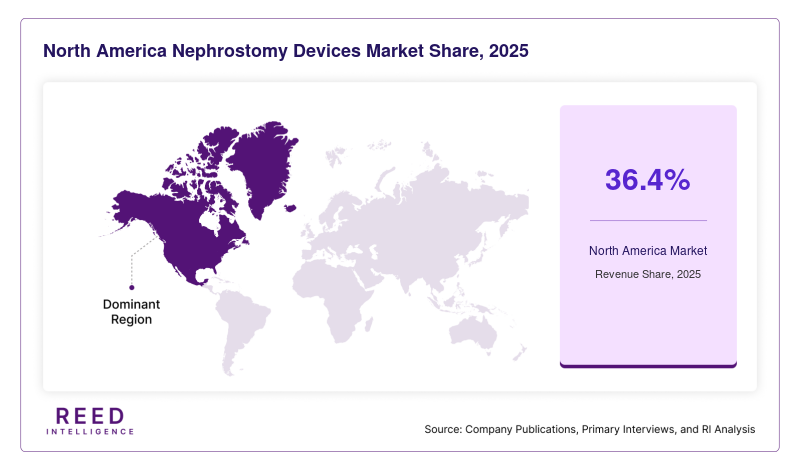
- North America dominated the market with a 36.4% share in 2025, while Asia Pacific is expected to grow at the fastest CAGR of 11.6% during 2026–2034.
- By product type, nephrostomy catheters accounted for the largest share of 44.8%, while guidewires are projected to grow at a CAGR of 10.9%.
- By application, kidney stone management led with a 39.6% share, whereas cancer-related urinary drainage is expected to expand at a CAGR of 11.3%.
- By end use, hospitals represented the dominant segment with a 58.7% share, while ambulatory surgical centers are anticipated to grow at a CAGR of 10.7%.
- The United States remained the dominant country, with market values of USD 382 million in 2024 and USD 417 million in 2025.
Market Trends
Increasing Adoption of Image-Guided Minimally Invasive Procedures
Healthcare providers are increasingly adopting image-guided nephrostomy procedures due to their ability to improve placement precision and reduce procedural complications. Ultrasound-guided and fluoroscopy-assisted nephrostomy interventions are becoming standard practices in major hospitals and interventional radiology centers. These procedures reduce trauma associated with traditional surgical drainage approaches and help patients recover more rapidly. The demand for minimally invasive nephrostomy devices is also increasing because healthcare facilities are attempting to lower inpatient treatment durations and reduce procedure-related costs. Advanced catheter materials with enhanced flexibility and kink resistance are gaining traction among surgeons and radiologists. Manufacturers are also focusing on developing hydrophilic-coated guidewires and anti-infection drainage systems that improve clinical outcomes and reduce device replacement frequency in long-term nephrostomy management.
Expansion of Outpatient Urology and Ambulatory Care Services
The growing shift toward outpatient urological procedures is influencing the demand for compact and easy-to-manage nephrostomy devices. Ambulatory surgical centers are increasingly performing nephrostomy tube placements for kidney stone decompression and temporary urinary drainage procedures. Healthcare providers are prioritizing outpatient treatment models because they reduce operational expenses and improve patient convenience. Portable drainage systems and disposable nephrostomy accessories are gaining higher adoption in ambulatory care settings due to their ease of use and lower infection risks. Emerging markets are also witnessing a rise in private specialty clinics offering interventional urology procedures, contributing to higher device consumption. Companies are responding to this trend by launching customized nephrostomy kits designed specifically for same-day surgical procedures and home-based post-procedure management.
Market Drivers
Rising Incidence of Kidney Stones and Urinary Obstruction Disorders
The increasing global incidence of kidney stones and urinary tract obstructions is a major factor driving demand in the Nephrostomy Devices Market. Sedentary lifestyles, dehydration, obesity, and poor dietary habits have contributed to a higher prevalence of renal calculi across both adult and elderly populations. Nephrostomy procedures are frequently performed to relieve urinary blockages caused by stones, tumors, or severe infections. Hospitals are reporting increasing emergency admissions related to acute urinary retention and obstructive nephropathy, especially among aging patients. The growing patient pool is creating consistent demand for nephrostomy catheters, drainage bags, and guidewires. Healthcare professionals also prefer nephrostomy drainage because it offers immediate decompression of the kidney while supporting subsequent therapeutic procedures such as lithotripsy and ureteral stenting.
Growth in Cancer-Associated Urological Complications
The rising burden of bladder, cervical, prostate, and colorectal cancers is contributing significantly to market expansion. Cancer patients frequently experience ureteral obstruction due to tumor progression or radiation-induced fibrosis, increasing the need for nephrostomy-based urinary diversion procedures. Oncology centers are increasingly utilizing nephrostomy devices to maintain renal function and improve quality of life during cancer treatment. The growing use of chemotherapy and pelvic radiation therapies has further increased the occurrence of urinary drainage complications requiring intervention. Healthcare providers are investing in advanced drainage systems that minimize infection risk and improve long-term patient comfort. In addition, rising cancer diagnosis rates in emerging economies are increasing the number of interventional procedures involving nephrostomy access, thereby supporting long-term market growth across hospitals and specialty care facilities.
Market Restraint
Risk of Catheter-Associated Infections and Procedural Complications
Despite growing clinical demand, the Nephrostomy Devices Market faces challenges related to catheter-associated infections and procedural complications. Nephrostomy tube placement can lead to bleeding, catheter dislodgement, urine leakage, and bacterial infections if not properly managed. Long-term catheter usage increases the possibility of biofilm formation and recurrent urinary tract infections, particularly among elderly and immunocompromised patients. These complications can increase hospital readmission rates and treatment expenses, limiting wider adoption in some healthcare facilities.
Healthcare providers in lower-income regions often face shortages of trained interventional radiologists and advanced imaging infrastructure required for safe nephrostomy placement. Inadequate post-procedure monitoring and inconsistent sterilization practices also affect patient outcomes in resource-constrained hospitals. Furthermore, some patients experience discomfort and mobility limitations associated with external drainage systems, reducing treatment compliance. Regulatory authorities are placing greater emphasis on device safety and infection prevention standards, increasing product development and compliance costs for manufacturers. These operational and clinical challenges may slow market penetration in smaller healthcare institutions and emerging economies with limited reimbursement coverage.
Market Opportunities
Technological Advancements in Antimicrobial and Biocompatible Devices
Manufacturers are increasingly investing in advanced nephrostomy devices with antimicrobial coatings and improved biocompatible materials. These innovations are expected to create strong growth opportunities across hospitals and long-term care settings. Antimicrobial-coated catheters can reduce infection rates associated with prolonged nephrostomy drainage, while flexible silicone-based materials improve patient comfort and reduce tissue irritation. Healthcare providers are seeking products that support extended use without requiring frequent replacements. This demand is encouraging companies to develop durable and low-maintenance drainage systems. Innovations in catheter locking mechanisms and anti-kink technologies are also improving device reliability during long-term treatment. As healthcare facilities continue prioritizing patient safety and reduced hospitalization costs, demand for technologically advanced nephrostomy products is expected to increase steadily throughout the forecast period.
Expanding Healthcare Infrastructure in Emerging Economies
Rapid healthcare infrastructure development in emerging economies presents substantial opportunities for market participants. Governments across Asia Pacific, Latin America, and the Middle East are increasing investments in specialized urology departments, diagnostic imaging systems, and interventional radiology services. The growing availability of skilled healthcare professionals is improving access to minimally invasive nephrostomy procedures in secondary and tertiary care hospitals. Rising health insurance penetration and public healthcare funding are also supporting higher procedural volumes.
Medical tourism growth in countries such as India, Thailand, and Brazil is further increasing demand for cost-effective urological treatment solutions. International healthcare providers are partnering with regional hospitals to expand access to advanced renal care services. Manufacturers are benefiting from increasing procurement activities among public hospitals seeking affordable nephrostomy kits and drainage accessories. These developments are expected to create strong long-term opportunities for both multinational and regional device suppliers operating in emerging healthcare markets.
Segmental Analysis
By Product Type
Nephrostomy catheters accounted for the largest share of the global market in 2024, representing 44.8% of total revenue. These products are widely used for temporary and long-term urinary drainage procedures in hospitals and specialty urology centers. The dominance of nephrostomy catheters is primarily attributed to their essential role in relieving urinary obstruction caused by kidney stones, tumors, and traumatic injuries. Healthcare providers increasingly prefer advanced catheters with flexible materials and anti-kink properties to improve patient comfort and drainage efficiency. Rising hospitalization rates associated with chronic kidney disorders are also supporting demand for high-performance drainage catheters. Manufacturers continue to focus on introducing biocompatible and infection-resistant products that enhance procedural safety while reducing the frequency of catheter replacement during prolonged treatment periods.
Guidewires are anticipated to register the fastest CAGR of 10.9% during the forecast period due to increasing demand for image-guided minimally invasive procedures. Guidewires are essential for accurate nephrostomy tube placement and improved procedural precision during interventional radiology treatments. Healthcare professionals are increasingly adopting hydrophilic-coated guidewires because they provide better maneuverability and reduce tissue trauma during insertion. Technological advancements in flexible guidewire designs are improving access to difficult anatomical pathways, especially in complex urological cases. Growing investments in fluoroscopy-assisted procedures and outpatient urology centers are also contributing to higher guidewire demand. In addition, manufacturers are introducing disposable and single-use guidewire systems designed to minimize infection risks and improve procedural efficiency across hospitals and ambulatory surgical settings.
By Application
Kidney stone management represented the dominant application segment in 2024 with a market share of 39.6%. The increasing prevalence of nephrolithiasis globally continues to generate significant demand for nephrostomy procedures used for emergency decompression and post-operative drainage. Poor dietary habits, rising obesity rates, and dehydration-related disorders have contributed to the growing burden of kidney stones across adult populations. Nephrostomy devices are commonly utilized before lithotripsy and other stone removal procedures to maintain urinary flow and reduce renal pressure. Hospitals and specialty clinics are increasingly adopting advanced drainage systems to improve patient outcomes during stone management treatments. Furthermore, rising awareness regarding early diagnosis of renal calculi is encouraging timely intervention, thereby increasing utilization of nephrostomy products in both developed and emerging healthcare markets.
Cancer-related urinary drainage is expected to witness the fastest CAGR of 11.3% during the forecast period. The increasing incidence of bladder, prostate, cervical, and colorectal cancers is driving demand for nephrostomy interventions associated with ureteral obstruction management. Oncology centers frequently rely on nephrostomy drainage systems to preserve kidney function in patients undergoing chemotherapy or radiation therapy. Growing awareness regarding palliative urinary care and improved cancer survival rates are also contributing to higher procedural volumes. Healthcare providers are adopting long-term drainage catheters with enhanced comfort and lower infection risk for oncology patients requiring extended treatment durations. In addition, increasing investments in cancer treatment infrastructure across Asia Pacific and Latin America are expected to create substantial opportunities for nephrostomy device manufacturers targeting oncology-related applications.
By End Use
Hospitals accounted for the largest share of the Nephrostomy Devices Market in 2024, contributing 58.7% of global revenue. The segment’s dominance is supported by the high volume of emergency nephrostomy procedures performed in tertiary care hospitals and specialized renal treatment centers. Hospitals possess advanced imaging systems and trained interventional radiologists required for safe nephrostomy tube placement. Increasing patient admissions related to obstructive uropathy, kidney stones, and cancer-associated urinary complications are further strengthening demand for nephrostomy devices in hospital settings. Large healthcare institutions are also investing in advanced drainage systems that reduce catheter-related complications and improve patient recovery outcomes. Furthermore, favorable reimbursement policies in developed economies continue to encourage hospitals to adopt technologically advanced nephrostomy products for both inpatient and outpatient procedural care.
Ambulatory surgical centers are projected to expand at the fastest CAGR of 10.7% during the forecast period. The growing shift toward minimally invasive outpatient procedures is supporting higher nephrostomy device utilization in ambulatory settings. Patients increasingly prefer same-day procedures because they reduce treatment costs and shorten hospital stays. Ambulatory centers are investing in compact imaging systems and disposable nephrostomy kits that improve operational efficiency and procedural turnaround times. Healthcare providers are also adopting portable drainage products designed specifically for outpatient recovery and home-based care management. The rising number of private urology clinics and specialty surgical facilities in emerging economies is creating additional opportunities for device manufacturers. In addition, government initiatives promoting cost-effective healthcare delivery are encouraging the expansion of ambulatory nephrostomy services across urban healthcare networks.
Regional Analysis
North America
North America accounted for 36.4% of the global Nephrostomy Devices Market in 2025 and is projected to maintain stable growth at a CAGR of 8.9% through 2034. The region benefits from advanced healthcare infrastructure, high procedural volumes, and strong adoption of minimally invasive urology treatments. Increasing cases of chronic kidney disease and urinary obstruction disorders continue to support device demand across hospitals and specialty clinics. The growing elderly population and rising healthcare expenditure are also contributing to sustained market expansion throughout the region.
The United States remains the dominant country in North America due to the strong presence of interventional radiology centers and favorable reimbursement systems. The country is experiencing increasing demand for image-guided nephrostomy procedures associated with cancer treatment and kidney stone management. Healthcare providers are rapidly adopting antimicrobial-coated drainage systems to reduce infection risks and improve patient outcomes. In addition, continuous investments in advanced hospital infrastructure and outpatient surgical care are supporting broader use of nephrostomy devices across clinical settings.
Europe
Europe represented 28.1% of the global market in 2025 and is anticipated to grow at a CAGR of 8.4% during the forecast period. The region benefits from widespread availability of universal healthcare systems and increasing awareness regarding early treatment of urinary tract complications. Countries across Western Europe are witnessing higher demand for minimally invasive drainage procedures due to aging demographics and increasing incidence of renal disorders. The presence of established medical device manufacturers is also supporting continuous product innovation and regional supply chain stability.
Germany emerged as the dominant country within Europe because of its strong hospital infrastructure and advanced urology care network. The country is witnessing increasing procedural volumes associated with urinary obstruction management and post-cancer drainage interventions. German healthcare facilities are investing in technologically advanced nephrostomy catheters designed for improved patient comfort and infection control. Additionally, growing collaboration between hospitals and medical technology companies is accelerating the adoption of next-generation interventional radiology equipment and drainage systems.
Asia Pacific
Asia Pacific held 22.6% of the global Nephrostomy Devices Market in 2025 and is forecast to register the fastest CAGR of 11.6% through 2034. Rapid urbanization, expanding healthcare access, and rising prevalence of kidney disorders are major factors supporting market growth in the region. Governments are increasing investments in hospital modernization and diagnostic imaging infrastructure, enabling broader access to nephrostomy procedures. The growing number of private specialty hospitals and ambulatory care centers is also contributing to higher device demand across developing economies.
China remains the dominant contributor within Asia Pacific due to its large patient population and expanding healthcare spending. Increasing cases of kidney stones and urological cancers are generating substantial demand for nephrostomy interventions across urban hospitals. Domestic manufacturers are introducing cost-effective drainage products to address rising procedural requirements in secondary healthcare institutions. Furthermore, the expansion of medical training programs and interventional radiology services is improving treatment accessibility and supporting long-term market growth throughout the country.
Middle East & Africa
The Middle East & Africa region accounted for 6.4% of the global market in 2025 and is expected to expand at a CAGR of 8.1% over the forecast period. Market growth is supported by rising investments in tertiary healthcare facilities and increasing diagnosis rates of chronic kidney disease. Gulf countries are enhancing access to advanced urology treatment services through public healthcare modernization programs. The growing prevalence of diabetes and hypertension, both major contributors to kidney complications, is also driving demand for nephrostomy procedures across the region.
Saudi Arabia emerged as the leading country in the regional market due to ongoing healthcare infrastructure expansion and increasing adoption of minimally invasive procedures. Hospitals in the country are investing in advanced imaging technologies and specialized renal care departments. Government healthcare reforms aimed at improving treatment accessibility are further supporting market growth. In addition, rising awareness regarding early diagnosis of urinary obstruction conditions is encouraging more patients to seek interventional treatment solutions in major urban medical centers.
Latin America
Latin America captured 6.5% of the global Nephrostomy Devices Market in 2025 and is projected to grow at a CAGR of 8.7% through 2034. Increasing healthcare expenditure and improving access to specialized urology care are supporting regional market expansion. Countries across the region are witnessing higher rates of kidney stone disease due to dietary changes and metabolic disorders. Public and private healthcare providers are increasing procurement of nephrostomy catheters and drainage systems to address rising patient demand for minimally invasive urinary drainage procedures.
Brazil remains the dominant country in Latin America because of its extensive hospital network and growing interventional radiology capabilities. The country is experiencing increasing demand for nephrostomy procedures associated with oncology treatment and emergency renal decompression. Private healthcare providers are investing in technologically advanced drainage systems that reduce procedural complications and improve patient recovery times. Furthermore, expanding medical tourism activities and rising healthcare insurance coverage are supporting broader adoption of nephrostomy devices across major metropolitan healthcare facilities.
Competitive Landscape
The Nephrostomy Devices Market remains moderately consolidated, with major global companies competing through product innovation, regional expansion, and strategic partnerships with hospitals and specialty care providers. Leading manufacturers are focusing on developing infection-resistant drainage systems and flexible catheter technologies designed for long-term patient use. Companies are also increasing investments in research activities aimed at improving procedural safety and reducing complications associated with nephrostomy tube placement.
Becton, Dickinson and Company continues to maintain a strong leadership position due to its broad interventional urology portfolio and extensive global distribution network. The company recently expanded its drainage catheter product line with enhanced anti-kink and antimicrobial features designed for prolonged urinary drainage applications.
Key Players
- Becton, Dickinson and Company
- Boston Scientific Corporation
- Cook Medical
- Teleflex Incorporated
- B. Braun SE
- Cardinal Health
- Medtronic plc
- Argon Medical Devices
- UreSil LLC
- Merit Medical Systems
- Coloplast Group
- AngioDynamics Inc.
- Romsons Scientific & Surgical Industries
- Advin Health Care
Recent Developments
- In February 2025, Boston Scientific Corporation introduced an advanced nephrostomy drainage catheter with enhanced flexibility and anti-microbial coating technology for long-term urinary drainage procedures.
- In July 2025, Cook Medical expanded its interventional urology manufacturing capacity in Europe to support rising demand for minimally invasive nephrostomy devices.
- In November 2024, Teleflex Incorporated launched a new single-use nephrostomy access kit designed for outpatient interventional radiology procedures and ambulatory surgical centers.
- In March 2025, B. Braun SE announced a strategic collaboration with regional hospitals in Asia Pacific to improve access to advanced renal drainage solutions.
- In January 2026, Cardinal Health expanded distribution partnerships across Latin America to strengthen the availability of nephrostomy catheters and drainage accessories in secondary healthcare facilities.
Nephrostomy Devices Market Segments
Product Type
- Nephrostomy Catheters
- Guidewires
- Drainage Bags
- Dilators
- Access Needles
- Sheaths and Introducers
Application
- Kidney Stone Management
- Cancer-Related Urinary Drainage
- Urinary Tract Obstruction
- Post-Surgical Drainage
- Trauma-Related Renal Procedures
End Use
- Hospitals
- Ambulatory Surgical Centers
- Specialty Urology Clinics
- Diagnostic and Interventional Centers
By Region
- North America
- Europe
- APAC
- Middle East and Africa
- LATAM