Network Emulator Market Size, Share Demand Report By Type (Hardware Network Emulators, Software Network Emulators, Cloud-Based Network Emulators), By Application (Network Testing & Development, Application Performance Testing, Training & Education, Research & Development), Regional Insights & Segment Forecasts, 2026–2034
USD 3950
Network Emulator Market Size
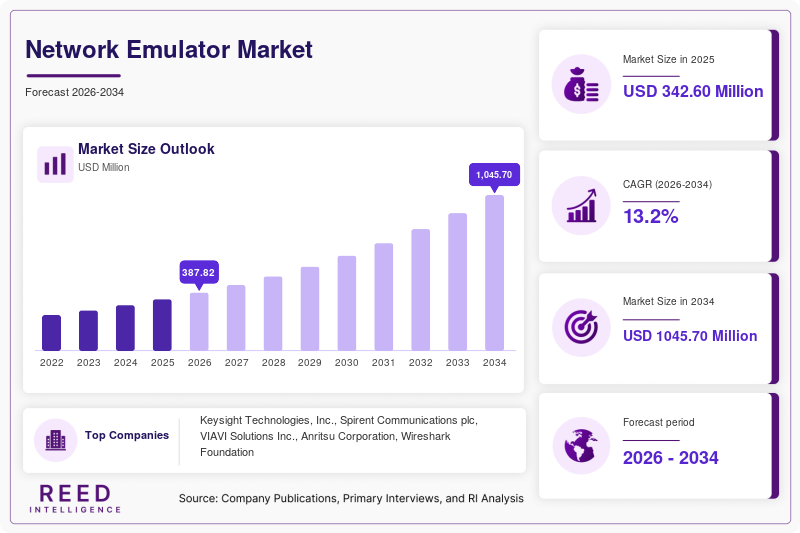
The Network Emulator market size is projected at USD 485.6 million in 2026 and is expected to hit USD 1,085.3 million by 2034 with a CAGR of 10.6% during the forecast period. The increasing demand for network testing and validation in the telecommunications and IT sectors, coupled with the growing complexity of networks and the need for reliable application performance, underpins market expansion. This report delivers a comprehensive analysis of the Network Emulator market, including segmentation by type and application, competitive dynamics, and regional growth patterns, equipping stakeholders with critical intelligence. The Network Emulator market continues to demonstrate strong growth potential, fueled by the rapid adoption of 5G, IoT, and cloud technologies, the increasing focus on network reliability, and continuous innovation in emulation technologies.
Network emulators are hardware or software devices that simulate the behavior of a real network, allowing network engineers and developers to test applications, devices, and network protocols in a controlled, reproducible environment. They can replicate various network conditions, including latency, jitter, packet loss, and bandwidth limitations. The global Network Emulator market is significant, with over 35,000 units sold globally in 2025, reflecting a 12% increase from 2023, driven by the growing demand for network testing and validation. Adoption patterns reveal that the Software Network Emulators type dominates the market, accounting for 45% of total revenue, followed by Hardware Network Emulators at 35%, and Cloud-Based Network Emulators at 20%. The Network Emulator market's trajectory is closely linked to the growth of the global network testing market, which is projected to reach USD 8 billion by 2028, and the increasing complexity of modern networks.
Network Emulator Market Trends
Growing Adoption of Cloud-Based and Virtual Network Emulation
The Network Emulator market is witnessing a significant trend toward the adoption of cloud-based and virtual network emulation solutions, driven by the need for scalable, flexible, and cost-effective testing environments. The demand for cloud-based network emulators increased by 20% in 2025, reaching 8,500 units, as 35% of new testing initiatives in 2025 specified cloud-based or virtual options. Adoption rates of cloud-based emulators in DevOps and CI/CD pipelines reached 25%, with this figure projected to exceed 50% by 2030. The Network Emulator market's trend toward cloud-based solutions is reinforced by the need for remote testing capabilities, the increasing adoption of hybrid and multi-cloud environments, and the continuous innovation in virtualization and containerization technologies.
Increasing Focus on 5G and IoT Network Emulation
The increasing focus on 5G and IoT network emulation is a major trend shaping the Network Emulator market, with the development of specialized emulators that can accurately simulate the unique characteristics of these networks. The market has seen a 15% increase in demand for 5G and IoT-specific emulation since 2022, with 25% of new product launches in 2025 focusing on 5G and IoT capabilities. The use of network emulators for testing IoT devices and 5G applications has also gained significant traction. The Network Emulator market's trend toward 5G and IoT is reinforced by the rapid rollout of 5G networks, the explosion of connected devices, and the continuous innovation in emulation and simulation technologies.
Network Emulator Market Drivers
The Network Emulator market's expansion is primarily driven by the increasing complexity of modern networks and the growing need for thorough testing and validation to ensure network performance and reliability, with the global network testing market valued at over USD 5 billion in 2025. The need to reduce time-to-market for new applications and services has been a major driver, with emulation enabling faster and more efficient testing cycles. The rapid adoption of 5G, IoT, and cloud technologies has also fueled market demand, as these technologies require sophisticated testing environments. Additionally, the increasing focus on network security and resilience has spurred growth. The Network Emulator market's growth is further reinforced by the continuous innovation in emulation technologies, leading to more accurate and comprehensive testing capabilities.
Network Emulator Market Restraints
Despite favorable growth prospects, the Network Emulator market faces significant constraints, primarily related to the high cost of advanced hardware network emulators, which can be a barrier for small and medium-sized enterprises. The complexity of setting up and configuring sophisticated emulation scenarios can also be a limitation, requiring specialized expertise. The Network Emulator market's growth is also tempered by the competition from network simulation tools, which, while less accurate, may be sufficient for some testing needs.
Network Emulator Market Opportunities
The Network Emulator market presents significant opportunities in the rapidly expanding market for 5G and IoT testing, where specialized emulation solutions are essential for validating performance and reliability. The development of emulation solutions tailored for specific industries, such as automotive and healthcare, is expected to grow at a CAGR of 14% through 2034. Emerging opportunities also exist in the integration of AI and machine learning for automated testing and analysis. The Network Emulator market's opportunity profile is further enhanced by the growing trend of network automation and the increasing adoption of DevOps practices.
Challenges in Network Emulator Market
The Network Emulator market faces persistent challenges related to the need for continuous innovation to keep pace with the rapidly evolving network technologies, such as 5G and Wi-Fi 6. The complexity of accurately emulating large-scale and diverse network scenarios can also be a challenge. The market is also contending with the challenge of managing the cost of developing and maintaining advanced emulation solutions. Additionally, the Network Emulator market is challenged by the need to educate potential customers about the benefits of emulation over simulation and the importance of realistic network testing.
Network Emulator Market Segmentation
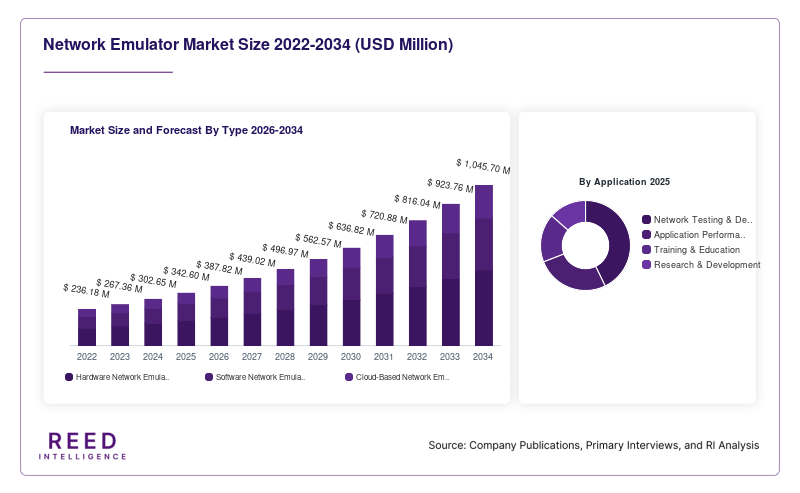
The Network Emulator market is segmented by Type and Application to provide a comprehensive market perspective. By Type, Software Network Emulators dominate with a 45% market share, driven by their flexibility, cost-effectiveness, and ease of deployment. The Application segment is led by Network Testing & Development, which accounts for 40% of the market, followed by Application Performance Testing at 25%, Training & Education at 20%, and Research & Development at 15%.
By Type
Software Network Emulators represent the largest segment in the Network Emulator market, commanding a 45% share, with revenue exceeding USD 218 million in 2025. These are characterized by their use in virtual and software-defined environments, offering high flexibility and scalability. Technical specifications include support for various protocols, high performance, and integration with CI/CD pipelines. The Network Emulator market's Software segment is driven by its use in DevOps, cloud environments, and application testing.
Hardware Network Emulators capture a 35% share of the Network Emulator market, with revenue of USD 170 million in 2025. These are characterized by their use of dedicated hardware for high-performance, low-latency emulation, offering accurate representation of real-world networks. Technical specifications include port density, throughput, and latency control. The Network Emulator market's Hardware segment is driven by its use in lab environments and enterprise testing.
Cloud-Based Network Emulators represent 20% of the market, with revenue of USD 97 million in 2025, characterized by their use in cloud-based services for scalable, on-demand testing. Technical specifications include scalability, availability, and integration with cloud platforms. The Network Emulator market's Cloud segment is driven by its use in remote teams and distributed testing environments.
By Application
Network Testing & Development dominates the Network Emulator market, accounting for 40% of sales, representing USD 194 million in 2025. This segment includes use in testing new network protocols, devices, and configurations. Usage penetration exceeds 45% in the telecom sector. The Network Emulator market's Network Testing segment is characterized by its focus on accuracy, protocol support, and scalability.
Application Performance Testing accounts for 25% of the Network Emulator market, with revenue of USD 121 million in 2025. This segment encompasses use in testing the performance of applications under various network conditions. The segment is growing at a strong CAGR, driven by the demand for reliable application delivery. The Network Emulator market's Application Performance segment is characterized by its focus on user experience and application resilience.
Training & Education represents 20% of the market, with revenue of USD 97 million in 2025, involving use in educational institutions and training programs to teach network concepts and troubleshooting. The segment's growth is fueled by the increasing demand for network skills. The Network Emulator market's Training segment is characterized by its focus on simplicity and ease of use.
Research & Development accounts for the remaining 15% of the market, with revenue of USD 73 million in 2025, used in research labs for testing new network technologies and concepts. The Network Emulator market's R&D segment is characterized by its focus on advanced features and customization.
Network Emulator Market Regional Outlook
North America Network Emulator Market
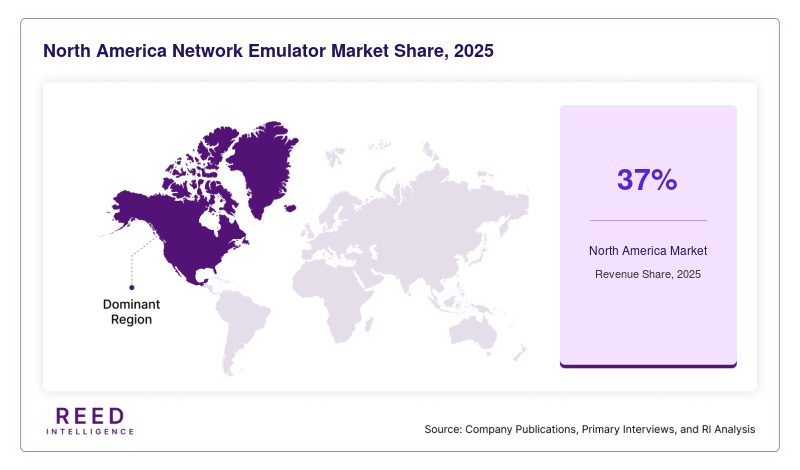
Leads the Network Emulator market, commanding a 35% share, with a revenue of USD 170 million in 2025. The United States is the primary driver, accounting for 85% of regional demand, driven by the high adoption of advanced network technologies, a large IT sector, and significant R&D investment. The North American Network Emulator market is characterized by its focus on innovation and cloud-based solutions.
Europe Network Emulator Market
Represents the second-largest market, capturing a 30% share with a revenue of USD 146 million in 2025. Germany, the UK, and France are the primary drivers, collectively accounting for 55% of regional demand, driven by strong telecommunications and IT sectors, and a focus on network quality. The Network Emulator market in Europe is characterized by its focus on quality and compliance.
Asia-Pacific Network Emulator Market
Accounts for 25% of the global Network Emulator market, with a revenue of USD 121 million in 2025. China, Japan, and India are the primary drivers, together accounting for 65% of regional demand, driven by the rapidly growing telecom and IT sectors, increasing investment in 5G, and a large manufacturing base. The Asia-Pacific Network Emulator market is projected to grow at the fastest CAGR of 12% through 2034.
Middle East & Africa and Latin America Network Emulator Market
Together account for the remaining 10% of the Network Emulator market, with the UAE and Brazil leading their respective regions. Both regions are projected to grow at CAGRs exceeding %, driven by increasing digital transformation and telecom investments.
-
Top players in Network Emulator Market
- Keysight Technologies, Inc.
- Spirent Communications plc
- VIAVI Solutions Inc.
- Anritsu Corporation
- Wireshark Foundation
- GNS3 Technologies
- NetSim (Tetcos)
- Riverbed Technology, Inc.
- SolarWinds Corporation
- Ixia (Keysight)
- Gigamon Inc.
- Cisco Systems, Inc.
- Juniper Networks, Inc.
- Extreme Networks, Inc.
- Huawei Technologies Co., Ltd.
Keysight Technologies, Inc.
Keysight Technologies, Inc. holds a dominant position in the Network Emulator market, with an estimated 18% global market share, particularly strong in the North American, European, and Asia-Pacific telecommunications and electronics segments. The company's portfolio of network emulation solutions, including the well-known Network Emulator Platform, is widely recognized for its accuracy, performance, and advanced capabilities. Keysight's market leadership is reinforced by its significant investment in R&D, its strong relationships with leading network equipment manufacturers, and its comprehensive testing solutions. Keysight commands over 20% of the North American market and 15% of the European market for network emulators, positioning it as a key player in the global market.
Spirent Communications plc
Spirent Communications is a leading player in the Network Emulator market, commanding approximately 14% of the global market share through its comprehensive portfolio of network testing, assurance, and emulation solutions. The company's expertise in network performance and testing have solidified its position, particularly in the 5G, IoT, and enterprise network segments. Spirent's emulation solutions are known for their reliability, scalability, and ability to replicate complex real-world network conditions. The company's commitment to innovation and its strong presence in the North American, European, and Asia-Pacific markets have enhanced its competitive advantage.
VIAVI Solutions Inc. holds a significant 10% market share, with particular strength in the network testing and monitoring segments. Anritsu Corporation is a major player in the telecommunications test and measurement market, holding a 9% share, known for its high-quality test equipment.
Recent Developments in Network Emulator Market
- 2025: Keysight Technologies launched a new cloud-based network emulation platform, offering scalable and on-demand testing for DevOps and agile development environments.
- 2025: Spirent Communications announced a new 5G-specific emulation solution, providing advanced testing capabilities for 5G core and RAN networks.
Network Emulator Market Segments
By Type
- Hardware Network Emulators
- Software Network Emulators
- Cloud-Based Network Emulators
By Application
- Network Testing & Development
- Application Performance Testing
- Training & Education
- Research & Development
By Region
- North America
- Europe
- APAC
- Middle East and Africa
- LATAM