Neurophotonic Market Size, Share, Growth & Industry Analysis Report By Technology (Imaging Systems, Optogenetics, Fiber Photometry, Spectroscopy), By Application (Neuroscience Research, Clinical Diagnostics, Drug Discovery), By End-Use (Academic & Research Institutes, Hospitals & Clinics, Pharmaceutical & Biotechnology Companies) By Regional Outlook and Segment Forecasts, 2025–2034
USD 3950
Market Overview
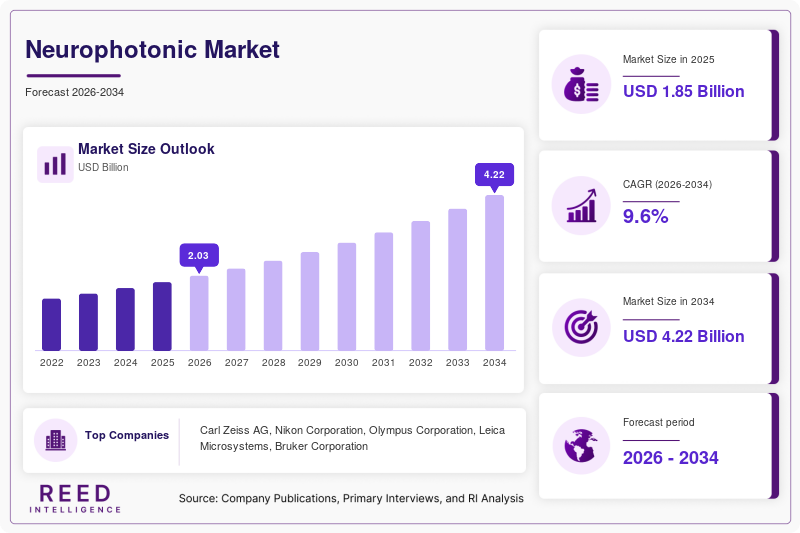
The Neurophotonic Market size is estimated at USD 1.85 billion, rising to approximately USD 2.05 billion in 2026. The market is projected to reach USD 4.65 billion by 2034, growing at a compound annual growth rate (CAGR) of 9.6% during the forecast period (2025–2034). This growth reflects increasing adoption of light-based imaging and stimulation tools in both academic and clinical settings.
Neurophotonics combines photonics with neuroscience to enable advanced imaging, sensing, and manipulation of neural activity. Technologies such as optogenetics, fluorescence microscopy, and fiber photometry are transforming how researchers study brain function. The rising prevalence of neurological disorders such as Alzheimer’s disease, Parkinson’s disease, and epilepsy is creating strong demand for advanced diagnostic and therapeutic tools. These conditions require precise neural mapping and real-time monitoring, which neurophotonic solutions can provide.
Key Highlights
- Market size estimated at USD 1.85 billion in 2025 and projected to reach USD 2.05 billion in 2026, reflecting steady early-stage expansion in the Neurophotonic Market
- Forecast to reach USD 4.65 billion by 2034, growing at a CAGR of 9.6% (2025–2034), driven by rising neurological disorder prevalence and research funding
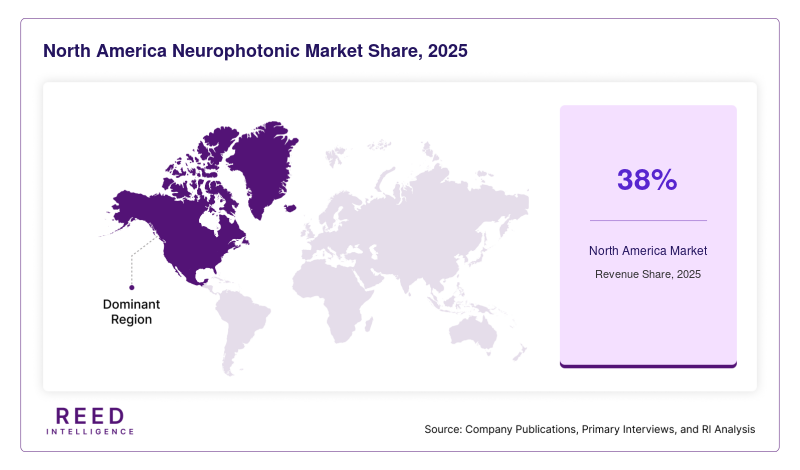
- North America dominated the market in 2025, accounting for the largest revenue share due to strong neuroscience research infrastructure and advanced healthcare systems
- Asia Pacific is the fastest-growing region, expected to register the highest CAGR of 10.8%, supported by increasing healthcare investments and expanding neurotechnology research
- By segmentation, imaging systems dominated the technology segment in 2024, driven by widespread use in neuroscience research and brain mapping applications
- The optogenetics segment is expected to grow fastest, fueled by advancements in light-based neural control and expanding applications in precision neuroscience
Market Trends
Increasing Adoption of Optogenetics in Neuroscience Research
Optogenetics is emerging as a core technology within the neurophotonic market due to its ability to control neural activity using light. Researchers are increasingly adopting this technique to understand brain circuits and neuronal behavior with high precision. The demand is rising in academic research institutions and pharmaceutical companies that aim to develop targeted therapies for neurological disorders. Advancements in light-sensitive proteins and gene delivery methods are improving the efficiency of optogenetic experiments. Furthermore, integration with high-resolution imaging tools allows simultaneous observation and manipulation of neural activity, enhancing research outcomes and supporting long-term market growth.
Development of Portable and Wearable Neurophotonic Devices
The shift toward portable and wearable neurophotonic devices is gaining traction across clinical and research environments. These systems enable real-time brain monitoring outside traditional laboratory settings, offering greater flexibility and patient comfort. Wearable optical imaging tools are being developed for applications such as cognitive assessment, mental health monitoring, and rehabilitation. Advances in miniaturization, wireless communication, and battery efficiency are making these devices more practical and cost-effective. This trend is expected to expand the use of neurophotonic technologies beyond research labs into everyday clinical practice and even consumer health applications.
Market Drivers
Rising Prevalence of Neurological Disorders
The increasing incidence of neurological disorders is a major driver of the neurophotonic market. Conditions such as Alzheimer’s disease, Parkinson’s disease, and multiple sclerosis are becoming more common due to aging populations and lifestyle factors. These disorders require early diagnosis and continuous monitoring, which neurophotonic technologies can facilitate through advanced imaging and sensing capabilities. Healthcare providers are adopting these tools to improve patient outcomes and reduce long-term treatment costs. Additionally, pharmaceutical companies are using neurophotonic techniques to study disease mechanisms and develop new therapies, further driving market demand.
Growth in Brain Research Funding and Initiatives
Government and private sector investments in brain research are significantly boosting the neurophotonic market. Large-scale initiatives aimed at mapping the human brain and understanding neural networks are creating demand for advanced optical technologies. Funding programs support the development of innovative tools and infrastructure, enabling researchers to explore complex neural processes. Academic institutions are collaborating with technology providers to commercialize new solutions. This growing ecosystem of research and innovation is accelerating the adoption of neurophotonic systems across multiple disciplines, including neuroscience, psychology, and biomedical engineering.
Market Restraint
High Cost and Technical Complexity of Neurophotonic Systems
One of the primary restraints in the neurophotonic market is the high cost and technical complexity associated with these systems. Advanced imaging equipment, such as multiphoton microscopes and optogenetic setups, require significant capital investment. This limits adoption, particularly in smaller research institutions and healthcare facilities with constrained budgets. Additionally, operating these systems requires specialized training and expertise, which can create barriers for widespread use.
The complexity of integrating optical components with biological systems also presents challenges. Researchers must ensure precise calibration and compatibility with biological tissues, which can be time-consuming and resource-intensive. For example, implementing optogenetic experiments involves genetic modification, light delivery systems, and data analysis tools, all of which require multidisciplinary knowledge. These factors can slow down adoption and limit market growth, especially in emerging regions where technical infrastructure and expertise may be limited.
Market Opportunities
Expansion in Clinical Diagnostics and Therapeutics
The growing application of neurophotonic technologies in clinical diagnostics and therapeutics presents a significant opportunity. Optical imaging techniques are increasingly being used for non-invasive brain monitoring and early detection of neurological disorders. These tools can provide real-time insights into brain function, enabling more accurate diagnosis and personalized treatment plans. In therapeutic applications, technologies such as optogenetics are being explored for targeted neural stimulation, offering potential alternatives to traditional drug therapies. As healthcare systems focus on precision medicine, the demand for neurophotonic solutions is expected to rise.
Integration with Artificial Intelligence and Data Analytics
The integration of artificial intelligence with neurophotonic systems is opening new avenues for market growth. AI algorithms can process large volumes of neural data generated by optical imaging systems, improving accuracy and efficiency. This enables researchers and clinicians to identify patterns and anomalies that may not be visible through traditional analysis methods. The combination of neurophotonics and AI is particularly valuable in areas such as brain mapping, cognitive research, and disease prediction. As data-driven healthcare becomes more prevalent, this integration is expected to drive innovation and expand the scope of neurophotonic applications.
Segmental Analysis
By Technology
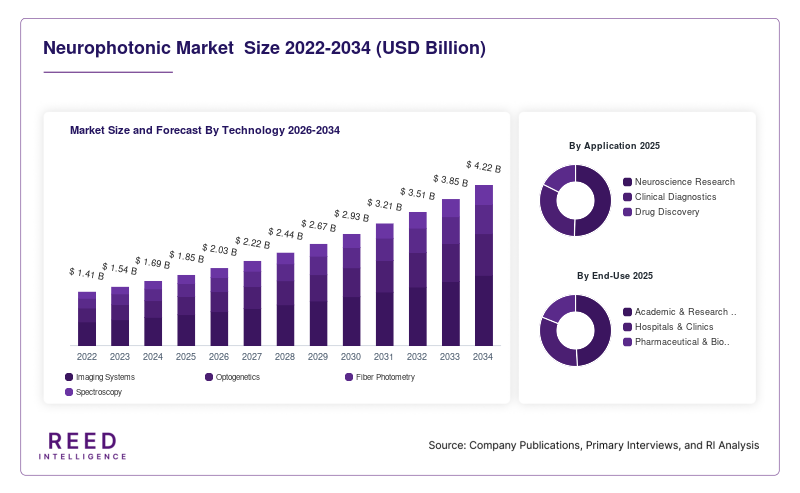
The imaging systems segment dominated the neurophotonic market in 2024, accounting for approximately 48% of the total share. This dominance is attributed to the widespread use of optical imaging techniques such as fluorescence microscopy and multiphoton imaging in neuroscience research. These systems provide high-resolution visualization of neural activity, enabling detailed analysis of brain function. Academic institutions and research laboratories are the primary users of imaging systems, as they require advanced tools for studying neural circuits. Continuous advancements in imaging technologies, including improved resolution and faster data acquisition, are further strengthening this segment’s position in the market.
The optogenetics segment is expected to be the fastest-growing, with a CAGR of 11.2% during the forecast period. This growth is driven by the increasing adoption of light-based neural stimulation techniques in both research and clinical applications. Optogenetics allows precise control of neuronal activity, making it a valuable tool for studying brain function and developing targeted therapies. The growing interest in neuroscience research and the development of new light-sensitive proteins are key factors supporting this segment’s growth. Additionally, integration with advanced imaging systems enhances its utility, further driving adoption.
By Application
The neuroscience research segment held the largest share of the neurophotonic market in 2024, accounting for around 52%. This segment’s dominance is driven by the extensive use of neurophotonic technologies in academic and research institutions. Researchers rely on these tools to study brain structure, function, and disorders. The increasing number of research projects and funding initiatives is supporting growth in this segment. Advanced imaging and sensing technologies enable detailed analysis of neural activity, making them essential for neuroscience research. The demand for accurate and reliable data is further driving the adoption of neurophotonic solutions in this field.
The clinical diagnostics segment is projected to be the fastest-growing, with a CAGR of 10.5%. This growth is attributed to the rising need for early detection and monitoring of neurological disorders. Neurophotonic technologies offer non-invasive and real-time diagnostic capabilities, making them suitable for clinical use. Healthcare providers are increasingly adopting these tools to improve patient outcomes and reduce diagnostic errors. The integration of artificial intelligence with diagnostic systems is also enhancing their efficiency and accuracy. As healthcare systems focus on precision medicine, the demand for advanced diagnostic solutions is expected to increase.
By End-Use
The academic and research institutes segment dominated the market in 2024, holding a share of approximately 55%. These institutions are the primary users of neurophotonic technologies, as they conduct extensive research on brain function and neurological disorders. The availability of funding and advanced infrastructure supports the adoption of high-end imaging and sensing systems. Researchers rely on these tools to gain insights into neural processes and develop new therapeutic approaches. The growing emphasis on interdisciplinary research is further driving demand for neurophotonic solutions in academic settings.
The hospitals and clinics segment is expected to grow at the fastest rate, with a CAGR of 10.1%. This growth is driven by the increasing adoption of neurophotonic technologies in clinical practice. Healthcare providers are using these tools for diagnosis, monitoring, and treatment of neurological conditions. The shift toward non-invasive and real-time diagnostic methods is a key factor supporting this segment’s growth. Additionally, advancements in portable and wearable devices are making neurophotonic technologies more accessible in clinical settings. As awareness of neurological disorders increases, hospitals and clinics are expected to invest more in advanced diagnostic tools.
Regional Analysis
North America
North America held the largest share of the neurophotonic market in 2025, accounting for approximately 38% of global revenue. The region is expected to grow at a CAGR of 9.2% during the forecast period. Strong investment in neuroscience research and advanced healthcare infrastructure support market growth. The presence of leading technology providers and research institutions further enhances adoption. Continuous innovation in imaging technologies and government funding programs contribute to sustained demand.
The United States dominates the regional market due to its extensive research ecosystem and high healthcare spending. A unique growth factor is the strong collaboration between academic institutions and private companies. This partnership accelerates the development and commercialization of neurophotonic solutions. Additionally, large-scale brain research initiatives provide consistent funding and resources, driving innovation and market expansion.
Europe
Europe accounted for around 27% of the neurophotonic market share in 2025 and is projected to grow at a CAGR of 8.8%. The region benefits from strong government support for scientific research and a well-established healthcare system. Increasing awareness of neurological disorders is driving demand for advanced diagnostic tools. Collaborative research programs across countries are also contributing to market growth.
Germany leads the European market, supported by its robust research infrastructure and technological expertise. A unique growth factor is the emphasis on precision medicine and personalized healthcare. This focus encourages the adoption of advanced imaging and diagnostic technologies. Additionally, partnerships between universities and medical device companies are fostering innovation and expanding the application of neurophotonic solutions.
Asia Pacific
Asia Pacific held a market share of approximately 22% in 2025 and is expected to grow at the highest CAGR of 10.8%. Rapid economic development and increasing healthcare investments are driving market expansion. The region is witnessing a rise in neurological disorders due to aging populations and changing lifestyles. Governments are investing in research and infrastructure to support advanced medical technologies.
China dominates the Asia Pacific market, driven by strong government initiatives and growing research capabilities. A unique growth factor is the increasing number of domestic technology companies entering the neurophotonic space. These companies are developing cost-effective solutions, making the technology more accessible. Additionally, expanding academic research programs are boosting demand for advanced imaging tools.
Middle East & Africa
The Middle East & Africa region accounted for about 7% of the neurophotonic market in 2025, with a projected CAGR of 7.5%. Growth is supported by improving healthcare infrastructure and increasing investment in medical technologies. However, limited access to advanced research facilities and high costs remain challenges. Governments are gradually focusing on enhancing healthcare services and adopting innovative solutions.
Saudi Arabia leads the regional market due to its investment in healthcare modernization. A unique growth factor is the development of specialized research centers focused on neuroscience. These centers are driving demand for advanced imaging and diagnostic tools. Additionally, government initiatives aimed at diversifying the economy are encouraging investment in healthcare technologies.
Latin America
Latin America held a market share of around 6% in 2025 and is expected to grow at a CAGR of 7.9%. The region is experiencing gradual adoption of advanced medical technologies. Increasing awareness of neurological disorders and improving healthcare access are supporting market growth. However, economic constraints and limited research infrastructure pose challenges.
Brazil dominates the Latin American market, supported by its relatively advanced healthcare system. A unique growth factor is the growing number of public and private research collaborations. These partnerships are facilitating the adoption of neurophotonic technologies. Additionally, government efforts to improve healthcare services are contributing to market expansion.
Competitive Landscape
The neurophotonic market is moderately competitive, with several established players and emerging companies contributing to innovation and market growth. Leading companies focus on developing advanced imaging systems, optogenetic tools, and integrated solutions for neuroscience research and clinical applications. Strategic collaborations, product launches, and technological advancements are common strategies adopted by market participants.
One of the leading players in the market is a global provider of optical imaging solutions, known for its strong product portfolio and research collaborations. This company has recently introduced a next-generation multiphoton imaging system with enhanced resolution and faster data processing capabilities. Other key players are focusing on expanding their presence in emerging markets and investing in research and development to maintain competitiveness. The increasing demand for advanced neurophotonic technologies is encouraging companies to innovate and differentiate their offerings.
Key Players
- Carl Zeiss AG
- Nikon Corporation
- Olympus Corporation
- Leica Microsystems
- Bruker Corporation
- Thorlabs Inc.
- Neurophotometrics Ltd.
- Femtonics Ltd.
- Cairn Research Ltd.
- Scientifica Ltd.
- Doric Lenses Inc.
- Hamamatsu Photonics K.K.
- Coherent Inc.
- Excelitas Technologies Corp.
- HORIBA Ltd.
Recent Developments
- A leading optical technology company launched an advanced multiphoton microscope with improved imaging depth and speed, enhancing neuroscience research capabilities.
- A neurotechnology startup introduced a portable fiber photometry system designed for real-time brain monitoring in clinical settings.
- A collaboration between a research institute and a medical device company resulted in the development of an AI-integrated neurophotonic platform for early detection of neurological disorders.
Neurophotonic Market Segments
By Technology
- Imaging Systems
- Optogenetics
- Fiber Photometry
- Spectroscopy
By Application
- Neuroscience Research
- Clinical Diagnostics
- Drug Discovery
By End-Use
- Academic & Research Institutes
- Hospitals & Clinics
- Pharmaceutical & Biotechnology Companies
By Region
- North America
- Europe
- APAC
- Middle East and Africa
- LATAM