Next Generation Anode Material Market Size, Share & Demand Report By Material Type (Graphene-Based Anodes, Composite Anodes, Others), By Battery Type (Solid-State Batteries, Sodium-Ion Batteries, Others), By End Use (Consumer Electronics, Grid-Scale Energy Storage, Industrial Applications, Aerospace and Defense, Others) By Region & Segment Forecasts, 2026–2034
USD 3950
Market Overview
The global Next Generation Anode Material Market size was valued at USD 5.8 billion in 2026 and is projected to reach USD 15.9 billion by 2034, expanding at a CAGR of 13.4% during the forecast period from 2026 to 2034. The market is witnessing notable expansion due to the increasing commercialization of advanced lithium-ion batteries across electric vehicles, grid-scale energy storage systems, consumer electronics, and industrial mobility applications. Rising investments in battery innovation and the growing focus on extending battery lifespan, charging speed, and energy density continue to support long-term market development. Manufacturers are increasingly adopting silicon-based, lithium-metal, and composite anode materials to overcome the performance limitations associated with conventional graphite anodes.
A major global factor supporting market growth is the rapid transition toward electric transportation. Governments across North America, Europe, and Asia Pacific are implementing emission reduction policies, battery manufacturing incentives, and clean energy programs that encourage large-scale battery production. This trend has accelerated demand for high-capacity anode materials capable of improving battery efficiency and reducing charging time. Automotive manufacturers are also entering strategic partnerships with battery developers and material suppliers to secure long-term supply chains for advanced anode technologies. In addition, improvements in nanomaterials, solid-state battery research, and recycling technologies are supporting innovation across the battery materials ecosystem
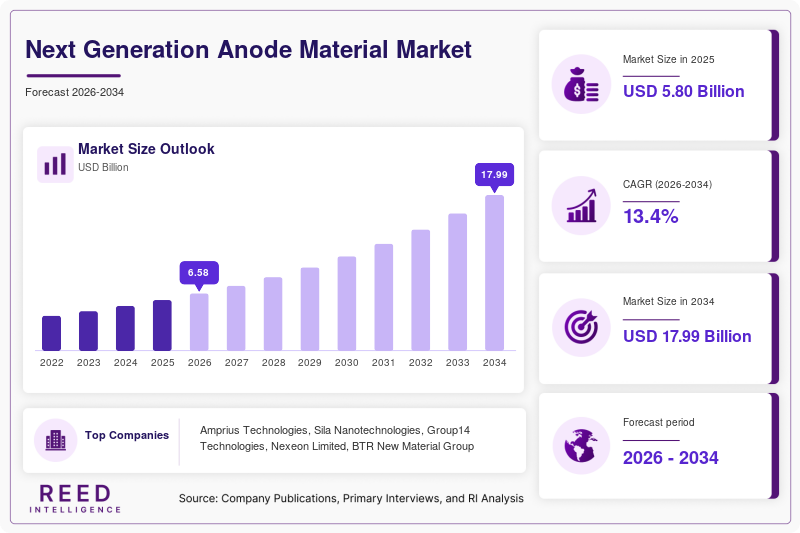
Key Highlights
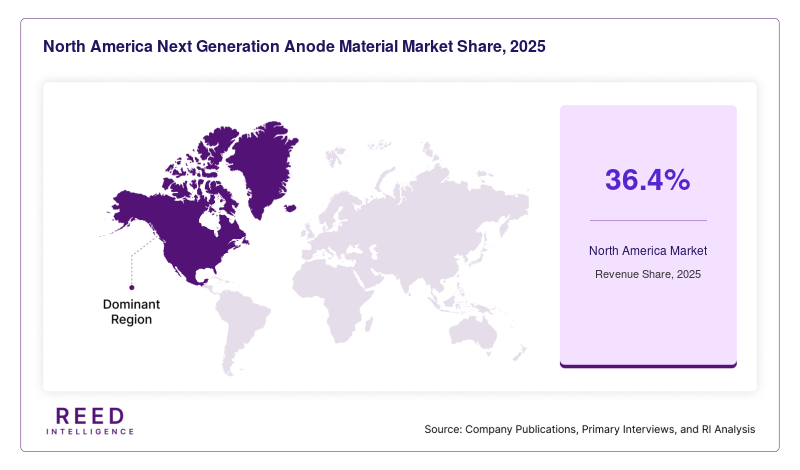
- North America dominated the market with a 36.4% share in 2025.
- Asia Pacific is expected to grow at the fastest CAGR of 14.8% during 2026–2034.
- By material type, silicon-based anode materials accounted for the largest share of 39.1%.
- while lithium-metal anodes are projected to grow at a CAGR of 16.2%.
- By battery type, lithium-ion batteries led with a 68.5% share.
- whereas solid-state batteries are expected to expand at a CAGR of 17.1%.
- By end use, electric vehicles accounted for the highest share of 47.6%.
- while grid-scale energy storage is anticipated to grow at a CAGR of 15.4%.
- The United States remained the dominant country, with market values of USD 1.48 billion in 2024 and USD 1.69 billion in 2025.
Market Trends
Rising Adoption of Silicon-Dominant Anode Technologies
Battery manufacturers are increasingly integrating silicon-dominant anode technologies into next-generation lithium-ion batteries to improve energy density and charging performance. Silicon has a significantly higher theoretical capacity compared to graphite, making it an attractive material for electric vehicle and consumer electronics applications. Companies are developing silicon-carbon composites and nano-engineered structures to address expansion challenges associated with silicon during charging cycles. Automotive companies are also investing in battery platforms that support high-capacity anode materials to extend vehicle range and reduce charging frequency. This trend is expected to accelerate as battery producers seek to improve performance without substantially increasing battery pack size or weight.
The growing commercialization of silicon-based anodes is further supported by investments in pilot-scale manufacturing facilities and advanced material processing technologies. Several battery startups and established manufacturers are collaborating with semiconductor and nanotechnology firms to improve production efficiency and scalability. Demand from premium electric vehicle manufacturers and portable electronics companies is encouraging suppliers to develop lightweight and high-efficiency anode materials. As battery technology continues to evolve, silicon-based anodes are expected to become a critical component in high-performance energy storage systems.
Expansion of Domestic Battery Supply Chains
Governments and private companies are increasingly focusing on domestic battery supply chains to reduce geopolitical risks and improve long-term material availability. Countries including the United States, China, Germany, South Korea, and Japan are investing heavily in battery manufacturing infrastructure and localized raw material processing. This trend has created strong demand for advanced anode materials produced within regional supply networks. Battery manufacturers are prioritizing local partnerships with mining firms, chemical suppliers, and recycling companies to strengthen supply chain resilience and lower transportation costs.
The development of regional battery ecosystems is also encouraging new investments in advanced anode material research and commercial-scale production. Companies are establishing integrated facilities that combine material processing, battery manufacturing, and recycling operations under a single supply framework. The growing adoption of government-backed clean energy programs and industrial incentives is expected to accelerate regional production capabilities over the next decade. This shift toward localized manufacturing is likely to support market stability, encourage technological innovation, and improve the competitiveness of next-generation anode material suppliers.
Market Drivers
Increasing Demand for High-Performance Electric Vehicle Batteries
The rapid expansion of the electric vehicle industry is one of the primary factors driving growth in the Next Generation Anode Material Market. Automotive manufacturers are under pressure to improve battery range, charging efficiency, and durability while maintaining cost competitiveness. Advanced anode materials such as silicon composites, lithium-metal, and graphene-enhanced structures offer significant improvements in battery performance compared to conventional graphite materials. These technologies enable higher energy density and faster charging capabilities, making them suitable for long-range passenger vehicles, commercial fleets, and electric mobility solutions.
Governments worldwide are introducing stricter emission regulations and offering incentives for electric vehicle adoption, which continues to accelerate battery demand. Automakers are also increasing investments in next-generation battery platforms to differentiate their products in competitive markets. The expansion of charging infrastructure and rising consumer preference for sustainable transportation are expected to further strengthen demand for advanced battery materials. As electric vehicle production volumes continue to increase, battery manufacturers are expected to scale up procurement of innovative anode materials to support next-generation battery architectures.
Growing Investments in Renewable Energy Storage Systems
The increasing deployment of renewable energy infrastructure is creating substantial demand for advanced energy storage technologies, supporting growth in the Next Generation Anode Material Market. Solar and wind energy systems require efficient battery storage solutions to manage intermittent power generation and ensure grid stability. Advanced anode materials improve battery efficiency, lifecycle performance, and energy retention, making them highly suitable for large-scale stationary energy storage applications.
Utility providers and energy companies are expanding investments in grid-scale battery projects to support clean energy integration and improve electricity reliability. Governments are also implementing energy transition policies that encourage the adoption of battery storage systems for residential, commercial, and industrial applications. The growing use of renewable energy across developing and developed economies is expected to increase demand for high-capacity batteries with longer operational lifespans. This trend is encouraging battery developers to adopt innovative anode materials that can support large-scale storage requirements while maintaining operational efficiency.
Market Restraint
High Production Costs and Material Processing Challenges
The high cost of advanced anode material production remains a significant restraint for the Next Generation Anode Material Market. Manufacturing next-generation materials such as silicon composites, lithium-metal structures, and graphene-enhanced anodes requires sophisticated processing technologies, specialized equipment, and high-purity raw materials. These requirements increase overall production expenses and limit large-scale commercialization, particularly in price-sensitive battery applications. Many battery manufacturers continue to rely on graphite-based anodes because they offer stable performance at lower production costs.
In addition, several advanced anode materials face technical challenges related to stability, cycle life, and scalability. Silicon anodes, for example, experience volume expansion during charging cycles, which can reduce battery durability if not properly managed. Lithium-metal anodes also require advanced safety controls due to dendrite formation risks. These technical limitations increase research and development costs and extend commercialization timelines. Smaller manufacturers often face financial constraints when attempting to scale production capacities or invest in advanced testing infrastructure.
Market Opportunities
Expansion of Solid-State Battery Commercialization
The growing commercialization of solid-state batteries presents a major opportunity for the Next Generation Anode Material Market. Solid-state batteries require advanced anode materials capable of delivering high energy density, improved safety, and longer cycle life. Lithium-metal anodes are gaining attention in this segment because they can significantly increase battery capacity while reducing battery weight. Automotive manufacturers and battery developers are accelerating investments in solid-state battery research to support future electric vehicle platforms and high-performance energy storage systems.
The increasing number of pilot projects and commercial partnerships in the solid-state battery industry is expected to create long-term demand for innovative anode technologies. Companies are establishing dedicated research facilities and strategic collaborations to improve production scalability and reduce manufacturing costs. As commercialization timelines improve, suppliers of advanced anode materials are expected to benefit from rising procurement requirements across automotive, aerospace, and consumer electronics industries. This opportunity is likely to support substantial revenue generation over the forecast period.
Rising Demand for Sustainable and Recyclable Battery Materials
Sustainability concerns and environmental regulations are creating new growth opportunities for manufacturers of recyclable and eco-friendly anode materials. Battery producers are increasingly focusing on circular economy models to reduce waste generation and improve raw material recovery. Advanced anode materials designed for easier recycling and lower environmental impact are gaining preference among automotive manufacturers and energy storage providers.
Governments are also introducing battery recycling regulations and sustainability standards that encourage the adoption of environmentally responsible production practices. Companies are investing in closed-loop recycling systems and advanced material recovery technologies to reduce dependence on newly mined resources. The growing emphasis on sustainable manufacturing is expected to increase demand for next-generation anode materials that support higher efficiency and lower environmental impact. Suppliers capable of developing recyclable and resource-efficient products are likely to gain competitive advantages in emerging battery markets.
Segmental Analysis
By Material Type
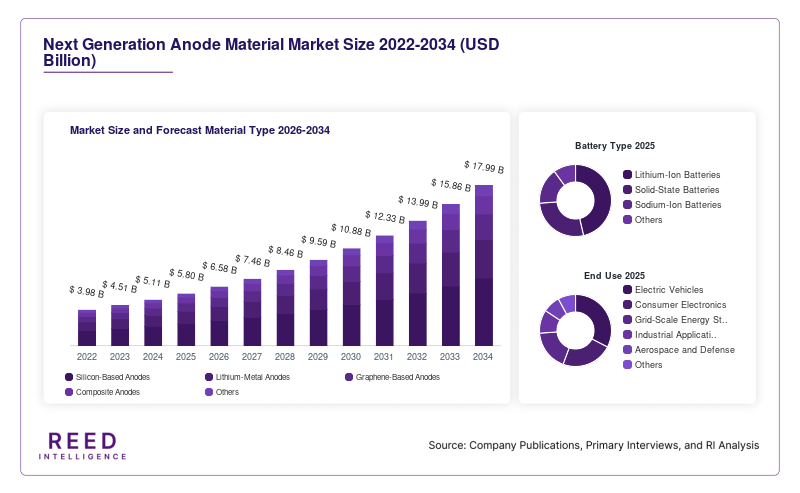
Silicon-based anode materials accounted for the largest share of the global Next Generation Anode Material Market in 2024, representing 39.1% of total revenue. The dominance of this subsegment is primarily linked to the increasing demand for high-energy-density batteries in electric vehicles and portable electronics. Silicon offers significantly higher lithium storage capacity compared to conventional graphite, making it an attractive solution for battery manufacturers aiming to improve charging efficiency and battery range. Several automotive and battery companies are integrating silicon-enhanced anodes into commercial battery platforms to achieve performance improvements without major modifications to existing battery architectures.
The growing adoption of silicon-based materials is also supported by advancements in nano-engineering and composite material technologies that improve structural stability during charging cycles. Manufacturers are developing silicon-carbon blends and advanced coatings to reduce volume expansion challenges and enhance battery lifespan. Increased investment in pilot-scale production facilities and strategic collaborations between battery developers and material science companies are further supporting commercialization. The combination of improved battery efficiency, growing electric vehicle adoption, and continuous technological innovation has positioned silicon-based anode materials as the dominant segment in the global market.
By Battery Type
Lithium-ion batteries accounted for the largest share of the Next Generation Anode Material Market in 2024, contributing 68.5% of overall revenue. The widespread use of lithium-ion batteries across electric vehicles, smartphones, laptops, industrial equipment, and renewable energy storage systems continues to drive demand for advanced anode materials within this segment. Battery manufacturers are integrating next-generation anode technologies into lithium-ion systems to improve energy density, operational lifespan, and charging performance. The mature commercial infrastructure associated with lithium-ion battery manufacturing also supports large-scale adoption of advanced materials.
The increasing penetration of electric vehicles and portable electronic devices has further strengthened demand for enhanced lithium-ion battery performance. Manufacturers are focusing on improving battery safety and reducing charging time through the integration of silicon-enhanced and composite anode structures. Continuous investment in battery production facilities, particularly in Asia Pacific and North America, is contributing to sustained market expansion. In addition, the growing use of lithium-ion batteries in grid-scale energy storage projects is expected to maintain strong long-term demand for innovative anode materials.
By End Use
Electric vehicles represented the largest end-use segment in the global Next Generation Anode Material Market in 2024, accounting for 47.6% of total revenue. The growing adoption of battery electric vehicles and plug-in hybrid vehicles is significantly increasing demand for high-performance battery materials capable of supporting extended driving range and faster charging times. Automotive manufacturers are prioritizing advanced battery technologies to meet evolving consumer expectations and comply with emission reduction targets. This trend is encouraging large-scale procurement of next-generation anode materials across global automotive supply chains.
The expansion of charging infrastructure and rising government incentives for electric mobility are also contributing to segment growth. Vehicle manufacturers are increasingly entering long-term supply agreements with battery material companies to secure access to advanced anode technologies. The integration of silicon-based and composite anode materials into commercial electric vehicle batteries is improving battery efficiency while reducing overall vehicle weight. As competition within the electric vehicle industry intensifies, demand for innovative battery materials is expected to remain strong throughout the forecast period.
Regional Analysis
North America
North America accounted for 36.4% of the global Next Generation Anode Material Market in 2025 and is expected to maintain a stable growth trajectory with a CAGR of 12.6% during the forecast period. The region benefits from strong electric vehicle adoption, advanced battery manufacturing infrastructure, and significant investments in clean energy technologies. Government incentives supporting domestic battery production and supply chain localization are encouraging investments in advanced anode material manufacturing facilities. Increasing collaboration between automotive manufacturers, battery developers, and material suppliers is also strengthening regional market growth.
The United States remained the dominant country within North America due to its large-scale electric vehicle production capacity and expanding renewable energy storage sector. Major battery manufacturers are increasing investments in research facilities focused on silicon-based and lithium-metal anode technologies. Federal funding programs supporting domestic battery supply chains and energy independence are creating favorable conditions for market expansion. In addition, growing demand for high-performance batteries in aerospace, defense, and industrial applications is contributing to sustained demand for next-generation anode materials.
Europe
Europe represented 27.1% of the global market in 2025 and is projected to expand at a CAGR of 12.9% from 2026 to 2034. The region is experiencing strong demand for advanced battery materials due to strict carbon emission regulations and the rapid electrification of transportation systems. European governments are investing heavily in battery gigafactories and sustainable energy infrastructure to reduce dependence on imported energy technologies. The growing emphasis on low-emission transportation and battery recycling is also supporting market growth.
Germany remained the leading country in the European market due to its strong automotive manufacturing industry and advanced battery research ecosystem. The country is investing in domestic battery production facilities and strategic partnerships focused on next-generation battery technologies. German automotive manufacturers are accelerating the development of long-range electric vehicles that require high-capacity battery systems. In addition, the presence of advanced engineering companies and research institutes continues to support innovation in silicon-based and composite anode materials.
Asia Pacific
Asia Pacific held a 24.8% share of the global Next Generation Anode Material Market in 2025 and is anticipated to record the fastest CAGR of 14.8% during the forecast period. The region benefits from large-scale battery manufacturing operations, rapid industrialization, and strong government support for electric mobility. Countries across Asia Pacific are investing heavily in battery supply chain development, including raw material processing, cell manufacturing, and recycling infrastructure. Rising demand for consumer electronics and electric vehicles is further driving the need for advanced anode materials.
China dominated the regional market due to its extensive battery production capabilities and leadership in electric vehicle manufacturing. The country has established a strong ecosystem of material suppliers, battery developers, and automotive manufacturers that supports continuous innovation. Government subsidies for clean energy technologies and large-scale investments in battery gigafactories continue to strengthen market expansion. China is also increasing investments in next-generation battery technologies, including solid-state batteries and silicon-enhanced anode systems, which is expected to create significant long-term opportunities.
Middle East & Africa
The Middle East & Africa region accounted for 6.2% of the global market in 2025 and is projected to grow at a CAGR of 11.1% through 2034. Market growth in the region is supported by increasing investments in renewable energy projects and expanding industrial diversification initiatives. Governments are gradually adopting energy storage systems to improve electricity reliability and support renewable power integration. The demand for advanced battery technologies in telecommunications, industrial operations, and transportation applications is also contributing to regional market development.
Saudi Arabia emerged as the dominant country within the region due to its growing investments in clean energy infrastructure and industrial modernization programs. The country is focusing on developing domestic manufacturing capabilities and attracting foreign investments in advanced technologies. Large-scale solar energy projects and smart city developments are increasing demand for efficient energy storage systems that require advanced battery materials. In addition, national economic diversification strategies are encouraging research and development activities related to sustainable energy technologies.
Latin America
Latin America captured 5.5% of the global Next Generation Anode Material Market in 2025 and is expected to grow at a CAGR of 10.8% during the forecast period. The region is witnessing increasing adoption of renewable energy systems and electric mobility solutions, particularly in urban transportation sectors. Governments are promoting cleaner transportation policies and encouraging investments in battery infrastructure to reduce carbon emissions. Growing industrialization and rising electricity demand are also supporting the adoption of advanced energy storage technologies.
Brazil remained the leading country in the Latin American market due to its expanding renewable energy sector and improving electric vehicle infrastructure. The country is investing in battery manufacturing partnerships and energy storage projects to strengthen grid stability and support sustainable transportation initiatives. Brazil also benefits from increasing research activities related to lithium-ion battery technologies and resource processing capabilities. Rising awareness regarding energy efficiency and environmental sustainability is expected to further stimulate demand for advanced anode materials across the country.
Competitive Landscape
The Next Generation Anode Material Market is characterized by increasing competition among battery material manufacturers, chemical companies, and technology startups focused on advanced energy storage solutions. Companies are investing heavily in research and development to improve battery efficiency, enhance material stability, and reduce production costs. Strategic partnerships, joint ventures, and capacity expansion projects are becoming common as manufacturers seek to strengthen supply chain resilience and accelerate commercialization.
Amprius Technologies emerged as one of the leading companies in the market due to its strong focus on silicon-anode battery innovation and commercial partnerships with electric mobility and aerospace companies. The company recently expanded its production capacity to support increasing demand for high-energy-density battery materials. Other market participants are also investing in pilot-scale manufacturing facilities and advanced recycling technologies to improve sustainability and operational efficiency.
Competitive intensity is expected to increase as automotive manufacturers continue to secure long-term agreements with battery material suppliers. Companies are prioritizing regional expansion strategies and localized manufacturing capabilities to reduce geopolitical risks and improve supply reliability. Technological differentiation, scalability, and sustainability performance are likely to remain key competitive factors throughout the forecast period.
Key Players
- Amprius Technologies
- Sila Nanotechnologies
- Group14 Technologies
- Nexeon Limited
- BTR New Material Group
- Hitachi Chemical Co., Ltd.
- POSCO Future M
- Mitsubishi Chemical Group
- NanoGraf Corporation
- OneD Battery Sciences
- Targray Technology International
- Resonac Holdings Corporation
- Enevate Corporation
- Albemarle Corporation
- Panasonic Energy Co., Ltd.
Recent Developments
- Amprius Technologies announced the expansion of its silicon-anode battery production facility to support commercial electric aviation and high-performance mobility applications.
- Group14 Technologies entered a strategic collaboration with a global automotive battery manufacturer to accelerate the commercialization of silicon-carbon composite anode materials.
- Sila Nanotechnologies secured additional funding for the development of next-generation battery materials aimed at improving electric vehicle charging efficiency and energy density.
- POSCO Future M expanded its advanced battery material manufacturing operations in Asia Pacific to strengthen regional supply chain capabilities.
- Enevate Corporation introduced a new fast-charging anode technology platform designed for next-generation electric vehicle batteries
Next Generation Anode Material Market Segments
Material Type
- Silicon-Based Anodes
- Lithium-Metal Anodes
- Graphene-Based Anodes
- Composite Anodes
- Others
Battery Type
- Lithium-Ion Batteries
- Solid-State Batteries
- Sodium-Ion Batteries
- Others
End Use
- Electric Vehicles
- Consumer Electronics
- Grid-Scale Energy Storage
- Industrial Applications
- Aerospace and Defense
- Others
By Region
- North America
- Europe
- APAC
- Middle East and Africa
- LATAM