Nickel Boride Alloy Market Size, Share & Demand Report By Type (Nickel-Rich Boride Alloys, Composite Boride Alloys), By Form (Powder, Coating, Bulk), By Application (Coatings, Additive Manufacturing, Industrial Tooling, Chemical Processing), By End-Use Industry (Aerospace, Automotive, Energy & Power, Oil & Gas, Industrial Manufacturing) & Segment Forecasts, 2026–2034
USD 3950
Market Overview
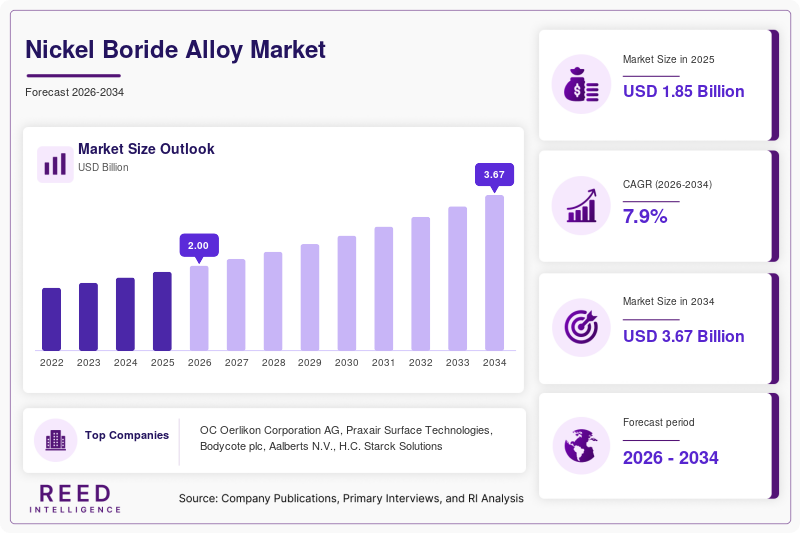
The Nickel Boride Alloy Market size was valued at approximately USD 1.85 billion in 2026 and is projected to reach USD 3.42 billion by 2034, expanding at a CAGR of 7.9% during the forecast period (2026–2034). Nickel boride alloys, known for their exceptional hardness, corrosion resistance, and wear resistance, are widely used in surface coatings, aerospace components, industrial tooling, and chemical processing equipment. The growing demand for durable and high-performance materials in harsh industrial environments has significantly contributed to market expansion.
A key global factor supporting the growth of the Nickel Boride Alloy Market is the increasing adoption of advanced coating technologies across manufacturing sectors. Industries are increasingly shifting toward materials that enhance operational efficiency and reduce maintenance costs, which has accelerated the use of nickel boride alloys in protective coatings and surface engineering applications.
Key Highlights:
- North America dominated the market with a share of 34.2% in 2025, while Asia Pacific is projected to grow at the fastest CAGR of 9.1% during the forecast period.
- The coating application segment led with a share of 41.6% in 2025, while the powder metallurgy segment is expected to grow at a CAGR of 8.7%.
- By end-use, the aerospace industry held the largest share, while the energy & power sector is anticipated to expand at the fastest CAGR of 9.3%.
- The United States accounted for a market value of USD 480 million in 2024, rising to USD 515 million in 2025, driven by strong industrial demand.
Market Trends
Rising Adoption of Advanced Surface Coating Technologies
The Nickel Boride Alloy Market is witnessing a steady shift toward advanced surface coating techniques such as electroless nickel boride plating and thermal spray coatings. These technologies provide enhanced hardness, low friction coefficients, and improved resistance to wear and corrosion. Industries such as aerospace, automotive, and heavy machinery are increasingly integrating these coatings to extend component life cycles. Additionally, the demand for uniform coating thickness and superior surface finish is driving innovation in deposition technologies, thereby supporting consistent market growth.
Integration in Additive Manufacturing and Powder Metallurgy
Another significant trend shaping the Nickel Boride Alloy Market is its growing use in additive manufacturing and powder metallurgy processes. Nickel boride powders are being adopted for producing high-performance parts with complex geometries. This trend is particularly prominent in industries requiring precision-engineered components, such as defense and medical devices. The compatibility of nickel boride alloys with 3D printing technologies is opening new avenues for customized production and rapid prototyping. As manufacturing shifts toward digitalization and automation, the use of nickel boride alloys in advanced fabrication processes is expected to increase substantially.
Market Drivers
Increasing Demand for Wear-Resistant Materials in Industrial Applications
The need for materials that can withstand extreme mechanical stress and corrosive environments is a primary driver of the Nickel Boride Alloy Market. Industrial sectors such as mining, oil & gas, and heavy manufacturing rely on durable materials to minimize equipment downtime and maintenance costs. Nickel boride alloys, with their superior hardness and chemical stability, are increasingly being used in tools, valves, and machinery components. This demand is expected to sustain long-term market growth.
Growth in Aerospace and Defense Manufacturing
The expansion of aerospace and defense industries globally is another key factor driving the Nickel Boride Alloy Market. These sectors require high-performance materials capable of operating under extreme temperatures and pressures. Nickel boride alloys are widely used in turbine components, landing gear systems, and structural parts due to their strength and resistance to oxidation. The increasing investments in aircraft production and defense modernization programs are contributing to the rising demand for these alloys.
Market Restraint
High Production Costs and Complex Processing Techniques
One of the major challenges facing the Nickel Boride Alloy Market is the high cost associated with production and processing. The manufacturing of nickel boride alloys involves complex procedures, including precise control of chemical composition and advanced deposition techniques. These processes require significant capital investment and skilled labor, which can limit adoption among small and medium-sized enterprises. Additionally, fluctuations in raw material prices, particularly nickel, further increase overall production costs. This cost barrier can restrict market penetration, especially in price-sensitive regions. While technological advancements are gradually reducing processing complexities, the high initial investment remains a key restraint impacting market growth.
Market Opportunities
Expansion in Renewable Energy Applications
The growing focus on renewable energy presents significant opportunities for the Nickel Boride Alloy Market. These alloys are increasingly being used in wind turbines, solar panel components, and energy storage systems due to their durability and corrosion resistance. As governments and organizations invest heavily in clean energy infrastructure, the demand for reliable materials is expected to rise, creating new growth avenues.
Development of Eco-Friendly Coating Solutions
Another emerging opportunity lies in the development of environmentally friendly coating technologies. Traditional coating methods often involve hazardous chemicals, prompting industries to seek sustainable alternatives. Nickel boride alloys are being explored as a safer option due to their efficiency and reduced environmental impact. Innovations in green chemistry and sustainable manufacturing processes are likely to enhance the adoption of nickel boride coatings, supporting long-term market growth.
Segmental Analysis
By Type
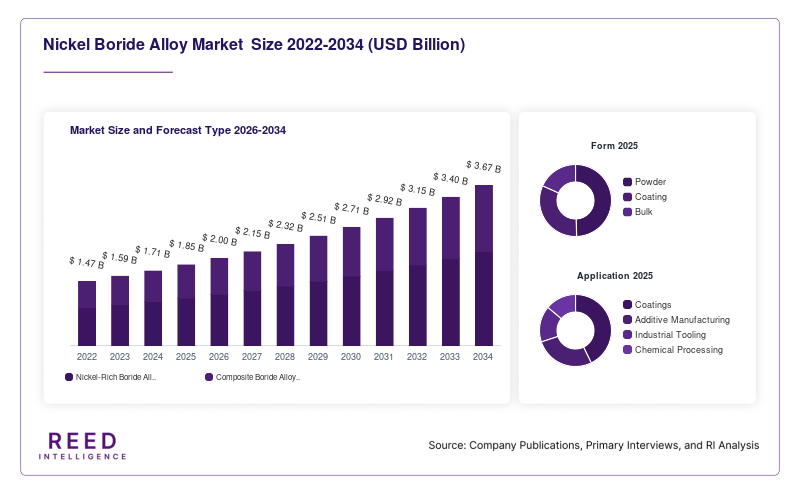
The nickel-rich boride alloys segment dominated the Nickel Boride Alloy Market in 2025, accounting for 58.4% of the total share. These alloys are widely used due to their superior hardness and corrosion resistance, making them suitable for demanding industrial applications.
The composite boride alloys segment will grow at the fastest CAGR of 8.9% during the forecast period, driven by their enhanced mechanical properties and versatility. These materials are expected to gain traction in advanced manufacturing applications requiring customized performance characteristics.
By Form
The powder form segment held the largest share of 46.7% in 2025, driven by its extensive use in coating and additive manufacturing processes. Powder forms offer better control over composition and are widely used in thermal spray applications.
The coating form segment will expand at a CAGR of 9.0%, supported by increasing demand for protective surface treatments across industries. The ability to enhance component durability will drive this segment’s growth.
By Application
The coatings application segment led the market with a share of 41.6% in 2025, owing to the widespread use of nickel boride coatings in industrial machinery and aerospace components.
The additive manufacturing segment is projected to grow at a CAGR of 9.4%, driven by the rising adoption of 3D printing technologies. The demand for high-performance materials in complex designs will support this growth.
By End-Use Industry
The aerospace sector dominated the Nickel Boride Alloy Market with a share of 32.1% in 2025, supported by the need for high-strength and corrosion-resistant materials.
The energy & power sector will grow at the fastest CAGR of 9.3%, driven by increasing investments in renewable energy infrastructure and the need for durable materials in energy systems.
Regional Analysis
North America
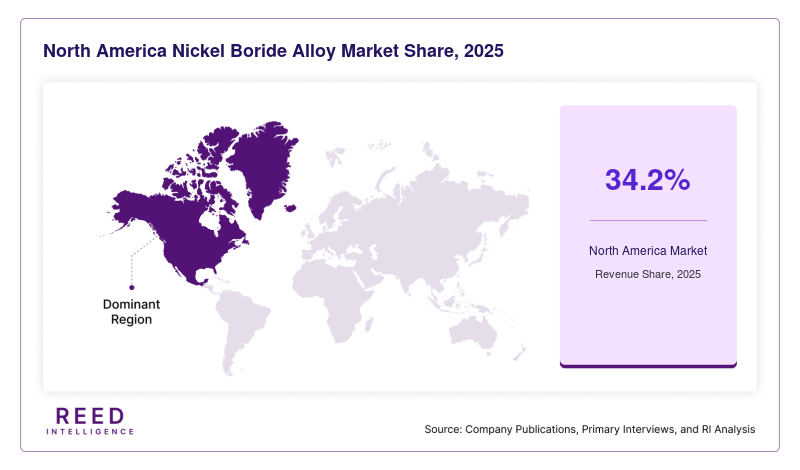
North America accounted for 34.2% of the Nickel Boride Alloy Market share in 2025, reflecting strong industrial adoption across multiple sectors. The region will expand at a CAGR of 7.2% from 2026 to 2034, supported by ongoing investments in advanced manufacturing and material science innovations.
The United States remained the dominant country due to its well-established aerospace and industrial machinery sectors. The presence of advanced research facilities and a strong focus on material innovation has contributed to the widespread use of nickel boride alloys. The demand is further supported by the need for high-performance coatings in critical infrastructure applications.
Europe
Europe held approximately 26.8% of the market share in 2025 and will grow at a CAGR of 7.5% during the forecast period. The region’s emphasis on sustainable manufacturing and technological advancements is driving market expansion.
Germany emerged as the leading country, driven by its robust automotive and industrial engineering sectors. The country’s focus on precision manufacturing and high-quality materials has led to increased adoption of nickel boride alloys in specialized applications. The shift toward energy-efficient production processes is also supporting demand.
Asia Pacific
Asia Pacific captured 22.5% of the Nickel Boride Alloy Market share in 2025 and is projected to grow at the fastest CAGR of 9.1% through 2034. Rapid industrialization and expanding manufacturing capabilities are key factors driving regional growth.
China dominated the regional market due to its large-scale production base and growing investments in infrastructure and heavy industries. The country’s increasing focus on improving product durability and performance has accelerated the use of nickel boride alloys in coatings and machinery components.
Middle East & Africa
The Middle East & Africa region accounted for 9.3% of the market share in 2025 and will grow at a CAGR of 6.8% during the forecast period. The region’s growth is supported by developments in oil & gas and industrial sectors.
Saudi Arabia led the market due to its strong presence in the energy sector. The demand for corrosion-resistant materials in harsh environmental conditions has driven the adoption of nickel boride alloys in pipelines and processing equipment.
Latin America
Latin America held 7.2% of the Nickel Boride Alloy Market share in 2025 and is expected to grow at a CAGR of 6.9% through 2034. The region is gradually adopting advanced materials to improve industrial efficiency.
Brazil emerged as the dominant country, supported by its growing manufacturing and mining sectors. The need for durable materials in resource extraction and processing industries is contributing to increased demand for nickel boride alloys.
Competitive Landscape
The Nickel Boride Alloy Market is moderately competitive, with key players focusing on product innovation, strategic partnerships, and capacity expansion. The market leader, OC Oerlikon Corporation AG, has strengthened its position through continuous advancements in coating technologies and material engineering. The company recently introduced a new range of nickel boride-based coatings designed for high-temperature applications, enhancing its competitive edge.
Other major players are actively investing in research and development to improve product performance and expand application areas. Collaborations with industrial manufacturers and technology providers are also common strategies to gain market share. The competitive environment is characterized by technological advancements and increasing demand for customized solutions.
Key Players List
- OC Oerlikon Corporation AG
- Praxair Surface Technologies
- Bodycote plc
- Aalberts N.V.
- H.C. Starck Solutions
- Kennametal Inc.
- Carpenter Technology Corporation
- Sandvik AB
- Höganäs AB
- ATI Inc.
- Voestalpine AG
- Linde plc
- Advanced Materials Corporation
- Nippon Steel Corporation
- Mitsubishi Materials Corporation
Recent Developments
- In 2025, OC Oerlikon Corporation AG launched advanced nickel boride coatings for aerospace applications.
- Praxair Surface Technologies expanded its production capacity for high-performance alloy powders.
- Bodycote plc introduced new heat treatment solutions integrating nickel boride materials.
- Sandvik AB invested in additive manufacturing technologies using boride alloys.
- Höganäs AB developed eco-friendly powder solutions for industrial coating applications.
Nickel Boride Alloy Market Segments
Type
- Nickel-Rich Boride Alloys
- Composite Boride Alloys
Form
- Powder
- Coating
- Bulk
Application
- Coatings
- Additive Manufacturing
- Industrial Tooling
- Chemical Processing
End-Use Industry
- Aerospace
- Automotive
- Energy & Power
- Oil & Gas
- Industrial Manufacturing
By Region
- North America
- Europe
- APAC
- Middle East and Africa
- LATAM