Nickel Cadmium Battery Market Size, Share & Demand Report By Type (Vented Nickel Cadmium Batteries, Sealed Nickel Cadmium Batteries), By Application (Industrial Backup Power, Aviation, Railways, Emergency Lighting, Energy Storage Systems), By End-Use Industry (Transportation, Energy & Utilities, Industrial Manufacturing, Defense & Aerospace, Telecommunications), By Region & Segment Forecasts, 2026–2034
USD 3950
Market Overview
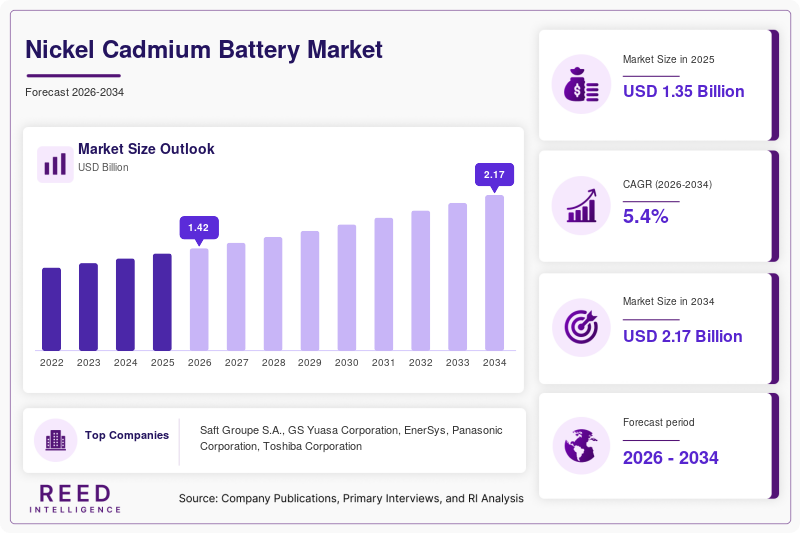
The Nickel Cadmium Battery Market size was valued at approximately USD 1.35 billion in 2026 and is projected to reach USD 2.05 billion by 2034, expanding at a compound annual growth rate (CAGR) of 5.4% during 2026–2034. The market continues to demonstrate steady growth due to its established role in critical applications requiring durability, reliability, and consistent performance across extreme environmental conditions. Despite competition from newer chemistries, nickel cadmium (Ni-Cd) batteries maintain a strong presence in aviation, emergency lighting, railways, and industrial backup systems.
A key global factor supporting market growth is the increasing demand for reliable backup power systems in critical infrastructure. Industries such as transportation, defense, and utilities rely on Ni-Cd batteries for their long lifecycle, ability to perform under temperature fluctuations, and resistance to deep discharge. These attributes make them preferable in mission-critical operations where performance failure is not acceptable.
Key Highlights
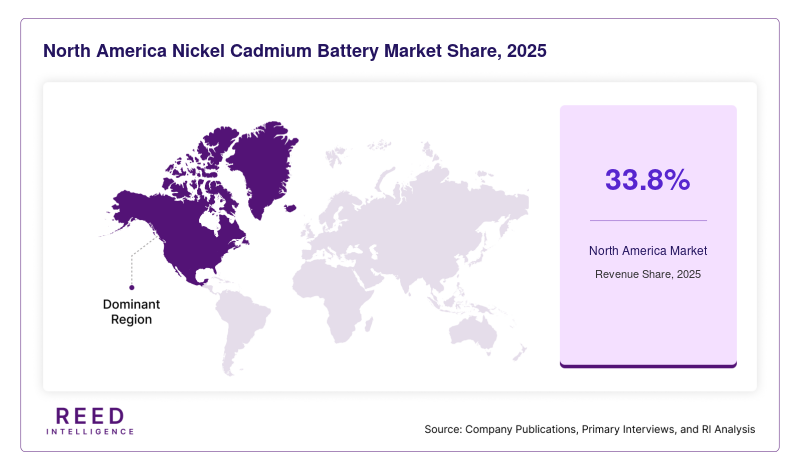
- North America dominated the market with a 33.8% share in 2025.
- Asia Pacific is expected to grow at the fastest CAGR of 6.3% during 2026–2034.
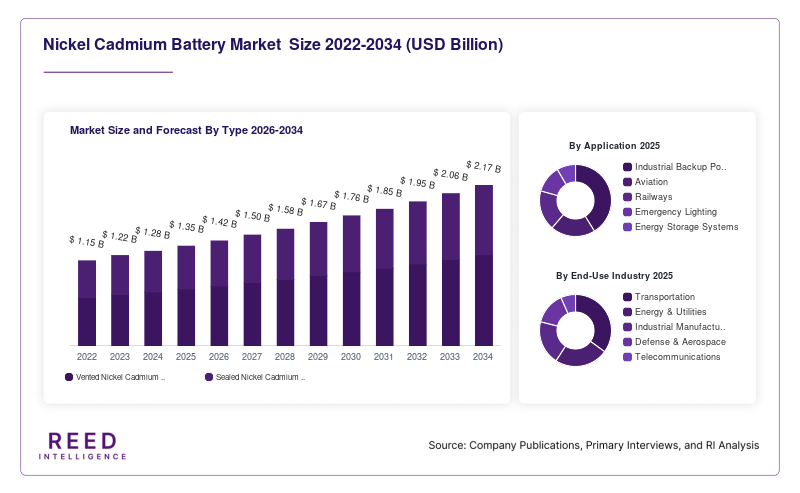
- By type, vented Ni-Cd batteries accounted for the largest share of 61.5%, while sealed Ni-Cd batteries are projected to grow at a CAGR of 6.8%.
- By application, industrial backup power led with a 39.4% share, whereas aviation is expected to expand at a CAGR of 6.5%.
- The United States remained the dominant country, with market values of USD 420 million in 2024 and USD 455 million in 2025.
Market Trends
Increasing Adoption in Aviation and Rail Systems
Nickel cadmium batteries are witnessing steady adoption in aviation and railway systems due to their proven reliability and long operational lifespan. Aircraft systems require batteries that can function under extreme temperature variations and pressure conditions, where Ni-Cd batteries outperform many alternatives. Similarly, railway signaling systems and onboard energy storage solutions rely on stable and durable battery technologies. Governments are investing in rail infrastructure upgrades, particularly in emerging economies, further boosting demand. Additionally, regulatory certifications for aviation-grade batteries favor Ni-Cd technology due to its established safety profile. This trend is expected to sustain demand despite competition from lithium-ion alternatives, especially in safety-critical sectors where proven performance outweighs newer technology adoption.
Focus on Recycling and Sustainable Battery Management
Environmental concerns surrounding cadmium usage have led to increased focus on recycling and sustainable battery management practices. Manufacturers and regulatory bodies are investing in advanced recycling technologies to reduce environmental impact and recover valuable materials. This has resulted in improved lifecycle management of Ni-Cd batteries, making them more acceptable in regulated markets. Many countries have implemented strict guidelines for disposal and recycling, encouraging manufacturers to adopt closed-loop systems. This trend is also driving innovation in battery design to enhance recyclability and reduce hazardous waste. As sustainability becomes a critical factor in procurement decisions, companies offering efficient recycling solutions are gaining competitive advantages in the market.
Market Drivers
High Reliability in Extreme Conditions
One of the primary drivers of the Nickel Cadmium Battery Market is its ability to operate efficiently under extreme environmental conditions. Ni-Cd batteries can function in both very high and very low temperatures without significant performance degradation. This makes them suitable for industries such as aerospace, defense, and oil & gas, where environmental conditions are unpredictable. Their resistance to overcharging and deep discharging further enhances reliability, reducing the risk of system failure. These characteristics are particularly important in emergency systems and mission-critical applications, where uninterrupted power supply is essential. As industries continue to prioritize reliability and operational safety, the demand for Ni-Cd batteries remains strong.
Long Lifecycle and Low Maintenance Requirements
Nickel cadmium batteries offer a longer lifecycle compared to many alternative battery technologies. They can endure a high number of charge-discharge cycles, making them cost-effective over the long term. This durability reduces replacement frequency and lowers overall maintenance costs. Industrial sectors, including utilities and transportation, prefer Ni-Cd batteries for their consistent performance and reduced downtime. Additionally, their robust design minimizes the need for complex battery management systems, further lowering operational costs. As organizations aim to optimize cost efficiency while maintaining performance standards, the long lifecycle of Ni-Cd batteries continues to drive their adoption across multiple industries.
Market Restraint
Environmental and Regulatory Challenges
The primary restraint impacting the Nickel Cadmium Battery Market is the environmental concern associated with cadmium, a toxic heavy metal. Regulatory bodies across various regions have imposed strict guidelines on the use, disposal, and recycling of cadmium-based batteries. These regulations increase compliance costs for manufacturers and limit the adoption of Ni-Cd batteries in certain consumer applications. For example, in the European market, stringent directives have restricted the use of Ni-Cd batteries in portable electronics, encouraging a shift toward alternative chemistries such as lithium-ion and nickel-metal hydride.
This regulatory pressure has also influenced procurement decisions in industries aiming to align with sustainability goals. Companies are increasingly evaluating environmentally friendly alternatives to reduce their carbon footprint and comply with environmental standards. While industrial and critical applications still rely on Ni-Cd batteries due to their reliability, the overall market growth is constrained by these environmental concerns. Manufacturers are investing in recycling programs and eco-friendly processes to mitigate these challenges, but regulatory limitations continue to pose a significant barrier to widespread adoption.
Market Opportunities
Growth in Emerging Infrastructure Projects
Emerging economies are investing heavily in infrastructure development, including transportation networks, power generation facilities, and industrial plants. These projects require reliable backup power systems, creating significant opportunities for Ni-Cd battery adoption. The durability and long operational life of these batteries make them suitable for infrastructure projects with long-term operational requirements. Countries in Asia Pacific, Latin America, and the Middle East are particularly focusing on expanding their industrial and transportation infrastructure, which is expected to drive demand. Additionally, government initiatives aimed at improving energy reliability further support the adoption of robust battery technologies like Ni-Cd.
Expansion in Renewable Energy Backup Systems
The increasing integration of renewable energy sources such as solar and wind has created a need for efficient energy storage solutions. Ni-Cd batteries are being considered for backup systems in renewable energy installations due to their ability to handle fluctuating charge cycles and extreme weather conditions. While lithium-ion batteries dominate the primary storage market, Ni-Cd batteries are gaining traction in backup and auxiliary roles. Their reliability and long service life make them suitable for remote and off-grid applications. As renewable energy adoption continues to grow globally, the demand for dependable backup systems presents a promising opportunity for the Nickel Cadmium Battery Market.
Segmental Analysis
By Type
Vented nickel cadmium batteries held the dominant share of 61.5% in 2024 due to their widespread use in industrial and heavy-duty applications. These batteries are known for their robustness, high capacity, and ability to withstand extreme conditions. Industries such as railways, aviation, and utilities prefer vented batteries for their reliability and long service life. Their design allows for easy maintenance and monitoring, making them suitable for large-scale installations. Additionally, vented Ni-Cd batteries offer better performance in high-load applications, which further supports their dominance in the market.
Sealed nickel cadmium batteries are the fastest-growing subsegment, with a projected CAGR of 6.8% during the forecast period. The growth is driven by their compact design, lower maintenance requirements, and suitability for portable applications. These batteries are increasingly used in emergency lighting, medical devices, and small-scale industrial equipment. The convenience of sealed designs eliminates the need for regular maintenance, making them attractive for applications where accessibility is limited. As industries continue to adopt compact and efficient energy solutions, the demand for sealed Ni-Cd batteries is expected to rise significantly.
By Application
Industrial backup power accounted for the largest share of 39.4% in 2024 due to the critical need for uninterrupted power supply in industrial operations. Ni-Cd batteries are widely used in power plants, manufacturing facilities, and data centers to ensure operational continuity. Their ability to provide stable power during outages makes them essential in industries where downtime can lead to significant financial losses. The reliability and long lifecycle of these batteries further enhance their suitability for backup applications, contributing to their dominant position in the market.
The aviation segment is expected to grow at the fastest CAGR of 6.5% during the forecast period. The increasing demand for air travel and the expansion of airline fleets are driving the need for reliable onboard power systems. Ni-Cd batteries are preferred in aviation due to their safety, durability, and ability to perform under extreme conditions. Regulatory approvals and certifications also support their adoption in this sector. As the aviation industry continues to grow, the demand for high-performance battery systems is expected to increase, driving the growth of this segment.
By End-Use Industry
The transportation sector held the largest share of 36.2% in 2024 due to the extensive use of Ni-Cd batteries in railways and aviation systems. These batteries provide reliable power for signaling, communication, and onboard systems, ensuring safe and efficient operations. The growing focus on transportation infrastructure development, particularly in emerging economies, further supports the demand for Ni-Cd batteries. Their ability to operate under varying environmental conditions makes them ideal for transportation applications, contributing to their dominance in this segment.
The energy sector is the fastest-growing subsegment, with a CAGR of 6.1%. The increasing integration of renewable energy sources and the need for reliable backup systems are driving demand in this segment. Ni-Cd batteries are used in energy storage and backup applications to ensure consistent power supply. Their durability and long lifecycle make them suitable for energy systems with high operational demands. As the global focus on energy security and sustainability continues to grow, the demand for reliable battery solutions in the energy sector is expected to increase significantly.
Regional Analysis
North America
North America accounted for approximately 33.8% of the Nickel Cadmium Battery Market share in 2025 and is expected to grow at a CAGR of 4.9% during the forecast period. The region’s growth is driven by the strong presence of aerospace, defense, and industrial sectors that require reliable battery systems. Additionally, investments in infrastructure modernization and energy security contribute to market expansion.
The United States dominates the regional market due to its advanced industrial base and high demand for backup power solutions. A unique growth factor is the increasing investment in defense and aviation systems, where Ni-Cd batteries are widely used due to their reliability and safety profile.
Europe
Europe held a market share of 27.6% in 2025 and is projected to grow at a CAGR of 4.5%. The region’s market is influenced by strict environmental regulations, which have limited the use of Ni-Cd batteries in certain applications. However, industrial and aviation sectors continue to support demand.
Germany leads the European market due to its strong industrial sector and focus on engineering excellence. A unique growth factor is the region’s emphasis on sustainable battery recycling programs, which enable continued use of Ni-Cd batteries in compliance with environmental standards.
Asia Pacific
Asia Pacific accounted for 24.3% of the market in 2025 and is expected to grow at the fastest CAGR of 6.3%. Rapid industrialization and infrastructure development are key drivers in the region. Increasing investments in railways and energy systems further boost demand.
China dominates the regional market due to its large-scale manufacturing capabilities and infrastructure projects. A unique growth factor is the expansion of railway networks, which require reliable energy storage systems for signaling and operations.
Middle East & Africa
The Middle East & Africa region held a 7.1% share in 2025 and is projected to grow at a CAGR of 5.2%. Growth is driven by investments in oil & gas, utilities, and infrastructure projects. The need for durable batteries in harsh environmental conditions supports market demand.
Saudi Arabia leads the region due to its extensive energy sector investments. A unique growth factor is the demand for backup power systems in remote oil exploration sites, where reliability is critical.
Latin America
Latin America accounted for 7.2% of the market share in 2025 and is expected to grow at a CAGR of 5.0%. Infrastructure development and industrial expansion are key growth drivers in the region.
Brazil dominates the regional market due to its growing industrial base. A unique growth factor is the increasing adoption of backup power systems in utility and transportation sectors to enhance operational reliability.
Competitive Landscape
The Nickel Cadmium Battery Market is moderately consolidated, with several established players competing based on product quality, reliability, and technological innovation. Leading companies focus on enhancing battery performance, improving recycling processes, and expanding their product portfolios to maintain market presence.
A key leader in the market is Saft Groupe S.A., known for its strong presence in industrial and aviation battery solutions. The company has recently invested in advanced battery technologies and recycling initiatives to strengthen its position. Other major players are focusing on strategic partnerships, mergers, and acquisitions to expand their global footprint. Continuous innovation and adherence to regulatory standards are critical factors influencing competition in this market.
Key Players
- Saft Groupe S.A.
- GS Yuasa Corporation
- EnerSys
- Panasonic Corporation
- Toshiba Corporation
- BYD Company Limited
- Alcad AB
- HBL Power Systems Ltd.
- ALCON Electronics Pvt. Ltd.
- Sichuan Changhong Battery Co., Ltd.
- Nilar International AB
- VARTA AG
- Power Sonic Corporation
- EverExceed Industrial Co., Ltd.
- Shoto Group Co., Ltd.
Recent Developments
- In 2025, Saft Groupe S.A. expanded its production capacity to meet increasing demand from the aviation sector.
- GS Yuasa Corporation introduced an improved Ni-Cd battery series with enhanced lifecycle performance in 2024.
- EnerSys announced a partnership with a railway operator in 2025 to supply advanced battery systems for signaling applications.
Nickel Cadmium Battery Market Segments
By Type
- Vented Nickel Cadmium Batteries
- Sealed Nickel Cadmium Batteries
By Application
- Industrial Backup Power
- Aviation
- Railways
- Emergency Lighting
- Energy Storage Systems
By End-Use Industry
- Transportation
- Energy & Utilities
- Industrial Manufacturing
- Defense & Aerospace
- Telecommunications
By Region
- North America
- Europe
- APAC
- Middle East and Africa
- LATAM