Nickel Hydrogen Batteries Market Size, Share & Demand Report By Type (Small-Sized Nickel Hydrogen Batteries, Medium-Sized Nickel Hydrogen Batteries, Large-Sized Nickel Hydrogen Batteries), By Application (Aerospace and Satellites, Renewable Energy Storage, Telecommunications, Industrial Backup Power, Defense Systems), By End Use (Government and Defense Organizations, Commercial Energy Operators, Aerospace Companies, Industrial Facilities, Research Institutions) By Region & Segment Forecasts, 202
USD 3950
Market Overview
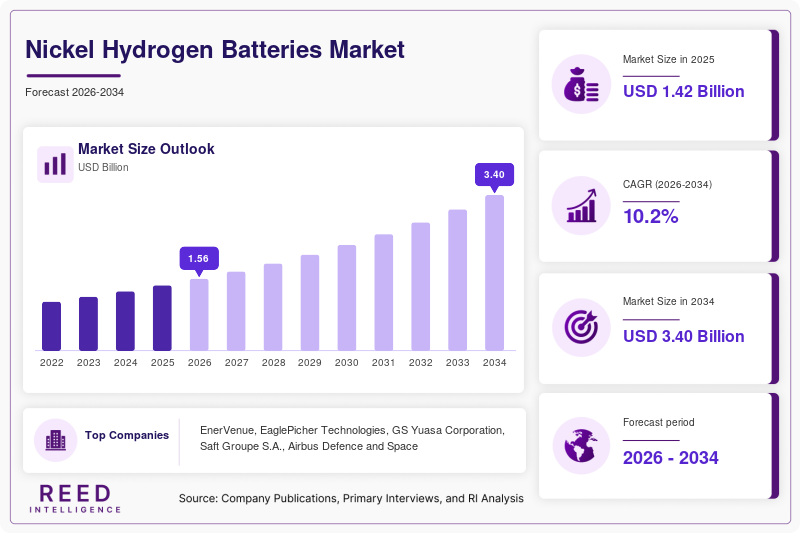
The global Nickel Hydrogen Batteries Market size was valued at USD 1.42 billion in 2026 and is projected to reach USD 3.08 billion by 2034, expanding at a CAGR of 10.2% during the forecast period from 2026 to 2034. The market continues to gain momentum due to the increasing need for durable and long-cycle energy storage systems across aerospace, satellite communication, renewable energy, and defense applications. Nickel hydrogen batteries are widely recognized for their high reliability, low maintenance requirements, and ability to operate in demanding environmental conditions. These characteristics make them suitable for long-duration missions and mission-critical operations where battery failure can result in substantial operational losses.
One of the major global factors supporting market growth is the increasing deployment of low-earth orbit satellites and deep-space exploration missions. Government space agencies and private aerospace companies are investing heavily in advanced power systems capable of delivering consistent energy over long operational periods. Nickel hydrogen batteries offer superior cycle life compared to several conventional battery technologies, making them highly preferred in space applications. In addition, the transition toward renewable energy infrastructure has encouraged utilities and industrial operators to explore dependable storage technologies that can withstand frequent charge and discharge cycles.
Key Highlights
- North America dominated the market with a 36.8% share in 2025.
- Asia Pacific is expected to grow at the fastest CAGR of 11.8% during 2026–2034.
- By type, small-sized nickel hydrogen batteries accounted for the largest share of 42.6%, while large-sized batteries are projected to grow at a CAGR of 12.1%.
- By application, aerospace and satellites led with a 47.4% share, whereas renewable energy storage is expected to expand at a CAGR of 12.6%.
- By end use, government and defense organizations accounted for the largest share of 39.8%, while commercial energy operators are projected to grow at a CAGR of 11.9%.
- The United States remained the dominant country, with market values of USD 470 million in 2024 and USD 525 million in 2025.
Market Trends
Expansion of Commercial Satellite Constellations
The rapid expansion of commercial satellite constellations is becoming one of the most influential trends in the Nickel Hydrogen Batteries Market. Private aerospace firms are launching communication, navigation, and earth observation satellites at a steady pace to improve global internet connectivity and data transmission capabilities. These satellites require highly durable battery systems that can operate continuously in extreme temperature conditions and repeated orbital charge cycles. Nickel hydrogen batteries are increasingly preferred because they deliver stable performance over long mission durations while minimizing replacement needs. As satellite deployment programs become larger and more complex, manufacturers are scaling production capacities and introducing compact battery configurations suitable for next-generation aerospace platforms.
The growing commercialization of space technology has also encouraged strategic partnerships between battery manufacturers and aerospace contractors. Companies are investing in advanced thermal management systems and lightweight battery components to improve payload efficiency. Demand from military communication satellites and weather monitoring missions is further contributing to product adoption. This trend is expected to continue as governments and commercial operators focus on expanding space infrastructure and ensuring uninterrupted satellite performance.
Integration of Long-Life Storage Systems in Renewable Energy Projects
Another significant trend influencing the Nickel Hydrogen Batteries Market is the integration of long-life storage systems into renewable energy projects. Utilities and industrial facilities are increasingly searching for storage technologies that can support solar and wind energy installations over extended operational cycles. Nickel hydrogen batteries are gaining attention because of their strong cycle durability and reduced maintenance requirements compared to some conventional storage alternatives. Their ability to function efficiently under variable temperature conditions makes them suitable for remote renewable power installations and critical backup systems.
Energy companies are deploying advanced storage systems to stabilize electricity supply and improve grid resilience. The growing emphasis on energy security and sustainable power management is encouraging investments in dependable storage infrastructure. Several manufacturers are also developing modular nickel hydrogen battery systems designed for scalable renewable energy operations. This trend is creating new opportunities for battery suppliers targeting industrial energy storage applications and off-grid renewable projects.
Market Drivers
Rising Investments in Space Exploration and Defense Programs
Increasing investments in space exploration and defense modernization programs are driving substantial growth in the Nickel Hydrogen Batteries Market. Government agencies and private aerospace companies are expanding budgets for satellite launches, planetary missions, surveillance systems, and military communication networks. These applications require energy storage technologies that can deliver stable power over long operational periods with minimal degradation. Nickel hydrogen batteries are widely adopted in these sectors because they offer long cycle life, dependable performance, and resistance to harsh environmental conditions.
The growing number of low-earth orbit satellite deployments and deep-space missions has increased demand for advanced aerospace-grade battery systems. Defense organizations are also modernizing communication and intelligence infrastructure, creating additional opportunities for battery manufacturers. As military operations become increasingly technology dependent, the need for reliable backup power systems continues to rise. This driver is expected to support continuous investments in high-performance nickel hydrogen battery technologies throughout the forecast period.
Increasing Demand for Reliable Long-Duration Energy Storage
The increasing demand for reliable long-duration energy storage solutions is another major driver supporting the Nickel Hydrogen Batteries Market. Utilities, industrial facilities, and renewable energy operators require battery systems capable of maintaining stable energy output during fluctuating power conditions. Nickel hydrogen batteries provide operational advantages such as extended lifespan, high reliability, and low maintenance, making them suitable for critical infrastructure and industrial energy management.
Renewable energy adoption is accelerating worldwide as governments implement carbon reduction targets and sustainable energy policies. Solar and wind power installations require dependable storage systems to manage intermittent electricity generation. Nickel hydrogen batteries are being evaluated for specialized storage applications where long-term operational reliability is essential. Industrial operators are also deploying these batteries in remote facilities, telecommunication networks, and emergency backup systems. Growing energy infrastructure investments and increasing concerns regarding power stability are expected to strengthen market demand during the coming years.
Market Restraint
High Manufacturing Costs and Limited Commercial Adoption
High manufacturing costs and limited commercial-scale adoption remain major restraints affecting the Nickel Hydrogen Batteries Market. Compared to lithium-ion and other widely commercialized battery technologies, nickel hydrogen batteries involve complex production processes and higher material costs. Manufacturing requires specialized components, precision engineering, and advanced testing procedures to ensure operational stability under demanding conditions. These factors increase overall production expenses and limit cost competitiveness in price-sensitive industries.
The high initial investment associated with nickel hydrogen battery systems often discourages adoption among small and medium-sized energy operators. Many commercial sectors continue to prioritize lower-cost battery alternatives that offer adequate short-term performance despite shorter operational lifespans. In addition, limited large-scale manufacturing infrastructure has restricted widespread commercialization and slowed market penetration in consumer-oriented applications.
Market Opportunities
Expansion of Deep-Space Exploration Missions
The increasing number of deep-space exploration missions presents a major opportunity for the Nickel Hydrogen Batteries Market. Space agencies and commercial aerospace companies are investing in lunar exploration programs, interplanetary missions, and advanced scientific research satellites. These projects require highly reliable energy storage systems capable of operating continuously in extreme radiation and temperature conditions. Nickel hydrogen batteries provide long operational life and dependable energy performance, making them highly suitable for extended space missions.
Manufacturers are focusing on improving battery efficiency, reducing system weight, and enhancing energy density to meet evolving aerospace requirements. Growing international collaboration in space exploration is expected to generate long-term contracts for battery suppliers and component manufacturers. The emergence of private space tourism and commercial lunar infrastructure projects may further increase demand for advanced energy storage technologies. This opportunity is likely to encourage innovation and strengthen investment activity across the global market.
Development of Hybrid Renewable Energy Infrastructure
The development of hybrid renewable energy infrastructure is creating promising opportunities for participants in the Nickel Hydrogen Batteries Market. Governments and utility providers are increasingly integrating solar, wind, and backup storage systems to improve energy reliability and reduce dependence on conventional fuels. Nickel hydrogen batteries are being explored for specialized renewable applications that require long cycle durability and consistent operational performance.
Industrial facilities located in remote or environmentally challenging regions are seeking dependable storage systems capable of supporting uninterrupted power supply. Hybrid renewable installations often require battery technologies that can withstand frequent charging cycles and harsh climatic conditions. Nickel hydrogen batteries are gaining attention because they provide stable performance over extended operational periods with relatively low maintenance requirements.
Battery manufacturers are also introducing modular energy storage systems that can be customized for industrial renewable projects and grid stabilization applications. As renewable energy investments continue to rise globally, opportunities for specialized long-duration storage technologies are expected to expand steadily during the forecast period.
Segmental Analysis
By Type
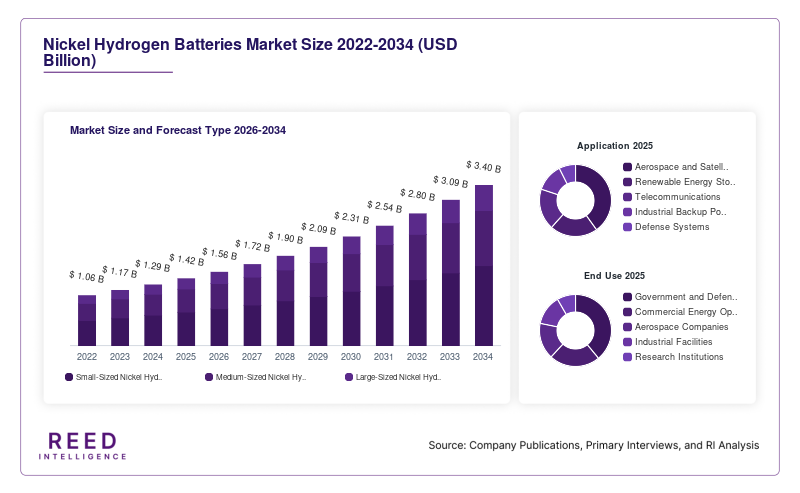
Small-sized nickel hydrogen batteries accounted for the largest share of the global market in 2024, representing approximately 42.6% of overall revenue. These batteries are widely used in compact aerospace equipment, communication systems, portable defense electronics, and small satellite applications. Their popularity is supported by operational flexibility, stable power delivery, and relatively lower integration complexity compared to larger systems. Manufacturers are increasingly focusing on improving compact battery efficiency to support next-generation aerospace technologies and portable industrial applications.
The demand for small-sized systems is also growing because of increased deployment of miniaturized satellites and lightweight communication devices. Government agencies and commercial aerospace operators continue to prioritize compact energy storage solutions capable of maintaining consistent performance under demanding conditions. In addition, the expansion of telecommunication infrastructure and portable monitoring equipment is contributing to rising product adoption. These factors have strengthened the position of small-sized nickel hydrogen batteries across several specialized industrial sectors.
By Application
Aerospace and satellite applications represented the largest share of the Nickel Hydrogen Batteries Market in 2024, accounting for nearly 47.4% of total revenue. Nickel hydrogen batteries are highly preferred in aerospace operations because they deliver exceptional cycle life, strong reliability, and consistent energy output under extreme environmental conditions. Satellites operating in low-earth orbit and deep-space missions require durable battery technologies capable of functioning continuously over long periods without significant performance degradation.
The growing commercialization of satellite communication services and earth observation systems has further strengthened demand within this application segment. Aerospace agencies and private companies are investing in advanced power management systems to support next-generation spacecraft and satellite networks. In addition, military surveillance systems and secure communication infrastructure continue to rely on highly dependable battery technologies. These factors have reinforced the leadership of aerospace and satellite applications within the overall market structure.
By End Use
Government and defense organizations accounted for the largest share of the Nickel Hydrogen Batteries Market in 2024, contributing approximately 39.8% of total revenue. These organizations require highly reliable energy storage systems for satellite communication, surveillance infrastructure, aerospace missions, and defense operations. Nickel hydrogen batteries are widely utilized because they offer dependable performance, long cycle life, and strong resistance to environmental stress. Their ability to function effectively in mission-critical applications has made them essential for national defense and advanced aerospace activities.
Increasing global defense expenditures and expanding space exploration programs continue to strengthen demand from this end-use segment. Governments are investing in secure communication networks, intelligence systems, and advanced military technologies that require durable power storage solutions. In addition, public sector research agencies are supporting innovation in aerospace battery technologies to improve mission reliability and operational efficiency. These factors have maintained the dominant position of government and defense organizations within the market.
Regional Analysis
North America
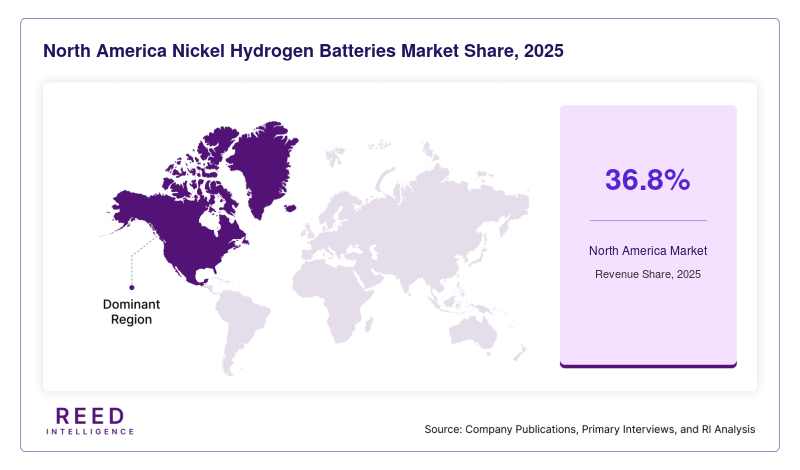
North America accounted for the largest share of the Nickel Hydrogen Batteries Market in 2025, representing approximately 36.8% of global revenue. The region is expected to maintain strong growth during the forecast period with a projected CAGR of 9.8% from 2026 to 2034. Market expansion is supported by substantial investments in aerospace infrastructure, satellite deployment programs, and advanced defense technologies. The presence of established battery manufacturers and government-funded space research programs continues to strengthen regional demand.
The United States remains the dominant country in North America due to its extensive aerospace and defense ecosystem. The country benefits from large-scale investments in satellite communication networks and national space exploration initiatives. One unique growth factor supporting the U.S. market is the increasing involvement of private aerospace firms in reusable spacecraft and low-earth orbit satellite programs. These developments are generating continuous demand for durable battery systems capable of supporting long operational missions.
Europe
Europe held a significant share of the Nickel Hydrogen Batteries Market in 2025 and is projected to expand at a CAGR of 9.5% during the forecast period. Regional growth is supported by increasing investments in renewable energy storage infrastructure and advanced aerospace research projects. European governments are focusing on sustainable energy strategies and resilient power systems, creating favorable conditions for long-duration battery technologies. Several countries are also strengthening defense communication networks and satellite monitoring capabilities.
Germany emerged as the dominant country within the European market due to its strong industrial manufacturing sector and renewable energy investments. The country has established research programs focused on advanced battery technologies and energy efficiency solutions. A unique growth factor driving the German market is the integration of industrial energy storage systems with renewable power installations. This trend is encouraging battery suppliers to develop reliable storage solutions suitable for industrial and utility-scale applications.
Asia Pacific
Asia Pacific is expected to record the fastest growth in the Nickel Hydrogen Batteries Market, with a forecast CAGR of 11.8% from 2026 to 2034. The region is benefiting from rapid industrialization, expanding satellite communication infrastructure, and increasing renewable energy investments. Governments across Asia Pacific are supporting domestic aerospace manufacturing and energy security initiatives, which are contributing to rising demand for advanced storage technologies. Growing telecommunication infrastructure and industrial automation projects are also strengthening market expansion.
China remains the leading country in the Asia Pacific market due to its extensive investments in space exploration and energy infrastructure development. The country is rapidly expanding satellite deployment activities and renewable power generation capacity. One unique factor driving growth in China is the government’s focus on achieving energy independence through advanced battery research and localized manufacturing capabilities. These initiatives are expected to increase domestic demand for high-performance nickel hydrogen battery systems.
Middle East & Africa
The Middle East & Africa region is experiencing steady development in the Nickel Hydrogen Batteries Market and is projected to grow at a CAGR of 8.7% during the forecast period. Market growth is supported by increasing investments in renewable energy diversification projects and defense modernization programs. Several countries are focusing on improving energy infrastructure reliability while reducing dependence on traditional fossil fuel systems. The adoption of advanced storage technologies is gradually increasing in industrial and utility-scale applications.
Saudi Arabia represents the dominant market within the region due to its large-scale renewable energy investments and strategic infrastructure projects. The country is actively developing solar energy facilities and advanced communication networks to support long-term economic diversification goals. A unique growth factor supporting the Saudi Arabian market is the integration of energy storage systems into remote industrial operations and smart infrastructure developments. This is encouraging demand for durable and low-maintenance battery technologies.
Latin America
Latin America accounted for a moderate share of the Nickel Hydrogen Batteries Market in 2025 and is expected to expand at a CAGR of 8.9% during the forecast period. Regional growth is supported by rising investments in renewable power generation and telecommunications infrastructure. Governments are increasingly promoting sustainable energy initiatives and backup power solutions for remote regions. Industrial facilities and utility operators are exploring dependable storage technologies capable of supporting long-duration energy management requirements.
Brazil remains the dominant country in the Latin American market due to its expanding renewable energy sector and industrial modernization initiatives. The country has increased investments in wind and solar power generation projects across multiple states. One unique growth factor contributing to Brazilian market expansion is the growing need for reliable backup power systems in remote agricultural and mining operations. These industries require durable storage solutions capable of operating efficiently in challenging environmental conditions.
Competitive Landscape
The Nickel Hydrogen Batteries Market is characterized by moderate competition with the presence of aerospace battery manufacturers, energy storage providers, and advanced technology companies. Leading participants are focusing on long-term supply agreements, product innovation, and strategic collaborations with aerospace agencies and defense contractors. Companies are also investing in research programs aimed at improving energy density, thermal stability, and operational lifespan.
Aerospace-grade battery manufacturing remains a highly specialized segment due to strict quality standards and technical requirements. Market participants are increasingly expanding production capabilities to support the growing number of satellite launches and renewable energy projects. Several companies are also introducing modular battery systems to target industrial and commercial energy storage applications.
Key Players
- EnerVenue
- EaglePicher Technologies
- GS Yuasa Corporation
- Saft Groupe S.A.
- Airbus Defence and Space
- Arotech Corporation
- Power-Sonic Corporation
- BYD Company Ltd.
- Panasonic Holdings Corporation
- EnerSys
- East Penn Manufacturing
- Concorde Battery Corporation
- VARTA AG
- NEC Corporation
- Mitsubishi Electric Corporation
Recent Developments
- In 2025, EnerVenue expanded its battery manufacturing capacity in North America to support increasing demand for utility-scale energy storage systems.
- In 2024, GS Yuasa Corporation introduced an upgraded nickel hydrogen battery design focused on improving energy density for aerospace applications.
- In 2025, Saft Groupe S.A. partnered with a European aerospace contractor to develop advanced battery systems for next-generation satellite programs.
- In 2024, EaglePicher Technologies announced new research investments aimed at enhancing thermal stability and operational lifespan in defense-grade battery systems.
Nickel Hydrogen Batteries Market Segments
Type
- Small-Sized Nickel Hydrogen Batteries
- Medium-Sized Nickel Hydrogen Batteries
- Large-Sized Nickel Hydrogen Batteries
Application
- Aerospace and Satellites
- Renewable Energy Storage
- Telecommunications
- Industrial Backup Power
- Defense Systems
End Use
- Government and Defense Organizations
- Commercial Energy Operators
- Aerospace Companies
- Industrial Facilities
- Research Institutions
By Region
- North America
- Europe
- APAC
- Middle East and Africa
- LATAM