Nickel Zinc Rechargeable Battery Market Size, Share & Demand Report By Type (AA Nickel Zinc Batteries, AAA Nickel Zinc Batteries, Industrial Nickel Zinc Battery Packs, Custom Nickel Zinc Modules), By Application (Consumer Electronics, Power Tools, Backup Power Systems, Energy Storage Systems), By End-Use (Electronics Manufacturers, Industrial Equipment, Renewable Energy Systems, Telecommunications Infrastructure), By Distribution Channel (Direct Sales, Distributors & Resellers, Online B2B Platfo
USD 3950
Market Overview
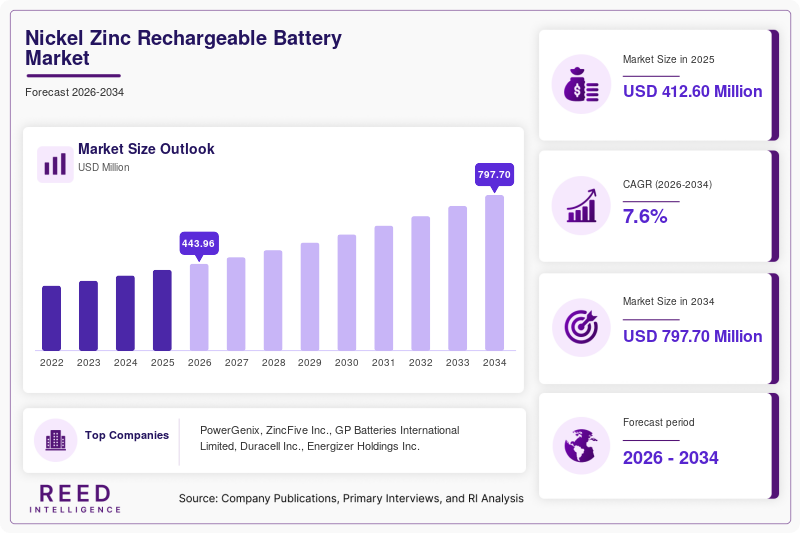
The global Nickel Zinc Rechargeable Battery Market size was valued at USD 412.6 million in 2025 and is projected to reach USD 798.4 million by 2033, registering a CAGR of 7.6% during the forecast period (2025–2034). Nickel zinc rechargeable batteries are gaining attention as an alternative energy storage technology due to their high power density, environmentally compatible chemistry, and ability to deliver higher voltage compared with conventional nickel-based battery systems. These batteries are widely used in consumer electronics, power tools, backup power systems, and emerging energy storage applications.
One global factor that has supported the growth of the Nickel Zinc Rechargeable Battery Market is the increasing focus on sustainable battery chemistries that reduce dependence on heavy metals and rare materials. Nickel zinc batteries use relatively abundant materials and offer improved recyclability compared with certain alternative battery technologies. This has attracted attention from manufacturers and end users seeking environmentally responsible energy storage solutions.
Key Highlights
- Asia Pacific accounted for the dominant share of 38.6% in 2025, while Latin America is expected to grow the fastest at 8.2% CAGR during the forecast period.
- In the Application segment, Consumer Electronics held the leading share of 34.9%, while Energy Storage Systems will expand fastest at 9.1% CAGR.
- In the End-Use segment, Electronics Manufacturers dominated with 41.5% share, while Renewable Energy Systems will grow fastest at 8.7% CAGR.
- China represented the leading national market with USD 92.4 million in 2025, expected to reach USD 99.1 million in 2026.
Market Trends
Increasing Adoption in High-Power Consumer Devices
The Nickel Zinc Rechargeable Battery Market is witnessing growing adoption in high-power consumer devices such as digital cameras, wireless accessories, and gaming controllers. Nickel zinc batteries offer higher voltage output compared with nickel-metal hydride alternatives, which allows devices to operate with improved efficiency. Manufacturers are increasingly evaluating these batteries for devices that require rapid discharge and stable voltage delivery. As consumer electronics continue to demand compact and efficient power sources, nickel zinc battery technology is gaining recognition as a viable option.
Integration into Backup Power and Energy Storage Systems
Another trend shaping the Nickel Zinc Rechargeable Battery Market is the integration of these batteries into backup power systems and small-scale energy storage installations. Nickel zinc batteries provide high cycle stability and fast recharge capability, making them suitable for uninterruptible power supply systems and grid-support applications. The expansion of distributed energy systems and localized energy storage solutions is contributing to the increasing adoption of this battery technology.
Market Drivers
Rising Demand for Sustainable Battery Technologies
The growing emphasis on environmentally responsible energy storage solutions has contributed to the expansion of the Nickel Zinc Rechargeable Battery Market. Nickel zinc batteries utilize materials that are widely available and can be recycled more easily than certain alternative chemistries. This environmental profile has encouraged manufacturers and technology developers to consider nickel zinc systems as part of broader sustainability initiatives.
Organizations across multiple industries are increasingly evaluating battery technologies based on lifecycle impact and recyclability. As sustainability goals become more integrated into corporate strategies, demand for environmentally compatible battery solutions is expected to support the market’s long-term outlook.
Growing Use of Rechargeable Batteries Across Multiple Industries
The increasing reliance on rechargeable battery technologies across industries such as electronics, telecommunications, and energy infrastructure has contributed to the growth of the Nickel Zinc Rechargeable Battery Market. Businesses are seeking battery solutions capable of delivering stable power performance while maintaining efficient recharge cycles.
Nickel zinc batteries offer advantages such as high discharge rates and improved voltage characteristics, which make them suitable for devices that require reliable and consistent power output. As industries expand their adoption of rechargeable energy storage systems, the demand for nickel zinc battery solutions continues to increase.
Market Restraint
Limited Cycle Life Compared with Certain Battery Chemistries
A significant challenge facing the Nickel Zinc Rechargeable Battery Market is the comparatively limited cycle life of some nickel zinc battery systems when compared with lithium-ion technologies. Although ongoing research has improved electrode durability and battery design, certain applications still require longer cycle life for extended operational use.
This limitation can influence purchasing decisions among manufacturers and energy storage system developers. Organizations evaluating battery technologies may prioritize chemistries that deliver longer operational lifespans. As a result, suppliers in the nickel zinc battery industry continue to invest in research and development to enhance battery longevity and performance.
Market Opportunities
Expansion of Smart Grid Energy Storage Systems
The modernization of power infrastructure is creating new opportunities for the Nickel Zinc Rechargeable Battery Market. Smart grid systems increasingly rely on distributed energy storage solutions that support power balancing and backup capabilities. Nickel zinc batteries can deliver reliable high-power output and fast charging characteristics, which makes them suitable for certain grid-support applications.
As energy utilities and infrastructure developers continue to deploy smart grid technologies, the integration of advanced battery storage systems will present new growth avenues for nickel zinc battery manufacturers.
Increasing Adoption in Industrial Backup Power Applications
Industrial facilities require dependable backup power solutions to maintain operational continuity during power interruptions. Nickel zinc rechargeable batteries offer stable voltage performance and can be used in backup power units designed for industrial equipment and telecommunications systems.
The continued expansion of data centers, telecommunications networks, and industrial automation systems is expected to create new demand for reliable backup power technologies. This trend will provide opportunities for the Nickel Zinc Rechargeable Battery Market to expand into additional industrial applications.
Segmental Analysis
By Application
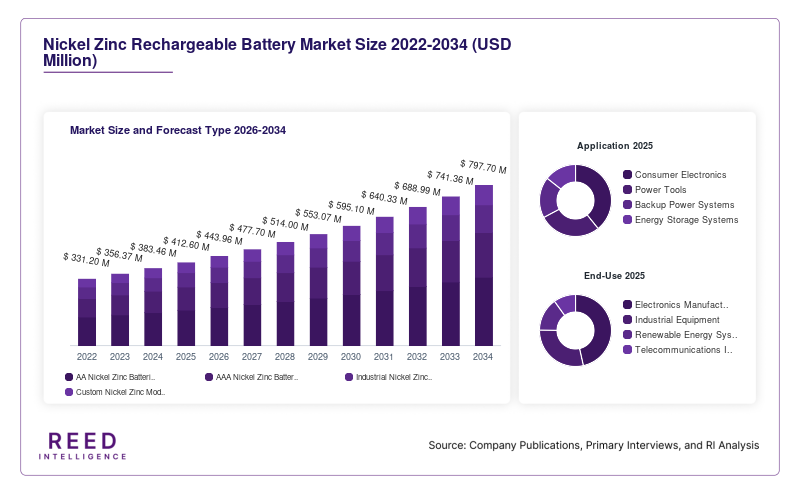
The Consumer Electronics segment accounted for the largest share of the Nickel Zinc Rechargeable Battery Market, representing 34.9% of total revenue in 2025. Consumer electronic devices require compact and reliable energy storage systems capable of delivering stable power output. Nickel zinc rechargeable batteries are used in products such as cameras, gaming devices, and wireless electronics where high discharge performance is required.
The Energy Storage Systems segment will grow at the fastest CAGR of 9.1% during the forecast period. Increasing deployment of distributed energy storage solutions has encouraged adoption of alternative battery chemistries capable of supporting rapid charging and high power output. As energy storage applications expand globally, demand for nickel zinc rechargeable battery systems will continue to increase.
By Type
The AA Nickel Zinc Batteries segment held the dominant 41.7% share of the Nickel Zinc Rechargeable Battery Market in 2025. AA batteries remain widely used in consumer electronics and portable devices due to their standardized size and compatibility with various electronic products. Manufacturers have developed nickel zinc AA batteries designed to deliver higher voltage and improved performance compared with traditional rechargeable batteries.
The Industrial Nickel Zinc Battery Packs segment will grow at a CAGR of 8.4% during the forecast period. Industrial battery packs are designed for applications that require higher energy capacity and consistent performance under demanding conditions. As industrial automation and equipment electrification expand, demand for specialized battery packs will increase.
By End-Use
The Electronics Manufacturers segment accounted for the leading 41.5% share of the Nickel Zinc Rechargeable Battery Market in 2025. Electronics manufacturers integrate rechargeable batteries into devices that require reliable power sources and efficient charging capabilities. Nickel zinc battery technology has been utilized in various electronic applications that demand high power output.
The Renewable Energy Systems segment will grow at a CAGR of 8.7% through 2034. Renewable energy systems frequently incorporate battery storage technologies to manage power fluctuations and support grid stability. Nickel zinc rechargeable batteries are increasingly being evaluated for these systems due to their performance characteristics and environmental compatibility.
By Distribution Channel
The Direct Sales segment dominated the Nickel Zinc Rechargeable Battery Market with a 53.2% share in 2025. Battery manufacturers often supply products directly to equipment manufacturers and industrial customers through long-term supply agreements. This distribution model allows companies to ensure consistent product specifications and supply reliability.
The Online B2B Distribution segment will grow at a CAGR of 7.8% during the forecast period. Digital procurement platforms are becoming increasingly popular among manufacturers seeking efficient sourcing channels for battery components and energy storage solutions. As industrial procurement processes become more digitalized, online distribution channels will gain importance.
Regional Analysis
North America
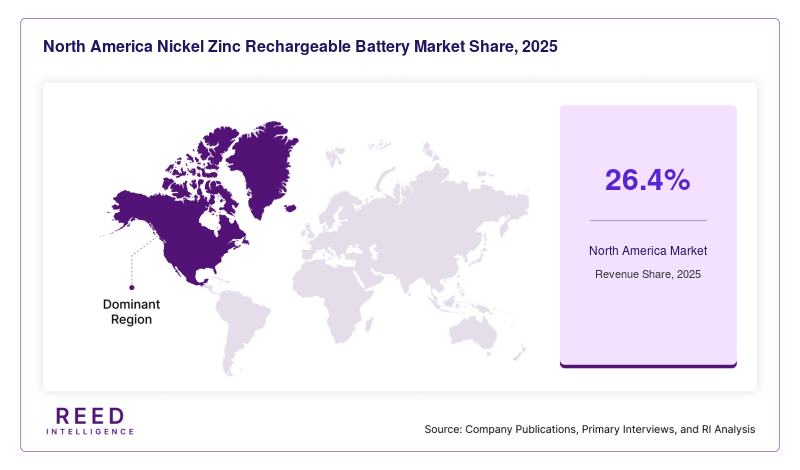
North America accounted for 26.4% of the global Nickel Zinc Rechargeable Battery Market in 2025. The region is expected to grow at a CAGR of 7.1% from 2025 to 2034. Demand for rechargeable battery technologies has increased across various sectors including consumer electronics, telecommunications infrastructure, and energy storage systems. The regional market has also benefited from ongoing investments in advanced battery research and manufacturing capabilities.
The United States represented the dominant country within North America. One notable factor supporting national market growth has been the development of backup power solutions for data centers and communication networks. As digital infrastructure expands, companies are integrating reliable battery technologies to support uninterrupted operations. Nickel zinc rechargeable batteries are being evaluated for these systems due to their high power output and stable voltage characteristics.
Europe
Europe held 22.1% of the global Nickel Zinc Rechargeable Battery Market in 2025 and is projected to expand at a CAGR of 6.8% through 2034. The region has experienced increasing interest in alternative battery technologies as industries diversify energy storage solutions across consumer and industrial applications.
Germany emerged as the dominant country within the European market. The country hosts a well-developed industrial sector and a strong electronics manufacturing base. Companies across the region have been investing in battery technologies to support advanced equipment and industrial automation systems. Nickel zinc rechargeable batteries are being considered for certain applications that require high power density and stable performance.
Asia Pacific
Asia Pacific represented the largest regional share of 38.6% in the Nickel Zinc Rechargeable Battery Market in 2025 and will grow at a CAGR of 7.9% during the forecast period. The region has become a major center for electronics manufacturing and battery production. Rapid expansion of consumer electronics industries and increasing adoption of rechargeable battery technologies have contributed to market growth.
China served as the dominant national market within the region. The country has developed extensive battery manufacturing infrastructure and supports a large electronics production ecosystem. Companies operating within this ecosystem frequently adopt diverse battery chemistries to meet varying product requirements. Nickel zinc rechargeable batteries have gained attention for applications requiring high discharge capability and reliable performance.
Middle East & Africa
The Middle East & Africa accounted for 7.8% of the global Nickel Zinc Rechargeable Battery Market in 2025 and will grow at a CAGR of 7.2% between 2025 and 2034. Demand for rechargeable battery technologies in the region has gradually expanded across telecommunications infrastructure and energy storage projects.
United Arab Emirates represented the dominant country within the regional market. The nation has been investing in modern infrastructure and energy systems, including distributed power storage solutions. As infrastructure projects expand, battery technologies are increasingly integrated into backup power and energy management systems, supporting demand for nickel zinc rechargeable batteries.
Latin America
Latin America captured 5.1% of the Nickel Zinc Rechargeable Battery Market in 2025 and will expand at the fastest CAGR of 8.2% through 2034. The region has experienced increasing adoption of rechargeable energy storage technologies across industrial and consumer sectors.
Brazil dominated the regional market due to its expanding electronics manufacturing sector and increasing adoption of energy storage technologies. As industries continue to modernize equipment and power infrastructure, companies are exploring various battery chemistries that provide reliable performance and operational flexibility.
Competitive Landscape
The Nickel Zinc Rechargeable Battery Market features a mix of established battery manufacturers and specialized technology developers. Companies in the market focus on improving battery performance, extending cycle life, and expanding application areas for nickel zinc technology.
PowerGenix has been recognized as a prominent player in the nickel zinc battery industry. The company has focused on developing advanced nickel zinc battery technologies designed for high-power applications. Recent developments include the introduction of improved electrode materials aimed at increasing battery cycle life and overall efficiency.
Other key companies are investing in battery design innovation and strategic partnerships with electronics manufacturers to expand the commercial adoption of nickel zinc rechargeable batteries.
Key Players List
- PowerGenix
- ZincFive Inc.
- GP Batteries International Limited
- Duracell Inc.
- Energizer Holdings Inc.
- Panasonic Corporation
- BYD Company Limited
- Eos Energy Enterprises
- East Penn Manufacturing Company
- ZAF Energy Systems
- Saft Groupe S.A.
- VARTA AG
- Enersys
- Arotech Corporation
- Shenzhen PKCELL Battery Co., Ltd.
Recent Developments
- In 2024, several battery technology companies introduced improved nickel zinc battery designs aimed at enhancing cycle life and energy efficiency.
- In 2023, manufacturers expanded research initiatives to develop advanced electrode materials that improve performance stability in nickel zinc rechargeable batteries.
- In 2024, battery producers partnered with electronics manufacturers to integrate nickel zinc battery systems into new generations of high-power consumer devices.
Nickel Zinc Rechargeable Battery Market Segments
Type
- AA Nickel Zinc Batteries
- AAA Nickel Zinc Batteries
- Industrial Nickel Zinc Battery Packs
- Custom Nickel Zinc Modules
Application
- Consumer Electronics
- Power Tools
- Backup Power Systems
- Energy Storage Systems
End-Use
- Electronics Manufacturers
- Industrial Equipment
- Renewable Energy Systems
- Telecommunications Infrastructure
Distribution Channel
- Direct Sales
- Distributors & Resellers
- Online B2B Platforms
By Region
- North America
- Europe
- APAC
- Middle East and Africa
- LATAM