Niobium Oxide Market Size, Share & Demand Report By Type (High-Purity Niobium Oxide, Nano Niobium Oxide, Technical Grade Niobium Oxide, Others), By Application (Batteries and Energy Storage, Optical Coatings, Catalysts, Advanced Ceramics, Glass Manufacturing, Others), By End-Use (Electronics and Semiconductors, Automotive, Aerospace and Defense, Renewable Energy Systems, Healthcare and Medical Devices, Industrial Manufacturing), By Region & Segment Forecasts, 2026–2034
USD 3950
Market Overview
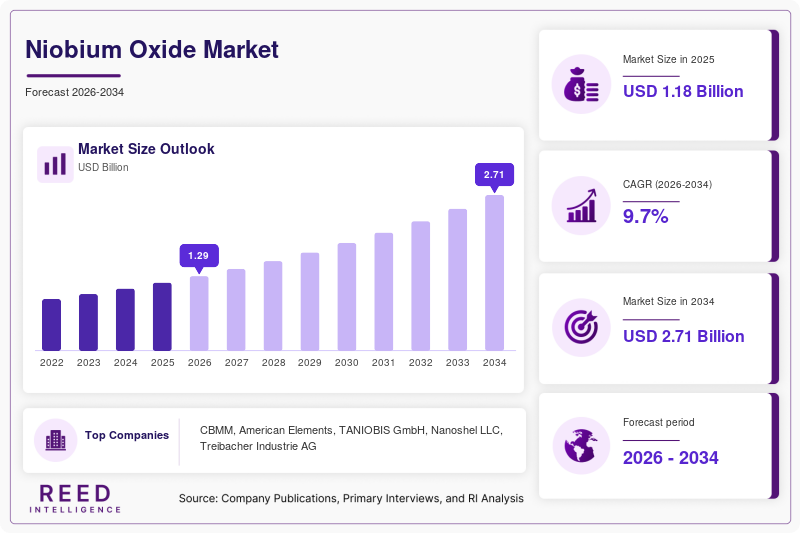
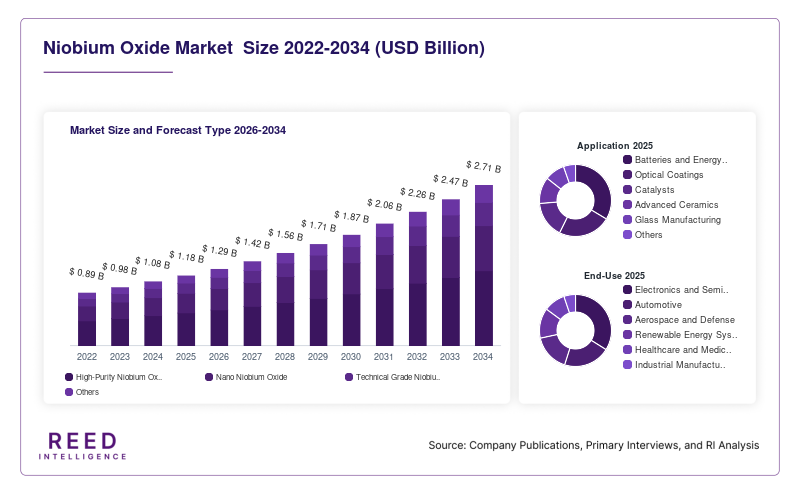
The global Niobium Oxide Market size was valued at USD 1.18 billion in 2026 and is projected to reach USD 2.47 billion by 2034, expanding at a CAGR of 9.7% during the forecast period from 2026 to 2034. Rising demand for advanced materials across electronics, energy storage, aerospace, and optical coating applications continues to support long-term market expansion. Niobium oxide is increasingly used in lithium-ion battery anodes, ceramic capacitors, specialty glass, catalysts, and superconducting materials because of its thermal stability, dielectric properties, and corrosion resistance. The growing shift toward electrification and clean energy technologies has strengthened investments in high-performance oxides that improve energy efficiency and product durability.
A major global factor driving market growth is the increasing adoption of electric vehicles and renewable energy infrastructure. Manufacturers of batteries and electronic components are focusing on materials that improve conductivity, energy density, and cycle life. Niobium oxide has emerged as an important material in these applications due to its ability to enhance charging speed and structural stability. In addition, increasing industrial automation and demand for miniaturized electronic devices have accelerated the consumption of high-purity niobium oxide powders in semiconductor and optical applications.
Key Highlights
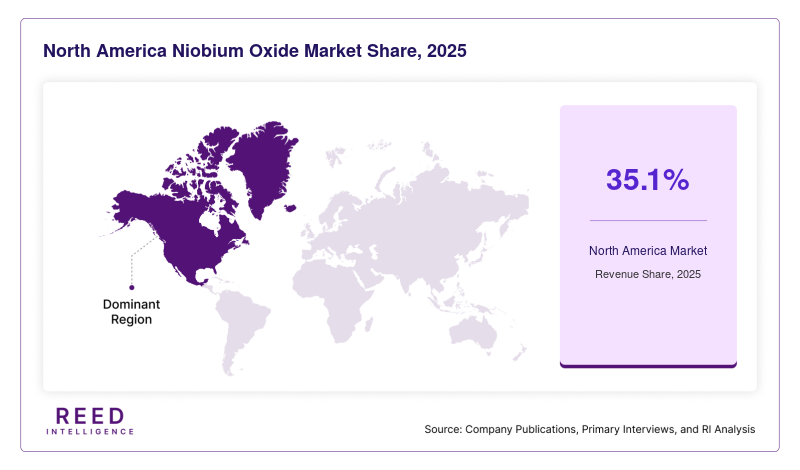
- North America dominated the market with a 35.1% share in 2025, while Asia Pacific is expected to grow at the fastest CAGR of 11.4% during 2026–2034.
- By type, high-purity niobium oxide accounted for the largest share of 42.8%, while nano niobium oxide is projected to grow at a CAGR of 12.1%.
- By application, batteries and energy storage led with a 37.6% share, whereas optical coatings are expected to expand at a CAGR of 11.7%.
- By end-use, electronics and semiconductors held the dominant share of 39.3%, while renewable energy systems are projected to grow at a CAGR of 12.3%.
- The United States remained the dominant country, with market values of USD 356 million in 2024 and USD 392 million in 2025.
Market Trends
Rising Integration of Niobium Oxide in Fast-Charging Battery Technologies
Battery manufacturers are increasingly integrating niobium oxide into lithium-ion battery systems to improve charging speed, thermal stability, and battery lifespan. Automotive companies and energy storage developers are investing in advanced battery chemistries that support rapid charging without compromising safety or durability. Niobium oxide-based materials help reduce lithium plating and improve structural stability during repeated charging cycles, making them suitable for electric mobility and industrial energy storage applications. The growing demand for fast-charging electric vehicles in North America, Europe, and Asia Pacific is encouraging battery producers to diversify material sourcing and expand research into niobium-enhanced battery systems. This trend is also supported by increasing investments in public charging infrastructure and grid-scale storage projects.
Expansion of High-Purity Oxides in Electronics and Optical Applications
The use of high-purity niobium oxide in semiconductors, optical coatings, and specialty glass manufacturing is increasing as electronic devices become smaller and more efficient. Electronics manufacturers require materials with strong dielectric properties, high refractive index, and improved heat resistance to support next-generation components. Niobium oxide is gaining traction in optical lenses, thin-film coatings, capacitors, and advanced ceramic systems because it improves optical clarity and chemical durability. Demand from consumer electronics and telecommunications industries has encouraged suppliers to focus on ultra-high-purity grades with controlled particle sizes. Growth in 5G infrastructure, smart devices, and industrial sensors is expected to further increase consumption of niobium oxide materials across precision electronic manufacturing applications.
Market Drivers
Growth in Electric Vehicle Manufacturing and Energy Storage Demand
The rapid expansion of the electric vehicle industry has significantly increased demand for advanced battery materials, including niobium oxide. Automotive manufacturers are focusing on batteries that support longer driving ranges, reduced charging times, and enhanced thermal management. Niobium oxide contributes to improved conductivity and structural performance in battery systems, making it an attractive material for next-generation lithium-ion technologies. Governments across major economies are introducing policies that encourage electric mobility adoption, battery manufacturing localization, and carbon emission reduction. These initiatives are creating a favorable environment for niobium oxide suppliers. In addition, rising investments in renewable energy storage systems and industrial backup power solutions are strengthening demand for durable and high-efficiency battery materials.
Increasing Demand for Advanced Ceramics and Functional Coatings
Industrial sectors such as aerospace, electronics, healthcare, and telecommunications are increasing their use of advanced ceramic materials and functional coatings. Niobium oxide is widely used in these applications because of its corrosion resistance, thermal stability, and optical performance. The material is increasingly incorporated into ceramic capacitors, optical lenses, protective coatings, and catalysts used in high-temperature industrial processes. Manufacturers are also exploring niobium oxide for biomedical coatings and specialty glass products due to its chemical stability and compatibility with precision manufacturing processes. Growth in semiconductor fabrication, industrial automation, and telecommunications infrastructure continues to increase demand for high-performance oxides that support long operational life and reliable electrical performance.
Market Restraint
Volatility in Raw Material Supply and High Processing Costs
The Niobium Oxide Market faces challenges related to concentrated raw material production and the high cost of refining processes. A significant portion of global niobium reserves is concentrated in a limited number of countries, creating supply chain risks for manufacturers and downstream industries. Changes in mining regulations, export policies, and geopolitical conditions can affect the availability and pricing of niobium-based materials. In addition, the production of high-purity niobium oxide requires advanced refining technologies, strict quality control, and energy-intensive processing methods. These factors increase manufacturing costs and create pricing pressure for smaller producers.
Industries such as electronics and energy storage often require highly specialized niobium oxide grades with precise purity levels and particle characteristics. Meeting these standards increases operational complexity and capital investment requirements. For example, battery manufacturers seeking ultra-fine niobium oxide powders for fast-charging applications must invest in advanced material engineering and testing processes, which can extend production timelines and raise overall costs. These challenges may limit market entry for new suppliers and affect profit margins across the value chain.
Market Opportunities
Expansion of Renewable Energy Infrastructure and Smart Grid Projects
The growing deployment of renewable energy infrastructure is creating new opportunities for niobium oxide manufacturers. Solar power systems, wind energy projects, and smart grid networks require efficient energy storage technologies and durable electronic components. Niobium oxide is increasingly used in battery systems and advanced capacitors that support energy management and power stability. Governments and utility providers are investing in grid modernization projects to improve energy efficiency and integrate renewable power sources into national electricity systems. These developments are expected to increase demand for advanced oxide materials with strong thermal and electrical properties. Companies that develop specialized niobium oxide products for renewable energy storage applications are likely to benefit from long-term infrastructure investments.
Rising Research in Nanotechnology and High-Performance Materials
Research institutions and industrial manufacturers are increasing investments in nanotechnology and high-performance materials, creating opportunities for nano niobium oxide applications. Nano-scale niobium oxide particles offer enhanced surface area, catalytic efficiency, and conductivity compared to conventional materials. These characteristics make them suitable for advanced coatings, biomedical devices, catalysts, sensors, and electronic systems. Universities, government laboratories, and private technology companies are conducting research to improve material efficiency and develop innovative commercial applications. The growing focus on miniaturized electronics, lightweight aerospace materials, and next-generation sensors is expected to support the adoption of nano niobium oxide products. Producers that expand research partnerships and invest in advanced manufacturing technologies may gain a competitive advantage in specialized industrial markets.
Segmental Analysis
By Type
High-purity niobium oxide accounted for the largest market share of 42.8% in 2024 due to its widespread use in electronics, optical coatings, and advanced ceramic applications. Manufacturers in semiconductor and telecommunications industries increasingly require ultra-pure materials to improve electrical conductivity, thermal stability, and optical performance. High-purity grades are also used in specialty glass and thin-film coatings where material consistency and low contamination levels are critical. Growing investments in high-performance electronics and miniaturized components have encouraged suppliers to expand production capacities for refined niobium oxide materials. In addition, rising demand for advanced industrial coatings and high-temperature catalysts has strengthened the adoption of high-purity products across aerospace, industrial automation, and medical device manufacturing sectors.
Nano niobium oxide is projected to register the fastest CAGR of 12.1% during the forecast period because of increasing research in nanotechnology and advanced functional materials. Nano-scale particles offer enhanced surface area, improved catalytic efficiency, and better conductivity compared to conventional oxide materials. These characteristics support applications in biomedical devices, energy storage systems, smart coatings, and advanced sensors. Research organizations and industrial manufacturers are actively developing new nano-material technologies to improve battery performance and electronic efficiency. The expansion of wearable electronics, smart manufacturing systems, and precision medical devices is expected to further increase demand for nano niobium oxide products. Companies investing in advanced particle engineering and nanomaterial production technologies are likely to strengthen their market position.
By Application
Batteries and energy storage represented the largest application segment with a 37.6% market share in 2024. The growing adoption of electric vehicles, renewable energy storage systems, and industrial backup power solutions has increased demand for niobium oxide-enhanced battery materials. Niobium oxide helps improve charging speed, thermal management, and battery lifespan, making it suitable for advanced lithium-ion technologies. Battery manufacturers are focusing on materials that improve efficiency and safety while reducing charging time. Government incentives supporting electric mobility and energy transition projects are also contributing to segment growth. In addition, increasing deployment of grid-scale energy storage systems and portable electronic devices is creating sustained demand for high-performance battery materials across developed and emerging markets.
Optical coatings are anticipated to grow at the fastest CAGR of 11.7% from 2026 to 2034 due to increasing use in consumer electronics, telecommunications, and industrial optics. Niobium oxide is widely used in optical coating systems because of its high refractive index, transparency, and durability. Manufacturers of cameras, sensors, display panels, and laser systems are increasingly adopting advanced coating materials to improve optical performance and product longevity. The expansion of 5G infrastructure, autonomous vehicle sensors, and smart imaging technologies is expected to strengthen demand for precision optical coatings. In addition, rising adoption of high-performance lenses in healthcare diagnostics and industrial automation systems is supporting growth opportunities for niobium oxide suppliers.
By End-Use
Electronics and semiconductors held the dominant market share of 39.3% in 2024 because of increasing consumption of advanced oxide materials in capacitors, semiconductors, sensors, and integrated circuits. Niobium oxide is valued for its dielectric properties and thermal resistance, which improve the performance and reliability of electronic components. The rapid growth of consumer electronics, data centers, industrial automation systems, and communication networks has increased the need for durable and high-efficiency materials. Semiconductor manufacturers are also focusing on advanced materials that support miniaturization and higher processing speeds. The increasing adoption of artificial intelligence infrastructure and connected devices continues to create strong demand for niobium oxide across electronic manufacturing industries.
Renewable energy systems are projected to witness the fastest CAGR of 12.3% during the forecast period due to growing investments in solar energy, wind power, and smart grid infrastructure. Niobium oxide is increasingly incorporated into energy storage devices, advanced coatings, and electrical components used in renewable energy projects. Governments and utility providers are investing heavily in clean energy systems to reduce carbon emissions and improve energy security. The expansion of battery energy storage systems and decentralized power networks is creating additional demand for high-performance materials with long operational life. Increasing research related to energy-efficient technologies and grid stability solutions is also expected to accelerate the adoption of niobium oxide in renewable energy applications.
Regional Analysis
North America
North America accounted for 35.1% of the global Niobium Oxide Market share in 2025 and is projected to expand at a CAGR of 8.9% through 2034. Strong demand from electric vehicle battery manufacturing, semiconductor production, and aerospace applications continues to support regional growth. The presence of advanced research institutions and established industrial infrastructure has encouraged innovation in high-purity niobium oxide materials. Manufacturers in the region are also investing in supply chain diversification to reduce dependency on imported critical minerals and strengthen domestic production capabilities.
The United States remained the leading country in North America due to its large electronics manufacturing base and increasing investments in clean energy technologies. A key growth factor is the rapid expansion of domestic battery production facilities supported by government funding and industrial incentives. Several technology companies are focusing on advanced battery materials that improve charging efficiency and operational stability. In addition, increasing adoption of niobium oxide in defense electronics and specialty coatings is supporting long-term demand across industrial sectors.
Europe
Europe represented 26.4% of the global Niobium Oxide Market in 2025 and is expected to register a CAGR of 9.1% during the forecast period. The region is witnessing strong growth in renewable energy projects, electric mobility initiatives, and advanced manufacturing activities. European industries are increasingly adopting high-performance oxide materials to improve energy efficiency and reduce environmental impact. Demand for niobium oxide is also increasing in optical coatings, industrial catalysts, and ceramic electronics due to strict quality and sustainability standards across manufacturing sectors.
Germany remained the dominant country in the European market because of its strong automotive manufacturing sector and advanced industrial technology ecosystem. One unique growth factor is the region’s emphasis on sustainable battery innovation and recycling technologies. Automotive companies and research organizations are collaborating to develop high-efficiency battery materials with improved lifecycle performance. The expansion of electric vehicle charging infrastructure and industrial automation projects is further increasing the use of niobium oxide in electronic and energy storage systems.
Asia Pacific
Asia Pacific held 24.8% of the global market share in 2025 and is projected to witness the fastest CAGR of 11.4% from 2026 to 2034. The region benefits from rapid industrialization, large-scale electronics manufacturing, and increasing investments in renewable energy infrastructure. Countries across Asia Pacific are expanding semiconductor fabrication, battery manufacturing, and telecommunications equipment production, which continues to increase demand for high-purity niobium oxide materials. Strong manufacturing capabilities and lower production costs also support regional market competitiveness.
China dominated the Asia Pacific market due to its large electronics production base and expanding electric vehicle industry. A major growth factor is the country’s aggressive investment in battery supply chains and energy storage technologies. Chinese manufacturers are increasing production of advanced lithium-ion batteries for automotive and industrial applications, driving demand for niobium oxide-enhanced materials. The growing adoption of smart devices, 5G infrastructure, and industrial automation systems is also contributing to higher consumption of specialty oxide materials in the region.
Middle East & Africa
The Middle East & Africa region accounted for 7.2% of the global Niobium Oxide Market share in 2025 and is expected to grow at a CAGR of 8.1% through 2034. Industrial diversification initiatives and infrastructure development projects are contributing to market expansion across the region. Demand for niobium oxide is increasing in energy, construction, and specialty coating applications as governments focus on industrial modernization. Growth in renewable energy investments and petrochemical industries is also supporting demand for advanced materials with strong thermal and corrosion resistance.
Saudi Arabia emerged as the leading country in the regional market due to increasing industrial investments and large-scale infrastructure projects. A unique growth factor is the development of advanced manufacturing zones focused on clean energy and technology-driven industries. The country is investing in renewable energy systems, industrial automation, and high-performance materials to diversify its economy beyond oil production. These developments are creating opportunities for niobium oxide suppliers serving energy storage, coatings, and industrial electronics applications.
Latin America
Latin America captured 6.5% of the global Niobium Oxide Market share in 2025 and is projected to expand at a CAGR of 8.4% during the forecast period. The region benefits from access to niobium reserves and growing industrial applications in metallurgy, electronics, and energy systems. Increasing investments in mining infrastructure and advanced material processing are helping regional producers strengthen export capabilities. Governments across Latin America are also supporting industrial development strategies that encourage value-added mineral processing and manufacturing activities.
Brazil dominated the Latin American market because it remains one of the largest producers of niobium-based materials globally. One important growth factor is the country’s focus on expanding downstream processing and specialty material production. Local companies are investing in refining technologies that improve the purity and performance of niobium oxide products for electronics and battery applications. Rising collaborations between mining firms and technology manufacturers are expected to strengthen regional supply chains and support future market growth.
Competitive Landscape
The global Niobium Oxide Market is moderately consolidated, with leading companies focusing on high-purity material production, strategic partnerships, and technology innovation to strengthen their market position. Major players are investing in advanced refining technologies and research collaborations to improve product quality and expand application areas. Companies are also increasing production capacities to address rising demand from battery manufacturing, electronics, and renewable energy industries.
CBMM remained the leading company in the market due to its strong niobium production capabilities, integrated supply chain, and extensive research initiatives related to battery materials and advanced oxides. The company recently expanded its collaboration with battery technology firms to accelerate the commercialization of niobium-based fast-charging battery solutions. Other important participants, including American Elements, Nanoshel, Treibacher Industrie AG, and TANIOBIS GmbH, are focusing on product innovation and global distribution expansion.
Key Players
- CBMM
- American Elements
- TANIOBIS GmbH
- Nanoshel LLC
- Treibacher Industrie AG
- Materion Corporation
- H.C. Starck Solutions
- Molycorp Advanced Materials
- Neo Performance Materials
- Stanford Advanced Materials
- Edgetech Industries LLC
- ALB Materials Inc.
- SkySpring Nanomaterials Inc.
- Shanghai Xinglu Chemical Technology Co., Ltd.
- Nanografi Nano Technology
Recent Developments
- In February 2026, CBMM announced the expansion of its advanced niobium oxide processing facility to support growing demand from electric vehicle battery manufacturers.
- In July 2025, American Elements introduced a new ultra-high-purity niobium oxide product line designed for semiconductor and optical coating applications.
- In November 2025, TANIOBIS GmbH entered a strategic partnership with a European battery technology company to develop niobium-enhanced fast-charging battery materials.
- In March 2026, Nanoshel LLC expanded its nano niobium oxide production capabilities to address rising demand from research laboratories and advanced electronics manufacturers.
- In September 2025, Treibacher Industrie AG invested in process optimization technologies aimed at improving the efficiency and sustainability of specialty oxide manufacturing.
Niobium Oxide Market Segments
Type
- High-Purity Niobium Oxide
- Nano Niobium Oxide
- Technical Grade Niobium Oxide
- Others
Application
- Batteries and Energy Storage
- Optical Coatings
- Catalysts
- Advanced Ceramics
- Glass Manufacturing
- Others
End-Use
- Electronics and Semiconductors
- Automotive
- Aerospace and Defense
- Renewable Energy Systems
- Healthcare and Medical Devices
- Industrial Manufacturing
By Region
- North America
- Europe
- APAC
- Middle East and Africa
- LATAM