Nitrogen Tire Inflator Market Size, Share & Demand Report By Type (Automatic Nitrogen Tire Inflators, Portable Nitrogen Tire Inflators), By Application (Passenger Vehicles, Commercial Vehicles), By End-Use (Automotive Service Stations, Fleet Maintenance Facilities, Aviation Sector), By Distribution Channel (Direct Sales, Online Sales) & Segment Forecasts, 2025–2034
USD 3950
Market Overview
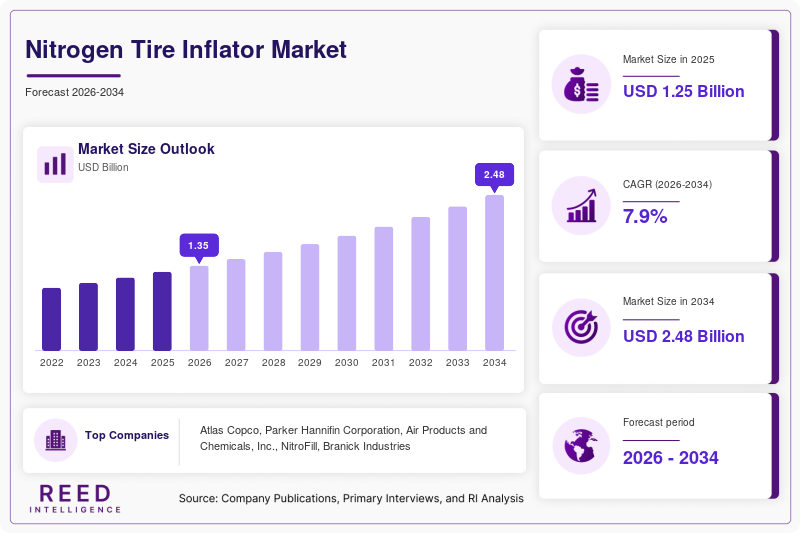
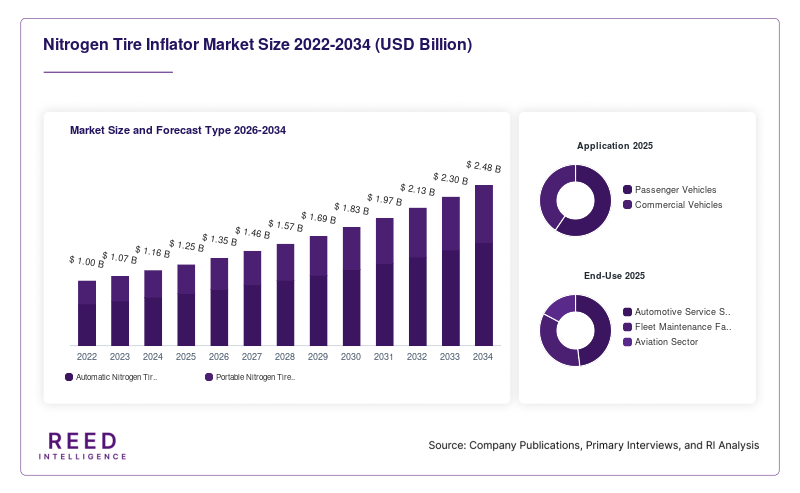
The global Nitrogen Tire Inflator Market size was valued at approximately USD 1.25 billion in 2025 and is projected to reach USD 2.48 billion by 2034, expanding at a CAGR of 7.9% during the forecast period (2025–2034). The market growth is being supported by increasing awareness regarding tire performance optimization, fuel efficiency, and safety benefits associated with nitrogen inflation compared to compressed air.
A key global factor contributing to the expansion of the Nitrogen Tire Inflator Market is the rising adoption of advanced vehicle maintenance practices across both developed and emerging economies. Automotive owners, fleet operators, and service centers are increasingly prioritizing tire longevity and consistent pressure maintenance, which nitrogen inflation supports by reducing oxidation and pressure loss.
The market is witnessing steady demand across passenger vehicles, commercial fleets, and aviation sectors, with increasing penetration of automated nitrogen inflation systems in service stations and workshops. Furthermore, growing investments in automotive aftermarket infrastructure and expansion of fuel station networks are enhancing accessibility to nitrogen tire inflation services.
Key Highlights
- North America dominated the market with a 34.2% share in 2025, while Asia Pacific is projected to grow at the fastest CAGR of 9.1%.
- Automatic nitrogen tire inflators led the type segment with a 58.6% share, while portable inflators are expected to grow at a CAGR of 8.8%.
- Passenger vehicles dominated the application segment with a 52.4% share, whereas commercial fleets are projected to expand at a CAGR of 8.5%.
- The U.S. market was valued at USD 380 million in 2025 and is expected to reach USD 405 million in 2026.
Market Trends
Integration of Smart and Digital Inflation Systems
The Nitrogen Tire Inflator Market is experiencing a shift toward smart inflation systems equipped with digital interfaces, pressure sensors, and automation features. These systems provide real-time monitoring, automated pressure control, and integration with vehicle diagnostics, enhancing operational efficiency. Service stations and fleet operators are adopting these systems to improve accuracy and reduce human intervention. The trend is also aligned with the broader adoption of smart automotive maintenance technologies, contributing to improved customer experience and operational reliability.
Expansion of Nitrogen Inflation in Commercial Fleets
Commercial fleet operators are increasingly adopting nitrogen tire inflators due to their ability to maintain stable tire pressure over long distances. This trend is driven by the need to reduce fuel consumption, minimize tire wear, and improve vehicle uptime. Logistics companies and public transportation operators are integrating nitrogen inflation into routine maintenance practices, which is strengthening demand. Additionally, regulatory emphasis on fuel efficiency and emission reduction is indirectly supporting this trend across multiple regions.
Market Drivers
Increasing Focus on Fuel Efficiency and Tire Longevity
The growing emphasis on fuel efficiency is a major driver for the Nitrogen Tire Inflator Market. Nitrogen-filled tires maintain pressure longer than air-filled tires, leading to reduced rolling resistance and improved fuel economy. This benefit is particularly significant for commercial fleets, where fuel costs constitute a major operational expense. As businesses seek cost optimization and sustainability, nitrogen inflation is gaining traction as a practical solution.
Growth in Automotive Aftermarket Services
The expansion of automotive aftermarket services globally is contributing to the adoption of nitrogen tire inflators. Service stations, repair shops, and dealerships are incorporating nitrogen inflation as a value-added service to attract customers. The increasing number of vehicles on the road, combined with rising consumer awareness of preventive maintenance, is driving demand for such services. This trend is further supported by the availability of compact and cost-effective inflator systems.
Market Restraint
High Initial Investment and Limited Awareness in Developing Regions
One of the primary challenges in the Nitrogen Tire Inflator Market is the relatively high initial cost associated with installing nitrogen inflation systems. Small-scale service providers and independent workshops often face budget constraints, limiting adoption. Additionally, in several developing regions, awareness regarding the benefits of nitrogen tire inflation remains limited among end users.
Consumers in these regions often rely on traditional air inflation due to its accessibility and lower cost. This creates a barrier to market penetration, especially in price-sensitive markets. Furthermore, the perceived lack of immediate visible benefits compared to air inflation discourages widespread adoption.
Although awareness campaigns and industry initiatives are gradually addressing this issue, the pace of adoption varies significantly across regions. Overcoming this restraint will require continued education, cost reduction strategies, and improved distribution networks to make nitrogen inflation systems more accessible.
Market Opportunities
Rising Adoption in Electric Vehicles (EVs)
The increasing adoption of electric vehicles presents a significant opportunity for the Nitrogen Tire Inflator Market. EVs require optimized tire performance to maximize battery efficiency and driving range. Nitrogen-filled tires help maintain consistent pressure, reducing energy consumption and enhancing vehicle efficiency. As the global EV market expands, the demand for nitrogen inflation systems is expected to grow alongside it.
Expansion in Emerging Markets
Emerging economies offer substantial growth potential due to rapid urbanization, increasing vehicle ownership, and expanding automotive service infrastructure. Countries in Asia Pacific, Latin America, and Africa are witnessing a rise in service stations and repair facilities, creating opportunities for nitrogen inflator manufacturers. As awareness increases and disposable incomes improve, adoption is expected to accelerate in these regions.
Segmental Analysis
By Type
Automatic nitrogen tire inflators accounted for 58.6% of the Nitrogen Tire Inflator Market share in 2025. Their dominance was attributed to ease of use, accuracy, and efficiency in maintaining tire pressure. These systems were widely adopted in service stations and commercial facilities where high throughput and precision were essential.
Portable nitrogen inflators are expected to grow at a CAGR of 8.8% during the forecast period. Their growth will be driven by increasing demand among individual vehicle owners and small workshops. The convenience of mobility and ease of installation will support adoption, particularly in emerging markets where infrastructure is still developing.
By Application
Passenger vehicles held a 52.4% share of the Nitrogen Tire Inflator Market in 2025. The segment’s dominance was driven by the large number of passenger vehicles globally and increasing consumer awareness of tire maintenance. Nitrogen inflation was widely used to enhance fuel efficiency and extend tire life.
Commercial fleets are projected to grow at a CAGR of 8.5%. The segment will benefit from the need for cost optimization and operational efficiency. Fleet operators will increasingly adopt nitrogen inflators to reduce maintenance costs and improve vehicle performance over long distances.
By End-Use
Automotive service stations dominated the market with a 46.7% share in 2025. These facilities offered nitrogen inflation as a value-added service, attracting customers seeking advanced maintenance solutions. The widespread presence of service stations supported the segment’s growth.
Fleet maintenance facilities are expected to grow at a CAGR of 8.3%. The increasing focus on fleet efficiency and preventive maintenance will drive adoption. Companies managing large vehicle fleets will invest in nitrogen inflators to improve performance and reduce downtime.
By Distribution Channel
Direct sales accounted for 55.1% of the Nitrogen Tire Inflator Market in 2025. Manufacturers preferred direct sales channels to maintain control over pricing and customer relationships. This approach was particularly common for large-scale installations in service stations and commercial facilities.
Online sales are expected to grow at a CAGR of 9.0%. The increasing popularity of e-commerce platforms and digital purchasing will support this growth. Customers will benefit from a wider range of options and competitive pricing, encouraging adoption among smaller businesses and individual users.
Regional Analysis
North America
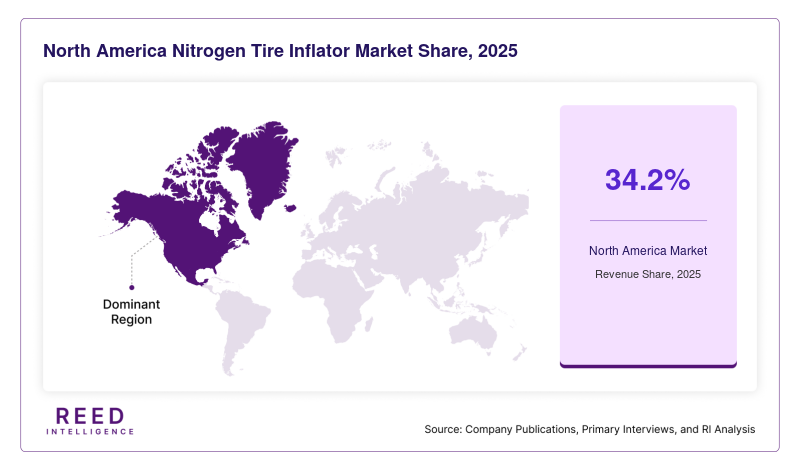
North America accounted for 34.2% of the Nitrogen Tire Inflator Market share in 2025 and will grow at a CAGR of 7.2% during the forecast period. The region’s established automotive aftermarket ecosystem and strong presence of advanced service infrastructure contributed to its leading position. High consumer awareness regarding vehicle maintenance and fuel efficiency supported widespread adoption of nitrogen tire inflators.
The United States dominated the regional market due to its large vehicle parc and extensive network of service stations. A key growth factor was the increasing adoption of premium automotive services among consumers. Fleet operators in the country emphasized cost efficiency and operational performance, driving demand for nitrogen inflation systems. Additionally, the presence of technologically advanced service providers facilitated the adoption of automated inflators.
Europe
Europe held a 27.5% share of the Nitrogen Tire Inflator Market in 2025 and is expected to grow at a CAGR of 7.5% through 2034. The region’s focus on environmental sustainability and fuel efficiency contributed to market growth. Strict emission regulations encouraged the adoption of technologies that improve vehicle efficiency, including nitrogen tire inflation.
Germany emerged as the dominant country due to its strong automotive industry and emphasis on engineering excellence. The country’s well-developed service infrastructure supported the integration of nitrogen inflation systems. Additionally, the growing popularity of high-performance vehicles and premium maintenance services contributed to demand.
Asia Pacific
Asia Pacific accounted for 22.8% of the market in 2025 and will expand at the fastest CAGR of 9.1% during the forecast period. Rapid urbanization, increasing vehicle ownership, and expanding automotive service networks supported market growth. The region is witnessing a shift toward modern vehicle maintenance practices, which is driving adoption.
China dominated the regional market due to its large automotive market and growing middle-class population. A key growth factor was the expansion of automotive service chains and fuel stations offering value-added services. Increasing awareness of tire maintenance and fuel efficiency further supported demand for nitrogen tire inflators.
Middle East & Africa
The Middle East & Africa region held a 9.3% share in 2025 and is projected to grow at a CAGR of 7.8%. The region’s harsh climatic conditions, including high temperatures, made nitrogen inflation an attractive solution for maintaining tire pressure stability. This factor supported adoption across both passenger and commercial vehicles.
Saudi Arabia emerged as the dominant country due to its extensive road network and high vehicle usage. The demand for durable and efficient tire solutions drove the adoption of nitrogen inflators. Additionally, the expansion of fuel stations and service centers contributed to market growth.
Latin America
Latin America accounted for 6.2% of the Nitrogen Tire Inflator Market in 2025 and will grow at a CAGR of 7.6%. The region’s growing automotive sector and increasing focus on vehicle maintenance supported market expansion. Economic development and rising disposable incomes contributed to the adoption of advanced automotive services.
Brazil dominated the regional market due to its large automotive base and expanding service infrastructure. A key growth factor was the increasing presence of organized automotive service providers offering nitrogen inflation as a premium service. This trend is expected to continue as awareness increases.
Competitive Landscape
The Nitrogen Tire Inflator Market is moderately fragmented, with several global and regional players competing based on product innovation, pricing, and distribution networks. Leading companies are focusing on developing advanced inflators with digital features and automation capabilities to enhance user experience.
A prominent market leader is Atlas Copco, which has established a strong presence through its technologically advanced products and extensive global distribution network. The company recently introduced a new range of smart nitrogen inflators with enhanced efficiency and digital monitoring features, strengthening its market position.
Other key players are investing in expanding their product portfolios and entering emerging markets to capture growth opportunities. Strategic partnerships, mergers, and acquisitions are also being pursued to enhance market presence and technological capabilities.
Key Players
- Atlas Copco
- Parker Hannifin Corporation
- Air Products and Chemicals, Inc.
- NitroFill
- Branick Industries
- Hamaton Automotive Technology
- Martins Industries
- Texa S.p.A.
- Shanghai Fhope Machinery
- Gaither Tool Company
- Pressure Systems International
- Haltec Corporation
- Cejn AB
- Airtec Corporation
- Elgi Equipments Limited
Recent Developments
- In 2024, Atlas Copco launched a new series of digital nitrogen tire inflators with improved automation features.
- In 2023, Parker Hannifin expanded its product portfolio with energy-efficient nitrogen generation systems.
- In 2024, Martins Industries introduced portable nitrogen inflators targeting small workshops and individual users.
- In 2023, Air Products and Chemicals enhanced its distribution network in Asia Pacific to strengthen market presence.
- In 2024, NitroFill partnered with automotive service chains to expand its installation base globally.
Nitrogen Tire Inflator Market Segments
Type
- Automatic Nitrogen Tire Inflators
- Portable Nitrogen Tire Inflators
Application
- Passenger Vehicles
- Commercial Vehicles
End-Use
- Automotive Service Stations
- Fleet Maintenance Facilities
- Aviation Sector
Distribution Channel
- Direct Sales
- Online Sales
By Region
- North America
- Europe
- APAC
- Middle East and Africa
- LATAM