NO2 Sensor Market Size, Share & Demand Report By Type (Electrochemical Sensors, Optical Sensors, Semiconductor Sensors), By Application (Automotive, Environmental Monitoring, Industrial Safety, Healthcare), By End-Use Industry (Industrial, Automotive, Healthcare, Residential), By Technology (Wired Sensors, Wireless Sensors), By Region & Segment Forecasts, 2025–2034
USD 3950
Market Overview
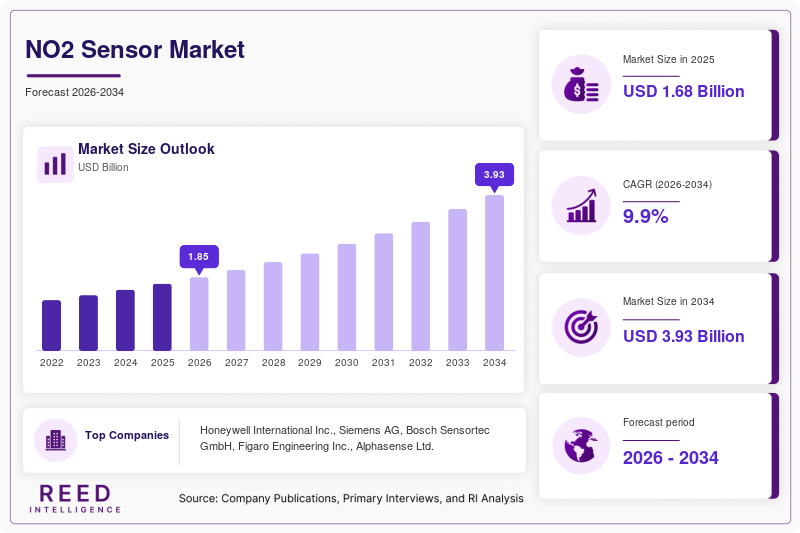
The global NO2 Sensor Market size was valued at approximately USD 1.68 billion in 2025 and is projected to reach USD 3.94 billion by 2034, expanding at a CAGR of 9.9% during the forecast period (2025–2034). The market growth is primarily driven by increasing concerns regarding air pollution monitoring and regulatory mandates across industrial and urban environments. Nitrogen dioxide (NO2), a critical air pollutant, has been linked to severe health and environmental impacts, which has intensified the adoption of advanced sensing technologies across various industries.
A key global factor supporting market growth is the widespread implementation of stringent emission control regulations in developed and developing economies. Governments and environmental agencies are increasingly mandating real-time monitoring systems for industrial emissions, automotive exhaust, and urban air quality, thereby accelerating demand for high-precision NO2 sensors.
Key Highlights:
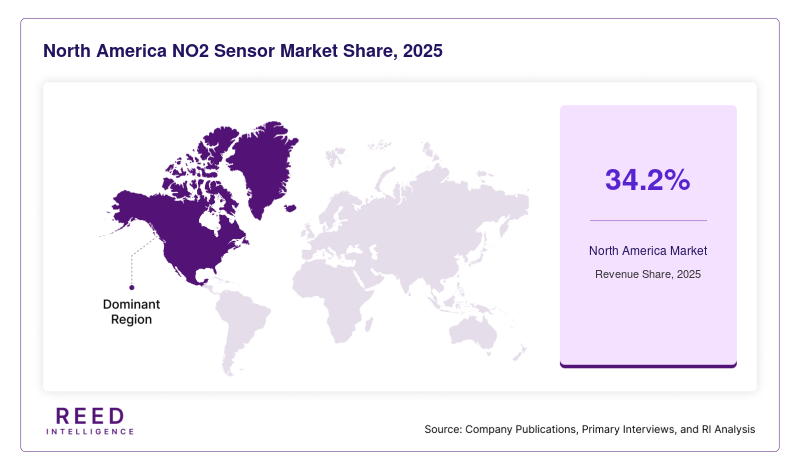
- North America dominated the market with a share of 34.2% in 2025, while Asia Pacific is projected to register the fastest CAGR of 11.3%.
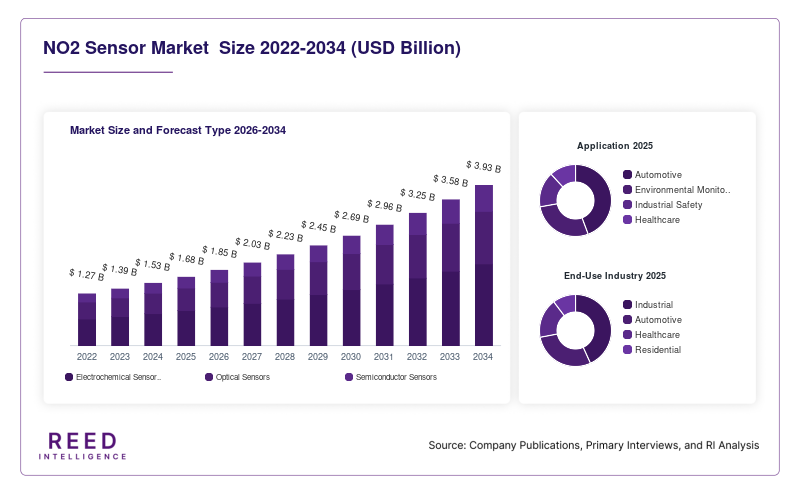
- Electrochemical sensors led the type segment with a share of 41.8%, while optical sensors are anticipated to grow at the fastest CAGR of 12.1%.
- Automotive applications held the largest share at 38.6%, while environmental monitoring is projected to grow at a CAGR of 11.7%.
- The United States remained the dominant country, with market values of USD 420 million in 2024 and USD 455 million in 2025.
Market Trends
Integration of IoT-Enabled Air Quality Monitoring Systems
The integration of NO2 sensors with IoT platforms has emerged as a significant trend shaping the NO2 Sensor Market. Smart cities and industrial ecosystems are increasingly adopting connected sensor networks to enable real-time air quality monitoring and predictive analytics. These systems allow centralized data collection, remote monitoring, and automated alerts, enhancing environmental compliance and operational efficiency. The growing adoption of cloud-based analytics further strengthens this trend by enabling data-driven decision-making.
Advancements in Miniaturized and Low-Power Sensors
Another notable trend is the development of compact, energy-efficient NO2 sensors suitable for portable and wearable devices. Manufacturers are focusing on reducing power consumption while maintaining high sensitivity and accuracy. This trend is particularly relevant in consumer electronics, personal air quality monitors, and mobile health applications. The increasing demand for lightweight and cost-effective sensors is expected to drive innovation in materials and fabrication techniques, supporting broader market penetration.
Market Drivers
Rising Stringency of Environmental Regulations
Governments worldwide are enforcing strict emission standards to combat air pollution. Regulatory frameworks mandate the installation of gas detection systems in industries such as manufacturing, oil & gas, and automotive. This has significantly increased the adoption of NO2 sensors for compliance and monitoring purposes.
Expansion of Automotive Emission Monitoring Systems
The automotive sector has become a major contributor to the growth of the NO2 Sensor Market. Modern vehicles are equipped with advanced emission control systems that rely on accurate NO2 sensing for optimizing combustion processes and reducing harmful emissions. The transition toward hybrid and internal combustion engine vehicles with stricter emission norms has further boosted demand for reliable NO2 sensors.
Market Restraints
High Cost and Calibration Complexity
One of the primary challenges hindering the growth of the NO2 Sensor Market is the high cost associated with advanced sensor technologies. High-precision sensors, particularly optical and laser-based variants, require sophisticated materials and manufacturing processes, which increase overall costs. Additionally, frequent calibration and maintenance requirements add to operational expenses.
Calibration complexity is particularly critical in industrial and environmental applications, where accuracy is essential for compliance and safety. Sensor drift and sensitivity degradation over time necessitate regular recalibration, which can disrupt operations and increase downtime. These factors may limit adoption among small and medium enterprises with budget constraints, thereby affecting overall market expansion.
Market Opportunities
Growth in Smart City Initiatives
The increasing development of smart cities presents a strong opportunity for the NO2 Sensor Market. Governments are investing in advanced air quality monitoring systems to ensure sustainable urban living. NO2 sensors play a crucial role in these systems by providing real-time data for pollution control and urban planning.
Rising Demand in Healthcare and Personal Monitoring
The growing awareness of the health impacts of air pollution has created opportunities in personal monitoring devices. Portable NO2 sensors are increasingly used in wearable devices and home air quality systems. This emerging application area is expected to drive innovation and expand the market beyond traditional industrial and automotive uses.
Segmental Analysis
By Type
Electrochemical sensors dominated the NO2 Sensor Market in 2024, accounting for 41.8% of the total share. Their widespread adoption was attributed to high sensitivity, accuracy, and cost-effectiveness. These sensors were extensively used in industrial and environmental monitoring applications due to their ability to detect low concentrations of NO2.
Optical sensors are expected to be the fastest-growing subsegment, with a projected CAGR of 12.1%. Their growth will be driven by superior precision and minimal interference from other gases. These sensors are increasingly used in advanced applications requiring high reliability, such as research laboratories and high-end industrial systems.
By Application
The automotive segment held the largest share of 38.6% in 2024. NO2 sensors were widely used in emission control systems to monitor exhaust gases and ensure compliance with environmental regulations. The increasing production of vehicles and stricter emission norms supported this dominance.
Environmental monitoring is anticipated to grow at the fastest CAGR of 11.7%. The expansion of air quality monitoring networks and rising public awareness regarding pollution will drive this growth. Governments are increasingly investing in monitoring infrastructure, boosting demand for NO2 sensors.
By End-Use Industry
The industrial sector dominated the market in 2024 with a share of 36.9%. Industries such as manufacturing, oil & gas, and chemicals relied heavily on NO2 sensors for safety and regulatory compliance. Continuous monitoring of emissions was a key requirement in these sectors.
The healthcare sector is expected to grow at a CAGR of 10.8% during the forecast period. Increasing use of air quality monitoring devices in hospitals and residential settings will drive demand. The focus on indoor air quality and patient safety will further support growth.
By Technology
Wired sensors accounted for the largest share in 2024 due to their reliability and stable performance in industrial environments. These systems were preferred in applications requiring continuous monitoring and minimal signal disruption.
Wireless sensors are projected to grow at the fastest CAGR of 11.5%. Their flexibility, ease of installation, and compatibility with IoT platforms make them ideal for modern applications. The increasing adoption of smart monitoring systems will drive their growth.
Regional Analysis
North America
North America accounted for 34.2% of the NO2 Sensor Market share in 2025 and is expected to grow at a CAGR of 8.7% during the forecast period. The region benefited from early adoption of advanced environmental monitoring technologies and well-established regulatory frameworks.
The United States dominated the regional market due to strong regulatory enforcement and high industrial adoption. A key growth factor was the increasing deployment of air quality monitoring systems in urban areas. Government-backed initiatives to improve air quality and investments in smart infrastructure further supported market expansion.
Europe
Europe held a market share of 27.5% in 2025 and is projected to expand at a CAGR of 9.1% through 2034. The region’s focus on environmental sustainability and emission reduction targets contributed significantly to market growth.
Germany emerged as the leading country, driven by its strong automotive industry and emphasis on emission control technologies. The country’s adoption of advanced sensor systems in vehicles and industrial applications played a crucial role in supporting demand.
Asia Pacific
Asia Pacific represented 23.8% of the market in 2025 and is anticipated to register the fastest CAGR of 11.3% during the forecast period. Rapid industrialization and urbanization have increased the need for air quality monitoring solutions.
China dominated the region due to its large industrial base and increasing focus on pollution control. Government initiatives aimed at reducing air pollution levels and improving environmental monitoring infrastructure significantly boosted demand for NO2 sensors.
Middle East & Africa
The Middle East & Africa held a market share of 7.6% in 2025 and is expected to grow at a CAGR of 8.2% through 2034. The region experienced steady growth due to increasing industrial activities and infrastructure development.
Saudi Arabia led the regional market, supported by investments in oil & gas and industrial sectors. The need for emission monitoring in harsh environments drove the adoption of durable and high-performance NO2 sensors.
Latin America
Latin America accounted for 6.9% of the market in 2025 and is projected to grow at a CAGR of 8.5% during the forecast period. The region’s growth was supported by rising environmental awareness and regulatory developments.
Brazil emerged as the dominant country, driven by industrial expansion and urban pollution concerns. Increasing adoption of monitoring systems in industrial facilities contributed to market growth.
Competitive Landscape
The NO2 Sensor Market is characterized by the presence of several established players focusing on product innovation and strategic collaborations. Companies are investing in research and development to enhance sensor performance and expand their application scope.
A leading player in the market is Honeywell International Inc., which has maintained a strong position through its advanced sensing technologies and global distribution network. The company recently introduced a new line of high-sensitivity NO2 sensors designed for industrial and environmental applications, strengthening its product portfolio.
Other key players are actively pursuing partnerships and technological advancements to gain a competitive edge. The market remains moderately fragmented, with both global and regional companies contributing to its growth.
Key Players
- Honeywell International Inc.
- Siemens AG
- Bosch Sensortec GmbH
- Figaro Engineering Inc.
- Alphasense Ltd.
- Aeroqual Ltd.
- Amphenol Advanced Sensors
- ABB Ltd.
- City Technology Ltd.
- Membrapor AG
Recent Developments
- 2025: Honeywell launched a next-generation NO2 sensor with enhanced sensitivity for industrial emissions monitoring.
- 2024: Siemens expanded its environmental monitoring solutions portfolio with integrated NO2 sensing capabilities.
- 2024: Bosch Sensortec introduced compact NO2 sensors for consumer electronics and wearable devices.
- 2023: Aeroqual partnered with urban development agencies to deploy smart air quality monitoring systems.
- 2023: Sensirion developed low-power NO2 sensors targeting portable air quality applications.
NO2 Sensor Market Segments
Type
- Electrochemical Sensors
- Optical Sensors
- Semiconductor Sensors
Application
- Automotive
- Environmental Monitoring
- Industrial Safety
- Healthcare
End-Use Industry
- Industrial
- Automotive
- Healthcare
- Residential
Technology
- Wired Sensors
- Wireless Sensors
By Region
- North America
- Europe
- APAC
- Middle East and Africa
- LATAM