Non Corrosive Fluxe Market Size, Share & Demand Report By Type (Rosin-Based Non Corrosive Fluxes, No-Clean Non Corrosive Fluxes, Organic Acid Fluxes), By Application (Electronics Assembly, Semiconductor Packaging, Electric Vehicle Battery Systems, Industrial Equipment, Renewable Energy Systems), By End-Use Industry (Automotive, Aerospace & Defense, Industrial Manufacturing, Healthcare Electronics) By Region & Segment Forecasts, 2026–2034
USD 3950
Market Overview
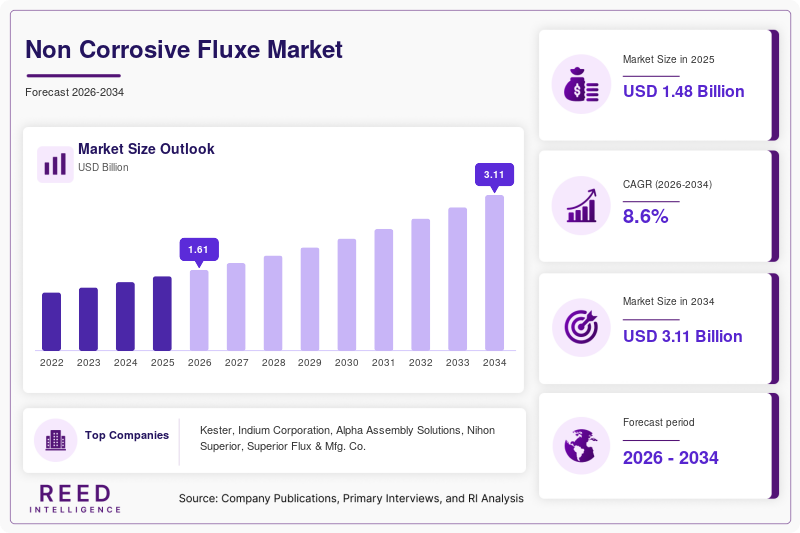
The global Non Corrosive Fluxe Market size was valued at approximately USD 1.48 billion in 2026 and is projected to reach USD 2.86 billion by 2034, expanding at a CAGR of 8.6% during the forecast period from 2026 to 2034. Non corrosive fluxes are widely used in soldering, brazing, welding, and electronics assembly processes because they reduce oxidation without damaging metal surfaces or electronic components. Their increasing adoption across automotive electronics, renewable energy systems, consumer electronics, and industrial manufacturing has accelerated market expansion in recent years. Manufacturers are increasingly shifting toward low-residue and environmentally safer formulations to meet regulatory standards and improve product reliability.
One of the major global factors supporting market growth is the rising production of advanced electronic devices and electric vehicles. The rapid integration of compact electronic circuits, battery systems, sensors, and semiconductor modules has increased the need for precision soldering materials that provide stable conductivity and minimal residue. Non corrosive fluxes are gaining preference because they reduce cleaning requirements and improve assembly efficiency. In addition, industrial automation and high-speed production lines are encouraging manufacturers to use reliable flux formulations that maintain consistent solder joint quality during mass production.
Key Highlights
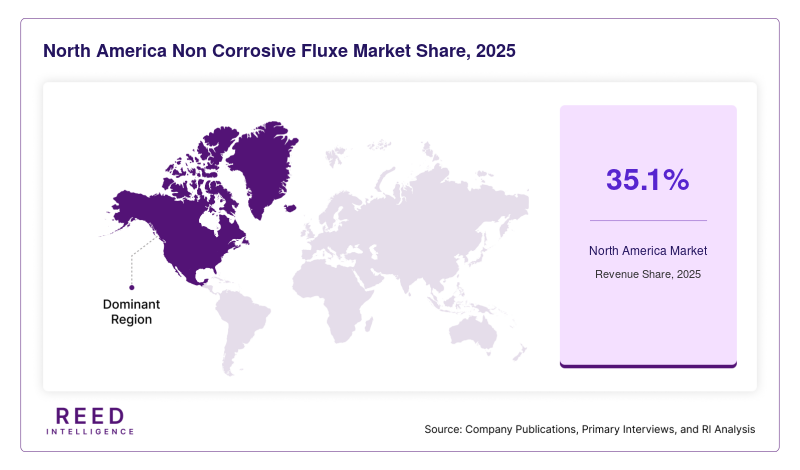
- North America dominated the market with a 35.1% share in 2025.
- Asia Pacific is expected to grow at the fastest CAGR of 10.9% during 2026–2034.
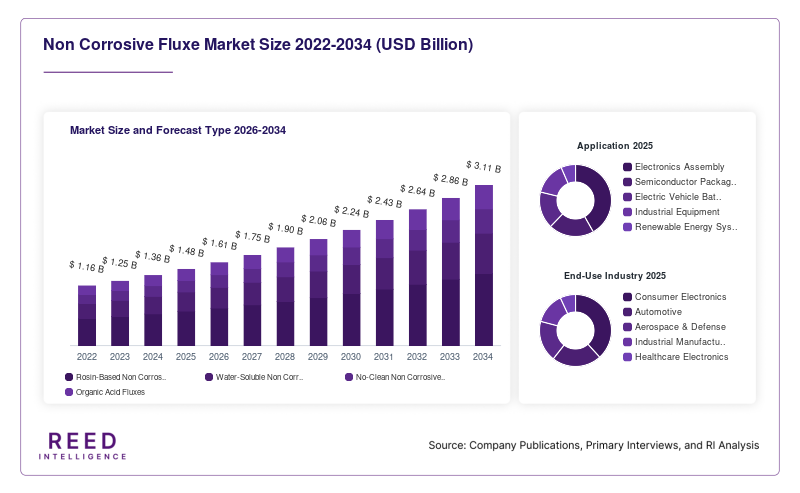
- By type, rosin-based non corrosive fluxes accounted for the largest share of 39.4%.
- while water-soluble non corrosive fluxes are projected to grow at a CAGR of 11.6%.
- By application, electronics assembly led with a 43.8% share.
- whereas electric vehicle battery systems are expected to expand at a CAGR of 12.1%.
- The United States remained the dominant country, with market values of USD 420 million in 2024 and USD 458 million in 2025.
Market Trends
Rising Adoption of Low-Residue and Halide-Free Flux Formulations
Manufacturers across the electronics and semiconductor industries are increasingly adopting low-residue and halide-free non corrosive flux formulations to improve production efficiency and comply with environmental regulations. Traditional flux materials often required extensive post-solder cleaning processes, which increased production time and operational expenses. Modern non corrosive fluxes are designed to minimize residue while maintaining strong wetting performance and reliable conductivity. This trend is particularly visible in consumer electronics manufacturing, where compact devices and multilayer circuit boards demand precision soldering with minimal contamination risk. The demand for cleaner soldering processes is also rising in medical electronics and aerospace applications, where product reliability remains critical. As a result, suppliers are investing in research and advanced chemical formulations to improve thermal stability, residue control, and process compatibility.
Expansion of Electric Vehicle and Renewable Energy Manufacturing
The rapid growth of electric vehicle production and renewable energy installations is creating strong demand for advanced non corrosive flux solutions. Electric vehicles contain complex battery systems, power modules, and control units that require high-quality soldering materials capable of handling temperature fluctuations and continuous electrical loads. Non corrosive fluxes support durable solder joints while reducing corrosion risks within battery assemblies and charging systems. Similarly, solar panels and energy storage systems rely on stable conductive connections for long-term operational efficiency. Manufacturers are increasingly developing specialized flux products tailored for renewable energy and electric mobility applications. The trend toward energy-efficient manufacturing and sustainable infrastructure development is expected to support continuous demand for high-performance flux technologies during the forecast period.
Market Drivers
Increasing Demand for Consumer Electronics and Semiconductor Devices
The growing global consumption of smartphones, wearable devices, laptops, gaming systems, and smart home electronics is significantly driving the Non Corrosive Fluxe Market. Modern electronic products contain compact circuit boards and miniature components that require highly reliable soldering solutions. Non corrosive fluxes help manufacturers achieve strong electrical conductivity and stable solder joints while reducing the risk of component damage. Semiconductor manufacturers are also adopting advanced flux formulations to improve precision during microelectronic assembly processes. The expansion of 5G infrastructure and artificial intelligence-enabled devices has further increased the need for high-density electronic packaging solutions. As production volumes rise across Asia Pacific and North America, electronics manufacturers continue to invest in efficient soldering materials that enhance productivity and reduce defects in automated assembly lines.
Growth of Automotive Electronics and Electric Mobility
The increasing integration of electronics in modern vehicles is another major factor driving market growth. Automotive manufacturers are using advanced electronic control units, sensors, infotainment systems, battery management systems, and driver assistance technologies that require dependable soldering materials. Non corrosive fluxes are widely preferred because they reduce oxidation and improve the long-term reliability of soldered components exposed to vibration and thermal stress. The global transition toward electric vehicles is further strengthening demand, as EV battery modules require precise and durable electrical connections. Governments across several countries are encouraging electric mobility through subsidies and infrastructure investments, resulting in higher production of electric vehicles and charging equipment. This development continues to generate strong opportunities for non corrosive flux suppliers serving automotive and energy storage manufacturers.
Market Restraint
Volatility in Raw Material Prices and Regulatory Compliance Challenges
Fluctuations in the prices of raw materials used in flux manufacturing remain a significant challenge for market participants. Ingredients such as resins, solvents, activators, and specialty chemicals are subject to price instability due to supply chain disruptions, petrochemical market fluctuations, and trade restrictions. Rising transportation and energy costs have also increased manufacturing expenses for flux producers. Smaller manufacturers often face difficulties maintaining stable profit margins while meeting customer expectations for cost-effective products. In addition, strict environmental regulations related to volatile organic compounds and hazardous chemical emissions are compelling manufacturers to reformulate products and invest in compliance measures. The need to balance performance, safety, and sustainability has increased research and development costs across the industry. Companies operating in highly regulated regions such as Europe and North America must continuously upgrade production processes and documentation systems to maintain compliance, which may slow product launches and affect overall market expansion.
Market Opportunities
Expansion of Automated Manufacturing and Smart Factories
The increasing implementation of automated production systems and smart factory technologies is creating substantial opportunities for the Non Corrosive Fluxe Market. Modern manufacturing facilities rely on robotic soldering systems and precision assembly equipment that require highly consistent flux performance. Non corrosive fluxes with stable viscosity, low residue characteristics, and high thermal reliability are becoming essential for automated electronics production. Smart factories also focus on reducing operational downtime and improving product quality, encouraging manufacturers to adopt premium flux solutions that support efficient mass production. Industrial sectors including telecommunications, industrial electronics, and medical equipment manufacturing are investing in advanced automation infrastructure. This transition is expected to increase demand for specialized non corrosive flux formulations optimized for high-speed production environments and precision assembly applications.
Increasing Penetration in Aerospace and Medical Electronics
The aerospace and medical electronics industries present strong long-term growth opportunities for non corrosive flux manufacturers. Aircraft electronics, navigation systems, communication modules, and medical diagnostic equipment require durable solder joints capable of operating under demanding conditions. Non corrosive fluxes help improve electrical reliability while reducing contamination risks in highly sensitive electronic assemblies. Medical device manufacturers are increasingly adopting advanced soldering materials to support miniaturized equipment and wearable healthcare technologies. Similarly, aerospace companies require high-performance materials that comply with strict safety and reliability standards. The rising demand for compact medical monitoring systems, implantable devices, and advanced avionics is expected to encourage greater adoption of specialized flux products. Manufacturers focusing on high-purity and low-residue formulations are likely to gain competitive advantages within these specialized industrial applications.
Segmental Analysis
By Type
Rosin-based non corrosive fluxes accounted for the largest market share of approximately 39.4% in 2024 due to their wide compatibility with electronics soldering applications and reliable wetting performance. These fluxes are extensively used in printed circuit board assembly, consumer electronics manufacturing, and semiconductor packaging because they provide stable solder joint formation while reducing oxidation during heating processes. Manufacturers prefer rosin-based formulations because they offer strong insulation resistance and lower residue generation compared to conventional alternatives. The growing production of compact electronic devices and communication equipment has further strengthened demand for rosin-based products. In addition, their cost efficiency and operational reliability make them suitable for both automated and manual soldering applications across industrial production facilities worldwide.
Water-soluble non corrosive fluxes are projected to witness the fastest CAGR of 11.6% during the forecast period due to increasing environmental awareness and demand for cleaner manufacturing processes. These formulations allow easier residue removal and improved compatibility with high-density electronic assemblies. Manufacturers in automotive electronics and semiconductor industries are increasingly adopting water-soluble fluxes to comply with strict environmental regulations related to volatile organic compounds and hazardous residues. The growth of automated cleaning technologies and precision soldering equipment is also supporting market expansion for this segment. Furthermore, water-soluble fluxes are gaining popularity in renewable energy applications and advanced industrial electronics because they provide enhanced thermal stability and improved reliability under demanding operational conditions.
By Application
Electronics assembly represented the largest application segment with a market share of nearly 43.8% in 2024. The segment continues to dominate because non corrosive fluxes play a critical role in soldering printed circuit boards, semiconductor devices, and compact electronic components. Rapid growth in consumer electronics production, telecommunications infrastructure, and smart devices has accelerated demand for reliable soldering materials. Manufacturers require high-performance fluxes capable of supporting precision assembly while minimizing residue and oxidation risks. The increasing adoption of automated surface mount technology lines is also encouraging the use of advanced non corrosive flux formulations. In addition, electronics manufacturers are prioritizing materials that improve operational efficiency and reduce post-solder cleaning requirements, further strengthening the position of this application segment.
Electric vehicle battery systems are anticipated to record the fastest CAGR of 12.1% during the forecast period. The rapid global shift toward electric mobility is increasing the demand for advanced battery manufacturing processes and durable electrical connections. Non corrosive fluxes are widely used in battery module assembly because they improve solder joint quality and reduce corrosion-related failures. The increasing production of lithium-ion batteries, charging infrastructure, and energy storage systems is creating significant growth opportunities for this segment. Government support for electric vehicle adoption and rising investments in battery gigafactories are further accelerating market expansion. Manufacturers are also developing specialized flux formulations capable of handling higher thermal loads and complex assembly requirements associated with next-generation battery technologies.
By End-Use Industry
The consumer electronics industry held the dominant share of around 36.7% in 2024 due to the continuous production of smartphones, laptops, tablets, wearable devices, and gaming systems. Non corrosive fluxes are essential in ensuring reliable soldering and conductivity within miniature electronic assemblies. The growing preference for lightweight and compact devices has increased the need for advanced soldering materials capable of supporting precision manufacturing processes. Consumer electronics manufacturers are increasingly investing in automated production systems that require highly stable and low-residue flux formulations. Rising demand for connected devices, smart appliances, and wireless communication equipment is also supporting segment growth. Additionally, shorter product replacement cycles continue to increase manufacturing volumes across global electronics supply chains.
The automotive industry is expected to witness the fastest CAGR of 11.3% during the forecast period due to the increasing integration of electronic systems in modern vehicles. Advanced driver assistance systems, infotainment platforms, battery management units, and electric powertrain components require reliable soldering materials capable of operating under challenging thermal and mechanical conditions. Non corrosive fluxes help improve product durability and electrical performance within automotive electronic assemblies. The transition toward electric vehicles and hybrid mobility solutions is further accelerating demand for specialized flux technologies. Automotive manufacturers are increasingly focusing on lightweight electronic architectures and efficient battery systems, creating strong opportunities for suppliers offering high-performance and environmentally compliant soldering materials for next-generation vehicle platforms.
Regional Analysis
North America
North America accounted for approximately 35.1% of the global Non Corrosive Fluxe Market in 2025 and maintained its position as the leading regional market. The region is projected to expand at a CAGR of 7.9% during the forecast period due to increasing demand from electronics manufacturing, aerospace applications, and electric vehicle production. The presence of advanced industrial infrastructure and strong investments in semiconductor manufacturing continue to support regional market growth. Companies operating in North America are also focusing on environmentally compliant soldering materials that meet strict industrial regulations and sustainability goals.
The United States remained the dominant contributor within North America due to its large electronics and automotive manufacturing sectors. Growing investments in domestic semiconductor fabrication facilities and electric vehicle battery production are generating substantial demand for advanced flux materials. Another important growth factor is the increasing adoption of automated production systems across industrial facilities. Manufacturers are prioritizing non corrosive flux formulations that improve assembly precision, reduce cleaning requirements, and enhance long-term reliability in electronic systems used across defense, healthcare, and renewable energy industries.
Europe
Europe represented nearly 27.4% of the global Non Corrosive Fluxe Market in 2025 and is expected to witness stable growth at a CAGR of 7.4% through 2034. The region benefits from strong automotive manufacturing activity, growing renewable energy installations, and strict environmental standards promoting safer industrial materials. European manufacturers are increasingly adopting low-emission and halide-free soldering solutions to comply with regional sustainability policies. The demand for reliable soldering materials is also increasing within industrial automation and telecommunications sectors across Germany, France, and the Nordic countries.
Germany dominated the European market due to its advanced automotive and industrial manufacturing ecosystem. The country’s strong electric vehicle production capacity and leadership in industrial automation are major contributors to market growth. Another important factor driving demand is the expansion of renewable energy equipment manufacturing, including solar modules and energy storage systems. German manufacturers are emphasizing high-performance and environmentally sustainable flux technologies to improve product durability and operational efficiency across precision engineering applications.
Asia Pacific
Asia Pacific held around 24.8% of the global market in 2025 and is projected to record the fastest CAGR of 10.9% during the forecast period. Rapid industrialization, rising electronics exports, and increasing semiconductor manufacturing activities are fueling regional growth. Countries such as China, Japan, South Korea, and India have become major electronics production hubs, resulting in strong demand for reliable soldering materials. The expansion of consumer electronics production and electric vehicle manufacturing is further supporting the adoption of non corrosive fluxes across the region.
China emerged as the dominant country in Asia Pacific due to its extensive electronics manufacturing industry and growing renewable energy infrastructure. The country continues to attract investments in semiconductor fabrication and battery manufacturing facilities, creating sustained demand for advanced soldering materials. Another unique growth factor is the expansion of domestic electric vehicle production supported by government incentives and industrial policy initiatives. Chinese manufacturers are increasingly developing high-performance flux formulations tailored for automated and high-volume production environments.
Middle East & Africa
The Middle East & Africa region accounted for approximately 6.1% of the global Non Corrosive Fluxe Market in 2025 and is expected to grow at a CAGR of 6.8% through 2034. Industrial diversification initiatives and infrastructure modernization projects are contributing to increasing demand for electronics and industrial equipment across the region. Investments in telecommunications, renewable energy, and manufacturing facilities are encouraging the adoption of advanced soldering materials. The market is also benefiting from the gradual expansion of electronics assembly operations in selected Gulf countries and South Africa.
Saudi Arabia remained the dominant market within the region due to ongoing industrial development and investments in renewable energy infrastructure. The country’s economic diversification programs are supporting growth in manufacturing and industrial automation activities. Another important growth factor is the expansion of solar energy projects requiring durable electrical connections and efficient assembly processes. Demand for non corrosive fluxes is increasing as manufacturers seek reliable soldering solutions capable of withstanding harsh environmental conditions and long operational cycles.
Latin America
Latin America captured nearly 6.6% of the global market in 2025 and is projected to grow at a CAGR of 7.1% during the forecast period. The region is witnessing gradual expansion in electronics assembly, automotive manufacturing, and industrial equipment production. Government initiatives supporting domestic manufacturing and infrastructure modernization are encouraging industrial investments in countries such as Brazil and Mexico. Rising adoption of consumer electronics and increasing demand for automotive electronics are also contributing to market growth across the region.
Brazil dominated the Latin American market due to its relatively large industrial base and expanding automotive production sector. The country continues to attract investments in electronics manufacturing and renewable energy infrastructure, creating opportunities for advanced soldering materials. Another significant growth factor is the increasing demand for industrial automation technologies within manufacturing facilities. Brazilian companies are gradually adopting modern assembly processes that require high-performance non corrosive flux solutions capable of improving operational efficiency and reducing maintenance requirements.
Competitive Landscape
The Non Corrosive Fluxe Market remains moderately fragmented, with several international and regional manufacturers competing through product innovation, strategic partnerships, and expansion of production capabilities. Leading companies are focusing on environmentally compliant formulations, low-residue technologies, and advanced soldering solutions tailored for semiconductor and electric vehicle applications. Research and development investments continue to increase as manufacturers seek to improve thermal stability, reliability, and compatibility with automated assembly systems.
Kester emerged as one of the leading players in the market due to its broad product portfolio and strong presence across electronics manufacturing industries. The company recently introduced a new halide-free flux formulation designed for high-speed automated soldering applications in electric vehicle electronics and semiconductor packaging. Other major participants are also strengthening their global distribution networks and expanding production facilities to meet growing industrial demand. Strategic collaborations with automotive and renewable energy manufacturers are becoming increasingly common as companies aim to secure long-term supply agreements and improve market penetration across high-growth regions.
Key Players
- Kester
- Indium Corporation
- Alpha Assembly Solutions
- Nihon Superior
- Superior Flux & Mfg. Co.
- Heraeus Electronics
- Tamura Corporation
- Shenmao Technology
- AIM Solder
- Senju Metal Industry
- Inventec Performance Chemicals
- Qualitek International
- Yashida Tech
- Balver Zinn
- MG Chemicals
Recent Developments
- In February 2026, Kester expanded its production facility in Southeast Asia to increase output capacity for low-residue non corrosive flux formulations used in semiconductor manufacturing.
- In August 2025, Indium Corporation launched a new environmentally compliant non corrosive flux product designed for electric vehicle battery module assembly applications.
- In November 2025, Heraeus Electronics partnered with an automotive electronics manufacturer to develop advanced soldering materials optimized for high-temperature electronic control units.
Non Corrosive Fluxe Market Segments
Type
- Rosin-Based Non Corrosive Fluxes
- Water-Soluble Non Corrosive Fluxes
- No-Clean Non Corrosive Fluxes
- Organic Acid Fluxes
Application
- Electronics Assembly
- Semiconductor Packaging
- Electric Vehicle Battery Systems
- Industrial Equipment
- Renewable Energy Systems
End-Use Industry
- Consumer Electronics
- Automotive
- Aerospace & Defense
- Industrial Manufacturing
- Healthcare Electronics
By Region
- North America
- Europe
- APAC
- Middle East and Africa
- LATAM