Non Cryogenic Air Separation Unit Market Size, Share & Demand Report By Technology (Pressure Swing Adsorption (PSA), Vacuum Pressure Swing Adsorption (VPSA)), By Gas Type (Nitrogen Generation, Oxygen Generation), By Capacity (Low-Capacity Systems, Medium-Capacity Systems, High-Capacity Systems), By End Use (Manufacturing Industries, Healthcare Facilities) By Region & Segment Forecasts, 2026–2034
USD 3950
Market Overview
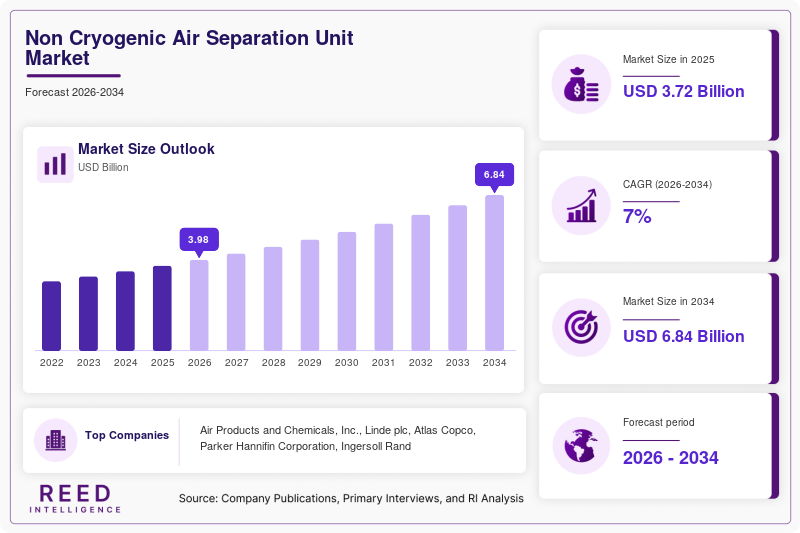
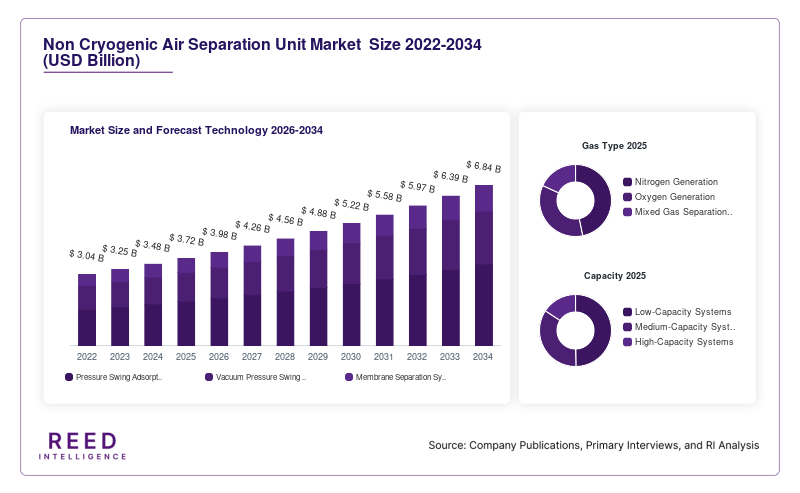
The Non Cryogenic Air Separation Unit Market size was valued at USD 3.72 billion in 2026 and is projected to reach USD 6.41 billion by 2034, expanding at a CAGR of 7.0% during the forecast period of 2026–2034. The global Non Cryogenic Air Separation Unit Market growth has been supported by increasing industrial demand for cost-efficient gas separation technologies across manufacturing, healthcare, electronics, food processing, and energy sectors. Rising emphasis on energy-efficient industrial operations and decentralized gas production systems has accelerated the adoption of non cryogenic air separation units globally.
Non cryogenic air separation units are advanced systems designed to separate atmospheric gases such as nitrogen and oxygen using technologies including pressure swing adsorption (PSA), vacuum pressure swing adsorption (VPSA), and membrane separation. These systems are widely preferred for small- and medium-scale industrial applications due to their lower operational costs, reduced energy consumption, and simplified installation requirements compared to conventional cryogenic systems.
Key Highlights
- Asia Pacific accounted for 41.6% of the global Non Cryogenic Air Separation Unit Market share in 2025, while Middle East & Africa is projected to witness the fastest CAGR of 7.8% during 2026–2034.
- By technology, pressure swing adsorption systems held the dominant share of 48.9% in 2025, whereas membrane separation systems are anticipated to grow at the fastest CAGR of 7.6%.
- By gas type, nitrogen generation represented the leading segment with 57.4% share in 2025, while oxygen generation systems are expected to expand at a CAGR of 7.3%.
- By end use, manufacturing industries accounted for 36.8% of the market share in 2025, whereas healthcare facilities are projected to register a CAGR of 7.9%.
- By capacity, medium-capacity systems dominated with 44.3% share in 2025, while compact low-capacity systems are forecast to grow at a CAGR of 7.5%.
- China remained the dominant country market and was valued at USD 602.5 million in 2024 and USD 648.9 million in 2025.
Market Trends
Increasing Adoption of On-Site Gas Generation Systems
The growing preference for on-site industrial gas production has become a major trend shaping the Non Cryogenic Air Separation Unit Market. Industries are increasingly adopting non cryogenic systems to reduce dependence on external gas suppliers and improve operational flexibility.
On-site gas generation systems help manufacturers reduce transportation costs, minimize supply disruptions, and improve production continuity. This trend is particularly strong in metal fabrication, food packaging, and electronics manufacturing industries where continuous gas supply is essential.
Rising Integration of Smart Monitoring Technologies
Industrial operators are increasingly integrating digital monitoring and automation technologies into non cryogenic air separation systems. Smart sensors, predictive maintenance tools, and remote monitoring platforms are improving operational efficiency and system reliability.
Manufacturers are focusing on intelligent gas separation units capable of real-time pressure monitoring, energy optimization, and automated process adjustments. This trend is expected to enhance productivity while reducing maintenance costs across industrial applications.
Market Drivers
Expansion of Industrial Manufacturing Activities
The rapid expansion of industrial manufacturing operations globally has significantly driven the Non Cryogenic Air Separation Unit Market. Manufacturing facilities increasingly require nitrogen and oxygen for cutting, welding, packaging, and chemical processing applications.
Industries are investing in efficient gas separation technologies to improve production efficiency and reduce long-term operational costs. Growing industrialization across emerging economies continues to strengthen demand for decentralized gas generation systems.
Growing Demand from Healthcare Infrastructure
The increasing expansion of healthcare infrastructure and medical gas requirements has accelerated demand for non cryogenic air separation units. Hospitals and healthcare facilities increasingly rely on oxygen generation systems for respiratory care and emergency medical applications.
Healthcare providers prefer on-site oxygen generation systems to ensure continuous supply reliability and improve medical emergency preparedness. Rising investments in healthcare facilities across developing countries are expected to support market growth.
Market Restraint
Limited Suitability for Large-Scale Gas Production
Limited suitability for high-volume industrial gas production remains a major restraint for the Non Cryogenic Air Separation Unit Market. Non cryogenic technologies may not achieve the same production efficiency levels as cryogenic systems for very large industrial applications.
Industries requiring ultra-high-purity gases in large quantities often continue relying on conventional cryogenic separation systems. This limitation may restrict market penetration in heavy industrial sectors with extensive gas consumption requirements.
Market Opportunities
Increasing Adoption in Renewable Energy Projects
The growing expansion of renewable energy and green hydrogen projects presents significant opportunities for the Non Cryogenic Air Separation Unit Market. Oxygen and nitrogen generation systems are increasingly used in energy storage, hydrogen processing, and clean energy applications.
Industrial operators are expected to invest in energy-efficient gas separation technologies to support sustainability initiatives and reduce environmental impact during industrial processing operations.
Growth of Food and Beverage Packaging Applications
The expanding food and beverage processing industry is creating new opportunities for non cryogenic air separation unit manufacturers. Nitrogen gas is increasingly used in food packaging applications to improve shelf life and maintain product quality.
Manufacturers are developing compact and energy-efficient nitrogen generation systems specifically designed for food processing facilities and packaging operations. Rising packaged food consumption globally is expected to support segment expansion.
Segmental Analysis
By Technology
Based on technology, the Non Cryogenic Air Separation Unit Market is segmented into pressure swing adsorption (PSA), vacuum pressure swing adsorption (VPSA), and membrane separation systems.
Pressure swing adsorption systems dominated the market with a 48.9% share in 2025 owing to their operational efficiency, lower installation costs, and wide industrial applicability. These systems were extensively used for nitrogen and oxygen generation across manufacturing industries.
Membrane separation systems are expected to witness the fastest CAGR of 7.6% during the forecast period. Improved membrane durability, compact system design, and reduced maintenance requirements will continue supporting increasing adoption across industrial facilities.
By Gas Type
Based on gas type, the market is categorized into nitrogen generation, oxygen generation, and mixed gas separation systems.
Nitrogen generation accounted for the leading market share of 57.4% in 2025 due to extensive utilization in food packaging, electronics manufacturing, and metal fabrication industries. Industries increasingly relied on nitrogen systems for controlled atmosphere processing applications.
Oxygen generation systems are projected to grow at a CAGR of 7.3% during 2026–2034. Rising healthcare oxygen demand and expanding wastewater treatment operations will continue supporting segment growth globally.
By Capacity
Based on capacity, the Non Cryogenic Air Separation Unit Market is segmented into low-capacity systems, medium-capacity systems, and high-capacity systems.
Medium-capacity systems held the dominant share of 44.3% in 2025 due to their balanced operational efficiency and suitability for medium-sized industrial facilities. Manufacturing industries widely adopted medium-capacity systems for stable gas production operations.
Low-capacity systems are expected to register the fastest CAGR of 7.5% during the forecast period. Growing adoption among small manufacturing facilities, laboratories, and healthcare centers will continue supporting demand for compact systems.
By End Use
Based on end use, the market is divided into manufacturing industries, healthcare facilities, food & beverage processing, electronics manufacturing, and chemical processing.
Manufacturing industries dominated the market with a 36.8% share in 2025 owing to increasing industrial gas requirements for fabrication, welding, and production processes. Industrial operators increasingly adopted on-site gas generation technologies to improve efficiency.
Healthcare facilities are projected to witness the fastest CAGR of 7.9% during the forecast period. Expanding medical infrastructure and increasing demand for continuous oxygen supply systems will support rising adoption across hospitals and healthcare centers.
Regional Analysis
Asia Pacific
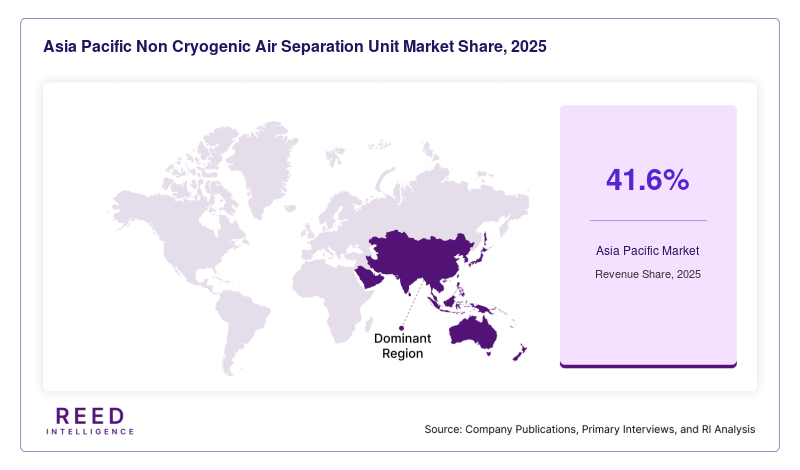
Asia Pacific accounted for 41.6% of the global Non Cryogenic Air Separation Unit Market share in 2025 and is projected to expand at a CAGR of 7.4% during 2026–2034. The region maintained its dominant position due to rapid industrialization and increasing manufacturing investments.
China remained the dominant country market because of large-scale industrial production activities and expanding electronics manufacturing operations. Strong investments in industrial infrastructure and healthcare facilities further supported regional market growth.
North America
North America represented 24.1% of the global Non Cryogenic Air Separation Unit Market share in 2025 and is anticipated to grow at a CAGR of 6.5% during the forecast period. The region benefited from advanced industrial automation and rising adoption of on-site gas generation technologies.
The United States dominated the regional market owing to increasing investments in healthcare infrastructure and growing demand for industrial nitrogen generation systems across manufacturing facilities.
Europe
Europe captured 21.8% of the global Non Cryogenic Air Separation Unit Market share in 2025 and is expected to grow at a CAGR of 6.3% during the forecast period. Industrial modernization and sustainability initiatives contributed significantly to regional market demand.
Germany led the regional market because of its strong manufacturing base and increasing implementation of energy-efficient industrial technologies. Growing adoption of advanced industrial automation systems further supported market expansion.
Middle East & Africa
Middle East & Africa accounted for 7.2% of the global Non Cryogenic Air Separation Unit Market share in 2025 and is projected to witness the fastest CAGR of 7.8% during 2026–2034. Rising investments in oil & gas processing and industrial infrastructure supported regional growth.
Saudi Arabia remained the dominant country market owing to expanding petrochemical manufacturing activities and increasing adoption of industrial gas generation systems for refinery operations.
Latin America
Latin America held 5.3% of the global Non Cryogenic Air Separation Unit Market share in 2025 and is forecast to expand at a CAGR of 6.7% during the study period. Growing food processing industries and industrial modernization activities supported regional development.
Brazil emerged as the dominant country market due to increasing industrial manufacturing investments and rising demand for nitrogen generation systems in food packaging applications.
Competitive Landscape
The Non Cryogenic Air Separation Unit Market remains moderately competitive with industrial gas equipment manufacturers focusing on energy efficiency improvements, compact system development, and digital monitoring integration. Companies are increasingly investing in advanced adsorption materials and membrane technologies to improve gas separation performance.
Air Products and Chemicals, Inc. remained a leading participant due to its strong industrial gas technology portfolio and extensive global distribution network. The company recently expanded its non cryogenic gas generation solutions for manufacturing and healthcare applications.
Parker Hannifin Corporation continued strengthening its membrane separation technologies for industrial nitrogen generation systems. Atlas Copco focused on compact gas generation equipment for industrial facilities, while Ingersoll Rand expanded smart monitoring capabilities for gas separation systems. Linde plc emphasized sustainable industrial gas generation technologies for energy-efficient operations.
Key Players List
- Air Products and Chemicals, Inc.
- Linde plc
- Atlas Copco
- Parker Hannifin Corporation
- Ingersoll Rand
- Air Liquide
- Messer Group GmbH
- GENERON
- Praxair Technology, Inc.
- Universal Industrial Gases, Inc.
- Oxymat A/S
- NovaAir Pvt. Ltd.
- PCI Gases
- Peak Scientific
- On Site Gas Systems, Inc.
Recent Developments
- In 2025, Air Products and Chemicals, Inc. expanded industrial nitrogen generation solutions for manufacturing facilities.
- In 2024, Atlas Copco introduced compact membrane separation systems for decentralized industrial gas production.
- In 2025, Parker Hannifin Corporation strengthened advanced membrane technology capabilities for industrial air separation systems.
- In 2024, Linde plc invested in energy-efficient non cryogenic gas generation technologies for sustainable manufacturing operations.
- In 2025, Ingersoll Rand launched smart monitoring solutions integrated with industrial gas generation systems.
Non Cryogenic Air Separation Unit Market Segments
Technology
- Pressure Swing Adsorption (PSA)
- Vacuum Pressure Swing Adsorption (VPSA)
- Membrane Separation Systems
Gas Type
- Nitrogen Generation
- Oxygen Generation
- Mixed Gas Separation Systems
Capacity
- Low-Capacity Systems
- Medium-Capacity Systems
- High-Capacity Systems
End Use
- Manufacturing Industries
- Healthcare Facilities
- Food & Beverage Processing
- Electronics Manufacturing
- Chemical Processing
By Region
- North America
- Europe
- APAC
- Middle East and Africa
- LATAM