Non Magnetic Wheelchair Market Size, Share & Demand Report By Product Type (Manual Non Magnetic Wheelchairs), By Material (Aluminum, Carbon Fiber, Stainless Steel), By Application (MRI Room Transportation, Surgical Imaging Support), By End Use (Hospitals, Specialty Diagnostic Centers, Ambulatory Surgical Centers), By Distribution Channel (Direct Sales, Distributors, Online Procurement Platforms), By Region & Segment Forecasts, 2026–2034
USD 3950
Market Overview
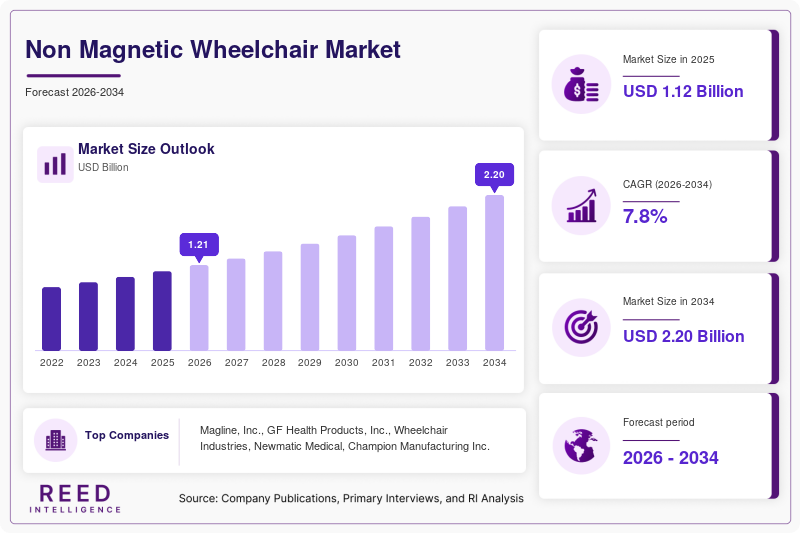
The global Non Magnetic Wheelchair Market size was valued at USD 1.12 billion in 2026 and is projected to reach USD 2.04 billion by 2034, expanding at a CAGR of 7.8% during the forecast period from 2026 to 2034. The market growth has been supported by the increasing installation of MRI systems across hospitals, specialty diagnostic centers, and ambulatory surgical facilities worldwide. Healthcare providers have increasingly adopted non magnetic mobility equipment to improve patient safety in magnetic resonance imaging environments where conventional wheelchairs can interfere with imaging procedures and create operational risks.
The Non Magnetic Wheelchair Market has experienced steady growth due to the rising elderly population and increasing prevalence of neurological disorders, orthopedic conditions, spinal injuries, and mobility limitations. MRI-compatible wheelchairs have become essential in modern healthcare infrastructure because these products are specifically designed with non-ferrous materials that eliminate magnetic interference while ensuring safe patient transportation in high-field MRI suites.
Key Highlights
- North America accounted for 38.4% of the global Non Magnetic Wheelchair Market share in 2025, while Asia Pacific is projected to register the fastest CAGR of 9.3% during the forecast period.
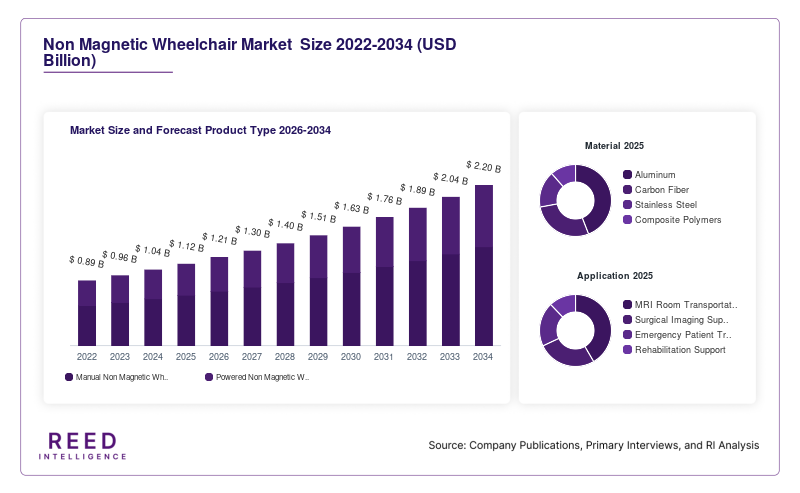
- By product type, manual non magnetic wheelchairs held the dominant share of 63.7% in 2025, whereas powered non magnetic wheelchairs are expected to grow at a CAGR of 8.9% through 2034.
- By material, aluminum-based non magnetic wheelchairs dominated with 41.5% share in 2025, while carbon fiber-based variants are anticipated to expand at a CAGR of 10.1%.
- By application, MRI room transportation accounted for 54.2% of the market share in 2025, whereas surgical imaging support applications are forecast to witness a CAGR of 8.6%.
- By end use, hospitals represented 58.9% of the global demand in 2025, while specialty diagnostic centers are expected to record a CAGR of 9.0%.
- The United States remained the dominant country market and was valued at USD 318 million in 2024 and USD 341 million in 2025.
Market Trends
Increasing Adoption of Lightweight Composite Designs
Manufacturers in the Non Magnetic Wheelchair Market are increasingly focusing on lightweight composite materials to improve portability and user handling. Carbon fiber and reinforced polymer components are replacing traditional heavy structures in several product categories. These materials reduce overall wheelchair weight while maintaining structural stability and MRI compatibility. Hospitals and imaging facilities are preferring lightweight models because they simplify patient transfers and reduce staff fatigue during transportation procedures.
Expansion of Customized MRI-Compatible Mobility Solutions
The market has witnessed growing demand for customized wheelchair configurations designed for specific healthcare applications. Producers are developing bariatric-compatible models, pediatric MRI wheelchairs, and foldable transport solutions tailored to specialized clinical environments. Custom seating systems, detachable armrests, and infection-resistant upholstery materials are also becoming common. This trend has supported product differentiation and strengthened procurement demand from advanced healthcare facilities.
Market Drivers
Rising Installation of MRI Systems Across Healthcare Facilities
The increasing number of MRI installations globally has significantly driven the Non Magnetic Wheelchair Market. Hospitals and diagnostic centers are expanding imaging departments to address rising patient volumes associated with chronic diseases and age-related disorders. MRI suites require safe patient handling systems that do not interfere with magnetic fields. This requirement has encouraged healthcare providers to procure certified non magnetic wheelchairs for operational compliance and patient safety.
Growing Prevalence of Mobility Disorders and Chronic Conditions
The rising prevalence of orthopedic disorders, spinal cord injuries, arthritis, and neurological conditions has increased the demand for mobility assistance products. Many patients undergoing MRI scans require specialized transport support due to reduced mobility. Healthcare providers have therefore expanded investments in MRI-compatible wheelchairs that improve patient comfort and reduce procedural complications during diagnostic imaging procedures.
Market Restraint
High Manufacturing and Procurement Costs
The use of specialized non-ferrous materials, customized engineering standards, and MRI safety certification processes has increased manufacturing costs for non magnetic wheelchairs. These products remain more expensive than standard wheelchairs, which has limited adoption among smaller healthcare facilities and budget-constrained institutions in developing economies.
Market Opportunities
Growing Demand from Emerging Healthcare Infrastructure
Emerging economies are increasing investments in advanced medical imaging infrastructure. New hospitals and diagnostic laboratories in countries across Asia Pacific, Latin America, and the Middle East are expanding MRI installations. This development is expected to create long-term opportunities for manufacturers supplying MRI-compatible mobility equipment.
Product Innovation in Powered Mobility Solutions
The development of powered non magnetic wheelchairs is creating new growth opportunities in the market. Advanced motor technologies compatible with MRI environments are supporting the introduction of automated patient transport systems. These products are expected to gain demand among large hospitals seeking efficient mobility solutions for critical care and elderly patients.
Segmental Analysis
By Product Type
Manual Non Magnetic Wheelchairs
Manual non magnetic wheelchairs accounted for 63.7% of the global market share in 2025. These products remained dominant because they offer lower operational costs, simple maintenance requirements, and high suitability for standard MRI transportation procedures. Hospitals preferred manual variants for routine patient movement within diagnostic departments.
Powered Non Magnetic Wheelchairs
Powered non magnetic wheelchairs are projected to expand at a CAGR of 8.9% during the forecast period. Growth will be driven by rising demand for automated mobility support in large healthcare facilities. These wheelchairs are expected to gain traction due to improved patient comfort, reduced caregiver burden, and enhanced maneuverability in complex hospital environments.
By Material
Aluminum-Based Non Magnetic Wheelchairs
Aluminum-based wheelchairs held the leading market share of 41.5% in 2025. Their dominance was associated with lightweight construction, corrosion resistance, and cost efficiency. Healthcare facilities preferred aluminum products because they offered a balance between durability and affordability for MRI-compatible applications.
Carbon Fiber-Based Non Magnetic Wheelchairs
Carbon fiber-based wheelchairs are anticipated to register a CAGR of 10.1% through 2034. The segment will benefit from increasing demand for ultra-lightweight products with enhanced structural strength. Advanced healthcare facilities are expected to adopt these wheelchairs due to their superior portability and long operational lifespan.
By Application
MRI Room Transportation
MRI room transportation accounted for 54.2% of the Non Magnetic Wheelchair Market share in 2025. The segment maintained leadership because patient movement within MRI facilities represented the primary use case for non magnetic wheelchairs. Hospitals consistently procured these products to ensure safe and uninterrupted imaging operations.
Surgical Imaging Support
Surgical imaging support applications are forecast to grow at a CAGR of 8.6% during the assessment period. Growth will be supported by rising adoption of MRI-assisted surgical procedures and intraoperative imaging systems. Healthcare providers are expected to increase investments in specialized mobility equipment for hybrid surgical environments.
By End Use
Hospitals
Hospitals represented 58.9% of the global market share in 2025. Large hospitals remained the dominant end users because they maintained higher MRI patient volumes and larger procurement budgets. Multi-specialty healthcare facilities also expanded imaging infrastructure to improve diagnostic efficiency.
Specialty Diagnostic Centers
Specialty diagnostic centers are projected to witness a CAGR of 9.0% during the forecast period. Rising outpatient imaging procedures and growing private diagnostic chains are expected to drive demand for compact and efficient MRI-compatible wheelchairs. Increasing emphasis on patient convenience will further support segment growth.
By Distribution Channel
Direct Sales
Direct sales accounted for the largest market share in 2025. Manufacturers relied on direct hospital partnerships and long-term procurement agreements to strengthen product distribution. This channel allowed healthcare facilities to obtain customized configurations and maintenance support.
Online Procurement Platforms
Online procurement platforms are expected to expand at a CAGR of 8.4% through 2034. Digital purchasing systems are likely to gain adoption because they improve product comparison, streamline procurement processes, and increase accessibility for smaller healthcare providers.
Regional Analysis
North America
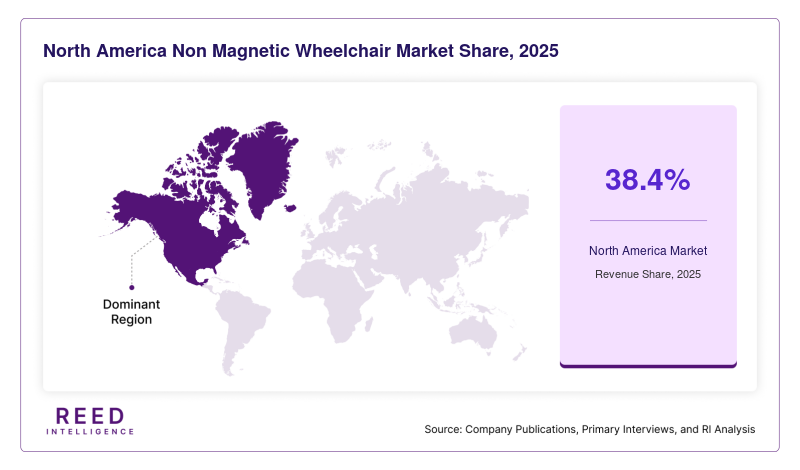
North America accounted for 38.4% of the global Non Magnetic Wheelchair Market share in 2025 and is projected to grow at a CAGR of 7.1% during the forecast period. The region maintained leadership due to widespread MRI adoption, advanced hospital infrastructure, and strict patient safety regulations. The United States dominated the regional market because healthcare institutions continued investing in specialized imaging transportation systems. Rising replacement demand for aging hospital equipment also contributed to market expansion.
Europe
Europe held 27.6% of the global Non Magnetic Wheelchair Market share in 2025 and is anticipated to expand at a CAGR of 7.3% through 2034. Regional growth has been influenced by strong public healthcare systems and rising investments in radiology modernization programs. Germany emerged as the dominant country owing to its extensive diagnostic imaging network and growing adoption of advanced hospital mobility equipment. Increasing demand for ergonomic and infection-resistant wheelchairs further supported market development across the region.
Asia Pacific
Asia Pacific represented 22.8% of the global Non Magnetic Wheelchair Market share in 2025 and is forecast to register the fastest CAGR of 9.3% between 2026 and 2034. Rapid healthcare infrastructure development and rising hospital construction projects have accelerated regional demand. China dominated the regional market due to expanding MRI installation capacity and increasing healthcare expenditure. The growth of private diagnostic centers and medical tourism facilities also strengthened procurement activities across several Asian economies.
Middle East & Africa
The Middle East & Africa accounted for 6.1% of the global market share in 2025 and is expected to grow at a CAGR of 6.9% during the forecast period. The region experienced steady market growth due to increasing healthcare modernization initiatives and expanding specialty diagnostic services. Saudi Arabia emerged as the leading country market because government-supported healthcare transformation programs encouraged investments in advanced imaging infrastructure and patient safety equipment.
Latin America
Latin America captured 5.1% of the Non Magnetic Wheelchair Market share in 2025 and is projected to witness a CAGR of 6.7% through 2034. Brazil dominated the regional market as hospitals and private imaging centers expanded MRI-based diagnostic services. Growing urban healthcare investments and improving access to specialized medical technologies supported the demand for MRI-compatible mobility products across the country.
Competitive Landscape
The Non Magnetic Wheelchair Market remains moderately consolidated with the presence of established medical mobility equipment manufacturers and specialized MRI-compatible product suppliers. Companies are focusing on lightweight material innovation, product certification, ergonomic enhancements, and regional distribution expansion to strengthen competitive positioning.
Magline, Inc. remained one of the leading market participants due to its diversified MRI-compatible mobility portfolio and strong healthcare distribution network. The company recently introduced an upgraded non magnetic transport wheelchair series with enhanced patient restraint systems and antimicrobial seating materials designed for advanced imaging facilities.
Several market participants are also expanding partnerships with hospitals and diagnostic centers to improve long-term procurement contracts. Product customization and regulatory compliance continue to remain important competitive factors within the industry.
Key Players List
- Magline, Inc.
- GF Health Products, Inc.
- Wheelchair Industries
- Newmatic Medical
- Champion Manufacturing Inc.
- MRIequip
- Metrasens
- Ferno-Washington, Inc.
- Medequip Assistive Technology Ltd.
- Howard Wright Limited
- Direct Healthcare Group
- Benmor Medical
- Antano Group
- Wardray Premise Ltd.
Recent Developments
- In February 2026, Magline, Inc. introduced a next-generation non magnetic wheelchair featuring improved ergonomic support and MRI-safe braking mechanisms for advanced imaging facilities.
- In October 2025, GF Health Products, Inc. expanded its MRI-compatible mobility product portfolio with lightweight aluminum wheelchair models designed for outpatient diagnostic centers.
- In August 2025, Metrasens partnered with regional hospital networks in Europe to improve MRI safety infrastructure and patient handling capabilities.
- In June 2025, Wardray Premise Ltd. launched an upgraded bariatric non magnetic wheelchair line with enhanced weight capacity and reinforced composite frames.
- In March 2025, MRIequip expanded manufacturing capacity to address rising procurement demand from hospitals across Asia Pacific and North America.
Non Magnetic Wheelchair Market Segments
Product Type
- Manual Non Magnetic Wheelchairs
- Powered Non Magnetic Wheelchairs
Material
- Aluminum
- Carbon Fiber
- Stainless Steel
- Composite Polymers
Application
- MRI Room Transportation
- Surgical Imaging Support
- Emergency Patient Transfer
- Rehabilitation Support
End Use
- Hospitals
- Specialty Diagnostic Centers
- Ambulatory Surgical Centers
- Rehabilitation Facilities
Distribution Channel
- Direct Sales
- Distributors
- Online Procurement Platforms
By Region
- North America
- Europe
- APAC
- Middle East and Africa
- LATAM