Non-Viral Transfection Reagent Market Size, Share & Demand Report By Product Type (Lipid-Based Transfection Reagents, Polymer-Based Transfection Reagents, Nanoparticle-Based Transfection Reagents, Peptide-Based Transfection Reagents, Others), By Application (Biomedical Research, Gene Therapy Development, Protein Production, Cancer Research, Drug Discovery, Others), By End User (Pharmaceutical and Biotechnology Companies, Academic and Research Institutes, Contract Research Organizations, Hospital
USD 3950
Market Overview
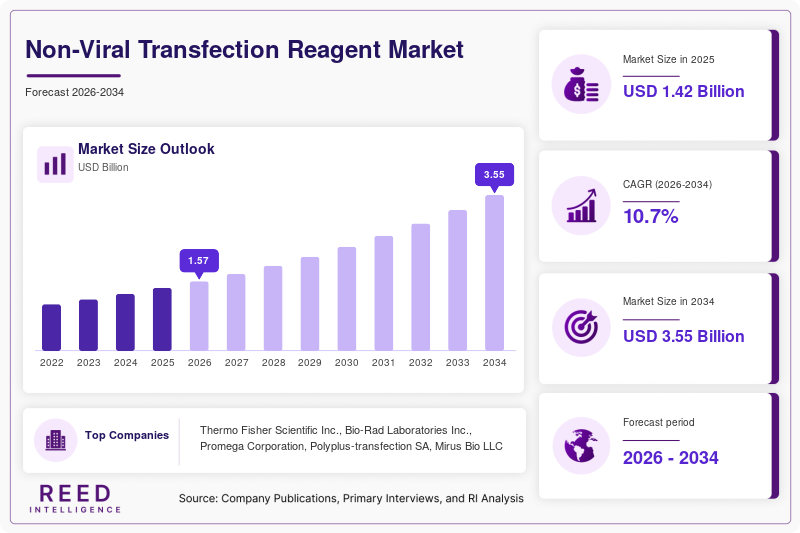
The global Non-Viral Transfection Reagent Market size was valued at USD 1.42 billion in 2026 and is projected to reach USD 3.21 billion by 2034, expanding at a CAGR of 10.7% during the forecast period. The market continues to gain momentum due to the increasing adoption of gene editing technologies, cell-based therapies, and nucleic acid delivery systems across pharmaceutical and biotechnology industries. Non-viral transfection reagents are widely used in molecular biology applications because they offer improved safety profiles, reduced immunogenicity, and greater flexibility when compared with viral vectors. Growing investments in genomic research and the rising number of clinical studies focused on RNA therapeutics are also supporting market expansion.
The growing demand for personalized medicine has created strong demand for efficient transfection technologies capable of delivering DNA, RNA, and CRISPR components into target cells. Pharmaceutical companies are increasing their research spending on cancer immunotherapy, regenerative medicine, and vaccine development, which has strengthened the use of lipid-based and polymer-based transfection reagents. In addition, the expansion of biotechnology startups and academic collaborations across developed and emerging economies has accelerated product innovation in transfection platforms.
Key Highlights
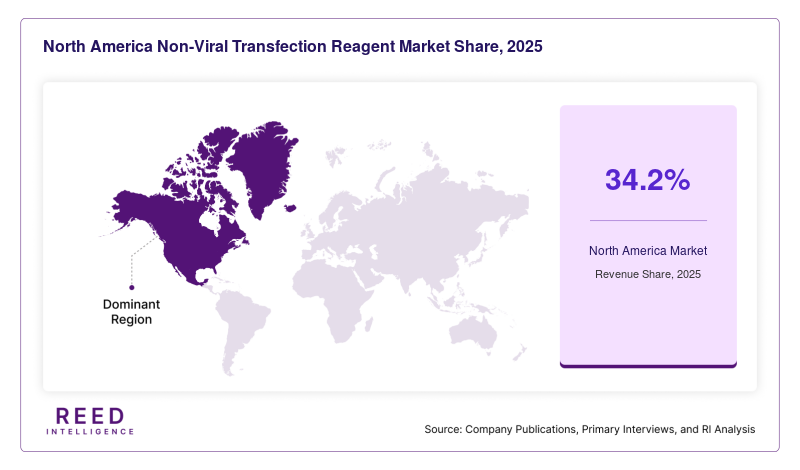
- North America dominated the market with a 34.2% share in 2025, while Asia Pacific is expected to grow at the fastest CAGR of 11.8% during 2026–2034.
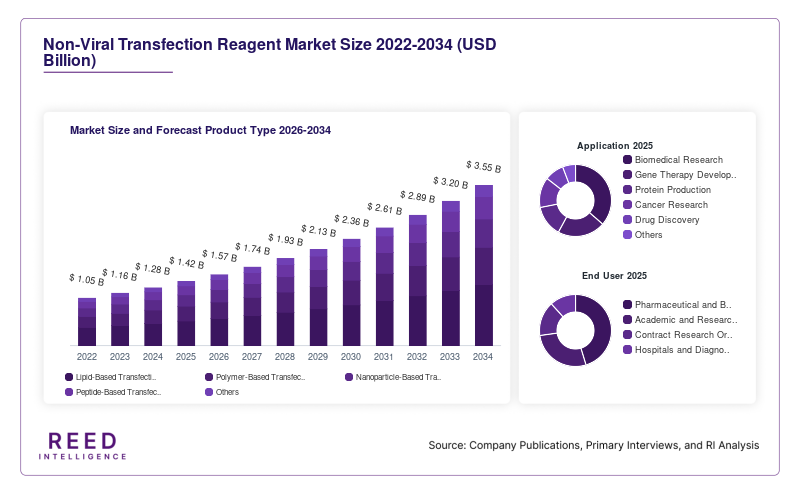
- By product type, lipid-based transfection reagents accounted for the largest share of 44.6%, while nanoparticle-based reagents are projected to grow at a CAGR of 12.6%.
- By application, biomedical research led with a 39.1% share, whereas gene therapy development is expected to expand at a CAGR of 13.1%.
- The United States remained the dominant country, with market values of USD 468 million in 2024 and USD 516 million in 2025.
Market Trends
Rising Integration of CRISPR and RNA-Based Therapeutics
The increasing adoption of CRISPR gene editing and RNA-based therapeutics is shaping the future direction of the Non-Viral Transfection Reagent Market. Research institutions and pharmaceutical companies are using non-viral delivery systems to improve the intracellular delivery of guide RNA, messenger RNA, and plasmid DNA into mammalian cells. Lipid nanoparticles and cationic polymers are gaining strong demand because they support efficient gene expression while reducing safety concerns associated with viral vectors. The rapid commercialization of mRNA vaccines has also accelerated interest in non-viral delivery technologies, particularly in cancer therapeutics and infectious disease research. Companies are expanding their product pipelines to include reagents optimized for difficult-to-transfect cells, enabling broader adoption in stem cell and regenerative medicine applications.
Increasing Preference for High-Throughput and Automated Research Platforms
Biotechnology laboratories are increasingly shifting toward automated workflows and high-throughput screening systems, which has strengthened the demand for scalable transfection reagents. Researchers require transfection products that can deliver reproducible results across multiple cell lines while maintaining compatibility with robotic liquid handling systems. This trend is encouraging reagent manufacturers to develop stable formulations suitable for automated genomic screening, drug discovery, and proteomics applications. Academic research institutes and contract research organizations are investing in advanced laboratory infrastructure to accelerate molecular biology studies. As laboratories continue to process large sample volumes, demand for reliable and low-toxicity transfection reagents is expected to increase steadily across pharmaceutical and biotechnology sectors.
Market Drivers
Expanding Investments in Cell and Gene Therapy Research
Growing investments in cell and gene therapy development are contributing significantly to the expansion of the Non-Viral Transfection Reagent Market. Pharmaceutical companies and biotechnology firms are increasing funding for therapies targeting inherited disorders, rare diseases, and oncology applications. Non-viral transfection technologies are widely preferred in early-stage research because they provide flexible nucleic acid delivery without the complexity associated with viral production systems. Governments and private investors are supporting advanced research programs focused on precision medicine and regenerative therapies, creating sustained demand for efficient transfection solutions. In addition, rising clinical trial activity involving RNA therapeutics and engineered cell therapies is increasing the need for reagents capable of improving transfection efficiency while maintaining cell viability.
Growing Demand for Safer and Cost-Effective Gene Delivery Methods
The market is also benefiting from the increasing preference for safer and cost-effective alternatives to viral vectors. Viral transfection systems often involve higher manufacturing costs, stricter biosafety requirements, and potential immune response risks. Non-viral reagents offer simpler production processes and greater scalability, making them suitable for research laboratories and commercial therapeutic applications. Academic institutions and biotechnology companies are adopting lipid-based, polymer-based, and nanoparticle-mediated transfection systems to reduce operational complexity while achieving consistent gene delivery performance. The ability of non-viral systems to support repeated administration and customizable formulations has further strengthened their adoption across biomedical research, vaccine development, and therapeutic protein production.
Market Restraint
Variability in Transfection Efficiency Across Cell Types
One of the major challenges affecting the Non-Viral Transfection Reagent Market is the variability in transfection efficiency across different cell lines and experimental conditions. Certain primary cells, stem cells, and suspension cells remain difficult to transfect using conventional non-viral delivery methods. Researchers frequently encounter issues related to low gene expression, inconsistent uptake, and cytotoxic effects during transfection procedures. These limitations can increase experimental costs and reduce reproducibility in large-scale research projects.
The challenge becomes more significant in clinical and therapeutic applications where precise delivery efficiency is required for consistent treatment outcomes. Many biotechnology companies invest heavily in optimizing formulations for specific cell types, which can extend product development timelines and increase operational expenses. In some cases, laboratories continue to rely on viral vectors for applications requiring long-term gene expression or higher transfection accuracy. The lack of universal transfection solutions capable of delivering reliable performance across all cell types remains a limiting factor for broader commercial adoption.
Market Opportunities
Expansion of Personalized Medicine and Precision Therapeutics
The increasing adoption of personalized medicine presents strong growth opportunities for the Non-Viral Transfection Reagent Market. Healthcare providers and pharmaceutical companies are focusing on patient-specific therapies that rely heavily on genomic analysis and targeted gene delivery technologies. Non-viral transfection reagents are becoming essential tools in the development of individualized cancer treatments, RNA therapeutics, and engineered immune cell therapies. The ability to customize nucleic acid delivery systems according to patient-specific biological conditions is creating new commercial opportunities for reagent manufacturers. Growing collaborations between biotechnology companies and healthcare institutions are expected to accelerate innovation in precision therapeutic platforms and expand the use of advanced transfection systems in clinical applications.
Increasing Demand from Emerging Biotechnology Markets
Emerging economies across Asia Pacific, Latin America, and the Middle East are creating favorable growth opportunities for market participants. Governments in these regions are increasing investments in biotechnology research infrastructure, genomic medicine programs, and pharmaceutical manufacturing capabilities. Academic institutions and contract research organizations are also expanding their molecular biology and gene editing activities, which is increasing demand for affordable transfection technologies. Local biotechnology startups are entering the market with a focus on cell therapy development and RNA research, further strengthening regional demand. Manufacturers that introduce cost-efficient and easy-to-use transfection reagents tailored for developing markets are expected to gain competitive advantages during the forecast period.
Segmental Analysis
By Product Type
Lipid-based transfection reagents accounted for the largest market share of 44.6% in 2024 due to their high efficiency and compatibility with a wide range of cell types. These reagents are widely used in gene expression studies, RNA interference experiments, and mRNA delivery applications. Researchers prefer lipid-based formulations because they provide relatively low cytotoxicity and support effective intracellular delivery of nucleic acids. Pharmaceutical and biotechnology companies are increasingly adopting lipid-mediated transfection technologies for vaccine development, cancer research, and therapeutic protein production. Continuous advancements in cationic lipid chemistry and nanoparticle engineering have improved transfection performance, making these products suitable for both research and clinical development applications. The growing use of lipid nanoparticles in RNA therapeutics has further strengthened the commercial demand for this segment.
Nanoparticle-based transfection reagents are projected to expand at the fastest CAGR of 12.6% during the forecast period due to their enhanced stability and targeted delivery capabilities. Researchers are increasingly exploring inorganic nanoparticles, polymeric nanoparticles, and hybrid delivery systems to improve nucleic acid transport into difficult-to-transfect cells. These technologies support controlled release mechanisms and reduce degradation risks associated with conventional delivery systems. The rising popularity of precision medicine and advanced gene editing platforms is encouraging pharmaceutical companies to invest in nanoparticle-mediated delivery solutions. In addition, ongoing research focused on reducing toxicity and improving intracellular uptake efficiency is expected to accelerate the adoption of nanoparticle-based reagents across clinical and commercial applications.
By Application
Biomedical research represented the largest application segment with a 39.1% market share in 2024. Universities, academic institutions, and pharmaceutical laboratories extensively use non-viral transfection reagents for functional genomics, protein expression studies, and cell biology experiments. The increasing number of research projects involving RNA interference, gene silencing, and plasmid DNA delivery has contributed to strong segment growth. Biotechnology companies are also using advanced transfection reagents in drug discovery programs to evaluate molecular targets and therapeutic mechanisms. The expansion of genomic sequencing technologies and increasing investments in molecular diagnostics have further strengthened the use of transfection systems in laboratory research environments. High demand for reproducible and scalable transfection methods continues to support the dominance of this application segment.
Gene therapy development is expected to register the fastest CAGR of 13.1% over the forecast period due to increasing investments in precision medicine and regenerative therapies. Non-viral transfection systems are becoming important tools for delivering genetic material into target cells during preclinical and clinical development stages. Pharmaceutical companies are increasingly focusing on therapies for rare genetic disorders, oncology, and autoimmune diseases, which is driving demand for advanced delivery technologies. Lipid nanoparticles and polymer-based vectors are gaining traction because they offer improved safety profiles and lower immunogenicity compared with viral vectors. Furthermore, the growing number of clinical trials involving CRISPR and RNA-based therapeutics is expected to create significant growth opportunities for transfection reagent manufacturers.
By End User
Pharmaceutical and biotechnology companies held the dominant share of 46.8% in 2024 due to rising investments in biologics development, gene therapy research, and molecular diagnostics. These organizations require advanced transfection reagents for drug discovery, protein production, and cell engineering applications. The increasing adoption of automated laboratory systems and high-throughput screening technologies has strengthened the demand for scalable and reproducible transfection solutions. Large pharmaceutical firms are also collaborating with biotechnology startups to accelerate the development of RNA therapeutics and personalized medicine platforms. The growing emphasis on precision healthcare and targeted therapies has encouraged companies to invest in efficient non-viral delivery technologies capable of supporting large-scale commercial applications.
Contract research organizations are anticipated to witness the fastest CAGR of 11.9% during the forecast period as pharmaceutical companies continue outsourcing research and development activities. CROs provide specialized expertise in molecular biology, genomic screening, and cell-based assay development, making them important end users of transfection reagents. Increasing pressure to reduce operational costs and accelerate clinical development timelines has encouraged biotechnology companies to collaborate with external research providers. CROs are investing in automated laboratory infrastructure and advanced cell culture technologies to support growing client demand. Additionally, the expansion of biotechnology research activities in emerging economies is expected to increase outsourcing trends, creating strong opportunities for transfection reagent suppliers serving contract research organizations.
Regional Analysis
North America
North America accounted for 34.2% of the global Non-Viral Transfection Reagent Market in 2025 and is projected to maintain steady growth at a CAGR of 9.8% during the forecast period. The region benefits from strong biotechnology infrastructure, substantial research funding, and widespread adoption of advanced genomic technologies. Pharmaceutical companies across the United States and Canada are actively investing in gene editing, mRNA therapeutics, and oncology research programs. Academic institutions and research laboratories continue to adopt high-performance transfection reagents to support drug discovery and cell biology studies.
The United States remained the leading country in the regional market due to its strong concentration of biotechnology companies and advanced healthcare research ecosystem. Increasing investments in precision medicine and immunotherapy development continue to support demand for non-viral delivery systems. The presence of leading pharmaceutical manufacturers and government-backed genomic initiatives has accelerated product innovation in lipid-based and nanoparticle-based transfection technologies. Growing collaborations between universities and biotechnology firms are further strengthening the commercialization of next-generation transfection solutions.
Europe
Europe represented 27.4% of the global market in 2025 and is expected to grow at a CAGR of 9.5% between 2026 and 2034. The region continues to benefit from rising investments in molecular diagnostics, regenerative medicine, and pharmaceutical innovation. Countries such as Germany, France, and the United Kingdom are expanding their research capabilities in cell therapy and gene editing applications. European biotechnology companies are also focusing on developing low-toxicity transfection reagents suitable for clinical research and therapeutic development.
Germany emerged as the dominant country within Europe due to its strong pharmaceutical manufacturing base and extensive biomedical research activities. The country has established multiple research collaborations involving genomic medicine, RNA therapeutics, and advanced biologics production. Government support for biotechnology innovation and favorable research grants have contributed to increased adoption of non-viral transfection technologies. In addition, the rising presence of contract development and manufacturing organizations has strengthened regional demand for scalable and reproducible transfection systems.
Asia Pacific
Asia Pacific held 23.1% of the Non-Viral Transfection Reagent Market in 2025 and is projected to register the fastest CAGR of 11.8% during the forecast period. The rapid expansion of biotechnology research, increasing healthcare expenditure, and growing pharmaceutical manufacturing activities are supporting regional market growth. Countries including China, Japan, South Korea, and India are investing heavily in genomic medicine and molecular biology research. The growing number of biotechnology startups and academic research collaborations is also accelerating the demand for efficient transfection technologies.
China dominated the Asia Pacific market due to large-scale investments in biotechnology infrastructure and gene therapy research. The country has significantly expanded its pharmaceutical manufacturing capacity and clinical research ecosystem over the past few years. Government initiatives supporting precision medicine and domestic biopharmaceutical production are encouraging local companies to adopt advanced transfection platforms. In addition, increasing demand for mRNA-based therapeutics and vaccine development programs is creating new opportunities for lipid nanoparticle and polymer-based transfection reagent manufacturers.
Middle East & Africa
The Middle East & Africa region accounted for 7.3% of the global market in 2025 and is anticipated to grow at a CAGR of 8.6% through 2034. The market is gradually expanding due to improving healthcare infrastructure, rising investments in biomedical research, and increasing awareness of genomic medicine. Several countries in the Gulf region are investing in biotechnology innovation centers and precision healthcare initiatives. Research institutes are increasingly adopting molecular biology tools to support disease diagnostics and genetic disorder studies.
Saudi Arabia remained the dominant country within the regional market due to increasing healthcare modernization programs and government-supported biotechnology investments. The country is strengthening its pharmaceutical research capabilities to reduce dependence on imported healthcare technologies. Investments in academic research institutions and specialized healthcare centers are supporting the adoption of advanced transfection reagents. Furthermore, the growing prevalence of chronic diseases and increasing interest in personalized treatment strategies are encouraging pharmaceutical companies to expand genomic research activities across the region.
Latin America
Latin America captured 8.0% of the global Non-Viral Transfection Reagent Market in 2025 and is expected to grow at a CAGR of 8.9% during the forecast period. The region is witnessing gradual expansion in biotechnology research and pharmaceutical manufacturing capabilities. Countries such as Brazil and Mexico are increasing investments in biomedical research infrastructure and healthcare innovation. Rising collaboration between academic institutions and international pharmaceutical companies is supporting the adoption of advanced laboratory technologies, including non-viral transfection systems.
Brazil dominated the Latin American market due to its expanding biotechnology industry and growing focus on public healthcare research. The country has strengthened investments in vaccine research, molecular diagnostics, and genetic engineering applications. Government-supported research institutions are increasingly using transfection reagents for oncology and infectious disease studies. In addition, the expansion of local pharmaceutical manufacturing and increasing participation in international clinical trials are expected to create favorable conditions for market growth over the coming years.
Competitive Landscape
The Non-Viral Transfection Reagent Market remains moderately consolidated, with several biotechnology and life science companies competing through product innovation, strategic partnerships, and geographic expansion. Leading manufacturers are focusing on improving transfection efficiency, reducing cytotoxicity, and developing reagents optimized for complex cell types such as stem cells and primary cells. Companies are also investing in advanced lipid nanoparticle technologies to strengthen their positions in RNA therapeutic and gene editing applications.
Thermo Fisher Scientific remains one of the leading participants in the market due to its extensive product portfolio and strong global distribution network. The company continues to expand its transfection reagent offerings for mRNA delivery and CRISPR applications. Bio-Rad Laboratories, Promega Corporation, and Polyplus-transfection are actively investing in next-generation delivery systems designed for high-throughput screening and clinical research. Mirus Bio has also strengthened its market presence through the launch of specialized transfection products for difficult-to-transfect cell lines.
Key Players
- Thermo Fisher Scientific Inc.
- Bio-Rad Laboratories Inc.
- Promega Corporation
- Polyplus-transfection SA
- Mirus Bio LLC
- Lonza Group AG
- QIAGEN N.V.
- Merck KGaA
- Roche Holding AG
- GenScript Biotech Corporation
- OZ Biosciences
- MaxCyte Inc.
- Altogen Biosystems
- SignaGen Laboratories
- Sartorius AG
Recent Developments
- Thermo Fisher Scientific expanded its lipid nanoparticle transfection portfolio in 2025 to support large-scale mRNA therapeutic development and improve delivery efficiency in primary cells.
- Polyplus-transfection introduced a new polymer-based reagent platform optimized for CRISPR gene editing workflows in biotechnology research laboratories during 2024.
- Lonza Group AG announced the expansion of its cell and gene therapy manufacturing capabilities in 2025 to support increasing global demand for advanced transfection technologies.
- Mirus Bio launched a next-generation transfection reagent designed for suspension cell applications, targeting biopharmaceutical production and vaccine development programs.
- Bio-Rad Laboratories strengthened its partnership network with academic institutions to accelerate genomic research and improve accessibility to high-efficiency non-viral delivery systems.
Non-Viral Transfection Reagent Market Segments
Product Type
- Lipid-Based Transfection Reagents
- Polymer-Based Transfection Reagents
- Nanoparticle-Based Transfection Reagents
- Peptide-Based Transfection Reagents
- Others
Application
- Biomedical Research
- Gene Therapy Development
- Protein Production
- Cancer Research
- Drug Discovery
- Others
End User
- Pharmaceutical and Biotechnology Companies
- Academic and Research Institutes
- Contract Research Organizations
- Hospitals and Diagnostic Laboratories
By Region
- North America
- Europe
- APAC
- Middle East and Africa
- LATAM