Nonwoven Flanging Market Size, Share & Demand Report By Material Type (Polypropylene, Polyester, Polyethylene, Rayon, Others), By Application (Automotive Interiors, Medical Textiles, Filtration Systems, Packaging, Construction Materials, Others), By End-Use Industry (Industrial Manufacturing, Healthcare, Automotive, Consumer Goods, Construction, Others), By Region & Segment Forecasts, 2026–2034
USD 3950
Market Overview
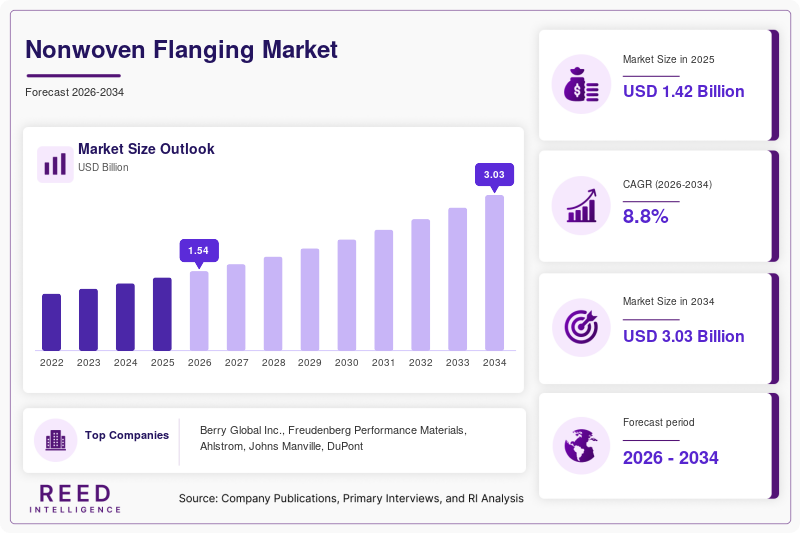
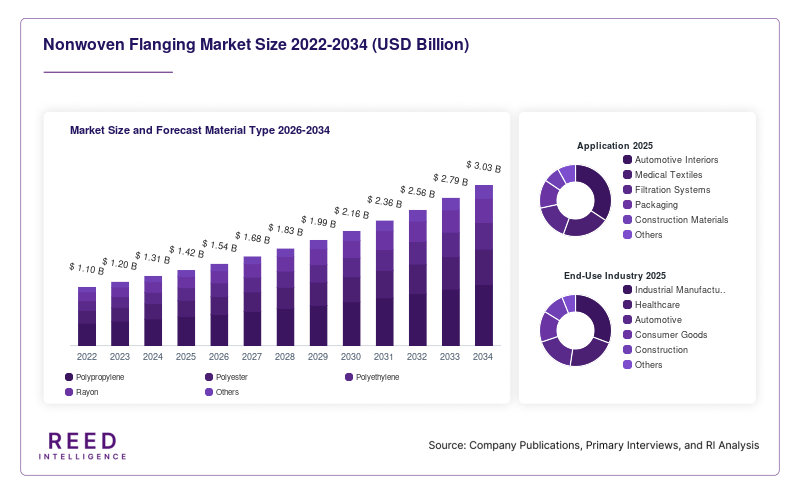
The global Nonwoven Flanging Market size was valued at USD 1.42 billion in 2026 and is projected to reach USD 2.78 billion by 2034, expanding at a CAGR of 8.8% during the forecast period from 2026 to 2034. The market is gaining momentum due to rising demand for lightweight, durable, and cost-efficient reinforcement materials across healthcare, automotive, apparel, packaging, and industrial manufacturing applications. Nonwoven flanging products are increasingly used for edge reinforcement, seam stability, insulation support, and structural enhancement in both consumer and industrial products. Manufacturers are also adopting advanced bonding technologies and recycled fiber integration to improve performance while meeting sustainability objectives.
One major global factor supporting market growth is the expansion of automated manufacturing and technical textile production across emerging economies. Industries are shifting toward engineered nonwoven materials because of their flexibility, reduced production waste, and compatibility with high-speed manufacturing systems. In addition, increasing investments in medical disposables, filtration systems, and electric vehicle insulation components are contributing to broader adoption of nonwoven flanging materials. The growing focus on recyclable and low-emission textile solutions is further encouraging manufacturers to replace traditional stitched reinforcements with thermally bonded and adhesive-based nonwoven flanging products.
Key Highlights
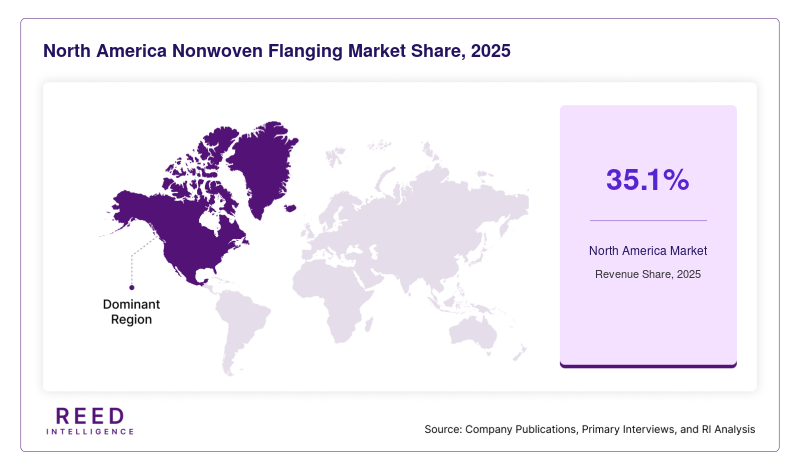
- North America dominated the market with a 35.1% share in 2025.
- Asia Pacific is expected to grow at the fastest CAGR of 10.9% during 2026–2034.
- By material type, polypropylene-based flanging accounted for the largest share of 39.4%.
- while polyester-based flanging is projected to grow at a CAGR of 10.7%.
- By application, automotive interiors led with a 36.8% share.
- whereas medical textiles are expected to expand at a CAGR of 11.4%.
- By end-use industry, industrial manufacturing accounted for the highest share of 33.6%.
- while healthcare is projected to grow at a CAGR of 11.1%.
- The United States remained the dominant country, with market values of USD 410 million in 2024 and USD 452 million in 2025.
Market Trends
Rising Adoption of Sustainable and Recyclable Nonwoven Materials
Sustainability has become a central trend shaping the Nonwoven Flanging Market as manufacturers increasingly adopt recyclable fibers, bio-based polymers, and low-emission production techniques. Industrial buyers are demanding nonwoven flanging solutions that align with environmental regulations and corporate sustainability goals. This trend is especially visible in Europe and North America, where automotive and packaging companies are replacing conventional textile reinforcements with lightweight recyclable nonwoven structures. Producers are also investing in water-efficient bonding methods and reduced-energy thermal processing technologies to improve operational efficiency.
The integration of recycled polypropylene and polyester materials into flanging applications is gaining attention because it lowers raw material costs while supporting circular economy initiatives. Textile companies are introducing thinner yet stronger nonwoven flanging layers that reduce waste generation without compromising durability. In addition, consumer awareness regarding environmentally responsible materials is encouraging apparel and hygiene product manufacturers to source sustainable nonwoven components. As environmental compliance standards continue to expand globally, the demand for eco-friendly nonwoven flanging products is expected to rise steadily throughout the forecast period.
Expansion of Technical Textile Applications Across Industries
The increasing use of technical textiles in industrial operations is another major trend accelerating the growth of the Nonwoven Flanging Market. Nonwoven flanging materials are now widely used in automotive insulation, filtration media, protective clothing, construction membranes, and medical disposables because they provide structural support while maintaining flexibility and lightweight performance. Manufacturers are prioritizing engineered textile solutions that can withstand heat, moisture, abrasion, and chemical exposure, creating strong demand for advanced nonwoven flanging technologies.
Automation in textile production is also encouraging the adoption of precision-engineered flanging materials compatible with robotic assembly and high-speed manufacturing lines. Automotive companies are integrating nonwoven flanging into vehicle interiors and acoustic insulation systems to reduce component weight and improve fuel efficiency. Meanwhile, healthcare manufacturers are expanding the use of sterile and breathable nonwoven flanging products in surgical gowns, masks, and wound-care products. The continued diversification of technical textile applications across multiple sectors is expected to support long-term market expansion.
Market Drivers
Growth of Automotive Lightweighting and Interior Applications
The increasing demand for lightweight vehicle components is a major driver supporting the Nonwoven Flanging Market. Automotive manufacturers are under pressure to improve fuel efficiency and extend electric vehicle battery performance by reducing vehicle weight. Nonwoven flanging materials provide an effective solution because they offer structural reinforcement while remaining lightweight and flexible. These materials are increasingly used in door panels, trunk liners, headliners, seat backing, and acoustic insulation systems.
The expansion of electric vehicle manufacturing in Asia Pacific, North America, and Europe is further contributing to market growth. Electric vehicles require enhanced thermal and acoustic insulation, creating demand for advanced nonwoven flanging products. In addition, automakers are seeking recyclable interior materials to meet environmental standards and consumer sustainability expectations. Suppliers are responding by developing flame-resistant and moisture-resistant nonwoven flanging solutions suitable for next-generation vehicle platforms. As automotive production volumes continue to recover and electric mobility investments increase, demand for nonwoven flanging materials is expected to strengthen significantly.
Increasing Demand from Healthcare and Hygiene Industries
The rapid expansion of healthcare and hygiene product manufacturing is another key factor driving market growth. Nonwoven flanging materials are widely used in medical textiles because they provide softness, breathability, durability, and contamination control. Hospitals and healthcare facilities are increasing procurement of disposable medical products such as surgical gowns, masks, drapes, wound dressings, and sterilization packaging, all of which utilize nonwoven materials.
Population growth, rising healthcare expenditure, and greater awareness regarding infection prevention are supporting higher consumption of medical disposables worldwide. Manufacturers are also developing antibacterial and hypoallergenic nonwoven flanging materials to meet strict healthcare standards. In the hygiene segment, the increasing use of baby diapers, feminine hygiene products, and adult incontinence products is creating additional demand for absorbent and flexible nonwoven components. Emerging economies are witnessing strong growth in healthcare infrastructure investments, which is expected to sustain long-term demand for advanced nonwoven flanging products.
Market Restraints
Volatility in Raw Material Prices and Supply Chain Disruptions
Fluctuations in the prices of synthetic fibers and polymer-based raw materials remain a significant challenge for the Nonwoven Flanging Market. Polypropylene, polyester, and polyethylene are widely used in nonwoven flanging production, and their pricing is closely linked to global petrochemical market conditions. Sudden increases in crude oil prices, transportation costs, and trade restrictions can directly impact production expenses for manufacturers. This volatility makes long-term pricing agreements difficult and reduces profit margins, especially for small and medium-sized producers.
Supply chain disruptions have also affected the availability of essential raw materials and industrial equipment. Delays in shipping, shortages of industrial chemicals, and regional geopolitical tensions have created operational uncertainty across textile and manufacturing industries. Many manufacturers face challenges in maintaining stable inventory levels while balancing production costs and delivery commitments. For example, automotive and medical product manufacturers often require uninterrupted material supply, and delays in nonwoven flanging deliveries can disrupt large-scale production operations. Although companies are investing in localized sourcing and supplier diversification strategies, raw material instability continues to limit predictable market expansion.
Market Opportunities
Emerging Demand for Smart and Functional Nonwoven Materials
The development of smart and multifunctional textile solutions presents a strong opportunity for the Nonwoven Flanging Market. Manufacturers are integrating advanced properties such as antimicrobial protection, thermal insulation, flame resistance, and moisture control into nonwoven flanging materials to serve specialized industrial applications. These innovations are gaining popularity in healthcare, military textiles, aerospace interiors, and high-performance workwear manufacturing.
The growing use of sensor-enabled and conductive textile systems is also opening new growth possibilities. Smart wearable devices and connected healthcare products require lightweight and adaptable textile components that can support electronic integration. Nonwoven flanging materials are increasingly being engineered to improve flexibility and durability in these applications. In addition, research into nanofiber coatings and biodegradable polymers is expected to create new product categories with enhanced performance characteristics. Companies investing in advanced material innovation are likely to gain a competitive advantage as demand for functional technical textiles continues to rise.
Expansion of Industrial Manufacturing in Emerging Economies
Rapid industrialization across Asia Pacific, Latin America, and parts of the Middle East is creating favorable opportunities for nonwoven flanging manufacturers. Expanding automotive production, rising healthcare investments, and growing construction activity are increasing the demand for industrial textiles and reinforcement materials. Emerging economies are also attracting global textile manufacturers because of lower labor costs, supportive industrial policies, and improving manufacturing infrastructure.
Governments in countries such as India, Vietnam, Brazil, and Indonesia are promoting domestic manufacturing through industrial development initiatives and export incentives. This is encouraging investments in nonwoven textile production facilities and advanced processing equipment. In addition, rising consumer demand for packaged goods, hygiene products, and affordable medical supplies is supporting higher production volumes across multiple industries. As regional supply chains become more localized and technologically advanced, manufacturers of nonwoven flanging materials are expected to benefit from expanding production capacities and stronger market penetration.
Segmental Analysis
By Material Type
Polypropylene-based nonwoven flanging materials accounted for the largest market share of 39.4% in 2024 due to their affordability, lightweight properties, and broad industrial compatibility. Polypropylene offers excellent moisture resistance, chemical stability, and processing flexibility, making it suitable for automotive interiors, medical textiles, hygiene products, and packaging applications. Manufacturers favor polypropylene because it supports high-volume production and can be easily integrated into thermal bonding and spunbond manufacturing systems. The material also delivers strong dimensional stability and durability while maintaining low production costs.
Demand for polypropylene-based flanging products remains particularly strong in the automotive and healthcare sectors, where manufacturers require reliable reinforcement materials that can withstand frequent use and varying environmental conditions. In addition, polypropylene materials are increasingly being produced using recycled feedstock, supporting sustainability initiatives and regulatory compliance. The availability of cost-efficient raw materials and well-established global supply chains continues to strengthen the dominance of polypropylene within the Nonwoven Flanging Market.
By Application
Automotive interiors represented the dominant application segment and accounted for 36.8% of the market share in 2024. Nonwoven flanging materials are extensively used in door trims, carpets, roof liners, trunk panels, and seat components because they provide lightweight reinforcement and acoustic insulation. Automotive manufacturers are increasingly focusing on fuel efficiency, electric vehicle performance, and passenger comfort, which has significantly increased the use of advanced nonwoven materials. The ability of nonwoven flanging products to reduce component weight while maintaining structural integrity makes them highly valuable in modern vehicle manufacturing.
The automotive sector also benefits from the design flexibility and cost-efficiency offered by nonwoven flanging materials. Manufacturers can easily mold and shape these materials into complex interior structures without compromising performance. In addition, increasing demand for recyclable and low-emission automotive components is supporting greater adoption of sustainable nonwoven products. As vehicle production expands across Asia Pacific and North America, the automotive interiors segment is expected to maintain its leading position within the market.
By End-Use Industry
Industrial manufacturing accounted for the highest market share of 33.6% in 2024 because nonwoven flanging materials are widely used in filtration systems, insulation products, packaging components, and industrial reinforcement applications. Manufacturing industries require lightweight and durable materials that can improve operational efficiency while reducing maintenance requirements. Nonwoven flanging products provide flexibility, thermal resistance, and cost-effectiveness, making them suitable for a broad range of industrial processes.
Industrial manufacturers are also adopting automation and high-speed production systems that require consistent and adaptable textile materials. Nonwoven flanging solutions are compatible with advanced manufacturing equipment and support improved product quality. In addition, increasing investment in industrial infrastructure and renewable energy projects is contributing to greater demand for insulation and filtration applications. The continued expansion of manufacturing operations across developing economies is expected to sustain strong demand from the industrial segment.
Regional Analysis
North America
North America accounted for 35.1% of the global Nonwoven Flanging Market share in 2025 and is expected to maintain steady growth at a CAGR of 7.9% during the forecast period. The region benefits from strong demand across automotive manufacturing, medical textiles, industrial filtration, and construction applications. High adoption of advanced production technologies and increasing investment in sustainable textile materials are supporting regional market expansion. In addition, the presence of established nonwoven fabric manufacturers and technical textile innovators contributes to consistent product development and commercialization.
The United States remains the dominant contributor to the regional market due to its large industrial manufacturing base and strong healthcare sector. The country is witnessing rising adoption of lightweight nonwoven flanging materials in electric vehicles and energy-efficient building systems. Another important growth factor is the increasing investment in domestic medical product manufacturing and supply chain localization. Companies are expanding production facilities to reduce import dependency and improve supply reliability for healthcare and industrial applications.
Europe
Europe represented 27.4% of the global Nonwoven Flanging Market in 2025 and is projected to grow at a CAGR of 8.1% through 2034. Demand is driven by stringent environmental regulations encouraging the use of recyclable and low-emission textile materials. Automotive manufacturers across the region are integrating lightweight nonwoven flanging components into vehicle interiors and insulation systems to meet emission reduction targets. The growing use of technical textiles in filtration, packaging, and construction applications is also contributing to stable market growth.
Germany continues to lead the European market due to its advanced automotive manufacturing sector and strong industrial automation capabilities. The country has a well-established technical textile industry supported by extensive research and development investments. A unique growth factor in Germany is the rapid transition toward electric mobility and sustainable industrial production. Automotive suppliers are increasing demand for durable and recyclable nonwoven flanging materials that improve energy efficiency and comply with strict environmental standards.
Asia Pacific
Asia Pacific held a 24.6% share of the Nonwoven Flanging Market in 2025 and is anticipated to register the fastest CAGR of 10.9% during the forecast period. Rapid industrialization, expanding textile manufacturing, and increasing healthcare investments are major drivers supporting regional growth. Countries across the region are becoming global production hubs for automotive components, medical products, and consumer textiles, creating strong demand for nonwoven flanging materials. Rising disposable incomes and urbanization are also encouraging greater consumption of hygiene and packaged products.
China dominates the Asia Pacific market due to its large-scale manufacturing ecosystem and extensive nonwoven textile production capacity. The country benefits from integrated supply chains, cost-efficient production, and strong export capabilities. One significant growth factor is the expansion of domestic electric vehicle manufacturing, which requires lightweight insulation and reinforcement materials. Government support for industrial modernization and sustainable manufacturing practices is also encouraging investments in advanced nonwoven processing technologies.
Middle East & Africa
The Middle East & Africa region accounted for 6.3% of the global Nonwoven Flanging Market in 2025 and is expected to grow at a CAGR of 7.4% through 2034. Infrastructure development, healthcare expansion, and increasing industrial activity are supporting demand for nonwoven flanging products across the region. Governments are investing in industrial diversification initiatives aimed at reducing dependence on oil-based economies, creating opportunities for textile and manufacturing industries. The rising use of industrial filtration and insulation materials is also contributing to market growth.
Saudi Arabia remains the leading market within the region because of its ongoing industrial development and healthcare infrastructure expansion. The country is investing heavily in domestic manufacturing capabilities under long-term economic diversification programs. A unique growth factor is the increasing establishment of industrial zones and specialized manufacturing hubs focused on automotive, packaging, and healthcare production. These developments are generating consistent demand for nonwoven reinforcement and insulation materials across multiple industries.
Latin America
Latin America captured 6.6% of the global Nonwoven Flanging Market share in 2025 and is projected to expand at a CAGR of 7.7% during the forecast period. The region is experiencing gradual growth in automotive assembly, packaging production, and healthcare manufacturing activities. Demand for cost-effective and lightweight industrial textile solutions is encouraging manufacturers to adopt nonwoven flanging materials across diverse applications. In addition, the growing popularity of disposable hygiene products is contributing to higher nonwoven material consumption.
Brazil dominates the Latin American market due to its relatively large industrial base and expanding consumer goods sector. The country is witnessing increased investment in automotive production and local textile manufacturing operations. One important growth factor is the rising demand for affordable medical and hygiene products driven by population growth and healthcare modernization initiatives. Domestic manufacturers are also increasing production capacity to reduce dependence on imported industrial textile components.
Competitive Landscape
The Nonwoven Flanging Market is moderately fragmented, with both multinational corporations and regional manufacturers competing through product innovation, capacity expansion, and strategic partnerships. Companies are focusing on sustainable materials, lightweight product development, and advanced bonding technologies to strengthen their market position. The competitive environment is shaped by increasing demand from automotive, healthcare, industrial filtration, and packaging industries.
Berry Global Inc. remains one of the leading companies in the market due to its extensive nonwoven production capabilities and diversified industrial customer base. The company recently expanded its sustainable nonwoven product portfolio by introducing recycled-content textile solutions for healthcare and industrial applications. Other major participants are also increasing investments in automation and high-performance textile manufacturing technologies to improve efficiency and product quality.
Freudenberg Performance Materials has strengthened its technical textile portfolio through advanced filtration and automotive reinforcement products. Ahlstrom continues to focus on specialty fiber solutions for healthcare and industrial applications, while Johns Manville is expanding its engineered nonwoven material production capacity. DuPont is investing in high-performance protective textile solutions designed for industrial safety and medical applications. Competitive differentiation is increasingly based on sustainability initiatives, product durability, and customization capabilities.
Key Players
- Berry Global Inc.
- Freudenberg Performance Materials
- Ahlstrom
- Johns Manville
- DuPont
- Fitesa S.A.
- Kimberly-Clark Corporation
- Toray Industries Inc.
- Suominen Corporation
- Glatfelter Corporation
- Fibertex Nonwovens
- PFNonwovens Group
- Mogul Nonwovens
- TWE Group
- Asahi Kasei Corporation
Recent Developments
- In February 2026, Berry Global Inc. expanded its recycled nonwoven textile production capacity in North America to meet rising demand from healthcare and packaging manufacturers.
- In September 2025, Freudenberg Performance Materials introduced a new lightweight nonwoven flanging solution designed for electric vehicle acoustic insulation applications.
- In June 2025, Ahlstrom launched advanced filtration-grade nonwoven materials with improved thermal resistance for industrial processing applications.
- In March 2026, DuPont announced investments in high-performance nonwoven protective textile development for healthcare and industrial safety applications.
Nonwoven Flanging Market Segments
Material Type
- Polypropylene
- Polyester
- Polyethylene
- Rayon
- Others
Application
- Automotive Interiors
- Medical Textiles
- Filtration Systems
- Packaging
- Construction Materials
- Others
End-Use Industry
- Industrial Manufacturing
- Healthcare
- Automotive
- Consumer Goods
- Construction
- Others
By Region
- North America
- Europe
- APAC
- Middle East and Africa
- LATAM