Nonwoven Weed Control Fabric Market Size, Share Demand Report By Material (Polypropylene, Polyester, Other), By Application (Agriculture & Horticulture, Landscaping & Gardening, Construction), Regional Insights & Segment Forecasts, 2026–2034
USD 3950
Nonwoven Weed Control Fabric Market Size
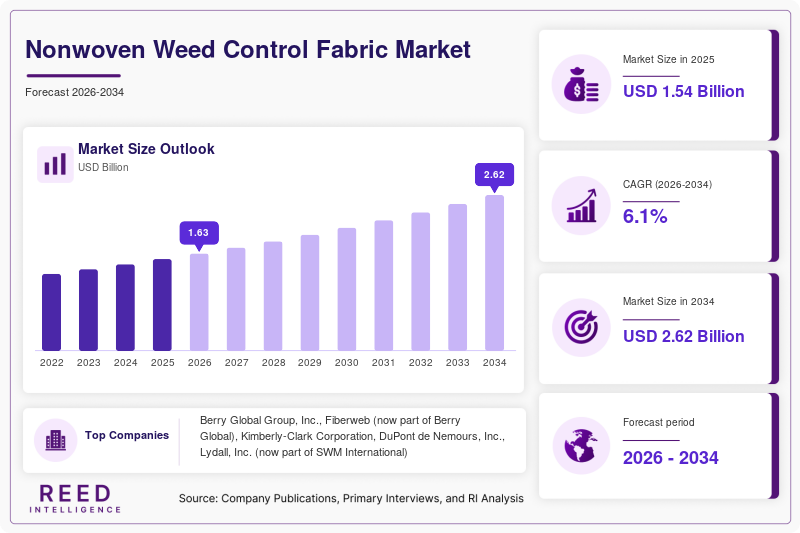
The Nonwoven Weed Control Fabric market size is projected at USD 1,485.6 million in 2026 and is expected to hit USD 2,485.3 million by 2034 with a CAGR of 6.6% during the forecast period. The increasing demand for sustainable and efficient weed management solutions in agriculture, horticulture, and landscaping, coupled with the growing awareness of the environmental benefits of nonwoven fabrics, underpins market expansion. This report delivers a comprehensive analysis of the Nonwoven Weed Control Fabric market, including segmentation by material and application, competitive dynamics, and regional growth patterns, equipping stakeholders with critical intelligence. The Nonwoven Weed Control Fabric market continues to demonstrate strong growth potential, fueled by the rising global population and food demand, the increasing adoption of modern agricultural practices, and continuous innovation in nonwoven fabric technology.
Key Takeaways
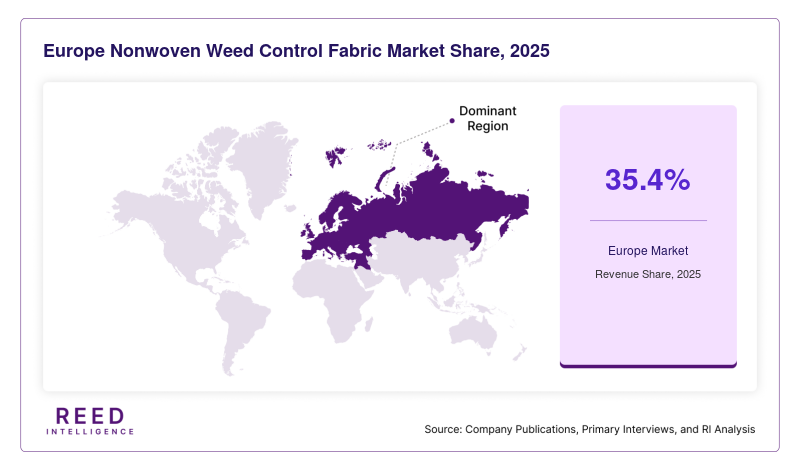
- Dominant Region: Europe leads the Nonwoven Weed Control Fabric market with a 35% share, while Asia-Pacific is the fastest-growing region with a projected CAGR of 7.5% through 2034.
- Dominant Segment: The Polypropylene material type dominates the market with a 60% share, while the Agriculture & Horticulture application is the leading segment with a 50% share.
- Emerging Country: The United States is projected to reach USD 485.6 million by 2034, expanding at a CAGR of 6.2%.
- Key Drivers: The increasing adoption of sustainable agricultural practices, the growing demand for high-value crops, and the need for efficient weed control are driving market growth.
Nonwoven Weed Control Fabric Market Trends
Growing Demand for Biodegradable and Eco-Friendly Fabrics
The Nonwoven Weed Control Fabric market is witnessing a significant trend toward the development and adoption of biodegradable and eco-friendly fabrics. This is driven by increasing environmental concerns, stringent regulations on plastic waste, and the growing preference for sustainable agricultural practices. Manufacturers are investing in research and development to produce nonwoven fabrics from natural fibers like jute, hemp, and PLA, which decompose naturally without harming the soil or environment. This trend is expected to create new opportunities for innovation and market expansion in the coming years.
Increasing Adoption of Precision Agriculture and Smart Farming
The increasing adoption of precision agriculture and smart farming techniques is a major trend shaping the Nonwoven Weed Control Fabric market. The integration of nonwoven fabrics with advanced irrigation systems, soil sensors, and automated machinery is enhancing the efficiency and effectiveness of weed control. The use of nonwoven fabrics in high-value crop production, such as fruits, vegetables, and ornamental plants, is also gaining momentum, driven by the need for improved crop quality and yield.
Nonwoven Weed Control Fabric Market Drivers
The Nonwoven Weed Control Fabric market's expansion is primarily driven by the increasing global population and the growing demand for food, which necessitates higher agricultural productivity. The need for sustainable and efficient weed management solutions that reduce the reliance on chemical herbicides has been a major driver, with nonwoven fabrics offering a safe and environmentally friendly alternative. The growing awareness of the environmental benefits of nonwoven fabrics, such as soil conservation and water retention, has also fueled market demand. Additionally, the increasing adoption of modern agricultural practices and the expansion of the horticulture and landscaping sectors have spurred growth.
Nonwoven Weed Control Fabric Market Restraints
Despite favorable growth prospects, the Nonwoven Weed Control Fabric market faces significant constraints, primarily related to the high initial cost of nonwoven fabrics compared to traditional weed control methods, such as chemical herbicides and plastic mulch. The lack of awareness and limited availability of high-quality nonwoven fabrics in developing regions can also be a limitation. The Nonwoven Weed Control Fabric market's growth is also tempered by the competition from other weed control methods, such as organic mulches and mechanical weeding.
Nonwoven Weed Control Fabric Market Opportunities
The Nonwoven Weed Control Fabric market presents significant opportunities in the rapidly expanding market for sustainable and organic agriculture, where nonwoven fabrics are increasingly used as a safe and effective weed control solution. The development of biodegradable and value-added nonwoven fabrics with enhanced properties, such as UV resistance and soil conditioning capabilities, is expected to create new growth avenues. Emerging opportunities also exist in the integration of nonwoven fabrics with smart farming technologies and the expansion of the market in developing regions.
Challenges in Nonwoven Weed Control Fabric Market
The Nonwoven Weed Control Fabric market faces persistent challenges related to the need for continuous innovation to develop more sustainable, cost-effective, and high-performance fabrics. The complexity of managing the supply chain and ensuring the availability of high-quality raw materials can also be a challenge. The market is also contending with the challenge of educating farmers and landscapers about the benefits and proper use of nonwoven weed control fabrics.
Nonwoven Weed Control Fabric Market Segmentation Analysis
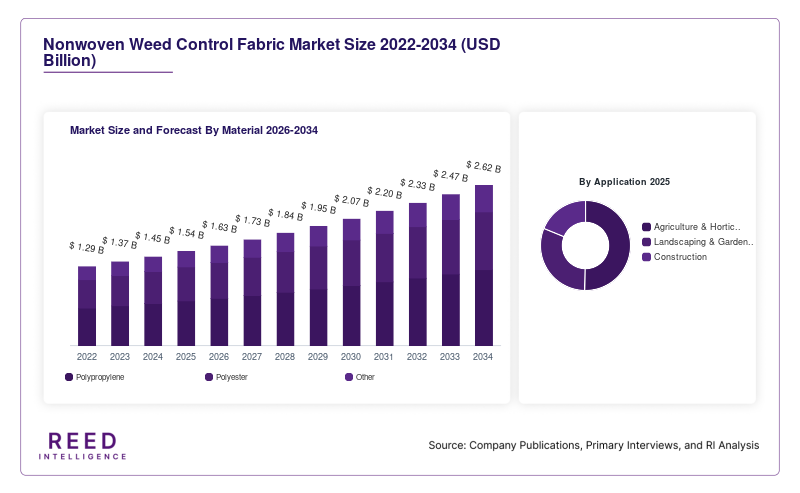
The Nonwoven Weed Control Fabric market is segmented by Material and Application to provide a comprehensive market perspective. By Material, Polypropylene dominates with a 60% market share, driven by its durability, cost-effectiveness, and wide availability. The Application segment is led by Agriculture & Horticulture, which accounts for 50% of the market, followed by Landscaping & Gardening at 30%, and Construction at 20%.
By Material
Polypropylene represent the largest segment in the Nonwoven Weed Control Fabric market, commanding a 60% share, with revenue exceeding USD 891 million in 2025. These are characterized by their high durability, resistance to degradation, and cost-effectiveness. Technical specifications include weight, tensile strength, and UV resistance. The Nonwoven Weed Control Fabric market's Polypropylene segment is driven by its use in a wide range of agricultural and landscaping applications.
Polyester capture a 30% share of the Nonwoven Weed Control Fabric market, with revenue of USD 446 million in 2025. These are characterized by their high strength, dimensional stability, and resistance to environmental degradation. Technical specifications include weight, tensile strength, and thermal stability. The Nonwoven Weed Control Fabric market's Polyester segment is driven by its use in high-demand applications requiring superior performance.
Other represent 10% of the market, with revenue of USD 149 million in 2025, including materials such as natural fibers and bioplastics. Technical specifications vary widely depending on the material. The Nonwoven Weed Control Fabric market's Other segment is driven by its use in niche and sustainable applications.
By Application
Agriculture & Horticulture dominates the Nonwoven Weed Control Fabric market, accounting for 50% of sales, representing USD 743 million in 2025. This segment includes use in row crops, orchards, vineyards, and nurseries for weed control, soil moisture conservation, and crop protection. Usage penetration exceeds 30% in high-value crop production. The Nonwoven Weed Control Fabric market's Agriculture & Horticulture segment is characterized by its focus on crop yield improvement and sustainability.
Landscaping & Gardening accounts for 30% of the Nonwoven Weed Control Fabric market, with revenue of USD 446 million in 2025. This segment encompasses use in residential and commercial landscaping, garden beds, and public green spaces for weed suppression and soil erosion control. The segment is growing at a strong CAGR, driven by the increasing popularity of gardening and landscaping. The Nonwoven Weed Control Fabric market's Landscaping & Gardening segment is characterized by its focus on aesthetics and ease of use.
Construction represents 20% of the market, with revenue of USD 297 million in 2025, involving use in erosion control, slope stabilization, and drainage applications in construction and civil engineering. The segment's growth is fueled by the increasing infrastructure development. The Nonwoven Weed Control Fabric market's Construction segment is characterized by its focus on durability and performance.
Nonwoven Weed Control Fabric Market Regional Analysis
Europe Nonwoven Weed Control Fabric Market
Leads the Nonwoven Weed Control Fabric market, commanding a 35% share, with a revenue of USD 520 million in 2025. Germany, France, and the UK are the primary drivers, collectively accounting for 55% of regional demand, driven by the strong agricultural and horticultural sectors, high environmental awareness, and strict regulations on chemical herbicides. The European Nonwoven Weed Control Fabric market is characterized by its focus on sustainability and quality.
Asia-Pacific Nonwoven Weed Control Fabric Market
Represents the second-largest market, capturing a 28% share with a revenue of USD 416 million in 2025. China, India, and Japan are the primary drivers, together accounting for 65% of regional demand, driven by the large agricultural sector, growing population, and increasing adoption of modern farming practices. The Asia-Pacific Nonwoven Weed Control Fabric market is projected to grow at the fastest CAGR of 7.5% through 2034.
North America Nonwoven Weed Control Fabric Market
Accounts for 22% of the global Nonwoven Weed Control Fabric market, with a revenue of USD 327 million in 2025. The United States is the primary driver, accounting for 85% of regional demand, driven by the advanced agricultural sector, high adoption of sustainable practices, and a strong focus on landscaping and horticulture. The North America Nonwoven Weed Control Fabric market is characterized by its focus on innovation and high-performance products.
Middle East & Africa and Latin America Nonwoven Weed Control Fabric Market
Together account for the remaining 15% of the Nonwoven Weed Control Fabric market, with Brazil and South Africa leading their respective regions. Both regions are projected to grow at CAGRs exceeding 7%, driven by increasing agricultural investments and growing awareness of sustainable weed control.
Top players in Nonwoven Weed Control Fabric Market
- Berry Global Group, Inc.
- Fiberweb (now part of Berry Global)
- Kimberly-Clark Corporation
- DuPont de Nemours, Inc.
- Lydall, Inc. (now part of SWM International)
- Conwed Plastics
- TenCate (now part of Low & Bonar)
- Mitsubishi Chemical Corporation
- Kuraray Co., Ltd.
- Toray Industries, Inc.
- Fitesa S.A.
- Asahi Kasei Corporation
- Freudenberg Performance Materials
- Johns Manville
- Kolon Industries, Inc.
Nonwoven Weed Control Fabric Market Segments
By Material
- Polypropylene
- Polyester
- Other
By Application
- Agriculture & Horticulture
- Landscaping & Gardening
- Construction
By Region
- North America
- Europe
- APAC
- Middle East and Africa
- LATAM