Nonylphenol Ethoxylate Market Size, Share & Demand Report By Application (Industrial Cleaning, Textile Processing, Agrochemicals, Paints & Coatings), By Form (Liquid, Solid), By End-use Industry (Chemicals, Textiles, Agriculture, Construction, Oil & Gas), By Distribution Channel (Direct Sales, Specialty Chemical Distributors, Industrial Suppliers), By Region & Segment Forecasts, 2026–2034
USD 3950
Market Overview
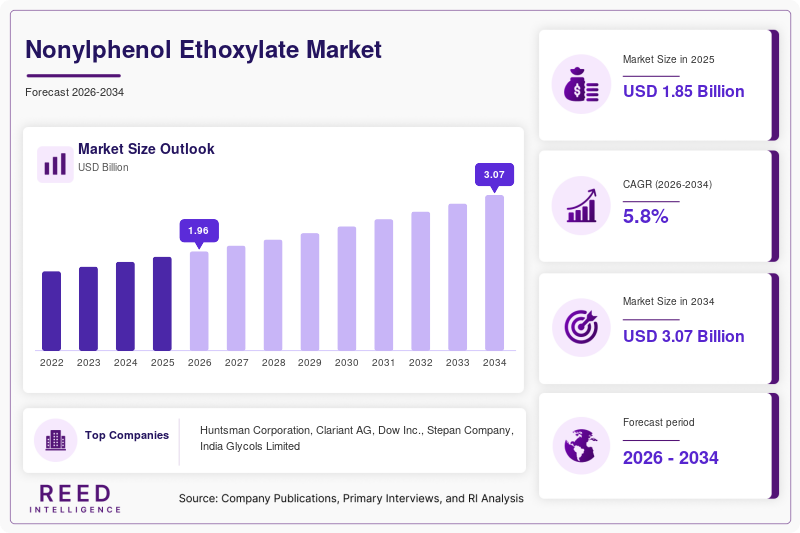
The Nonylphenol Ethoxylate Market size is estimated at USD 1.96 billion, and it is projected to reach USD 3.08 billion by 2034, registering a CAGR of 5.8% during 2026–2034. A major global factor supporting the growth of the Nonylphenol Ethoxylate Market is the continued expansion of industrial manufacturing activities across developing economies. Industrial sectors such as chemicals, textiles, construction, and agriculture are increasingly utilizing high-performance surfactants to improve processing efficiency, cleaning performance, emulsification properties, and formulation stability. Nonylphenol ethoxylates continue to maintain industrial relevance due to their strong wetting, dispersing, and detergent capabilities across multiple end-use industries.
The market is also benefiting from rapid urbanization, infrastructure expansion, and increasing industrial output in Asia Pacific, Latin America, and parts of the Middle East. Growing demand for industrial detergents, specialty chemicals, and crop protection formulations is further supporting the consumption of nonylphenol ethoxylates across commercial and industrial operations. In addition, manufacturers are investing in improved formulation technologies to enhance product efficiency and meet evolving industrial processing requirements.
Key Highlights
- Highest share region (2025): Asia Pacific – 43.5%
- Fastest-growing region CAGR (2026–2034): Middle East & Africa – 6.9%
- Leading subsegment (Application): Industrial Cleaning – 2025 share 31.4%
- Fastest-growing subsegment (End-use Industry): Agrochemicals – CAGR 7.2%
- Dominant country (2024): China – USD 0.41 billion
- Dominant country (2025): China – USD 0.45 billion
Market Trends
Increasing Demand for High-performance Industrial Surfactants
One major trend shaping the Nonylphenol Ethoxylate Market is the increasing industrial preference for high-efficiency surfactants capable of improving formulation stability and cleaning performance across complex manufacturing processes. Industries such as textiles, paints, coatings, and metal processing require surfactants that provide consistent emulsification and dispersing properties under varying temperature and chemical conditions. Nonylphenol ethoxylates continue to be utilized in several industrial environments where strong wetting and detergent characteristics remain critical to production efficiency.
Manufacturers are also focusing on customized surfactant formulations tailored to specific industrial applications. The development of application-specific blends is helping improve product effectiveness in industrial cleaning systems, agricultural formulations, and specialty chemical manufacturing processes. This trend is expected to maintain steady demand for nonylphenol ethoxylates in industrial operations where performance reliability is a major purchasing factor.
Expansion of Industrial Cleaning and Institutional Hygiene Applications
Another important trend influencing the Nonylphenol Ethoxylate Market is the growing demand for industrial and institutional cleaning solutions. Manufacturing facilities, warehouses, healthcare infrastructure, and commercial establishments are increasingly utilizing industrial cleaning chemicals containing surfactant-based formulations to maintain operational hygiene standards.
The rise in industrial sanitation requirements has increased demand for cleaning agents capable of handling grease, oil residues, and chemical contaminants effectively. Nonylphenol ethoxylates are being incorporated into several industrial detergent and degreasing formulations due to their ability to enhance surface penetration and emulsification efficiency. Growing awareness regarding workplace cleanliness and operational safety is further contributing to demand from industrial cleaning applications.
Market Drivers
Rising Demand from Textile Processing Industries
The growth of textile manufacturing activities is significantly driving the Nonylphenol Ethoxylate Market. Textile processing facilities widely utilize nonylphenol ethoxylates in dyeing, scouring, bleaching, and finishing operations due to their strong wetting and emulsification properties. Expanding textile exports from Asia Pacific countries are further increasing demand for specialty processing chemicals and surfactants.
Industrial textile manufacturers are increasingly focusing on improving production efficiency and maintaining consistent fabric quality standards. This has resulted in higher consumption of industrial surfactants capable of supporting uniform chemical processing performance across large-scale textile operations. The continued growth of apparel manufacturing and technical textile production is expected to support market demand during the forecast period.
Growth in Agrochemical Formulations
The increasing use of surfactants in pesticide and herbicide formulations is another major factor supporting the growth of the Nonylphenol Ethoxylate Market. Agrochemical manufacturers utilize nonylphenol ethoxylates to improve spreading, penetration, and dispersion characteristics in crop protection products.
Rising agricultural productivity requirements and increasing demand for efficient crop protection chemicals are contributing to higher surfactant consumption across farming applications. Developing agricultural economies are increasingly investing in advanced agrochemical solutions to improve crop yields and reduce pest-related losses. This trend is expected to create stable demand for industrial surfactants within agricultural formulation industries.
Market Restraint
Environmental and Regulatory Concerns Regarding Chemical Usage
One major restraint affecting the Nonylphenol Ethoxylate Market is the growing environmental concern regarding the disposal and ecological impact of certain surfactant compounds. Regulatory agencies in several developed economies have introduced stricter environmental guidelines related to industrial chemical usage and wastewater discharge.
These regulatory developments have increased compliance costs for manufacturers and encouraged some industries to explore alternative surfactant solutions. Additionally, environmental monitoring requirements and restrictions on industrial effluent disposal may limit market penetration in highly regulated regions.
Market Opportunities
Expansion of Oilfield Chemical Applications
The expansion of oilfield exploration and production activities is creating new opportunities for the Nonylphenol Ethoxylate Market. Oilfield service companies utilize surfactants in drilling fluids, enhanced oil recovery systems, and industrial cleaning applications. Increasing energy demand and rising upstream oilfield investments are expected to support additional market growth opportunities.
Emerging oil-producing economies are also investing in improved extraction technologies and production infrastructure. This trend is increasing demand for specialty industrial chemicals capable of enhancing drilling efficiency and operational performance in challenging environments.
Increasing Industrialization in Emerging Economies
Rapid industrialization across Asia Pacific, Africa, and Latin America is generating strong opportunities for the market. Expansion of manufacturing activities, chemical production facilities, and industrial infrastructure projects is increasing the requirement for surfactants and specialty processing chemicals.
Governments in developing economies are promoting industrial investments and infrastructure modernization projects to support economic growth. As industrial production capacity expands, demand for industrial cleaning agents, emulsifiers, and dispersing chemicals is expected to rise steadily.
Segmental Analysis
By Application
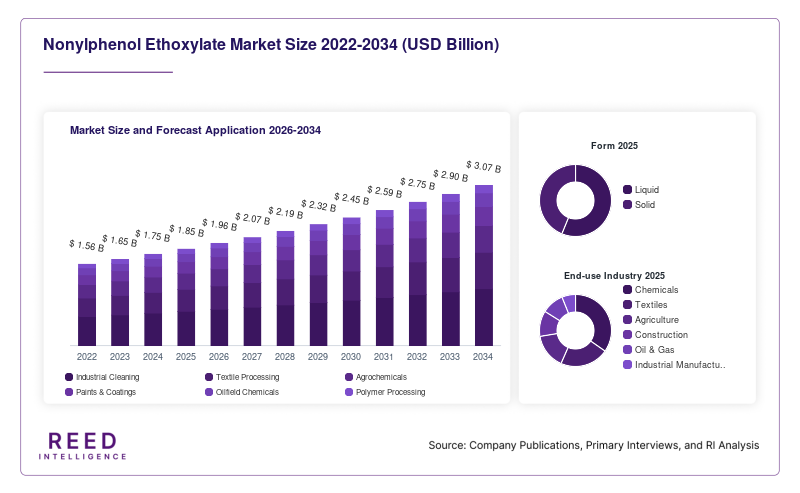
The Nonylphenol Ethoxylate Market is segmented into industrial cleaning, textile processing, agrochemicals, paints & coatings, oilfield chemicals, and polymer processing. Industrial cleaning dominated with a 31.4% share in 2025 due to increasing demand for industrial detergents and heavy-duty cleaning formulations across manufacturing facilities and institutional environments.
Agrochemicals are projected to grow at the fastest CAGR of 7.2% (2026–2034) due to increasing adoption of advanced crop protection formulations requiring improved surfactant efficiency and spreading performance.
By Form
Based on form, the market is segmented into liquid and solid formulations. Liquid nonylphenol ethoxylates accounted for 67.8% share in 2025 due to easier formulation compatibility, superior handling efficiency, and broad industrial application usage.
Solid formulations are projected to grow at a CAGR of 5.9% during the forecast period due to increasing demand for concentrated industrial chemical solutions and easier transportation requirements in certain manufacturing environments.
By End-use Industry
The end-use industries include chemicals, textiles, agriculture, construction, oil & gas, and industrial manufacturing. The chemical industry dominated with a 35.6% share in 2025 due to high consumption of surfactants in emulsification, dispersion, and industrial processing applications.
Agriculture is expected to grow at the fastest CAGR of 6.8% during the forecast period due to rising pesticide formulation demand and increasing focus on agricultural productivity improvement.
By Distribution Channel
Distribution channels include direct sales, specialty chemical distributors, industrial suppliers, and online B2B procurement platforms. Direct sales accounted for 48.2% share in 2025 due to long-term supply agreements between industrial chemical manufacturers and large end-use industries.
Online B2B procurement platforms are projected to grow at the fastest CAGR of 7.0% during 2026–2034 due to increasing digitization of industrial procurement systems and growing adoption of digital supply chain management solutions.
Regional Analysis
North America
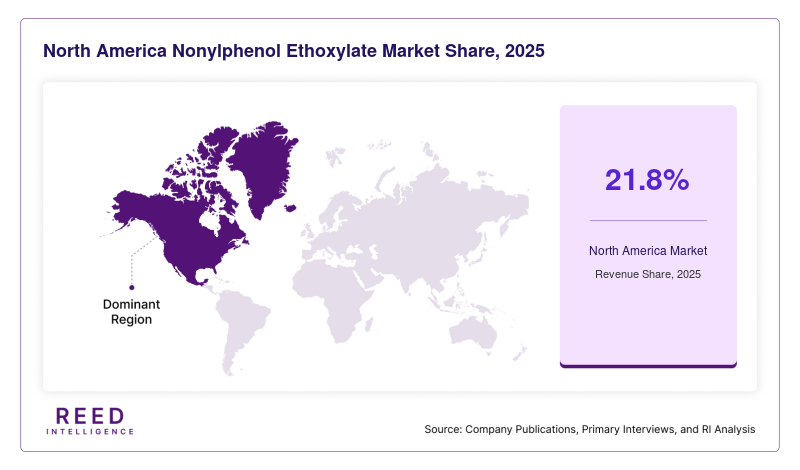
North America accounted for 21.8% share of the Nonylphenol Ethoxylate Market in 2025, supported by stable industrial manufacturing activities and strong demand from industrial cleaning applications. The region is expected to grow at a CAGR of 5.1% (2026–2034). The United States dominates the regional market due to its extensive chemical processing industry and high demand for specialty surfactant formulations across industrial operations.
Industrial maintenance activities, commercial sanitation requirements, and large-scale institutional cleaning operations continue to support product consumption across North America. In addition, growth in oilfield chemical applications across the United States and Canada is contributing to stable market demand.
Europe
Europe held 19.7% share in 2025, driven by demand from industrial processing industries and specialty chemical manufacturing sectors. The region is projected to grow at a CAGR of 4.8% (2026–2034). Germany remains the dominant country due to its strong industrial production capabilities and advanced manufacturing infrastructure.
The regional market is also supported by demand from paints, coatings, and industrial maintenance applications. Manufacturers are increasingly focusing on improving product efficiency and industrial formulation performance to maintain competitiveness across European industrial markets.
Asia Pacific
Asia Pacific captured 43.5% share in 2025 and is projected to grow at a CAGR of 6.5% (2026–2034) in the Nonylphenol Ethoxylate Market. China remains the dominant country due to large-scale chemical manufacturing activities, expanding textile production, and increasing agrochemical consumption.
India is also emerging as a major industrial surfactant consumer due to rising industrialization and growing agricultural chemical demand. Expanding industrial infrastructure projects, rapid urbanization, and increasing export-oriented manufacturing activities are expected to strengthen regional market growth throughout the forecast period.
Middle East & Africa
Middle East & Africa accounted for 8.2% share in 2025 and is projected to grow at the fastest CAGR of 6.9% during the forecast period. Saudi Arabia dominates the regional market due to increasing petrochemical investments and expanding industrial processing infrastructure.
The region is also witnessing rising demand for industrial cleaning products and oilfield chemicals across energy and manufacturing sectors. Growing infrastructure modernization activities are expected to support additional market opportunities for industrial surfactant suppliers.
Latin America
Latin America represented 6.8% share in 2025 and is projected to grow at a CAGR of 5.4% (2026–2034). Brazil leads the regional market due to increasing agricultural chemical consumption and expanding industrial cleaning applications.
Growing agrochemical manufacturing activities and rising industrial production are contributing to stable market expansion across the region. Demand from textile processing and construction-related chemical applications is also supporting regional product consumption.
Competitive Landscape
The Nonylphenol Ethoxylate Market is moderately fragmented, with several multinational chemical manufacturers and regional specialty surfactant suppliers competing through product quality, formulation expertise, and industrial distribution capabilities. Market participants are focusing on improving product efficiency, enhancing industrial application compatibility, and expanding regional manufacturing capacity to strengthen their competitive positions.
Major companies operating in the market include Huntsman Corporation, Clariant AG, Dow Inc., Stepan Company, and India Glycols Limited. Huntsman Corporation remains one of the key market participants due to its diversified industrial surfactant portfolio and strong global distribution network. The company has continued investing in specialty chemical product development and industrial formulation technologies to address changing industrial processing requirements.
Manufacturers are also focusing on strategic collaborations with industrial chemical distributors and end-use industries to improve supply chain efficiency and strengthen customer relationships. Increasing investment in industrial research and process optimization technologies is expected to remain an important competitive strategy across the global market.
Key Players List
- Huntsman Corporation
- Clariant AG
- Dow Inc.
- Stepan Company
- India Glycols Limited
- BASF SE
- Akzo Nobel N.V.
- Solvay S.A.
- Sasol Limited
- Croda International Plc
- Kao Corporation
- PCC Group
- Oxiteno S.A.
- Galaxy Surfactants Ltd.
- Evonik Industries AG
Recent Developments
- 2025: Several chemical manufacturers expanded industrial surfactant production capacity across Asia Pacific.
- 2025: Huntsman Corporation introduced upgraded industrial cleaning surfactant formulations for manufacturing applications.
- 2024: Clariant AG increased investment in specialty chemical research and industrial process optimization technologies.
- 2024: Multiple agrochemical companies expanded surfactant procurement for advanced pesticide formulations.
- 2024: Industrial cleaning product manufacturers introduced high-efficiency degreasing formulations using specialty surfactants.
- 2024: Chemical suppliers strengthened regional distribution partnerships across Latin America and the Middle East.
- 2024: Online industrial procurement platforms expanded specialty surfactant sourcing capabilities for industrial customers.
Nonylphenol Ethoxylate Market Segments
Application
- Industrial Cleaning
- Textile Processing
- Agrochemicals
- Paints & Coatings
- Oilfield Chemicals
- Polymer Processing
Form
- Liquid
- Solid
End-use Industry
- Chemicals
- Textiles
- Agriculture
- Construction
- Oil & Gas
- Industrial Manufacturing
Distribution Channel
- Direct Sales
- Specialty Chemical Distributors
- Industrial Suppliers
- Online B2B Procurement Platforms
By Region
- North America
- Europe
- APAC
- Middle East and Africa
- LATAM