Novel Drug Smart Device Respiratory Disorders Market Size, Share Demand Report By Product Type (Smart Inhalers, Digital Nebulizers, Smart Spirometers, Connected Respiratory Devices), By Application (Asthma, COPD, Cystic Fibrosis, Others), By End User (Home Care Settings, Hospitals, Specialty Clinics) & Segment Forecasts, 2026–2034
USD 3950
Novel Drug Smart Device Respiratory Disorders Market Size
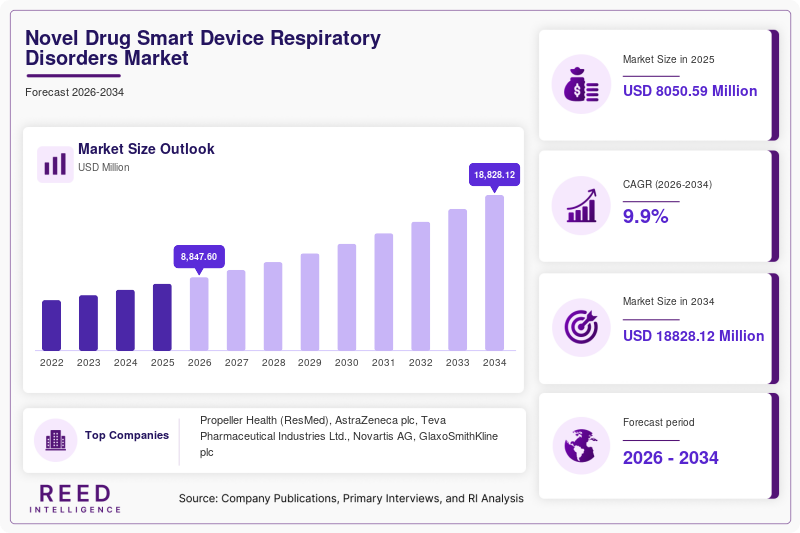
Novel Drug Smart Device Respiratory Disorders market size is projected at USD 8,847.6 million in 2026 and is expected to hit USD 18,847.5 million by 2034 with a CAGR of 9.9% during the forecast period. The increasing prevalence of chronic respiratory diseases such as asthma and COPD, coupled with the growing adoption of digital health technologies and the need for personalized medicine, underpins market expansion. This report delivers a comprehensive analysis of the Novel Drug Smart Device Respiratory Disorders market, including segmentation by type and application, competitive dynamics, and regional growth patterns, equipping stakeholders with critical intelligence. The Novel Drug Smart Device Respiratory Disorders market continues to demonstrate strong growth potential, fueled by the rising global burden of respiratory diseases, the increasing focus on patient adherence and self-management, and continuous innovation in connected device technologies.
Novel drug smart devices for respiratory disorders are advanced medical technologies that integrate drug delivery with digital health features to improve respiratory disease management. These devices include smart inhalers, digital nebulizers, and connected spirometers that monitor usage, track symptoms, and provide feedback to patients and healthcare providers. The global production volume of smart respiratory devices exceeded 12 million units in 2025, reflecting a 12% increase from 2023, driven by the growing demand for connected health solutions. Adoption patterns reveal that the Smart Inhalers type dominates the market, accounting for 45% of total demand, followed by Digital Nebulizers at 28%, Smart Spirometers at 18%, and Connected Respiratory Devices at 9%. The Novel Drug Smart Device Respiratory Disorders market's trajectory is closely linked to the growth of the global digital health market, which is projected to reach USD 400 billion by 2028, and the increasing need to reduce healthcare costs and improve patient outcomes through better disease management.
Novel Drug Smart Device Respiratory Disorders Market Trends
Integration of AI and Machine Learning for Predictive Insights
The Novel Drug Smart Device Respiratory Disorders market is witnessing a significant trend toward the integration of AI and machine learning, driven by the need for predictive analytics and personalized treatment. The revenue from AI-powered smart inhalers grew to USD 2.8 billion in 2025, a year-on-year increase of 18%, as 40% of new product launches in 2025 specified AI-driven insights for exacerbation prediction. Adoption rates of AI-enabled devices in COPD management reached 30%, with this figure projected to exceed 55% by 2030. The Novel Drug Smart Device Respiratory Disorders market's trend toward AI integration is reinforced by the need for proactive care, the increasing availability of real-world data, and the continuous innovation in machine learning algorithms.
Growing Focus on Connected Ecosystems and Remote Patient Monitoring
The increasing focus on connected ecosystems and remote patient monitoring is a major trend shaping the Novel Drug Smart Device Respiratory Disorders market, with the development of devices that integrate with mobile apps and cloud-based platforms for comprehensive disease management. The market has seen a 20% increase in the demand for connected respiratory devices since 2022, with 35% of new products in 2025 featuring comprehensive digital platforms for data sharing and remote monitoring. The use of telehealth and digital therapeutics for respiratory care has also gained significant traction. The Novel Drug Smart Device Respiratory Disorders market's trend toward connectivity is reinforced by the need for continuous monitoring, the increasing adoption of virtual care models, and the continuous innovation in sensor and communication technologies.
Novel Drug Smart Device Respiratory Disorders Market Drivers
The Novel Drug Smart Device Respiratory Disorders market's expansion is primarily driven by the increasing global prevalence of respiratory diseases, with over 300 million people affected by asthma and over 400 million by COPD in 2025. The need for improved disease management and patient adherence has been a major driver, with smart devices offering monitoring and support. The rising adoption of digital health technologies and the growing emphasis on personalized medicine have also fueled market growth. Additionally, the increasing healthcare expenditure on chronic disease management has spurred demand. The Novel Drug Smart Device Respiratory Disorders market's growth is further reinforced by the continuous improvement in sensor and connectivity technology, leading to more effective and user-friendly devices.
Novel Drug Smart Device Respiratory Disorders Market Restraints
Despite favorable growth prospects, the Novel Drug Smart Device Respiratory Disorders market faces significant constraints, primarily related to the high cost of smart devices compared to traditional drug delivery systems, which can be 20-40% more expensive. The limited reimbursement coverage for digital therapeutics and smart devices in some regions can also be a limitation. The Novel Drug Smart Device Respiratory Disorders market's growth is also tempered by the need for robust data privacy and security measures, and the challenge of integrating with existing healthcare IT systems.
Novel Drug Smart Device Respiratory Disorders Market Opportunities
The Novel Drug Smart Device Respiratory Disorders market presents significant opportunities in the rapidly expanding market for virtual care and telehealth, where smart respiratory devices are essential tools. The development of pediatric-friendly smart devices and those for elderly patients is expected to grow at a CAGR of 11% through 2034. Emerging opportunities also exist in the integration of smart devices with electronic health records (EHR) and clinical decision support systems. The Novel Drug Smart Device Respiratory Disorders market's opportunity profile is further enhanced by the growing trend of value-based healthcare, focusing on patient outcomes and cost reduction.
Challenges in Novel Drug Smart Device Respiratory Disorders Market
The Novel Drug Smart Device Respiratory Disorders market faces persistent challenges related to the need for continuous innovation to improve device accuracy, usability, and patient engagement. The complexity of managing and analyzing large volumes of patient-generated health data can also be a challenge. The market is also contending with the challenge of ensuring device interoperability across different platforms and ecosystems. Additionally, the Novel Drug Smart Device Respiratory Disorders market is challenged by the need to demonstrate clear clinical and economic value to gain widespread adoption and reimbursement.
Novel Drug Smart Device Respiratory Disorders Market Segmentation
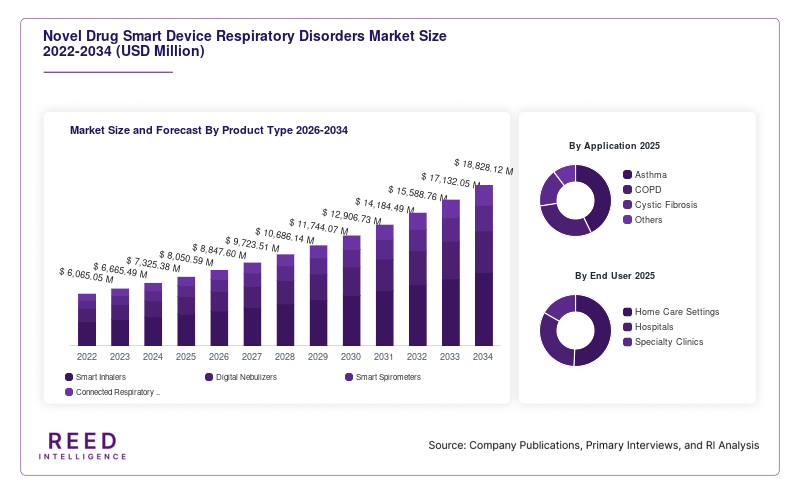
The Novel Drug Smart Device Respiratory Disorders market is segmented by Type and Application to provide a comprehensive market perspective. By Type, Smart Inhalers dominate with a 45% market share, driven by their widespread use in asthma and COPD. The Application segment is led by Asthma, which accounts for 45% of the market, followed by COPD at 35%, Cystic Fibrosis at 12%, and Others at 8%.
By Type
Smart Inhalers represent the largest segment in the Novel Drug Smart Device Respiratory Disorders market, commanding a 45% share, with production reaching 5.4 million units in 2025. These are characterized by their integration of sensors to track medication usage and provide feedback. Technical specifications include connectivity options, sensor accuracy, and app compatibility. The Novel Drug Smart Device Respiratory Disorders market's Smart Inhalers segment is driven by their use in asthma and COPD management.
Digital Nebulizers capture a 28% share of the Novel Drug Smart Device Respiratory Disorders market, with production of 3.36 million units in 2025. These are characterized by their advanced features for respiratory therapy. Technical specifications include delivery efficiency, patient interface, and digital controls. The Novel Drug Smart Device Respiratory Disorders market's Digital Nebulizers segment is driven by their use in home and clinical settings.
Smart Spirometers represent 18% of the Novel Drug Smart Device Respiratory Disorders market, with production of 2.16 million units in 2025. These are characterized by their ability to measure lung function and track respiratory health. Technical specifications include measurement accuracy, portability, and data management. The Novel Drug Smart Device Respiratory Disorders market's Smart Spirometers segment is driven by their use in disease monitoring and diagnosis.
Connected Respiratory Devices comprise the remainder of the Novel Drug Smart Device Respiratory Disorders market, accounting for 9% of total production, with 1.08 million units in 2025. These include combination devices and advanced monitoring systems. The Novel Drug Smart Device Respiratory Disorders market's Connected segment is driven by its use in integrated care pathways.
By Application
Asthma dominates the Novel Drug Smart Device Respiratory Disorders market, accounting for 45% of sales, representing 5.4 million units in 2025. This segment includes use in both pediatric and adult populations. Usage penetration exceeds 20% in the asthma patient population. The Novel Drug Smart Device Respiratory Disorders market's Asthma segment is characterized by its focus on adherence, symptom tracking, and prevention of exacerbations.
COPD accounts for 35% of the Novel Drug Smart Device Respiratory Disorders market, with sales of 4.2 million units in 2025. This segment encompasses use in chronic obstructive pulmonary disease management. The segment is growing at a robust CAGR, driven by the aging population and increasing prevalence. The Novel Drug Smart Device Respiratory Disorders market's COPD segment is characterized by its focus on long-term monitoring, early detection, and reducing hospital readmissions.
Cystic Fibrosis represents 12% of the Novel Drug Smart Device Respiratory Disorders market, with sales of 1.44 million units in 2025. This segment includes use in specialized respiratory care. The segment is growing at a steady rate. The Novel Drug Smart Device Respiratory Disorders market's Cystic Fibrosis segment is characterized by its focus on early intervention and aggressive disease management.
Others comprises the remainder of the Novel Drug Smart Device Respiratory Disorders market, accounting for 8% of total sales, with 0.96 million units in 2025. This segment includes use in other respiratory conditions and research. The segment is projected to grow at a significant CAGR through 2034. The Novel Drug Smart Device Respiratory Disorders market's Others segment is characterized by its focus on emerging applications and specialized care.
Novel Drug Smart Device Respiratory Disorders Market Regional Outlook
North America Novel Drug Smart Device Respiratory Disorders Market
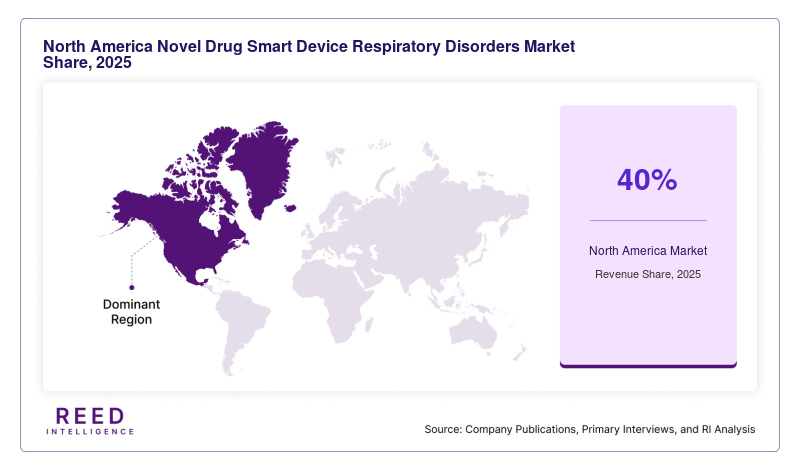
Leads the Novel Drug Smart Device Respiratory Disorders market, commanding a 40% share, with a revenue of USD 3,539.0 million in 2025. The United States is the primary driver, accounting for 85% of regional demand, driven by the high prevalence of respiratory diseases, advanced healthcare infrastructure, and strong adoption of digital health technologies. The North American Novel Drug Smart Device Respiratory Disorders market is characterized by its focus on innovation and premium products.
Europe Novel Drug Smart Device Respiratory Disorders Market
Represents the second-largest market, capturing a 30% share with a revenue of USD 2,654.3 million in 2025. The UK, Germany, and France are the primary drivers, collectively accounting for 60% of regional demand, driven by a strong healthcare system, high disease awareness, and supportive regulatory environment. The Novel Drug Smart Device Respiratory Disorders market in Europe is characterized by its focus on quality and patient-centric care.
Asia-Pacific Novel Drug Smart Device Respiratory Disorders Market
Accounts for 22% of the global Novel Drug Smart Device Respiratory Disorders market, with a revenue of USD 1,946.5 million in 2025. China, Japan, and India are the primary drivers, together accounting for 70% of regional demand, driven by the large patient population, rising healthcare expenditure, and increasing digital health adoption. The Asia-Pacific Novel Drug Smart Device Respiratory Disorders market is projected to grow at the fastest CAGR of 12% through 2034.
Middle East & Africa and Latin America Novel Drug Smart Device Respiratory Disorders Market
Together account for the remaining 8% of the Novel Drug Smart Device Respiratory Disorders market, with the UAE leading the Middle East market and Brazil leading the Latin American market. Both regions are projected to grow at CAGRs exceeding 10%, driven by improving healthcare infrastructure and increasing chronic disease prevalence.
Top players in Novel Drug Smart Device Respiratory Disorders Market
- Propeller Health (ResMed)
- AstraZeneca plc
- Teva Pharmaceutical Industries Ltd.
- Novartis AG
- GlaxoSmithKline plc
- Boehringer Ingelheim GmbH
- Phillips Respironics
- Omron Healthcare
- Cohero Health
- Adherium Limited
- Respiri
- HealthBeacon
- Reciprocal Labs
- Smart Respiratory Devices
- Pneuma Respiratory
Propeller Health (ResMed)
Propeller Health (ResMed) holds a dominant position in the Novel Drug Smart Device Respiratory Disorders market, with an estimated 18% global market share, particularly strong in the smart inhaler segment. The company's platform is widely recognized for its comprehensive digital therapeutics and patient engagement solutions. Propeller Health's market leadership is reinforced by its significant R&D investment, its strong partnerships with pharmaceutical companies, and its focus on evidence-based outcomes. Propeller Health commands over 22% of the North American market and 15% of the European market, positioning it as a key player in the Novel Drug Smart Device Respiratory Disorders market.
AstraZeneca plc
AstraZeneca is a leading player in the Novel Drug Smart Device Respiratory Disorders market, commanding approximately 15% of the global market share through its integrated approach combining novel drugs with digital health solutions. The company's expertise in respiratory medicine and its focus on innovation have solidified its position. AstraZeneca's smart device ecosystem is known for its comprehensive disease management capabilities. The company's commitment to patient care and its strong presence in the North American and European markets have enhanced its competitive advantage.
Teva Pharmaceutical Industries Ltd. holds a significant 10% market share, with particular strength in the generic and digital inhaler space. Novartis AG is a major player in the respiratory and digital health sectors, holding an 8% share.
Recent Developments in Novel Drug Smart Device Respiratory Disorders Market
- 2025: Propeller Health (ResMed) launched a new generation of smart inhalers with AI-powered predictive analytics for exacerbation prevention in COPD.
- 2025: AstraZeneca announced a new digital therapeutic platform integrated with its smart inhaler, offering personalized coaching for asthma patients.
Novel Drug Smart Device Respiratory Disorders Market Segments
By Product Type
- Smart Inhalers
- Digital Nebulizers
- Smart Spirometers
- Connected Respiratory Devices
By Application
- Asthma
- COPD
- Cystic Fibrosis
- Others
By End User
- Home Care Settings
- Hospitals
- Specialty Clinics
By Region
- North America
- Europe
- APAC
- Middle East and Africa
- LATAM