Nuclear LED Lighting Market Size, Share, Demand & Growth Report By Type (LED Fixtures, Sensors, Control Systems, Radiation-Hardened Lighting Modules), By Application (Structural Health Monitoring, Safety & Emergency Lighting, Nuclear Waste Management, Reactor Core & Containment Lighting), By End-use (Nuclear Power Plants, Nuclear Research Laboratories, Nuclear Decommissioning Sites, Radioactive Waste Storage Facilities), By Region Forecasts, 2026–2034
USD 3950
Market Overview
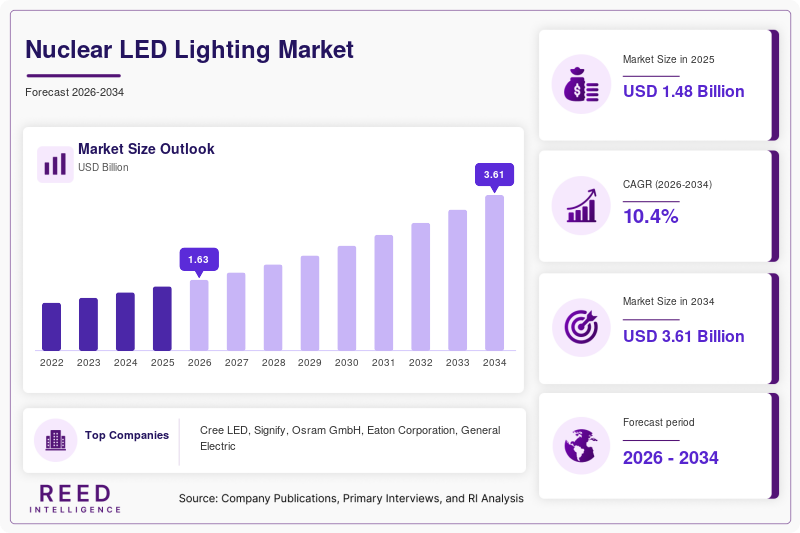
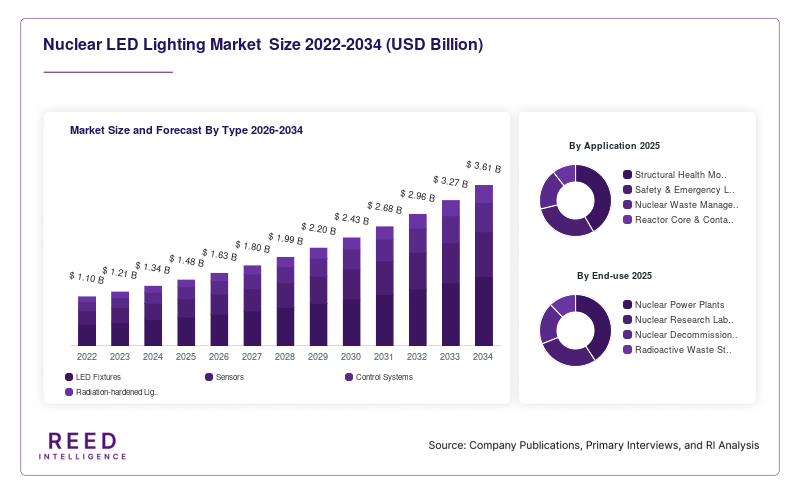
The global Nuclear LED Lighting Market size was valued at USD 1.48 billion in 2026 and is projected to reach USD 3.26 billion by 2034, expanding at a CAGR of 10.4% during the forecast period from 2026 to 2034. The market is gaining traction due to the modernization of nuclear power infrastructure and the increasing need for durable lighting systems that can operate in harsh radiation-intensive environments. Nuclear facilities require lighting products that provide stable illumination, low maintenance, thermal resistance, and long operational life. LED lighting technologies have become suitable for these requirements because they reduce energy consumption and improve operational efficiency in controlled industrial environments.
Governments and utility operators across developed and emerging economies are investing in the refurbishment of aging nuclear plants while also supporting new reactor construction programs. This global transition toward cleaner power generation and energy security has increased demand for advanced industrial lighting systems. Nuclear-grade LED solutions are increasingly used in containment areas, turbine halls, cooling systems, emergency response zones, and inspection corridors. Manufacturers are also focusing on smart monitoring capabilities and radiation-resistant materials to improve product reliability and compliance with nuclear safety standards.
Key Highlights
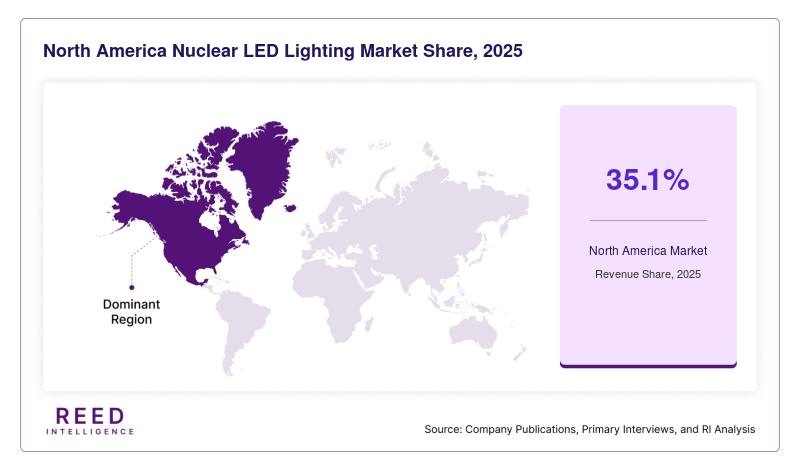
- North America dominated the market with a 35.1% share in 2025, while Asia Pacific is expected to grow at the fastest CAGR of 11.8% during 2026–2034.
- By product type, fixed nuclear LED luminaires accounted for the largest share of 42.6%, while portable radiation-resistant LED systems are projected to grow at a CAGR of 12.5%.
- By application, reactor containment lighting led with a 39.4% share, whereas emergency backup lighting is expected to expand at a CAGR of 11.9%.
- The United States remained the dominant country, with market values of USD 420 million in 2024 and USD 462 million in 2025.
Market Trends
Smart Monitoring Integration in Nuclear Lighting Infrastructure
The Nuclear LED Lighting Market is witnessing increased integration of smart monitoring technologies within industrial lighting systems. Nuclear facilities are adopting connected lighting platforms that enable remote diagnostics, predictive maintenance, and real-time monitoring of energy consumption. Operators prefer intelligent LED systems because they help reduce inspection time and improve safety compliance within radiation-sensitive environments. Advanced lighting units equipped with wireless sensors and centralized monitoring platforms allow maintenance teams to identify equipment degradation before failures occur. This trend is becoming more significant in large nuclear stations where continuous monitoring is necessary to maintain uninterrupted operations.
Digital transformation initiatives across the energy sector are also supporting the adoption of intelligent LED systems. Lighting manufacturers are developing products with automated dimming functions, occupancy sensors, and thermal management capabilities to improve operational efficiency. Nuclear operators are increasingly focusing on reducing maintenance exposure for workers in hazardous zones, which supports the deployment of remotely managed lighting systems. The trend is expected to strengthen further as utilities modernize older nuclear facilities and integrate industrial automation technologies into critical infrastructure.
Growing Preference for Radiation-Resistant and Long-Life Lighting Systems
The market is experiencing growing demand for radiation-resistant LED lighting systems designed specifically for high-temperature and high-radiation environments. Conventional lighting products often degrade rapidly under radiation exposure, creating operational and maintenance challenges in nuclear facilities. Manufacturers are therefore focusing on specialized coatings, reinforced semiconductor materials, and advanced heat dissipation technologies to improve lighting durability. These developments are increasing the adoption of nuclear-grade LED products in reactor containment zones, cooling stations, and waste management facilities.
Long operational lifespan has become a major purchasing factor for utility operators seeking to minimize maintenance shutdowns and replacement costs. Nuclear facilities typically operate continuously for extended periods, making durable lighting infrastructure essential for maintaining productivity and worker safety. LED systems with extended operating life and reduced failure rates are becoming more attractive than fluorescent and incandescent alternatives. The trend is also supported by stricter safety regulations and growing investments in nuclear facility modernization programs across Europe, North America, and Asia Pacific.
Market Drivers
Expansion of Nuclear Power Generation Projects Worldwide
The increasing number of nuclear power generation projects across developed and emerging economies is supporting the growth of the Nuclear LED Lighting Market. Governments are expanding nuclear energy capacity to improve energy security, reduce carbon emissions, and stabilize electricity supply. New reactor construction projects require advanced lighting infrastructure capable of operating efficiently in high-risk industrial environments. LED lighting products are increasingly preferred because they consume less energy, provide stronger illumination, and require minimal maintenance over long operational cycles.
Several countries are investing heavily in small modular reactors and next-generation nuclear technologies, which is creating additional demand for specialized industrial lighting systems. Lighting manufacturers are collaborating with engineering contractors and utility operators to deliver customized solutions for containment structures, turbine rooms, and underground maintenance areas. The shift toward modern nuclear infrastructure is expected to maintain steady demand for radiation-resistant and energy-efficient lighting products during the forecast period.
Rising Focus on Operational Safety and Energy Efficiency
Operational safety remains a critical priority for nuclear facility operators, driving investments in high-performance LED lighting systems. Nuclear environments require consistent illumination for monitoring, inspections, maintenance procedures, and emergency response activities. LED lighting systems provide superior visibility and stable performance under challenging operating conditions, which supports workplace safety and operational continuity. Improved lighting quality also reduces the risk of human error during routine and emergency operations.
Energy efficiency initiatives are another major growth factor supporting market expansion. Nuclear facilities are under increasing pressure to reduce operating costs and optimize energy consumption across infrastructure systems. LED technology consumes significantly less electricity than traditional lighting alternatives while delivering higher brightness and longer service life. Utility operators are replacing aging fluorescent systems with LED products to reduce maintenance expenditure and downtime. This transition is accelerating in both newly constructed facilities and aging reactors undergoing refurbishment projects.
Market Restraint
High Certification Costs and Complex Regulatory Requirements
The Nuclear LED Lighting Market faces challenges due to strict regulatory requirements and high product certification costs. Nuclear facilities operate under highly controlled environments where all equipment must comply with rigorous safety, radiation resistance, thermal endurance, and operational reliability standards. Lighting manufacturers are required to conduct extensive testing and validation procedures before products can be approved for nuclear applications. These certification processes increase development costs and lengthen product commercialization timelines.
Smaller manufacturers often struggle to enter the market because of the substantial investment required for compliance testing and product customization. In addition, nuclear projects usually involve long procurement cycles and complex approval procedures managed by government agencies and utility operators. Delays in reactor construction or modernization projects can also affect lighting equipment demand. The regulatory burden becomes more challenging in international markets where standards differ across regions, forcing suppliers to adapt products to multiple certification frameworks. These factors may limit market entry opportunities and slow the pace of technological innovation within the industry.
Market Opportunities
Increasing Investments in Small Modular Reactor Infrastructure
The growing development of small modular reactors is creating favorable opportunities for the Nuclear LED Lighting Market. Small modular reactors require compact, highly efficient, and digitally integrated infrastructure systems, including advanced lighting technologies. These facilities are designed with modular layouts and automated operations, increasing the need for intelligent LED solutions capable of supporting remote monitoring and energy optimization. Lighting manufacturers are developing specialized products tailored for smaller containment areas and compact reactor environments.
Governments and private energy companies are increasing investments in modular nuclear technologies to support low-carbon electricity generation and decentralized power supply systems. This expansion is expected to create new procurement opportunities for industrial lighting suppliers. Small modular reactor projects also prioritize operational efficiency and reduced maintenance requirements, making long-life LED systems attractive for facility operators. As commercial deployment of modular reactors expands, demand for customized radiation-resistant lighting products is expected to increase significantly.
Growth Potential in Nuclear Facility Refurbishment Programs
Aging nuclear infrastructure across North America and Europe is generating strong opportunities for LED lighting replacement and modernization projects. Many nuclear plants built several decades ago continue to operate after receiving life-extension approvals from regulatory authorities. Facility operators are investing in infrastructure upgrades to improve safety performance, energy efficiency, and operational reliability. Lighting modernization has become an important component of these refurbishment programs.
Nuclear operators are replacing outdated fluorescent and halogen lighting systems with modern LED solutions that provide longer lifespan, lower energy consumption, and better illumination quality. Refurbishment activities also create demand for portable emergency lighting and smart inspection systems capable of functioning in restricted or hazardous areas. Companies offering customized retrofit solutions and radiation-resistant technologies are expected to benefit from this trend. The increasing focus on extending reactor life cycles will continue to support replacement demand for advanced industrial lighting systems.
Segmental Analysis
By Product Type
Fixed nuclear LED luminaires represented the dominant subsegment in 2024, accounting for 42.6% of the global Nuclear LED Lighting Market share. These lighting systems are widely used in reactor buildings, turbine halls, cooling systems, containment zones, and operational corridors where continuous illumination is required. Fixed luminaires are preferred because they provide long operational life, stable brightness, and resistance to radiation exposure and thermal fluctuations. Nuclear facility operators prioritize permanent LED installations to reduce maintenance frequency and improve energy efficiency across large industrial environments. Manufacturers are increasingly integrating advanced heat management systems and reinforced semiconductor materials into fixed lighting products to enhance durability under extreme operating conditions. The strong demand for permanent lighting infrastructure in both newly constructed and refurbished nuclear plants continues to support the dominance of this segment.
Portable radiation-resistant LED systems are expected to witness the fastest CAGR of 12.5% during the forecast period. These lighting products are gaining popularity because they support maintenance inspections, emergency response activities, and temporary operational requirements in restricted nuclear zones. Portable systems are designed to provide flexible deployment and reliable illumination in hazardous environments where permanent infrastructure may not be available. Growing investments in nuclear facility maintenance and inspection activities are increasing demand for mobile lighting equipment with enhanced radiation tolerance and battery efficiency. Manufacturers are also developing compact and lightweight products with wireless monitoring features to improve operational convenience. The expansion of reactor refurbishment programs and rising focus on workforce safety are expected to drive strong adoption of portable LED lighting technologies over the coming years.
By Application
Reactor containment lighting held the largest market share of 39.4% in 2024 due to the critical need for continuous illumination within highly controlled nuclear environments. Containment structures require specialized lighting systems capable of operating under elevated radiation exposure, humidity variations, and thermal stress. LED technologies are increasingly replacing conventional lighting systems in containment areas because they deliver better energy efficiency, improved visibility, and lower maintenance requirements. Operators rely on high-performance containment lighting to support inspections, routine maintenance, monitoring activities, and emergency operations. The adoption of long-life industrial LED systems also helps reduce operational disruptions associated with frequent lamp replacement. As nuclear facilities continue upgrading critical infrastructure systems, demand for reliable containment lighting products is expected to remain strong across developed and emerging markets.
Emergency backup lighting is anticipated to expand at the fastest CAGR of 11.9% during the forecast period. Nuclear facilities are placing greater emphasis on emergency preparedness and operational resilience, increasing demand for advanced backup lighting systems. These products are designed to provide immediate illumination during power interruptions, equipment failures, or emergency evacuation procedures. Modern backup lighting systems incorporate battery storage technologies, intelligent monitoring features, and automated activation mechanisms to ensure reliable performance during critical situations. Regulatory authorities are also strengthening safety requirements related to emergency infrastructure within nuclear power facilities. This is encouraging operators to replace outdated systems with high-efficiency LED products that deliver stable illumination under extreme conditions. The growing focus on workplace safety and disaster preparedness is expected to support rapid growth within this segment.
By End Use
Nuclear power plants accounted for the largest share of the Nuclear LED Lighting Market in 2024, contributing 58.3% of total revenue. Power generation facilities require extensive lighting infrastructure across operational, maintenance, inspection, and safety management areas. LED lighting systems are widely deployed in reactor halls, control rooms, cooling facilities, storage areas, and emergency response zones due to their durability and energy-saving capabilities. Utility operators favor LED technologies because they reduce operational costs and minimize maintenance shutdowns in critical industrial environments. Increasing investments in nuclear energy generation capacity, especially in Asia Pacific and North America, continue to support demand for specialized industrial lighting systems. Furthermore, the modernization of aging power plants is accelerating replacement demand for advanced radiation-resistant lighting technologies with enhanced operational lifespan.
Research laboratories and nuclear research centers are projected to register the fastest CAGR of 11.3% during the forecast period. These facilities require highly specialized lighting systems capable of supporting scientific experiments, material testing, and radiation monitoring activities. Research institutions are increasingly adopting advanced LED technologies because they offer superior illumination control, thermal stability, and lower electromagnetic interference compared to conventional systems. Governments and private organizations are investing in nuclear research programs focused on reactor innovation, fusion technologies, and radiation safety studies. This is generating new demand for precision lighting solutions tailored for laboratory environments. In addition, expanding collaboration between research institutions and industrial lighting manufacturers is encouraging the development of customized products designed for sensitive nuclear research applications.
Regional Analysis
North America
North America accounted for 35.1% of the global Nuclear LED Lighting Market share in 2025 and is expected to maintain a steady CAGR of 9.8% through 2034. The region benefits from the presence of an extensive nuclear power infrastructure network, especially in the United States and Canada. Utility operators are increasingly investing in facility modernization programs to improve energy efficiency and safety compliance. Demand for radiation-resistant LED systems is rising as aging nuclear plants undergo refurbishment and life-extension upgrades. Strong regulatory standards and technological adoption continue to support market growth across the region.
The United States remains the dominant country in North America due to its large installed base of nuclear reactors and continuous investment in nuclear infrastructure modernization. One major growth factor is the increasing adoption of advanced monitoring systems integrated with industrial LED lighting solutions. Nuclear facilities are focusing on predictive maintenance technologies to reduce operational disruptions and worker exposure in hazardous areas. Federal support for clean energy generation and reactor life extension projects is also creating favorable demand conditions for nuclear-grade LED products.
Europe
Europe represented 27.4% of the Nuclear LED Lighting Market in 2025 and is projected to register a CAGR of 9.5% during the forecast period. The region continues to invest in nuclear energy to strengthen energy security and reduce dependence on fossil fuel imports. Several countries are modernizing aging nuclear facilities with upgraded electrical and lighting systems designed to improve operational efficiency. European utilities are increasingly adopting LED technologies due to their long service life, reduced maintenance needs, and energy-saving advantages. Strict industrial safety standards further contribute to steady demand for specialized lighting systems.
France dominated the European market because of its extensive nuclear power generation capacity and strong government support for nuclear energy infrastructure. A unique growth factor in the country is the increasing focus on reactor maintenance optimization through digital facility upgrades. Nuclear operators are implementing advanced inspection and monitoring systems supported by intelligent LED lighting platforms. The modernization of containment areas and emergency response facilities is creating consistent demand for radiation-resistant lighting technologies across French nuclear facilities.
Asia Pacific
Asia Pacific held a 22.8% share of the global Nuclear LED Lighting Market in 2025 and is expected to expand at the fastest CAGR of 11.8% between 2026 and 2034. The region is experiencing strong nuclear infrastructure development supported by rapid industrialization, rising electricity demand, and government-backed clean energy programs. Countries across Asia Pacific are constructing new reactors and expanding nuclear generation capacity to strengthen long-term energy security. These developments are increasing demand for advanced industrial lighting systems capable of operating in high-radiation environments.
China emerged as the leading country within Asia Pacific due to large-scale investments in nuclear reactor construction and infrastructure expansion. One key growth factor is the country’s emphasis on domestic manufacturing capabilities for nuclear-grade equipment and components. Local manufacturers are increasing production of specialized LED systems designed for nuclear applications, reducing dependence on imports. In addition, ongoing investments in smart industrial infrastructure and automated monitoring technologies are supporting broader adoption of intelligent LED lighting solutions in nuclear facilities.
Middle East & Africa
The Middle East & Africa region accounted for 7.1% of the Nuclear LED Lighting Market share in 2025 and is anticipated to grow at a CAGR of 8.9% during the forecast period. Although the regional market remains smaller than other regions, nuclear energy investments are increasing steadily. Countries are exploring nuclear power generation as part of long-term energy diversification strategies aimed at reducing dependence on oil and gas exports. This shift is encouraging investments in specialized industrial infrastructure, including high-performance LED lighting systems for nuclear facilities.
The United Arab Emirates leads the regional market due to the development and operational expansion of its commercial nuclear energy projects. A major growth factor is the increasing focus on advanced infrastructure standards and energy-efficient industrial systems within newly constructed nuclear facilities. Operators are adopting LED technologies to improve safety performance and reduce operational maintenance requirements. The establishment of modern nuclear infrastructure from the ground up is enabling faster integration of intelligent lighting and automation technologies across critical operational zones.
Latin America
Latin America captured 7.6% of the global Nuclear LED Lighting Market in 2025 and is projected to register a CAGR of 8.7% through 2034. The market is supported by gradual investments in nuclear power modernization and energy diversification initiatives across the region. Several countries are upgrading existing nuclear facilities to improve operational efficiency and align with modern industrial standards. LED lighting technologies are gaining popularity because they reduce electricity consumption and support longer operational cycles compared to conventional lighting products.
Brazil remains the dominant country in Latin America due to its established nuclear energy infrastructure and ongoing reactor modernization activities. One unique growth factor is the increasing investment in industrial safety and workforce efficiency within nuclear facilities. Operators are prioritizing advanced lighting systems that improve visibility during inspections and maintenance operations. Government initiatives supporting energy infrastructure modernization are also encouraging adoption of durable and energy-efficient lighting technologies across the country’s nuclear facilities.
Competitive Landscape
The Nuclear LED Lighting Market remains moderately consolidated, with established industrial lighting manufacturers competing alongside specialized nuclear equipment suppliers. Companies are focusing on radiation-resistant product development, strategic partnerships, and facility modernization contracts to strengthen market presence. Product reliability, compliance certifications, operational lifespan, and integration with intelligent monitoring systems remain important competitive factors.
Signify Holding emerged as one of the leading companies in the market due to its strong industrial lighting portfolio and expanding presence in critical infrastructure projects. The company recently introduced upgraded nuclear-grade LED luminaires featuring improved thermal resistance and remote monitoring capabilities for high-security industrial environments. Other major players are also increasing investments in smart lighting technologies, advanced semiconductor materials, and energy-efficient product platforms.
Key Players
- Signify Holding
- Eaton Corporation
- Emerson Electric Co.
- Acuity Brands Inc.
- Hubbell Incorporated
- Zumtobel Group AG
- Larson Electronics
- Dialight plc
- Toshiba Lighting & Technology Corporation
- ABB Ltd.
- General Electric Company
- Orion Energy Systems Inc.
- Cree LED
- Glamox AS
- Phoenix Products Company Inc.
Recent Developments
- In February 2026, Signify Holding launched a radiation-resistant LED luminaire platform designed for advanced nuclear containment applications with integrated remote diagnostics.
- In September 2025, Eaton Corporation secured a modernization contract for upgrading emergency LED lighting systems across multiple nuclear facilities in North America.
- In June 2025, ABB Ltd. introduced intelligent industrial lighting controls integrated with predictive maintenance software for nuclear energy infrastructure.
- In November 2025, Dialight plc expanded its industrial LED manufacturing capacity to support rising demand from reactor refurbishment projects in Europe and Asia Pacific.
Nuclear LED Lighting Market Segments
By Type
- LED Fixtures
- Sensors
- Control Systems
- Radiation-hardened Lighting Modules
By Application
- Structural Health Monitoring
- Safety & Emergency Lighting
- Nuclear Waste Management
- Reactor Core & Containment Lighting
By End-use
- Nuclear Power Plants
- Nuclear Research Laboratories
- Nuclear Decommissioning Sites
- Radioactive Waste Storage Facilities
By Region
- North America
- Europe
- APAC
- Middle East and Africa
- LATAM