Occupational Therapy Software Market Size, Share & Demand Report By Deployment Mode (Web-Based Software, Cloud-Based Software, On-Premise Software), By Application (Patient Management, Clinical Documentation, Billing & Revenue Cycle Management, Scheduling & Workflow Management), By End-Use (Hospitals, Rehabilitation Centers, Clinics, Home Healthcare Providers), By Organization Size (Large Enterprises, Small & Medium Enterprises), By Region & Segment Forecasts, 2025–2034
USD 3950
Market Overview
The Occupational Therapy Software Market size was valued at USD 1.45 billion in 2025 and is projected to reach USD 3.62 billion by 2034, expanding at a CAGR of 10.7% from 2025 to 2034. The market is experiencing steady growth due to the increasing need for digital healthcare solutions that streamline therapy workflows, improve patient outcomes, and ensure regulatory compliance across rehabilitation centers and hospitals.
One of the primary global factors supporting market growth is the accelerated adoption of digital health technologies across healthcare ecosystems. Governments and private healthcare providers are investing in electronic health records (EHR), telehealth, and therapy management platforms to improve care coordination and reduce administrative burden. Occupational therapy software enables therapists to document patient progress, automate billing, manage schedules, and deliver remote care, which has become increasingly important in both developed and emerging markets.
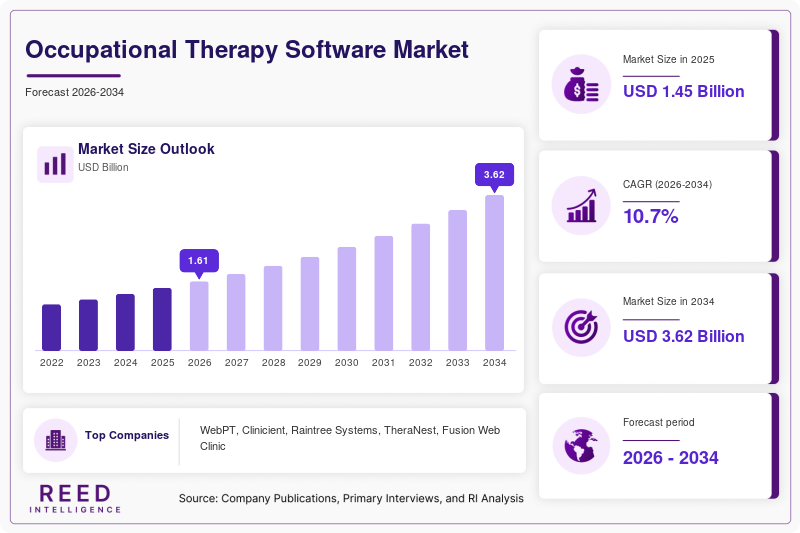
Key Highlights
- North America dominated the market with a 38.5% share in 2025, while Asia Pacific is expected to register the fastest growth at a CAGR of 12.6%.
- The web-based software segment led with a 46% share, while cloud-based solutions are projected to grow fastest at a CAGR of 13.2%.
- The hospitals segment held the largest share at 41%, while home healthcare is expected to expand rapidly at a CAGR of 13.8%.
- The United States remained the dominant country with market values of USD 520 million in 2025 and USD 565 million in 2026.
Market Trends
Integration of Teletherapy Capabilities
The integration of teletherapy into occupational therapy software platforms is reshaping service delivery models. Healthcare providers are increasingly adopting virtual care tools that allow therapists to conduct remote sessions, monitor patient progress, and maintain continuous engagement. These platforms often include video conferencing, digital assessments, and patient tracking features. The shift toward hybrid care models is particularly relevant in rural and underserved areas, where access to occupational therapists is limited. As a result, software vendors are enhancing interoperability and user experience to support seamless virtual care delivery.
AI-Driven Clinical Documentation and Analytics
Artificial intelligence (AI) is playing a growing role in automating clinical documentation and generating actionable insights. Occupational therapy software solutions are incorporating AI-based tools to reduce manual data entry, improve accuracy, and provide predictive analytics for treatment planning. These tools can analyze patient data patterns, suggest therapy adjustments, and support evidence-based care. The trend is improving efficiency for therapists while enhancing patient outcomes. As healthcare providers increasingly prioritize data-driven decision-making, demand for intelligent software solutions is expected to rise.
Market Drivers
Increasing Demand for Rehabilitation Services
The rising prevalence of chronic conditions, disabilities, and age-related disorders is driving demand for occupational therapy services. Patients recovering from injuries, neurological disorders, and surgeries require structured rehabilitation programs. Occupational therapy software helps manage patient records, track therapy outcomes, and streamline clinical workflows, making it an essential tool for modern rehabilitation centers. The growing patient population is directly contributing to increased software adoption.
Need for Workflow Automation in Healthcare Facilities
Healthcare providers are under pressure to improve efficiency while reducing administrative costs. Occupational therapy software automates key processes such as scheduling, billing, documentation, and compliance reporting. This reduces manual workload and minimizes errors, allowing therapists to focus more on patient care. The demand for automation is particularly strong in large hospitals and multi-specialty clinics, where managing patient data manually is time-consuming and inefficient.
Market Restraints
Data Security and Privacy Concerns
Data security remains a significant challenge for the Occupational Therapy Software Market. These platforms handle sensitive patient information, including medical histories, therapy notes, and billing details. Any breach or unauthorized access can lead to legal and financial consequences for healthcare providers.
Healthcare organizations are required to comply with strict data protection regulations, which can vary across regions. Ensuring compliance increases implementation complexity and costs for software providers. Smaller clinics and independent practitioners may hesitate to adopt digital solutions due to concerns about data breaches and the need for robust cybersecurity infrastructure.
Market Opportunities
Expansion in Emerging Markets
Emerging economies present significant growth opportunities for the Occupational Therapy Software Market. Increasing healthcare investments, improving infrastructure, and rising awareness about rehabilitation services are driving demand for digital solutions. Governments in countries across Asia Pacific, Latin America, and parts of Africa are promoting digital healthcare initiatives, creating a favorable environment for software adoption. Vendors can capitalize on this trend by offering cost-effective and scalable solutions tailored to local needs.
Integration with Wearable and IoT Devices
The integration of occupational therapy software with wearable devices and Internet of Things (IoT) technologies is opening new avenues for innovation. Wearables can track patient movements, activity levels, and therapy progress in real time. When integrated with software platforms, this data provides valuable insights for therapists, enabling personalized treatment plans and continuous monitoring. This capability enhances patient engagement and improves therapy outcomes, making it a promising area for future development.
Segmental Analysis
By Deployment Mode
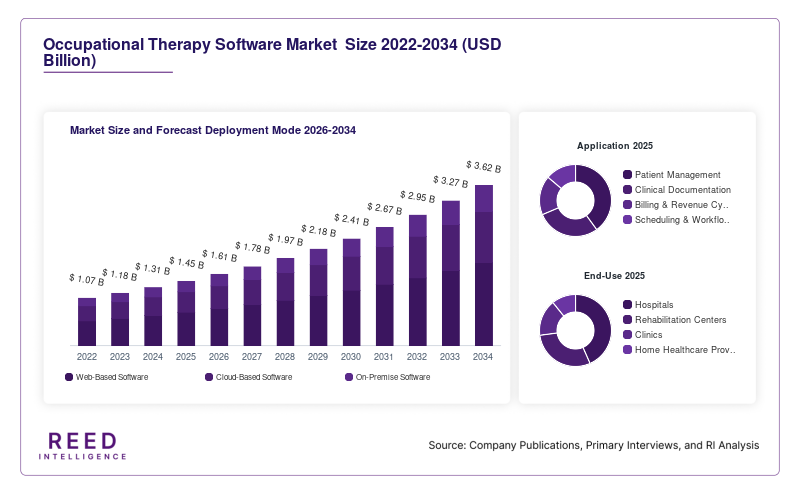
The web-based segment dominated the Occupational Therapy Software Market with a 46% share in 2025, as it offered easy accessibility and lower upfront costs. Healthcare providers preferred web-based solutions due to their compatibility with existing systems and minimal installation requirements.
The cloud-based segment will grow at the fastest CAGR of 13.2% during the forecast period. This growth will be driven by the increasing need for scalable, secure, and remote-access solutions. Cloud platforms will enable real-time data sharing, improved collaboration, and enhanced data security, making them a preferred choice for modern healthcare facilities.
By End-Use
Hospitals accounted for the largest share of 41% in 2025, as they handled a high volume of patients requiring occupational therapy services. The integration of software into hospital systems improved workflow efficiency and patient management.
Home healthcare will expand at the fastest CAGR of 13.8%. The shift toward home-based care and remote therapy services will drive demand for software solutions that support virtual consultations and patient monitoring.
By Application
Patient management systems held a dominant share of 39% in 2025, as they streamlined scheduling, documentation, and treatment tracking. These systems improved operational efficiency and enhanced patient care.
Clinical documentation solutions will grow at a CAGR of 12.9%, driven by the need for accurate and efficient record-keeping. These solutions will reduce administrative workload and improve compliance with regulatory standards.
By Organization Size
Large enterprises dominated with a 58% share in 2025, as they had the resources to invest in advanced software solutions. These organizations benefited from integrated systems that supported multiple departments.
Small and medium-sized enterprises will grow at a CAGR of 12.4%, driven by increasing awareness and availability of cost-effective solutions. Vendors will focus on offering scalable platforms tailored to smaller healthcare providers.
Regional Analysis
North America
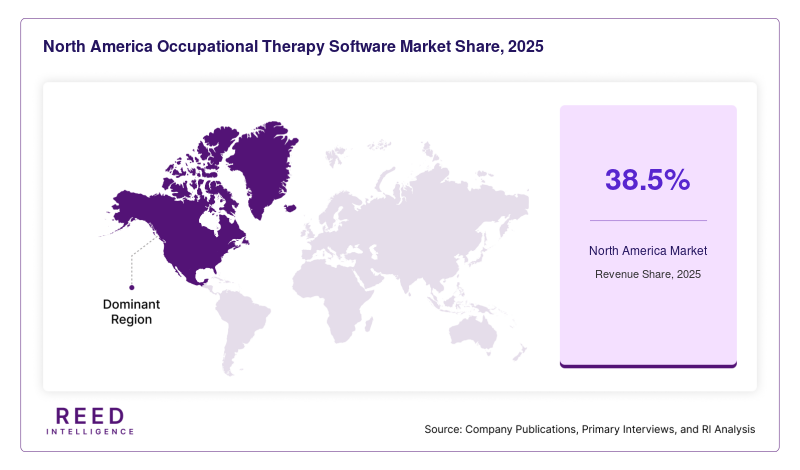
North America accounted for 38.5% of the Occupational Therapy Software Market share in 2025 and will grow at a CAGR of 9.8% through 2034. The region had a well-established healthcare infrastructure and high adoption of digital health solutions, which contributed to its leading position.
The United States dominated the regional market due to strong healthcare spending and early adoption of advanced technologies. The presence of large hospital networks and rehabilitation centers supported the use of occupational therapy software. Additionally, the emphasis on improving patient outcomes and reducing administrative workload drove continued investment in digital solutions.
Europe
Europe held approximately 27.2% of the market share in 2025 and is expected to expand at a CAGR of 10.1% during the forecast period. The region benefited from government initiatives promoting digital healthcare transformation and standardized patient data management systems.
Germany emerged as the dominant country, supported by its advanced healthcare system and focus on rehabilitation services. The country’s emphasis on quality care and regulatory compliance encouraged the adoption of occupational therapy software solutions across hospitals and clinics.
Asia Pacific
Asia Pacific represented 19.8% of the market in 2025 and will grow at the fastest CAGR of 12.6% from 2025 to 2034. Rapid urbanization, increasing healthcare investments, and a growing patient population contributed to market expansion.
China led the region due to its large population and increasing demand for rehabilitation services. Government initiatives to digitize healthcare systems and improve access to care supported the adoption of occupational therapy software.
Middle East & Africa
The Middle East & Africa accounted for 7.5% of the market share in 2025 and is projected to grow at a CAGR of 9.3%. The region experienced gradual adoption of digital healthcare technologies, supported by investments in healthcare infrastructure.
Saudi Arabia dominated the market due to its focus on healthcare modernization and digital transformation initiatives. The country’s efforts to improve rehabilitation services contributed to increased adoption of occupational therapy software.
Latin America
Latin America held 7.0% of the market share in 2025 and will grow at a CAGR of 9.7% through 2034. The region showed steady growth due to improving healthcare systems and rising awareness of rehabilitation services.
Brazil emerged as the leading country, driven by expanding healthcare facilities and increasing demand for digital solutions. The country’s focus on improving patient care and operational efficiency supported the adoption of occupational therapy software.
Competitive Landscape
The Occupational Therapy Software Market is moderately competitive, with several established players and emerging companies offering specialized solutions. Key companies focus on product innovation, strategic partnerships, and geographic expansion to strengthen their market position.
The market leader, WebPT, has maintained a strong presence by offering comprehensive therapy management solutions. The company recently introduced enhanced analytics features to improve patient outcome tracking and operational efficiency.
Other notable players are focusing on integrating advanced technologies such as AI and cloud computing into their platforms. Continuous innovation and customization of software solutions are key strategies adopted by companies to meet the evolving needs of healthcare providers.
Key Players
- WebPT
- Clinicient
- Raintree Systems
- TheraNest
- Fusion Web Clinic
- SimplePractice
- TherapyNotes
- Kareo
- Athenahealth
- Practice Fusion
- Net Health
- TheraPlatform
- Prompt EMR
- Rehab Optima
- Casamba
Recent Developments
- WebPT launched advanced analytics tools to enhance therapy outcome tracking.
- Raintree Systems introduced cloud-based upgrades to improve scalability.
- Net Health expanded its product portfolio with integrated telehealth features.
- Clinicient enhanced its billing automation capabilities to improve revenue cycle management.
- TherapyNotes focused on improving user interface and workflow customization features.
Occupational Therapy Software Market Segments
Deployment Mode
- Web-Based Software
- Cloud-Based Software
- On-Premise Software
Application
- Patient Management
- Clinical Documentation
- Billing & Revenue Cycle Management
- Scheduling & Workflow Management
End-Use
- Hospitals
- Rehabilitation Centers
- Clinics
- Home Healthcare Providers
Organization Size
- Large Enterprises
- Small & Medium Enterprises
By Region
- North America
- Europe
- APAC
- Middle East and Africa
- LATAM