Ocular Adhesive Market Size, Share & Demand Report By Product Type (Synthetic Adhesives, Natural Adhesives), By Application (Corneal Surgeries, Cataract Surgeries, Glaucoma Procedures, Vitreoretinal Surgeries), By End-Use (Hospitals, Ambulatory Surgical Centers, Specialty Clinics), By Region & Segment Forecasts, 2026–2034
USD 3950
Market Overview
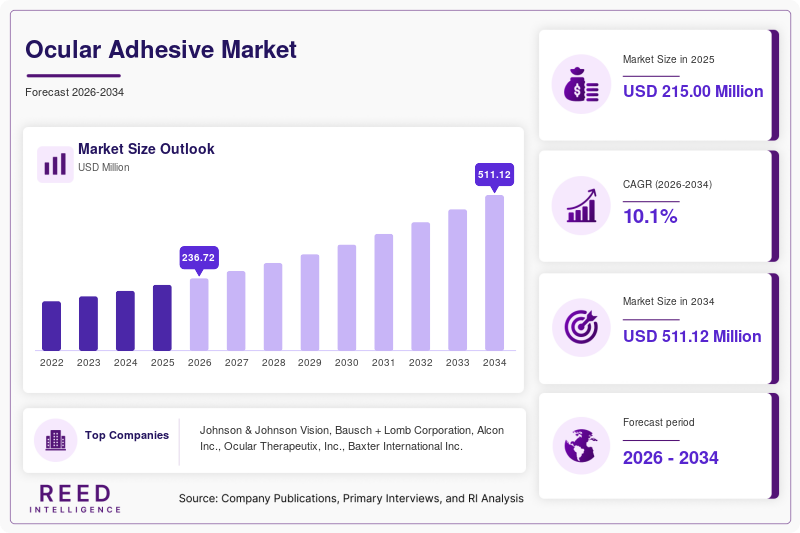
The global Ocular Adhesive Market was valued at approximately USD 215 million in 2026 and is projected to reach USD 462 million by 2034, expanding at a CAGR of 10.1% during the forecast period (2026–2034). Ocular adhesives are increasingly being adopted as alternatives to traditional sutures in ophthalmic procedures, offering advantages such as reduced surgical time, improved patient comfort, and lower risk of postoperative complications. The rising prevalence of eye-related disorders, including corneal injuries and cataract surgeries, has significantly contributed to the expansion of the market.
A key global factor supporting market growth is the increasing demand for minimally invasive surgical techniques across healthcare systems. Surgeons and healthcare providers are prioritizing solutions that improve clinical efficiency while reducing recovery time, and ocular adhesives align well with these evolving preferences. Technological advancements in biocompatible materials, particularly synthetic and bio-based adhesives, are further enhancing product performance and expanding their clinical applications.
Key Highlights
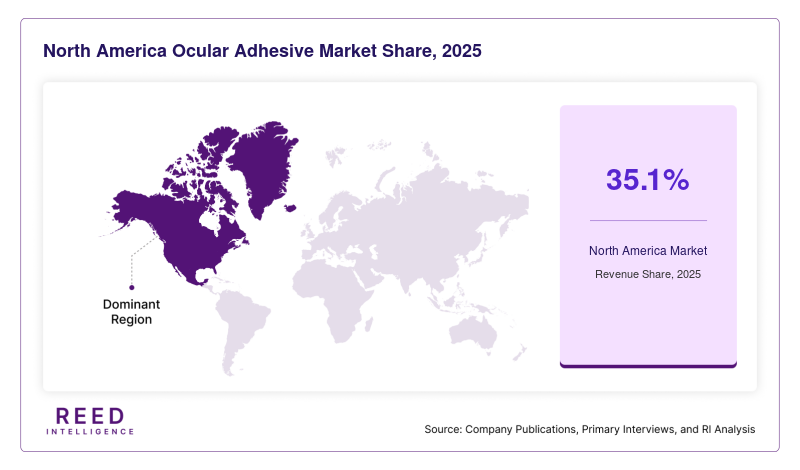
- North America dominated the market with a 35.1% share in 2025.
- Asia Pacific is expected to grow at the fastest CAGR of 11.4% during 2026–2034.
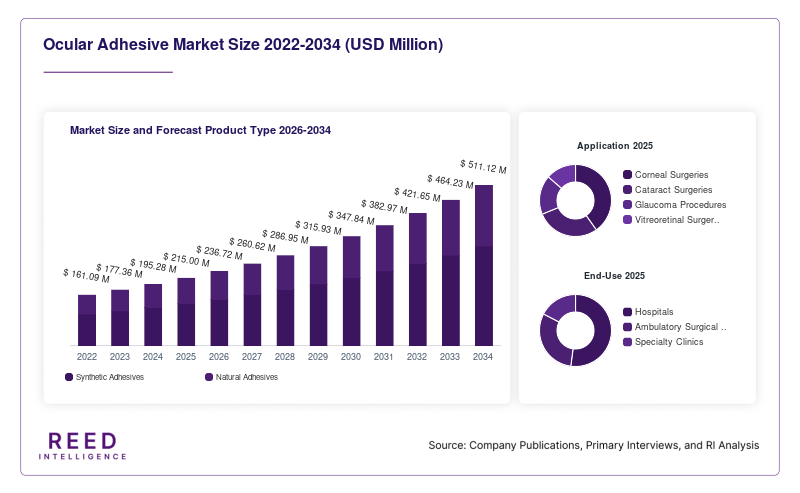
- By product type, synthetic adhesives accounted for the largest share of 42.7%.
- By application, corneal surgeries led with a 44.3% share, whereas glaucoma procedures are expected to expand at a CAGR of 10.9%.
- The United States remained the dominant country, with market values of USD 58 million in 2024 and USD 64 million in 2025.
Market Trends
Growing adoption of bio-based and biodegradable adhesives
The ocular adhesive market is witnessing a steady shift toward bio-based and biodegradable formulations, driven by increasing emphasis on patient safety and environmental sustainability. Manufacturers are investing in research to develop adhesives derived from natural polymers such as fibrin and collagen, which offer enhanced compatibility with ocular tissues. These materials reduce the risk of inflammation and toxicity, making them suitable for delicate eye procedures. Additionally, regulatory agencies are encouraging the use of safer biomaterials, further accelerating adoption. This trend is expected to reshape product development strategies, with companies focusing on improving adhesive strength, flexibility, and degradation rates to meet diverse surgical needs.
Integration of advanced delivery systems in ophthalmic procedures
Another notable trend is the development of precision delivery systems designed to improve the application of ocular adhesives during surgery. These systems enable controlled dispensing, ensuring accurate placement and minimizing wastage. Innovations such as micro-applicators and single-use sterile kits are enhancing procedural efficiency and reducing the risk of contamination. The trend is particularly relevant in outpatient and ambulatory surgical settings, where streamlined workflows are critical. As healthcare providers continue to prioritize accuracy and convenience, the integration of advanced delivery mechanisms is expected to gain traction, supporting overall market growth.
Market Drivers
Increasing prevalence of ophthalmic disorders
The rising incidence of ophthalmic conditions such as cataracts, glaucoma, and corneal injuries is a primary driver of the ocular adhesive market. Aging populations, particularly in developed and emerging economies, are contributing to a higher volume of eye surgeries. Ocular adhesives provide an effective alternative to sutures, reducing surgery duration and improving healing outcomes. Furthermore, the growing awareness of advanced treatment options among patients is encouraging the adoption of modern surgical techniques. As healthcare systems expand their ophthalmology services, the demand for efficient and reliable adhesives is expected to increase significantly.
Advancements in surgical techniques and healthcare infrastructure
Continuous improvements in ophthalmic surgical techniques are fueling demand for innovative solutions such as ocular adhesives. Surgeons are increasingly adopting minimally invasive approaches that require precise and quick wound closure methods. In parallel, investments in healthcare infrastructure, particularly in emerging markets, are expanding access to advanced surgical procedures. Hospitals and specialty clinics are integrating modern equipment and materials to enhance patient outcomes. These developments are creating a favorable environment for the adoption of ocular adhesives, which align with the evolving standards of care in ophthalmology.
Market Restraint
Limited awareness and regulatory challenges in emerging markets
Despite the promising growth outlook, the ocular adhesive market faces challenges related to limited awareness and regulatory complexities, particularly in developing regions. Many healthcare providers in these markets continue to rely on traditional suturing methods due to familiarity and cost considerations. The lack of training and exposure to advanced adhesive technologies further restricts adoption. Additionally, stringent regulatory requirements for medical devices and biomaterials can delay product approvals, increasing time-to-market for manufacturers.
These challenges have a direct impact on market penetration, especially for new entrants aiming to introduce innovative solutions. For example, smaller healthcare facilities may be hesitant to invest in ocular adhesives without clear evidence of cost-effectiveness and long-term benefits. Moreover, variations in regulatory standards across countries create additional hurdles for global companies seeking to expand their presence. Addressing these issues requires coordinated efforts, including educational initiatives, clinical demonstrations, and streamlined regulatory processes to ensure wider adoption.
Market Opportunitie
Expansion in emerging healthcare markets
Emerging economies present significant growth opportunities for the ocular adhesive market, driven by improving healthcare infrastructure and increasing access to ophthalmic care. Countries in Asia Pacific, Latin America, and parts of Africa are witnessing a rise in healthcare investments, enabling the adoption of advanced surgical technologies. Governments and private organizations are focusing on expanding eye care services to address unmet needs, particularly in rural and underserved areas. This creates a favorable environment for ocular adhesive manufacturers to introduce cost-effective and scalable solutions tailored to local requirements.
Development of multifunctional adhesives
The development of multifunctional ocular adhesives offers another promising opportunity for market growth. These next-generation products are designed to provide additional benefits such as antimicrobial properties, drug delivery capabilities, and enhanced healing support. By integrating therapeutic functions into adhesives, manufacturers can address multiple clinical needs with a single product, improving efficiency and patient outcomes. This innovation is particularly relevant in complex surgical procedures where infection control and tissue regeneration are critical. As research and development efforts continue to advance, multifunctional adhesives are expected to play a key role in shaping the future of the market.
Segmental Analysis
By Product Type
Synthetic adhesives dominated the ocular adhesive market in 2024, accounting for approximately 42.7% of the total share. These adhesives are widely used due to their strong bonding capabilities, consistent performance, and ease of application. Synthetic materials such as cyanoacrylate offer rapid polymerization, making them suitable for emergency procedures and quick wound closure. Additionally, they are available in standardized formulations, ensuring predictable outcomes in clinical settings. Healthcare providers prefer synthetic adhesives for their durability and cost-effectiveness, particularly in high-volume surgical environments.
Natural adhesives are expected to be the fastest-growing subsegment, with a projected CAGR of 11.8% during the forecast period. The growth of this segment is driven by increasing demand for biocompatible and biodegradable solutions that minimize adverse reactions. Natural adhesives, such as fibrin-based products, closely mimic the body's natural healing processes, enhancing patient safety and comfort. The rising focus on sustainable healthcare practices and advancements in biomaterial research are further supporting the adoption of natural adhesives.
By Application
Corneal surgeries held the largest share of 44.3% in 2024, driven by the high prevalence of corneal injuries and disorders. Ocular adhesives are widely used in these procedures to seal wounds, reduce surgical time, and improve healing outcomes. The increasing number of corneal transplant surgeries and advancements in surgical techniques are further contributing to the dominance of this segment. Healthcare providers are increasingly adopting adhesives as a reliable alternative to sutures in corneal procedures.
Glaucoma procedures are projected to grow at the fastest CAGR of 10.9% during the forecast period. The rising prevalence of glaucoma, particularly among aging populations, is a key factor driving this growth. Ocular adhesives are being increasingly used to enhance surgical efficiency and reduce postoperative complications in glaucoma treatments. Continuous advancements in surgical techniques and increasing awareness of early diagnosis are further supporting the expansion of this segment.
By End-Use
Hospitals accounted for the largest share of 48.6% in 2024, owing to the high volume of ophthalmic surgeries performed in these settings. Hospitals are equipped with advanced infrastructure and skilled professionals, enabling the adoption of innovative medical solutions such as ocular adhesives. The availability of comprehensive healthcare services and favorable reimbursement policies further support the dominance of this segment. Additionally, hospitals often serve as primary centers for complex surgical procedures, driving the demand for reliable adhesive solutions.
Ambulatory surgical centers are expected to grow at the fastest CAGR of 11.2% during the forecast period. The shift toward outpatient care and minimally invasive procedures is a key factor driving this growth. These centers offer cost-effective and efficient surgical services, making them increasingly popular among patients. Ocular adhesives play a crucial role in enhancing procedural efficiency and reducing recovery time in outpatient settings. As the demand for convenient healthcare services continues to rise, ambulatory surgical centers are expected to drive significant market growth.
Regional Analysis
North America
North America accounted for approximately 35.1% of the global ocular adhesive market share in 2025 and is expected to maintain steady growth with a CAGR of 9.6% during the forecast period. The region benefits from well-established healthcare systems, high adoption of advanced surgical technologies, and strong presence of leading market players. Increasing demand for minimally invasive procedures and rising healthcare expenditure are key factors supporting market expansion. Additionally, favorable reimbursement policies contribute to the widespread use of innovative medical solutions.
The United States dominates the North American market due to its advanced healthcare infrastructure and high volume of ophthalmic procedures. A unique growth factor in the country is the strong emphasis on research and clinical trials, which facilitates the introduction of innovative adhesive technologies. Academic institutions and private companies collaborate extensively, driving continuous advancements in product development.
Europe
Europe held a significant share of around 27.4% in 2025 and is projected to grow at a CAGR of 9.2% through 2034. The region's growth is supported by increasing prevalence of age-related eye conditions and rising demand for efficient surgical solutions. Healthcare systems across Europe are focusing on improving patient outcomes while reducing procedural costs, which aligns with the benefits offered by ocular adhesives. Regulatory frameworks, although stringent, ensure high product quality and safety standards.
Germany leads the European market, driven by its robust healthcare infrastructure and strong medical device industry. A unique growth factor is the country's emphasis on technological innovation and precision medicine. German healthcare providers are early adopters of advanced surgical techniques, creating a conducive environment for the adoption of ocular adhesives.
Asia Pacific
Asia Pacific is the fastest-growing region, with a CAGR of 11.4% expected during the forecast period. The region accounted for approximately 22.8% of the market share in 2025. Rapid urbanization, increasing healthcare investments, and rising awareness of advanced treatment options are driving market growth. The expanding middle-class population and improving access to healthcare services further contribute to the adoption of ocular adhesives.
China dominates the Asia Pacific market due to its large population and growing healthcare infrastructure. A unique growth factor is the government's focus on expanding ophthalmic care services, particularly in rural areas. Initiatives aimed at reducing preventable blindness are increasing the demand for efficient surgical solutions, including ocular adhesives.
Middle East & Africa
The Middle East & Africa region held a smaller market share of around 7.6% in 2025 but is expected to grow at a CAGR of 10.3% through 2034. Growth in this region is driven by increasing healthcare investments and rising awareness of advanced medical technologies. Governments are focusing on improving healthcare access and quality, which is expected to support market expansion. The adoption of ocular adhesives is gradually increasing as healthcare providers recognize their benefits.
Saudi Arabia leads the market in this region, supported by significant investments in healthcare infrastructure. A unique growth factor is the country's focus on modernizing its healthcare system as part of broader economic development initiatives. This includes the adoption of advanced surgical techniques and materials, creating opportunities for ocular adhesive manufacturers.
Latin America
Latin America accounted for approximately 7.1% of the global market share in 2025 and is projected to grow at a CAGR of 9.8% during the forecast period. The region's growth is supported by improving healthcare infrastructure and increasing demand for ophthalmic procedures. Governments and private organizations are investing in healthcare facilities, enabling the adoption of advanced medical technologies.
Brazil dominates the Latin American market due to its large population and expanding healthcare sector. A unique growth factor is the increasing number of ophthalmology clinics and specialized treatment centers. These facilities are adopting modern surgical techniques to enhance patient outcomes, driving the demand for ocular adhesives.
Competitive Landscape
The ocular adhesive market is characterized by the presence of several established players and emerging companies focusing on innovation and product development. The competitive landscape is shaped by strategies such as mergers, acquisitions, partnerships, and continuous investment in research and development. Companies are striving to enhance their product portfolios by introducing advanced adhesives with improved biocompatibility and performance.
Among the leading players, Johnson & Johnson Vision is recognized as a key market leader due to its strong global presence and extensive product offerings. The company recently introduced an advanced ocular adhesive designed to improve surgical outcomes and reduce application time. Other major players are focusing on expanding their geographical reach and strengthening their distribution networks to capture a larger market share. The increasing competition is expected to drive innovation and improve product accessibility.
Key Players List
- Johnson & Johnson Vision
- Bausch + Lomb Corporation
- Alcon Inc.
- Ocular Therapeutix, Inc.
- Baxter International Inc.
- Medtronic plc
- Carl Zeiss Meditec AG
- Santen Pharmaceutical Co., Ltd.
- Hoya Corporation
- Allergan (AbbVie Inc.)
- Dentsply Sirona
- Integra LifeSciences
- Advanced Medical Solutions Group plc
- Cohera Medical, Inc.
- BioCer Entwicklungs-GmbH
Recent Developments
- In 2025, a leading medical device company launched a next-generation biodegradable ocular adhesive designed to enhance tissue regeneration and reduce postoperative complications.
- In 2024, a strategic partnership between two healthcare firms aimed to expand the distribution of ocular adhesives in emerging markets, improving product accessibility.
- In 2026, a major player introduced an advanced delivery system for ocular adhesives, enabling precise application and improved surgical efficiency.
Ocular Adhesive Market Segments
Product Type
- Synthetic Adhesives
- Natural Adhesives
Application
- Corneal Surgeries
- Cataract Surgeries
- Glaucoma Procedures
- Vitreoretinal Surgeries
End-Use
- Hospitals
- Ambulatory Surgical Centers
- Specialty Clinics
By Region
- North America
- Europe
- APAC
- Middle East and Africa
- LATAM