Off Price Retail Market Size, Share, Demand Report By Type (Brick-and-Mortar Stores, Online Retail, Hybrid Retail), By Application (Apparel & Footwear, Home Goods, Beauty & Personal Care), By Region & Segment Forecasts, 2026–2034
USD 3950
Off-Price Retail Market Size
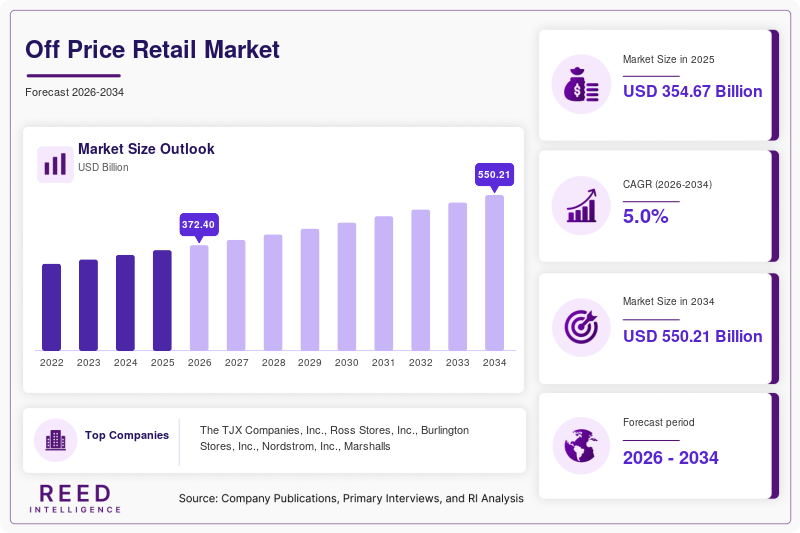
Global Off-Price Retail Market size is projected at USD 372.4 billion in 2026 and is expected to hit USD 550.21 billion by 2034 with a CAGR of 5.0%. The market is increasingly influenced by consumer demand for branded merchandise at discounted prices, inventory optimization, and flexible retail formats. Detailed market data, segmentation analysis, regional performance, and competitive intelligence are important for retailers and brands seeking to identify high-growth categories and changing consumer purchasing patterns.
Key Takeaways
- North America dominated the global market with an estimated 48.6% share in 2026, while Asia Pacific is projected to be the fastest-growing region at approximately 7.2% CAGR through 2034.
- Brick-and-mortar stores dominated by type, accounting for nearly 73.5% of 2026 revenue, while online retail is expected to record the fastest growth at approximately 8.1% CAGR.
- Apparel & footwear dominated the application segment with an estimated 58.2% share in 2026, supported by demand for branded fashion at lower prices.
- India is an emerging high-growth market, with its off-price retail market estimated at approximately USD 6.1 billion in 2026 and projected to reach USD 11.8 billion by 2034, representing an 8.6% CAGR.
- Increasing inventory availability, consumer trading-down behavior, digital discovery, and expansion into secondary cities are expected to support sustained market growth through 2034.
The global off-price retail market comprises retailers that sell branded, designer, seasonal, excess, cancelled-order, or closeout merchandise at prices below conventional retail levels. The sector has evolved from traditional clearance-based operations into a sophisticated sourcing and inventory-management model supported by data analytics, flexible procurement, localized merchandising, and omnichannel engagement. In 2025, the market was estimated at approximately USD 354.7 billion, with brick-and-mortar formats continuing to account for the majority of transactions. Global off-price retail networks collectively represented more than 120,000 physical retail units and outlets across major markets, while digital channels continued to expand their contribution. Apparel and footwear accounted for approximately 58% of market revenue, followed by home goods at around 27% and beauty and personal care at approximately 15%. Adoption is strongest in mature retail economies, while penetration is increasing rapidly in Asia Pacific, the Middle East, and other emerging consumer markets.
Off-Price Retail Market Trends
Digital Discovery and Omnichannel Expansion
Technology is reshaping the traditional treasure-hunt shopping model through personalized recommendations, mobile applications, digital loyalty programs, real-time inventory visibility, and targeted promotions. Retailers are increasingly integrating store inventory with e-commerce platforms, enabling consumers to discover discounted products digitally before completing purchases in physical locations. Artificial intelligence-supported forecasting and assortment planning are also improving the ability of retailers to identify demand patterns and reduce excess inventory.
Sector-specific demand is increasingly concentrated around apparel, footwear, home décor, beauty products, toys, accessories, and seasonal merchandise. Consumers are becoming more price-sensitive while continuing to seek recognizable brands, encouraging retailers to expand branded assortments without adopting full-price positioning. Younger shoppers are also responding positively to limited-quantity merchandise and frequently changing assortments, reinforcing the traditional off-price treasure hunt proposition across both stores and digital channels.
Off-Price Retail Market Drivers
Consumer Trading Down and Value-Oriented Purchasing
Inflationary pressure, higher household expenses, and increased price comparison are encouraging consumers to seek value without abandoning branded products. Off-price retailers benefit from this environment because they provide discounts while maintaining access to recognized brands. The ability to offer merchandise substantially below conventional retail pricing strengthens customer traffic and supports repeat purchases across apparel, footwear, home, and beauty categories.
Off-Price Retail Market Restraints
Unpredictable Merchandise Availability
Off-price retailers depend heavily on opportunistic sourcing, excess inventory, cancelled orders, closeouts, and changing supplier relationships. This creates variability in product availability, sizes, colors, and categories. Maintaining consistent customer expectations can therefore be difficult, particularly for online channels where consumers generally expect stable assortment and replenishment.
Off-Price Retail Market Opportunities
Expansion Across Emerging Consumer Markets
Emerging markets provide substantial opportunities as middle-income consumers become increasingly brand-conscious while remaining price-sensitive. India, China, Southeast Asia, the Middle East, and Latin America offer opportunities for localized off-price formats, outlet centers, online discount marketplaces, and hybrid retail concepts. International investments and partnerships can further accelerate market penetration.
Challenges in Off-Price Retail Market
Inventory Complexity and Margin Management
Retailers must continuously balance procurement costs, markdowns, store capacity, logistics expenses, and merchandise turnover. Rapid changes in fashion demand and consumer preferences can increase inventory risk. At the same time, digital commerce introduces additional fulfillment and return costs, requiring sophisticated analytics and supply-chain management to preserve margins.
Off-Price Retail Market Segmentation Analysis
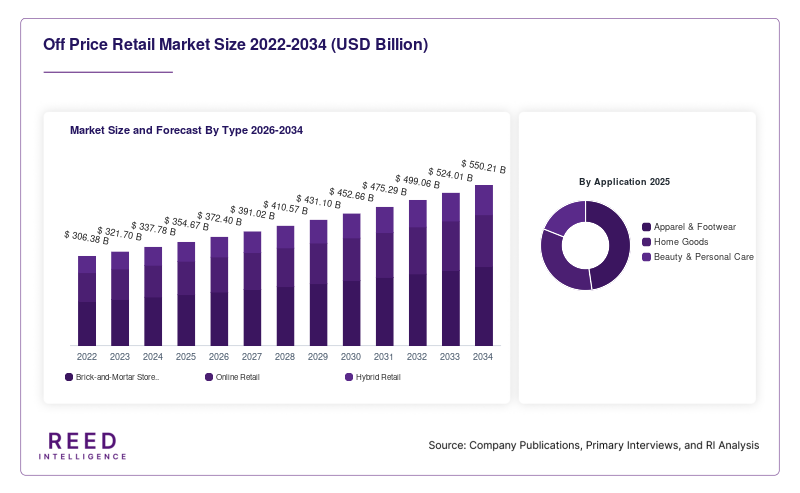
By type, brick-and-mortar stores accounted for approximately 73.5% of global market revenue in 2026 because of their strong customer traffic, treasure-hunt experience, and broad physical assortments. Online retail represented approximately 15.8%, while hybrid retail accounted for about 10.7%. By application, apparel and footwear held the largest share at approximately 58.2%, followed by home goods at 26.7% and beauty and personal care at 15.1%.
By Type
Brick-and-mortar stores represented approximately 73.5% of the market in 2026 and generated an estimated USD 273.7 billion in revenue. The segment includes conventional off-price stores, outlet-style locations, and discount department formats. More than 88,000 dedicated and multi-category off-price store units globally serve consumers through rapidly changing assortments. Typical store formats range from approximately 15,000 to 35,000 square feet, with high inventory turnover and flexible merchandise presentation. Physical stores remain particularly important for apparel and footwear because customers can inspect product quality and immediately purchase limited-availability items.
Online retail accounted for approximately 15.8% of 2026 revenue and is expected to achieve the fastest growth through 2034. The segment generated approximately USD 58.8 billion in 2026, supported by mobile commerce, personalized recommendations, flash promotions, and digital clearance events. Online platforms can offer extensive SKU databases and automated inventory matching across warehouses and stores. Improved search, recommendation engines, dynamic pricing, and AI-supported merchandising are increasing conversion rates while reducing dependence on physical store visits.
Hybrid retail represented approximately 10.7% of the market in 2026, corresponding to nearly USD 39.9 billion. These models combine physical stores, websites, applications, click-and-collect services, and integrated loyalty programs. Hybrid retailers generally operate localized inventory systems with real-time stock visibility, enabling customers to reserve or purchase products through digital channels and collect them from nearby stores. The model is particularly effective for footwear, fashion accessories, home products, and seasonal merchandise.
By Application
Apparel and footwear represented approximately 58.2% of market revenue in 2026, generating about USD 216.8 billion. The category includes women's apparel, men's apparel, children's clothing, footwear, accessories, coats, sportswear, and seasonal fashion. More than 65 billion individual merchandise units are estimated to move through off-price channels annually worldwide. The category benefits from frequent fashion turnover, excess seasonal inventory, brand markdowns, and consumers' preference for recognizable labels at reduced prices.
Home goods accounted for approximately 26.7% of 2026 revenue, equivalent to around USD 99.4 billion. The segment includes furniture, home décor, kitchen products, bedding, storage, lighting, and household accessories. Approximately 25 billion units are estimated to be sold through relevant off-price channels annually. Demand is supported by consumers seeking lower-cost home upgrades and by retailers using off-price channels to clear seasonal and discontinued home merchandise.
Beauty and personal care represented approximately 15.1% of market revenue in 2026, or about USD 56.2 billion. The segment covers cosmetics, fragrances, skincare, haircare, personal-care products, and beauty accessories. Approximately 18 billion product units are estimated to flow through off-price channels annually. Short product cycles, packaging changes, seasonal collections, and brand overstock create recurring sourcing opportunities for discount retailers.
Off-Price Retail Market Regional Analysis
North America Off-Price Retail Market
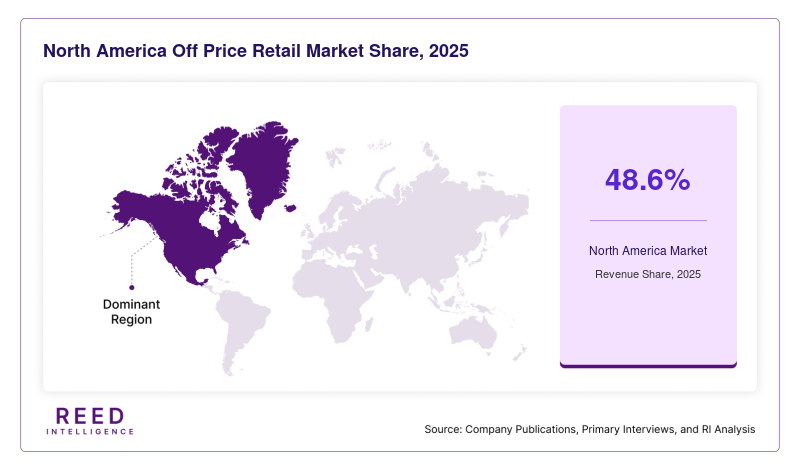
North America held approximately 48.6% of the global market in 2026, supported by mature consumer acceptance of discount shopping, extensive retail infrastructure, and strong off-price penetration in the United States. The U.S. represents the largest regional contributor, accounting for the majority of North American revenue, followed by Canada and Mexico. Apparel and footwear remain the leading sector, while home goods represent a significant secondary category. Store expansion by major off-price chains and continued consumer trading down are supporting regional growth.
Europe Off-Price Retail Market
Europe accounted for approximately 24.1% of the market in 2026. The UK, Germany, France, Italy, Spain, and the Netherlands are major contributors, with consumers increasingly seeking value-oriented branded merchandise. Apparel and footwear dominate the regional mix, while home furnishings and beauty are expanding. Outlet centers, clearance channels, discount department stores, and online platforms are increasing the availability of off-price merchandise across both mature and developing European markets.
Asia Pacific Off-Price Retail Market
Asia Pacific represented approximately 20.3% of the global market in 2026 and is expected to record the fastest regional growth at about 7.2% CAGR through 2034. China, Japan, South Korea, India, Australia, and Southeast Asian markets are the primary contributors. India is expected to experience particularly strong growth as organized retail expands and consumers become more brand-conscious. Apparel and footwear lead the regional sector split, followed by beauty, home products, and accessories.
Latin America Off-Price Retail Market
Latin America accounted for approximately 4.2% of global revenue in 2026. Brazil and Mexico represent the largest country markets, supported by expanding organized retail and strong consumer demand for discounted branded merchandise. Apparel, footwear, home products, and accessories constitute the primary sectors. Growth in secondary cities and digital commerce is expected to improve market penetration over the forecast period.
Middle East & Africa Off-Price Retail Market
The Middle East & Africa region represented approximately 2.8% of global revenue in 2026, with the UAE, Saudi Arabia, South Africa, and other Gulf markets contributing significantly. Apparel and footwear represent the largest segment, supported by demand for international brands at lower prices. Increasing investment in modern retail centers, tourism-oriented shopping destinations, and digital commerce is creating additional opportunities for off-price operators.
Top Players in the Off-Price Retail Market
- The TJX Companies, Inc.
- Ross Stores, Inc.
- Burlington Stores, Inc.
- Nordstrom, Inc.
- Marshalls
- T.J. Maxx
- HomeGoods
- TK Maxx
- dd's DISCOUNTS
- Sierra
- Brands For Less
- Groupe Beaumanoir
Recent Developments in Off-Price Retail Market
- January 2026: Saks Global announced a strategic wind-down of the majority of its Saks OFF 5TH and Last Call off-price operations, retaining a limited number of locations primarily to sell residual luxury inventory.
- February 2026: Burlington reported continued store expansion, with plans for significant new-store growth and additional distribution infrastructure to support its off-price network.
- March 2026: Ross Stores announced the opening of 17 new stores and reiterated plans to add approximately 110 locations during 2026 across Ross Dress for Less and dd's DISCOUNTS.
- March 2026: Major U.S. off-price retailers including TJX, Ross, and Burlington continued accelerating physical-store expansion as value-oriented consumer demand remained strong.
- May 2026: Burlington reported a store base exceeding 1,200 locations, while continuing to broaden its merchandise mix across apparel, footwear, beauty, home, toys, gifts, and seasonal categories.
Off Price Retail Market Segments
By Type
- Brick-and-Mortar Stores
- Online Retail
- Hybrid Retail
By Application
- Apparel & Footwear
- Home Goods
- Beauty & Personal Care
By Region
- North America
- Europe
- APAC
- Middle East and Africa
- LATAM