Office Automation System Market Size, Share & Trends Analysis Report By Component (Hardware, Software, Services), By Solution Type (Document Management & Processing, Communication & Collaboration), By Deployment (On-Premises, Cloud, Hybrid), By Organization Size (Small & Medium-Sized Enterprises, Large Enterprises), By End Use (BFSI, Healthcare, IT & Telecommunications) Forecasts, 2026-2034
USD 3950
Office Automation System Market Size
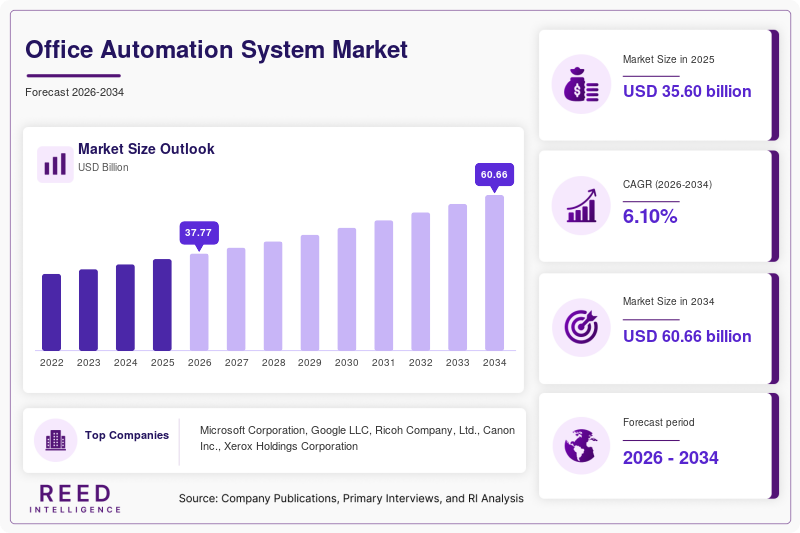
The global office automation system market was valued at USD 35.60 billion in 2025 and is estimated to reach USD 37.77 billion in 2026. Based on the supplied market forecast, the market is projected to reach USD 60.66 billion by 2034, representing a 6.10% CAGR during 2026–2034.
The market is moving beyond traditional office equipment toward connected productivity platforms that combine document management, workflow automation, communication, collaboration, analytics and AI agents. Microsoft describes its current workplace-agent strategy as extending from assistance into execution of business processes, while Google Workspace is adding agentic workflow capabilities across Gmail, Drive, Docs, Sheets and other applications.
Office automation systems are increasingly being defined as integrated digital work environments rather than standalone equipment. Traditional functions such as printing, scanning, document storage and communication are being connected with cloud applications, workflow engines, AI assistants and business-process automation.
The technology shift is particularly visible in enterprise productivity platforms. In April 2025, Google introduced Google Workspace Flows, designed to automate and orchestrate work across Workspace applications using AI. Google stated that Gemini in Workspace was already providing more than 2 billion AI assists per month to business users at that time.
Microsoft is pursuing a similar transition through Microsoft 365 Copilot, Copilot Studio, Work IQ and agent-management capabilities. Its current platform allows agents to retrieve organizational information, perform tasks such as updating CRM systems or submitting expense reports, and execute multi-step workflows.
Office Automation System Market Drivers
AI Agents Are Moving Office Automation From Assistance to Task Execution
The strongest technology shift is the movement from AI that generates content to AI that can execute workflows. Microsoft describes agents as systems capable of retrieving information, performing business tasks and automating processes such as financial planning, sales qualification and supplier communications.
Google has similarly introduced cross-application agentic capabilities that can work across Gmail, Drive, Docs, Slides and Chat. Its September 2026 update allows Gemini to orchestrate complex tasks across multiple Workspace applications while maintaining relevant context from files, emails and conversations.
The commercial implication is that office automation vendors can address entire workflows rather than individual repetitive tasks. The limitation is that enterprise deployment requires permissions, governance, data quality and human oversight before organizations can allow agents to take consequential actions.
Cloud-Based Office Automation Is Reducing Dependence on Local Infrastructure
Cloud deployment is becoming central to office automation because employees increasingly need access to documents, communication tools and workflows from multiple locations and devices. Microsoft Work IQ, for example, is designed to provide agents with contextual access to emails, chats, meetings, files and connected business systems.
The mechanism is important: cloud-based platforms allow automation rules, AI models, data and applications to be connected without requiring every workflow to be installed and maintained on individual machines.
Cross-Application Integration Is Becoming a Competitive Requirement
Office workers frequently move information between email, documents, spreadsheets, meetings, CRM platforms and internal databases. Automation vendors are therefore increasingly integrating previously separate applications.
Google's Workspace Intelligence, introduced in April 2026, is designed to create a unified understanding across Workspace content, projects, collaborators and organizational information.
Microsoft is pursuing a similar architecture through Work IQ, which provides workplace context to Copilot and agents.
The commercial consequence is greater demand for platforms capable of connecting multiple systems. Vendors that remain isolated within one application category may face increasing pressure from broader productivity ecosystems.
Office Automation System Market Restraints
Data Security and Governance Can Slow Enterprise Automation
As automation systems gain access to emails, documents, employee information and business applications, security and governance become more important. Microsoft specifically emphasizes governance, security, access control and lifecycle management for enterprise agents.
The constraint is not simply cybersecurity. Companies also need to determine which employees or agents can access particular information, which workflows can be executed automatically and when human approval is required.
Legacy Systems Increase Integration Costs
Many organizations continue to operate a mixture of legacy document systems, office equipment, enterprise applications and newer cloud services. Connecting these environments can require APIs, middleware, migration work and customized integrations.
This creates a cost barrier for smaller organizations and companies with highly fragmented IT environments. The value of automation may therefore be highest where organizations already have standardized digital workflows and structured data.
Implementation and Change-Management Costs Remain Material
Office automation changes how employees create documents, communicate, approve requests and manage information. Organizations therefore need employee training, process redesign and governance in addition to software licenses or hardware investments.
Microsoft's current guidance for AI-agent adoption explicitly separates planning, governance and security, building and ongoing management, demonstrating that deployment is an organizational process rather than simply a software installation.
Office Automation System Market Opportunities
Agentic Workflow Automation Creates a New Product Category
The transition toward AI agents creates opportunities for vendors to automate multi-step processes such as meeting follow-up, document preparation, customer-service workflows, finance administration and internal support.
Google's Workspace Studio now enables users to describe workflows in natural language and create automated flows without traditional coding.
This expands the addressable market from specialist IT departments to ordinary business users who can create and modify workflows themselves.
Small and Medium-Sized Businesses Offer an Expansion Opportunity
SMBs historically faced higher barriers to office automation because sophisticated workflow systems required technical resources. Low-code and AI-assisted automation reduces part of this barrier.
Microsoft and Google are both positioning AI-powered productivity and automation capabilities across business plans, while Google's Workspace Studio specifically promotes no-code workflow creation.
The opportunity is strongest for standardized processes such as approvals, document routing, scheduling, customer communications and administrative reporting.
Intelligent Document Processing Can Extend Existing Office Automation
Document automation remains relevant even as the market shifts toward AI. Businesses still process invoices, contracts, forms, reports and correspondence. AI can add classification, extraction, summarization and routing to conventional document-management systems.
This creates an upgrade path for organizations that already own scanners, multifunction printers or document-management software rather than requiring an immediate replacement of the existing infrastructure.
Segmental Analysis
By Component
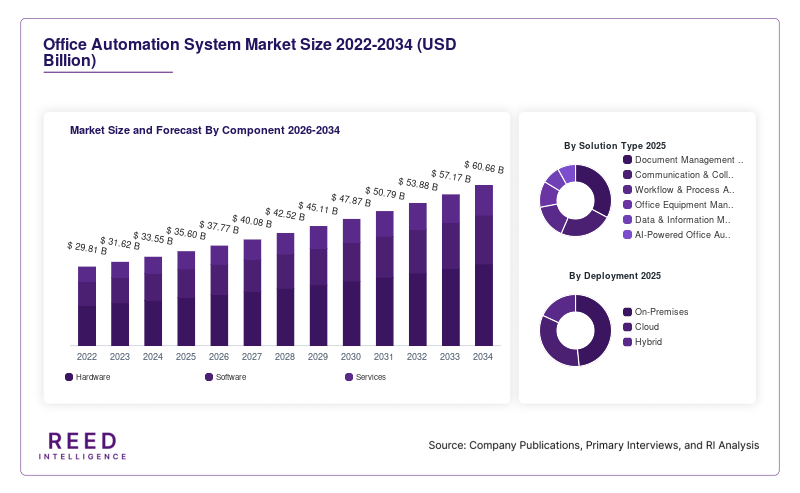
Software represents approximately 43% of the 2025 Office Automation System Market, equivalent to about USD 15.31 billion under the internal analytical allocation. It is modeled at approximately 7.00% CAGR through 2034, producing an indicative 2034 value of about USD 28.21 billion. Software represents the core of the market's transition toward workflow automation, cloud productivity platforms, document management and AI-powered task execution.
Hardware accounts for approximately 34%, or USD 12.10 billion, of the 2025 market under the internal allocation. It is modeled at approximately 4.80% CAGR through 2034, reaching an indicative USD 18.57 billion. The category includes multifunction printers, scanners, document-processing equipment, office communication hardware and connected workplace devices. Hardware demand is increasingly linked to connectivity and integration with digital workflows rather than standalone equipment purchases.
Services represent approximately 23%, equivalent to USD 8.19 billion, of the 2025 market under the internal analytical allocation. The segment is modeled at approximately 6.70% CAGR through 2034, resulting in an indicative value of about USD 14.61 billion. Services include implementation, integration, consulting, maintenance, managed services and employee support. Demand increases as enterprises require assistance connecting automation platforms with existing business systems.
By Solution Type
Document Management & Processing represents approximately 24% of the 2025 market, equivalent to USD 8.54 billion under the internal analytical allocation. It is modeled at approximately 5.80% CAGR through 2034, reaching an indicative USD 14.20 billion. The segment covers document capture, scanning, storage, indexing, search, electronic document workflows and intelligent document processing.
Communication & Collaboration accounts for approximately 19%, or USD 6.76 billion, of the 2025 market. It is modeled at approximately 6.20% CAGR through 2034, producing an indicative value of about USD 11.60 billion. The segment includes business messaging, video meetings, team collaboration, shared workspaces and integrated communication tools. The increasing integration of AI into email, meetings and collaborative documents is expanding the automation capability of these platforms.
Workflow & Process Automation represents approximately 21%, equivalent to USD 7.48 billion, in 2025 and is modeled at approximately 7.10% CAGR through 2034, reaching about USD 13.99 billion. It covers automated approvals, task routing, notifications, business-process workflows and no-code/low-code automation. This category is benefiting directly from the movement toward AI-assisted workflow creation.
Office Equipment Management accounts for approximately 14%, or USD 4.98 billion, of the 2025 market and is modeled at approximately 4.80% CAGR through 2034. The segment covers connected printing, scanning, device monitoring, fleet management and equipment administration.
Data & Information Management represents approximately 12%, equivalent to USD 4.27 billion, and is modeled at approximately 5.80% CAGR through 2034. The segment includes information repositories, search, data organization, access management and enterprise knowledge systems.
AI-Powered Office Automation represents approximately 10%, or USD 3.56 billion, of the 2025 market under the internal allocation. It is modeled at approximately 10.20% CAGR through 2034, resulting in an indicative value of about USD 8.52 billion. The segment includes AI assistants, autonomous agents, intelligent workflow orchestration, AI document processing and natural-language automation. Current Microsoft and Google product developments indicate that AI is increasingly moving from content generation toward direct workflow execution.
Regional Analysis
North America Office Automation System Market
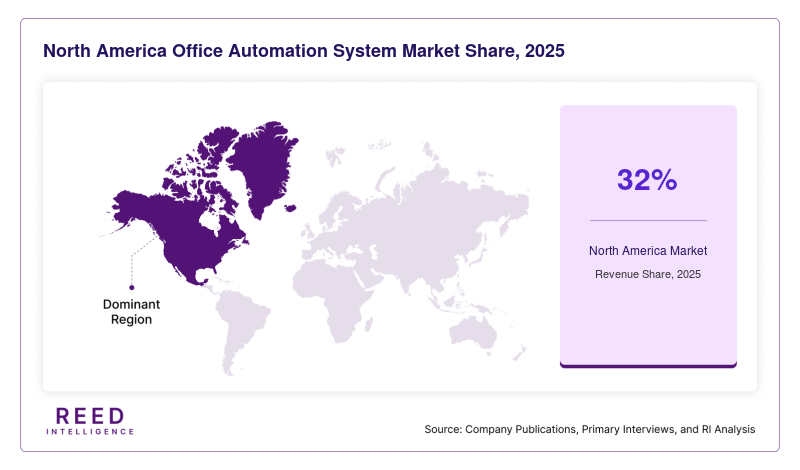
North America represents approximately 32% of the 2025 market, equivalent to about USD 11.39 billion under the internal allocation. It is modeled at approximately 5.70% CAGR through 2034, producing an indicative value of approximately USD 18.72 billion.
The region benefits from high enterprise software adoption and the presence of major productivity-platform vendors. Microsoft and Google are both expanding AI-driven automation across workplace applications, while enterprise customers are increasingly evaluating agent governance, security and integration alongside productivity benefits.
Europe Office Automation System Market
Europe accounts for approximately 25%, or USD 8.90 billion, of the 2025 market under the internal analytical allocation. It is modeled at approximately 5.50% CAGR through 2034, reaching about USD 14.38 billion.
European organizations have strong demand for document management, secure collaboration and process digitization. However, data protection, cybersecurity and governance requirements increase the importance of controlled deployment and permission-aware automation.
APAC Office Automation System Market
APAC represents approximately 28%, equivalent to USD 9.97 billion, of the 2025 market. It is modeled at approximately 7.20% CAGR through 2034, producing an indicative value of about USD 18.54 billion.
The region's higher modeled growth reflects increasing enterprise digitization, cloud adoption and expansion of technology-intensive workplaces across China, India, Japan, South Korea and Southeast Asia. AI-enabled productivity platforms are also lowering the technical barrier to workflow automation.
Middle East and Africa Office Automation System Market
Middle East and Africa represents approximately 8%, or USD 2.85 billion, of the 2025 market under the internal allocation. It is modeled at approximately 6.40% CAGR through 2034, reaching an indicative USD 4.94 billion.
Government digitization programs, enterprise modernization and cloud adoption are important mechanisms supporting office automation investment. Demand is particularly relevant for document digitization, electronic workflows and centralized information management.
Latin America Office Automation System Market
Latin America accounts for approximately 7%, equivalent to USD 2.49 billion, of the 2025 market and is modeled at approximately 6.20% CAGR through 2034, producing an indicative value of about USD 4.30 billion.
The region offers opportunities for cloud-based office automation because organizations can adopt subscription-based productivity and workflow platforms without making equivalent investments in large on-premises infrastructure.
Competitive Landscape
The competitive landscape is shifting from individual office-product categories toward integrated productivity ecosystems. Microsoft, Google and other enterprise technology providers are increasingly combining collaboration, document management, workflow automation and AI into unified platforms.
Microsoft's current strategy includes Microsoft 365 Copilot, Copilot Studio, Work IQ and Agent 365, with the latter providing centralized controls for observing, governing and securing organizational agents.
Google is developing a similar ecosystem through Workspace, Gemini, Workspace Intelligence and Workspace Studio. Its September 2026 capabilities allow Gemini to perform complex tasks across multiple Workspace applications, while Workspace Studio provides no-code workflow creation.
Key Market Players
- Microsoft Corporation
- Google LLC
- Ricoh Company, Ltd.
- Canon Inc.
- Xerox Holdings Corporation
- Konica Minolta, Inc.
- Hewlett Packard Enterprise
- HP Inc.
- Fujifilm Business Innovation
- Kyocera Corporation
- IBM Corporation
- OpenText Corporation
Recent Market Developments
September 2026 – Google Expanded Agentic Automation Across Workspace
In September 2026, Google introduced five new agentic capabilities across Workspace applications, enabling Gemini to complete complex cross-application tasks involving Gmail, Drive, Docs, Slides and Chat. The system can use selected files, emails and conversations as context while executing tasks.
May 2026 – Microsoft Made Agent 365 Generally Available
In May 2026, Microsoft made Microsoft 365 E7 and Agent 365 generally available. Agent 365 provides a control layer intended to help organizations observe, govern and secure AI agents across their environments.
Office Automation System Market Segments
By Component
- Hardware
- Software
- Services
By Solution Type
- Document Management & Processing
- Communication & Collaboration
- Workflow & Process Automation
- Office Equipment Management
- Data & Information Management
- AI-Powered Office Automation
By Deployment
- On-Premises
- Cloud
- Hybrid
By Organization Size
- Small & Medium-Sized Enterprises
- Large Enterprises
By End Use
- BFSI
- Healthcare
- IT & Telecommunications
- Government
- Education
- Retail & E-Commerce
- Manufacturing
- Other End Uses
By Region
- North America
- Europe
- APAC
- Middle East and Africa
- LATAM